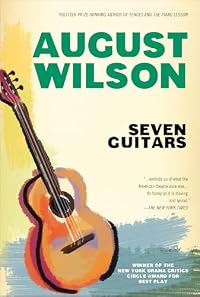
Seven Guitars
by August Wilson
Century Cycle: Chronological Order (1940s), Century Cycle: Production Order (play 7)
On This Page
Description
In the spring of 1948, in the still-cool evenings of Pittsburgh's Hill district, familiar sounds fill the air. A rooster crows. Screen doors slam. There's the laughter of friends gathered for a backyard card game rising just above the wail of a mother who has lost her son. And there's the sound of the blues, played and sung by young men and women with little more than a guitar in their hands and a dream in their hearts. August Wilson's Seven Guitars is the sixth chapter in the continuing show more theatrical saga that explores the hope, heartbreak, and heritage of the African-American experience in the twentieth century. The story follows a small group of friends who gather following the untimely death of Floyd "Schoolboy" Barton, a local blues guitarist on the edge of stardom. Together, they revisit his short life, reminisce about the good times they shared, and discover the unspoken passions and undying spirit that live within each of them. show lessTags
Recommendations
























Member Reviews
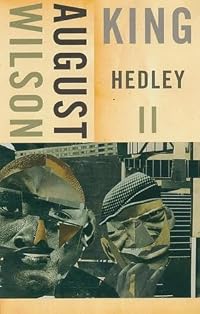
This is the sixth play I've read from Wilson's cycle of ten, each set in a different decade, all set in Pittsburgh. Despite some recurrent themes, each is unique and tells its own story with its own characters. I was surprised, therefore, when I realized how directly this one connects to King Hedley II. Ruby's telling of the fateful encounter between Elmore and Leroy differs from Elmore's version of the story in the chronologically later play, and is a perfect example of how realistic Wilson's mythology feels. These two-act plays are rich in what Wilson himself calls out as Black culture. As I keep moving back in time, I am enthralled by how timeless some experiences are. Though I have been disappointed in the short shrift given to his show more female characters, I enjoyed the richer characterizations Wilson created in the women of this story: Vera, Louise, and Ruby. show less
While I am still enjoying August Wilson's Century Cycle, the 5th play (1950s) is just okay. I think because style of speaking is the same from play to play. The characters are somewhat indistinguishable from play to play.
The themes are still important and interesting how Wilson subtly explores unfilled dreams.
Seven Guitars has seven characters. The main character is Floyd Barton who has recorded one hit record but is still broke. He has come to make amends with the woman he left, Vera who only wants true love, before heading back to Chicago to finally make it big. And Hedley aspires to be a "Big Man" once he gets his plantation.
The ending is surprising and sad. Another good play that I would love to see performed.
The themes are still important and interesting how Wilson subtly explores unfilled dreams.
Seven Guitars has seven characters. The main character is Floyd Barton who has recorded one hit record but is still broke. He has come to make amends with the woman he left, Vera who only wants true love, before heading back to Chicago to finally make it big. And Hedley aspires to be a "Big Man" once he gets his plantation.
The ending is surprising and sad. Another good play that I would love to see performed.
This is part of a series of plays referred to as the Pittsburgh Cycle or the Century Cycle. Each play, except for one, is set in Pittsburgh in a different decade of the 20th century. This play, set in 1948, is the seventh one that I have read. They are all very powerful stories that provide a glimpse into the life of black Americans.
All of the scenes in this play are set in the back yard of a two story apartment building. The reader is an onlooker into the day to day lives of the characters, the seven guitars. They either live in the building or are constant visitors from the neighborhood. The central character is Floyd "Schoolboy" Barton. He is a blues guitarist whose latest record has just become a hit and is often heard in the show more background. He just finished 90 days in jail for vagrancy that being he didn't have any money in his pocket. When he got out there was a letter waiting for him inviting him back to Chicago to do some more recording. He is trying to get his girlfriend Vera to go with him but she is still angry because the last time he left her and took off with someone else. Hedley raises chickens in the basement and kills them and then sells chicken sandwiches around the neighborhood. He is always singing a song from his father about the money Buddy Bolden is bringing him. Canewell plays harmonica for Barton but it is in the pawn shop with Floyd's guitar right now. Red Carter, the drummer for Floyd, Louise and Ruby round out the cast. Louise and Red like to play whist and Ruby has come up from the South looking for a man.
The poverty in everyone's life is their constant enemy in the struggle for human dignity. The color of a person's skin is a circumstance beyond their control that gives them the hereditary status of an underling like a serf in the days of feudalism. This fuels a constant undertone of violence that builds into a tragic climax and at the end we are back at the funeral of a young man that was the opening of the play. show less
All of the scenes in this play are set in the back yard of a two story apartment building. The reader is an onlooker into the day to day lives of the characters, the seven guitars. They either live in the building or are constant visitors from the neighborhood. The central character is Floyd "Schoolboy" Barton. He is a blues guitarist whose latest record has just become a hit and is often heard in the show more background. He just finished 90 days in jail for vagrancy that being he didn't have any money in his pocket. When he got out there was a letter waiting for him inviting him back to Chicago to do some more recording. He is trying to get his girlfriend Vera to go with him but she is still angry because the last time he left her and took off with someone else. Hedley raises chickens in the basement and kills them and then sells chicken sandwiches around the neighborhood. He is always singing a song from his father about the money Buddy Bolden is bringing him. Canewell plays harmonica for Barton but it is in the pawn shop with Floyd's guitar right now. Red Carter, the drummer for Floyd, Louise and Ruby round out the cast. Louise and Red like to play whist and Ruby has come up from the South looking for a man.
The poverty in everyone's life is their constant enemy in the struggle for human dignity. The color of a person's skin is a circumstance beyond their control that gives them the hereditary status of an underling like a serf in the days of feudalism. This fuels a constant undertone of violence that builds into a tragic climax and at the end we are back at the funeral of a young man that was the opening of the play. show less
Ratings
Members
- Recently Added By
Lists

Books Read in 2020
4,379 works; 123 members

My Play Collection
769 works; 3 members

Next Plays / 2025
352 works; 1 member
Author Information

28+ Works 5,878 Members
Playwright August Wilson was born on April 27, 1945 in Pittsburgh, Pennsylvania. His experiences of living in a primarily black community and then being the only black student in his class at a Roman Catholic high school would inform his dramatic writings. He dropped out of school at the age of 15 and continued his education on his own. Wilson show more wrote a ten play cycle that chronicles each decade of the black experience in the 20th century. Each of his plays focuses on what he perceived as the largest issue to confront African-Americans in that decade. He won the Pulitzer Prize for Drama for Fences and Piano Lesson, the best play Tony Award for Fences, and seven New York Drama Critics' Circle awards. He also received the Whiting Foundation Award, the American Theatre Critics Award, the 1999 National Humanities Medal awarded by the President, and numerous honorary degrees. He died of liver cancer on October 2, 2005 at the age of 60. (Bowker Author Biography) show less
Awards and Honors
Awards
Series


Belongs to Publisher Series
Work Relationships
Is contained in
Has as a student's study guide
Common Knowledge
- Original publication date
- 1996
Classifications
Statistics
- Members
- 278
- Popularity
- 115,561
- Reviews
- 4
- Rating
- (3.83)
- Languages
- English
- Media
- Paper, Ebook
- ISBNs
- 6
- UPCs
- 1
- ASINs
- 4