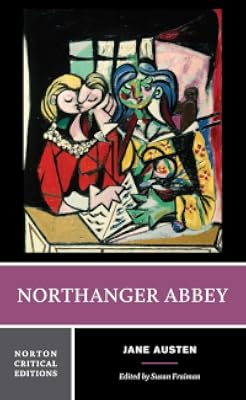
Northanger Abbey [Norton Critical Edition]
by Jane Austen
On This Page
Description
This Norton Critical Edition is the most extensively annotated student edition available. "Backgrounds" features material carefully chosen to enhance readers' appreciation of the novel, including biographical commentary, early works and correspondence related to Northanger Abbey, and excerpts by Ann Radcliffe, Frances Burney, and William Wordsworth, among others, tracing Austen's connection to her Romantic contemporaries. "Criticism" collects thirteen assessments of Northanger Abbey from a show more wide range of voices and periods, including essays by Margaret Oliphant and Rebecca West and critics Patricia Meyer Spacks, Claudia L. Johnson, Lee Erickson, and Joseph Litvak. A Chronology and Selected Bibliography are also included. show lessTags
Recommendations



Member Reviews
Obviously (I hope it's obvious, anyway), when I give Northanger Abbey three stars, I'm talking about this particular edition, not NA itself. I may be alone in thinking that NA is an absolute romp of a read. I don't mean it's *better* than Austen's other novels; I only mean that for me, it's pure pleasure.
This edition is fine: decent annotation (though perhaps only as good as the Penguin edition -- I expect more from Norton Critical Editions!), and very good essays and reviews to give the modern reader context. These run the gamut between deeply academic and accessibly informative.
Robert Hopkins offers an interesting idea about the significance of those "stupid pamphlets" General Tilney is so obsessed with in "General Tilney and Affairs show more of State." And I found Lee Erickson's dryly named "The Economy of Novel Reading: Jane Austen and the Circulating Library" absolutely fascinating. I had no idea that the lending libraries of the time (which were supported by subscriptions, unlike our free public libraries) also sold all manner of merchandise -- anything from hats and jewelry to tobacco and snuff!
I wouldn't have thought that an essay called "Free Indirect Speech and Jane Austen's 1816 Revision of Northanger Abbey" could do anything but serve as a soporific. But Narelle Shaw has some fascinating things to say about Austen's writing. Free indirect speech is when "a character's idiom is audibly mimicked by the author, who retains ultimate control of the operative passage." I hadn't realized how brilliantly Austen employs this until Shaw pointed out examples:
"Mrs. Allen's opinion [of the weather] was more positive. 'She had no doubt in the world of its being a very fine day, if the clouds would only go off, and the sun keep out.'"
Or:
"[Isabella] liked him the better for being a clergyman, 'for she must confess herself very partial to the profession.'"
I hadn't realized there was an official name for that sort of slipping into the character's phrasing while still keeping a third-person narration. It's very effective, to say the least!
Joseph Litvak's "The Most Charming Young Man in the World" was the only serious disappointment. I only slogged through it because after having read the rest of the book, I wasn't going to flip past nine pages and deny myself the credit of actually having *finished.* Queer theory is fine; but when the character Henry Tilney mentions reading a horror novel with his "hair standing on end the whole time," neither he nor Austen are referencing an erect penis. Sorry, but no. Actually, I'm not sorry. Cut it out.
So skim that essay. But if you love Austen and/or you're researching Regency England, don't miss out on this Norton edition of one of Austen's lesser known but terrifically fun novels. show less
This edition is fine: decent annotation (though perhaps only as good as the Penguin edition -- I expect more from Norton Critical Editions!), and very good essays and reviews to give the modern reader context. These run the gamut between deeply academic and accessibly informative.
Robert Hopkins offers an interesting idea about the significance of those "stupid pamphlets" General Tilney is so obsessed with in "General Tilney and Affairs show more of State." And I found Lee Erickson's dryly named "The Economy of Novel Reading: Jane Austen and the Circulating Library" absolutely fascinating. I had no idea that the lending libraries of the time (which were supported by subscriptions, unlike our free public libraries) also sold all manner of merchandise -- anything from hats and jewelry to tobacco and snuff!
I wouldn't have thought that an essay called "Free Indirect Speech and Jane Austen's 1816 Revision of Northanger Abbey" could do anything but serve as a soporific. But Narelle Shaw has some fascinating things to say about Austen's writing. Free indirect speech is when "a character's idiom is audibly mimicked by the author, who retains ultimate control of the operative passage." I hadn't realized how brilliantly Austen employs this until Shaw pointed out examples:
"Mrs. Allen's opinion [of the weather] was more positive. 'She had no doubt in the world of its being a very fine day, if the clouds would only go off, and the sun keep out.'"
Or:
"[Isabella] liked him the better for being a clergyman, 'for she must confess herself very partial to the profession.'"
I hadn't realized there was an official name for that sort of slipping into the character's phrasing while still keeping a third-person narration. It's very effective, to say the least!
Joseph Litvak's "The Most Charming Young Man in the World" was the only serious disappointment. I only slogged through it because after having read the rest of the book, I wasn't going to flip past nine pages and deny myself the credit of actually having *finished.* Queer theory is fine; but when the character Henry Tilney mentions reading a horror novel with his "hair standing on end the whole time," neither he nor Austen are referencing an erect penis. Sorry, but no. Actually, I'm not sorry. Cut it out.
So skim that essay. But if you love Austen and/or you're researching Regency England, don't miss out on this Norton edition of one of Austen's lesser known but terrifically fun novels. show less
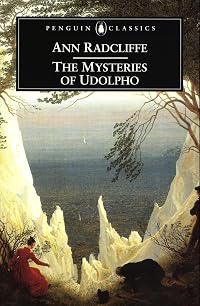
Northanger Abbey is Austen's satirical take on the Gothic style that was popular in the late 18th century, and as such, it is a bit different than her other, more famous works. Catherine is perhaps the least developed of Austen's heroines, and she seems to lack the personality of the other heroines. But she is young, sweet, and endearing, and she has an active imagination (as most 15 year old girls do). In order to understand what Austen is trying to accomplish with Northanger Abbey, it's best to at least have a familiarity with the Gothic novels of the time- "The Mysteries of Udolpho" or "The Monk" were written prior to this, and provide solid evidence of the style Austen is mocking. I really enjoyed Northanger Abbey, and I think it's show more important to consider this a different style of work than her other major novels. show less
Ratings
Members
- Recently Added By
Lists

Favourite Books
1,817 works; 316 members

Female Author
1,235 works; 67 members
Author Information

702+ Works 316,874 Members
Jane Austen's life is striking for the contrast between the great works she wrote in secret and the outward appearance of being quite dull and ordinary. Austen was born in the small English town of Steventon in Hampshire, and educated at home by her clergyman father. She was deeply devoted to her family. For a short time, the Austens lived in the show more resort city of Bath, but when her father died, they returned to Steventon, where Austen lived until her death at the age of 41. Austen was drawn to literature early, she began writing novels that satirized both the writers and the manners of the 1790's. Her sharp sense of humor and keen eye for the ridiculous in human behavior gave her works lasting appeal. She is at her best in such books as Pride and Prejudice (1813), Mansfield Park (1814), and Emma (1816), in which she examines and often ridicules the behavior of small groups of middle-class characters. Austen relies heavily on conversations among her characters to reveal their personalities, and at times her novels read almost like plays. Several of them have, in fact, been made into films. She is considered to be one of the most beloved British authors. (Bowker Author Biography) show less
Work Relationships
Contains
Is a parody of
Common Knowledge
- Canonical title
- Northanger Abbey [Norton Critical Edition]
- Original publication date
- 1817
- Disambiguation notice
- Do Not Combine: This is a "Norton Critical Edition", it is a unique work with significant added material, including essays and background materials. Do not combine with other editions of the work. Please maintain the p... (show all)hrase "Norton Critical Edition" in the Canonical Title and Publisher Series fields.
Classifications
Statistics
- Members
- 264
- Popularity
- 121,845
- Reviews
- 2
- Rating
- (4.13)
- Languages
- English
- Media
- Paper, Ebook
- ISBNs
- 2
- ASINs
- 3