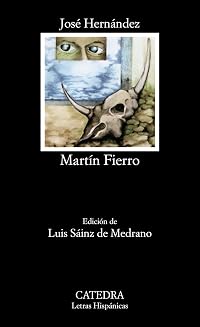
Martín Fierro
by José Rafael Hernández y Pueyrredón
On This Page
Description
Readers will take pleasure in discovering the classics through these beautifully packaged and affordably priced editions of famous works of literature from all over the world. A variety of periods, themes, and authors is represented.Tags
Recommendations























Member Reviews
This epic poem is considered a classic of Argentine literature/identity & emblematic of the gaucho life. And it was actually different than I had anticipated, a bit. Because I pictured an epic poem about gaucho life being free on the plains with the horses, maté, & the stars in the sky. And it is, to a certain extent. But it's also very much about how the gauchos were forced into (often unpaid) labor & abuse, serving in forts as the colonial settlers continued their push to take land from first nation groups.
In addition to reading this out of curiosity, I also read it in preparation for reading a feminist riff on Martín Fierro, The Adventures of China Iron by Gabriela Cabezón Cámara, trans. from the Spanish by Fiona Mackintosh & show more Iona Macintyre. show less
In addition to reading this out of curiosity, I also read it in preparation for reading a feminist riff on Martín Fierro, The Adventures of China Iron by Gabriela Cabezón Cámara, trans. from the Spanish by Fiona Mackintosh & show more Iona Macintyre. show less
Martín Fierro is an epic poem divided into two parts, the first published in 1872 and the second in 1879. I decided to reread this book because I wanted to go back to the basics of Argentine literature and revisit some of the 19th century classics that I once read in a university Spanish class, superficially analyzing them in the way that foreigners analyze literature of places that they want to learn about, in languages that they are not entirely familiar with. I was happy to find how much more I found to inspire me in Hernández’s book, now that I’ve become more familiar with the Spanish language and Argentine literature. I absolutely loved the first part of the book in its depiction of the marginalized and exploited gaucho; the show more famous scenes, such as Martín Fierro’s confrontation with the authorities (when Cruz comes to his aid), as well has his two knife fights, were extremely entertaining. And while I was a bit disappointed by the second part, I still like the way that Hernández brings back picaresque characters and themes from centuries past and injects them into gaucho Argentina. The first part of the story belongs to Martín Fierro (with a brief interlude documenting the life of the heroic Cruz), while the second part tells the stories of his two sons and the gaucho Picardía, and then concludes with a guitar battle between Martín Fierro and the son of a man he once killed, along with some final advice from the protagonist to his sons. It´s all in verse and the language is Hernández’s written interpretation of gaucho speech. The whole story is told by a guitar player, and the characters who tell their story do it all in musical form, to the accompaniment of a guitar (they all recognize their condition as musicians and humbly ask their audience to forgive their shortcomings at the beginning of their stories).
I just read Mariano Azuela’s Los de abajo and was struck by how much the fictional characters had become real as time passed and the book stood as a document of the Mexican revolution. I felt the same thing here: Martín Fierro is probably more connected to the people’s image of the gaucho in Argentina than any real historical figures, and I think that when people think of gauchos in Argentina, his character eclipses most other representations. It’s an interesting image: he’s been uprooted from his home and family (much like Demetrio Macías in Los de abajo) to serve on the frontier and fight the Indians who menace the Argentine Wild West. His labor is exploited, he doesn’t get paid for his work, and he’s basically been lied to and betrayed by his country. When he is able to escape and go home, his homestead and family are gone. In his marginalized state, he wanders from place to place, afraid of facing the authorities due to his status as a deserter; when he finds solace in alcohol and rural gatherings, violence is the result on a few separate occasions, and he becomes even more isolated and separated from civilization. By the end of the first part of the poem, he has forsaken society and is prepared to seek acceptance amongst the Indians that populate the Argentine plains. His individualism and unwillingness to obey the unfair treatment that he receives from society as a gaucho cause him to turn his back on the civilized world. As a national hero and a representative of a bygone class of people, I think that Martín Fierro is an admirable and worthy creation. His convictions and unwillingness to be controlled by an unlawful government are admirable.
I was trying to think if the United States has a comparable book to Martín Fierro: a book, preferably an epic poem, which presents an image of the American, the Cowboy perhaps, defining that idolized, romanticized class of people who figure so prominently in our country’s history. The closest things I can think of, although very different from Martín Fierro, are Thoreau’s Civil Disobedience and Walden. It seems to me that an American is presented there that is somewhat relatable to the gaucho Martín Fierro. It’s not a poem, though, so I’m still a bit dissatisfied. Maybe I should read Leaves of Grass? That’s about the best example of a canonical American poem that I can think of. I think about the United States and Argentina as being very similar in their 19th and early 20th century histories: similar waves of westward expansion and genocide of native peoples, similar patterns of European immigration and growth, and similar struggles for national definition. Having read a lot of Argentine literature, and especially now that I’m stepping back into the fundamental stages of the national literature of Argentina, I now wonder what books I should read or reread that provide similar representations of the United States at those important moments in its literary history. There’s an episode of Seinfeld where Elaine dates a guy who is a “bizarro Jerry,” and he has a whole cast of friends who are just like George, Kramer and Newmann, except completely different and “bizarro.” I’ve always thought about Argentina as being a bit like a “bizarro United States,” and I would kind of like to get to know early American literature now that I’ve become somewhat familiar with Argentine literature. show less
I just read Mariano Azuela’s Los de abajo and was struck by how much the fictional characters had become real as time passed and the book stood as a document of the Mexican revolution. I felt the same thing here: Martín Fierro is probably more connected to the people’s image of the gaucho in Argentina than any real historical figures, and I think that when people think of gauchos in Argentina, his character eclipses most other representations. It’s an interesting image: he’s been uprooted from his home and family (much like Demetrio Macías in Los de abajo) to serve on the frontier and fight the Indians who menace the Argentine Wild West. His labor is exploited, he doesn’t get paid for his work, and he’s basically been lied to and betrayed by his country. When he is able to escape and go home, his homestead and family are gone. In his marginalized state, he wanders from place to place, afraid of facing the authorities due to his status as a deserter; when he finds solace in alcohol and rural gatherings, violence is the result on a few separate occasions, and he becomes even more isolated and separated from civilization. By the end of the first part of the poem, he has forsaken society and is prepared to seek acceptance amongst the Indians that populate the Argentine plains. His individualism and unwillingness to obey the unfair treatment that he receives from society as a gaucho cause him to turn his back on the civilized world. As a national hero and a representative of a bygone class of people, I think that Martín Fierro is an admirable and worthy creation. His convictions and unwillingness to be controlled by an unlawful government are admirable.
I was trying to think if the United States has a comparable book to Martín Fierro: a book, preferably an epic poem, which presents an image of the American, the Cowboy perhaps, defining that idolized, romanticized class of people who figure so prominently in our country’s history. The closest things I can think of, although very different from Martín Fierro, are Thoreau’s Civil Disobedience and Walden. It seems to me that an American is presented there that is somewhat relatable to the gaucho Martín Fierro. It’s not a poem, though, so I’m still a bit dissatisfied. Maybe I should read Leaves of Grass? That’s about the best example of a canonical American poem that I can think of. I think about the United States and Argentina as being very similar in their 19th and early 20th century histories: similar waves of westward expansion and genocide of native peoples, similar patterns of European immigration and growth, and similar struggles for national definition. Having read a lot of Argentine literature, and especially now that I’m stepping back into the fundamental stages of the national literature of Argentina, I now wonder what books I should read or reread that provide similar representations of the United States at those important moments in its literary history. There’s an episode of Seinfeld where Elaine dates a guy who is a “bizarro Jerry,” and he has a whole cast of friends who are just like George, Kramer and Newmann, except completely different and “bizarro.” I’ve always thought about Argentina as being a bit like a “bizarro United States,” and I would kind of like to get to know early American literature now that I’ve become somewhat familiar with Argentine literature. show less
I read this because an episode from it was used as as the basis for a short story I liked very much by Borges. I must admit reading the original poem I was rather disappointed. It is not bad, but not as good as Borges. But who is?
Epic Poem. This is the story of the Gaucho in Argentina. The man is poor and has been mistreated by those around him. He loses his home, wife, children when he is conscripted. In the conscription, he is not paid, fed, or clothed. Only abused and used. There are two sections. The first is 13 cantos and the second part is 33 cantos. It is not hard to read but it is long and I am not much for poetry though I would rather read one like this that is actually a story than just straight poetry.
Es un libro escrito en lenguaje gauchesco por un autor culto. Refleja una realidad muy cruda ,característica de esa época y lo leí en varias oportunidades,encontrando cada vez más mensajes válidos ,aplicables a la actualidad.
I wanted to read this book ever since I read the Borges short story based on an episode from it. Years ago Ibought a battered Spanish copy, and I also read a translation from a library. I was a bit disappointed in it, but still I thought it important enough to Argentine culture to buy this copy when it was available cheap.
This was read for school. And by read I mean I started it and never finished it.
What can I say... it may be the most classical book in our country but I still didn't like it...
What can I say... it may be the most classical book in our country but I still didn't like it...
Members
- Recently Added By
Author Information

Some Editions
Awards and Honors
Series
Belongs to Publisher Series
Work Relationships
Is contained in
Has the adaptation
Is abridged in
Common Knowledge
- Canonical title*
- El gaucho Martín Fierro; El gaucho Martín Fierro y La vuelta de Martín Fierro
- Original title
- El gaucho Martín Fierro
- Original publication date
- 1872 (El gaucho Martín Fierro) (El gaucho Martín Fierro); 1879 (La vuelta de Martín Fierro) (La vuelta de Martín Fierro)
- People/Characters
- Martín Fierro; Sergeant Cruz
- Related movies*
- Martín Fierro (1968 | IMDb); Martín Fierro, La Película (2007 | IMDb); Martín Fierro (1989 | IMDb); Martín Fierro, el ave solitaria (2006 | IMDb); La vuelta de Martín Fierro (1974 | IMDb)
- First words
- Here I come to sing to the beat of my guitar; /
because a man who is kept from sleep by an uncommon sorrow /
conforts himself with singing, like a solitary bird. - Last words
- (Click to show. Warning: May contain spoilers.)But he has to fix his hope in the God who created him.... /
And with that I'll take my leave -- I've related as I know how /
evils that everyone knows about, but no one told before now. - Original language
- Spanish
*Some information comes from Common Knowledge in other languages. Click "Edit" for more information.
Classifications
Statistics
- Members
- 1,278
- Popularity
- 19,159
- Reviews
- 72
- Rating
- (3.95)
- Languages
- 7 — Catalan, English, Esperanto, French, Italian, Portuguese, Spanish
- Media
- Paper, Audiobook, Ebook
- ISBNs
- 208
- ASINs
- 39