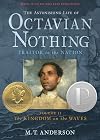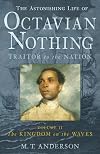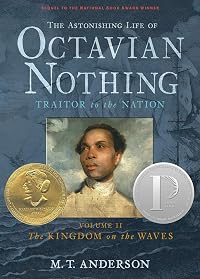
The Astonishing Life of Octavian Nothing, Traitor to the Nation, Volume II: The Kingdom on the Waves
by M. T. Anderson
The Astonishing Life of Octavian Nothing, Traitor to the Nation (2)
On This Page
Description
"A novel of the first rank, the kind of monumental work Italo Calvino called 'encyclopedic' in the way it sweeps up history into a comprehensible and deeply textured pattern." — The New York Times Book ReviewFearing a death sentence, Octavian and his tutor, Dr. Trefusis, escape through rising tides and pouring rain to find shelter in British-occupied Boston. Sundered from all he knows — the College of Lucidity, the rebel cause — Octavian hopes to find safe harbor. Instead, he is soon show more to learn of Lord Dunmore's proclamation offering freedom to slaves who join the counterrevolutionary forces.
In Volume II of his unparalleled masterwork, M. T. Anderson recounts Octavian's experiences as the Revolutionary War explodes around him, thrusting him into intense battles and tantalizing him with elusive visions of liberty. Ultimately, this astonishing narrative escalates to a startling, deeply satisfying climax, while reexamining our national origins in a singularly provocative light.
. show less
Tags
Recommendations






Member Recommendations
Member Reviews
This second volume in the Octavian Nothing series begins right when the first left off, with Octavian and Dr. Trefusis running away from the College of Lucidity. Their flight through the rain and mud-flats leaves Dr. Trefusis with a terrible fever, and Octavian must find a place for them to stay and a way to pay for lodgings - not an easy task for a runaway slave in Boston, a city under siege during the Revolution.
This is merely the beginning of a long and intelligent examination of the early American Revolution, and the treatment of slaves by rebels and British. Every detail plays into the historical fiction of a document written in that time period: the vocabulary and voice of the characters, the rough-cut pages, and the old-fashioned show more title page and type. The story investigates the ideals of liberty and the hypocrisy of those who would cry "liberty" for themselves while condemning others to slavery. Though not for the fainthearted because of the descriptions of war and sickness, for those willing to persevere the story provides much food for thought. show less
This is merely the beginning of a long and intelligent examination of the early American Revolution, and the treatment of slaves by rebels and British. Every detail plays into the historical fiction of a document written in that time period: the vocabulary and voice of the characters, the rough-cut pages, and the old-fashioned show more title page and type. The story investigates the ideals of liberty and the hypocrisy of those who would cry "liberty" for themselves while condemning others to slavery. Though not for the fainthearted because of the descriptions of war and sickness, for those willing to persevere the story provides much food for thought. show less
M. T. Anderson continues to write brilliantly, and the tale of Octavian Nothing is as immersive as ever. It's especially great to have Pro Bono back in action, as he was probably the best supporting character from the previous novel. And the gruesome plight of the main characters, as "free" soldiers in the British forces during the Revolutionary War, is portrayed with just the right amount of reality, becoming quite uncomfortable at times. It's a fair bit longer than the first volume, and I feel like that's where the problem lies, as there's a lot of time where the characters just all seem to hang out a ship together, waiting and waiting and waiting. I just felt like it went on and on and on. To be fair, so did Octavian, but continual show more diary entries about boredom are not exactly compelling Still, the end is fantastic, and the last page of Anderson's epilogue is a poetic as anything else in the book, too. show less
An absolutely brilliant sequel to the first volume -- explores the ambiguity of "liberty" for African Americans fighting on both sides of the rebellion of the North American colonies. Together the two books are a rich and persuasive imagining, steeped in historical detail, of the African American experience of the founding of the United States, and a brilliant critique of the Enlightenment project and its political legacies.
Not only does Anderson's fiction provide a sense of verisimilitude inevitably missing from scholarly accounts of this history (essential as these are), he masterfully challenges us to think about what this history must mean for us today. I never appreciated the value of historical fiction until encountering these show more two books.
Great reading for the 4th of July. But warning -- you absolutely must read Volume 1 to appreciate volume 2. They really ought to have just been published together. But I guess an 800+ page novel that's is a non-starter in the young adult market unless it's about teenage wizards. show less
Not only does Anderson's fiction provide a sense of verisimilitude inevitably missing from scholarly accounts of this history (essential as these are), he masterfully challenges us to think about what this history must mean for us today. I never appreciated the value of historical fiction until encountering these show more two books.
Great reading for the 4th of July. But warning -- you absolutely must read Volume 1 to appreciate volume 2. They really ought to have just been published together. But I guess an 800+ page novel that's is a non-starter in the young adult market unless it's about teenage wizards. show less
This book, the second of M.T. Anderson's two Octavian Nothing books, gets off to a strong start. The story itself is much more straightforward than in the previous volume, and there are some amusing moments in the first chapter. The old-fashioned language wasn’t really a barrier for my understanding. I think I’ve gotten used to it after listening to the first book. And I love the idea of looking at the American Revolution from a new angle. It was jarring to hear those I’ve always thought of as “Patriots” or “Americans” being referred to as “Rebels,” although that’s obviously what they were from the British perspective. The fact that the Rebels are fighting for freedom, while enslaving so many, is a tragic irony of show more American history that Anderson looks at square in the face.
However, interesting ideas and a fresh perspective don’t necessary make for a good story, and on audiobooks in particular, a compelling story is key for me. When Dunmore and his soldiers are stuck on their ships, the story comes to a screeching halt. Most of the narrative at this point consists of Octavian’s musings in his journal—about his past and his future hopes, about his philosophical studies, about the details of his daily life. He also records the stories of the other men in his regiment. Some of Octavian’s thoughts are intriguing, as are many of the former slaves’ stories, but there still needs to be something more happening.
In print, I might be happier because I could skim some of the discussions of John Locke—or read them slowly and thoughtfully if I’m in a philosophical mood—and I could page ahead to see when a big shift might happen. But on audio, I’m forced to march ahead with no notion of where I’m going and when relief might come.
See my complete review at Shelf Love. show less
However, interesting ideas and a fresh perspective don’t necessary make for a good story, and on audiobooks in particular, a compelling story is key for me. When Dunmore and his soldiers are stuck on their ships, the story comes to a screeching halt. Most of the narrative at this point consists of Octavian’s musings in his journal—about his past and his future hopes, about his philosophical studies, about the details of his daily life. He also records the stories of the other men in his regiment. Some of Octavian’s thoughts are intriguing, as are many of the former slaves’ stories, but there still needs to be something more happening.
In print, I might be happier because I could skim some of the discussions of John Locke—or read them slowly and thoughtfully if I’m in a philosophical mood—and I could page ahead to see when a big shift might happen. But on audio, I’m forced to march ahead with no notion of where I’m going and when relief might come.
See my complete review at Shelf Love. show less
Another masterpiece from Anderson. This is the second and final book about Octavian Nothing, and it tells the story of the American Revolution from a unique viewpoint. The meaning of liberty is slippery, indeed.
Octavian is a slave who does work for both sides of the conflict at different points. His companions are achingly real. My favorite character is perhaps Bono, who is by turns hilarious and profane. Here's my favorite bit of Bono dialogue, where he is talking to Octavian, who is ill.
"Sweet mercy in a firkin!" swore Bono. "Not another word of your damn metaphorizing! By God, don't you have vomiting to do?"
The story is impeccably researched and searingly hard to stomach, infused with sadness and intellect. Highly recommended, but show more do read the first one before you pick this up.
The only drawback, for me, is the lingering tendency to talk in a slightly stilted Octavian manner. show less
Octavian is a slave who does work for both sides of the conflict at different points. His companions are achingly real. My favorite character is perhaps Bono, who is by turns hilarious and profane. Here's my favorite bit of Bono dialogue, where he is talking to Octavian, who is ill.
"Sweet mercy in a firkin!" swore Bono. "Not another word of your damn metaphorizing! By God, don't you have vomiting to do?"
The story is impeccably researched and searingly hard to stomach, infused with sadness and intellect. Highly recommended, but show more do read the first one before you pick this up.
The only drawback, for me, is the lingering tendency to talk in a slightly stilted Octavian manner. show less
Like the first half, this is an astonishing work, the voice is unlike anything I have ever read, the language is full of wonderful words I have never heard before, but suit the moment perfectly. I bet the audiobook is splendid, but I was too impatient to wait for it. It is also incredibly sad, watching Octavian grow up to be a man in a world where the price of a man fluctuates with the price of tobacco.
have to admit that I was very reluctant to read this book. It's been on my to-read list since it came out, and I would repeatedly pass it by in the library. Eventually, it stared me down and I was forced to check it out. The reason I kept putting it off was because I didn't particularly enjoy the first one. Yes, I appreciated its artsiness, but it was very long and quite boring.
In this installment, we follow Octavian as he runs away once again, but this time with his tutor Dr. Trefusis. Instead of joining up with the rebels, he becomes a soldier in Lord Dunmore's Ethiopian Regiment with the promise of his freedom.
I can honestly say this novel surprised me. I was expecting this novel to be even more dull than the first one since it was show more even longer. Instead, I ate it up. I think its because I actually got it this time. Perhaps I didn't like the first one because I was distracted and couldn't get into it. This time I realized the humor and was genuinely invested in Octavian's journey. It was funny, tragic, and philosophical. Nothing was sugar-coated, and sometimes the writing was brutal. The writing, tedious in the first book, was fully appreciated here. The 18th century style fitted the story and time period perfectly. Octavian grew up in this book. He really loosened up in this one and was finally showing some emotions.
Also, through out this whole book, it reminded me of something else I read. I couldn't put my finger on it until I saw the title in another person's review. Mary Shelley's Frankenstein. They were alike in the sense of style: both were written in 18th century style, and featured letters as a technique. And the plot was alike too when I think about it. Octavian and Frankenstein's monster are both elegant experiments searching for their place in the world. I have to say I did enjoy this book more though, so if you hated Frankenstein feel free to read this one.
I whole-heartedly recommend this novel. It is a very unique young adult book and a must for historical fiction fans looking for a challenge. It is in no way an easy read, for both the prose and material is difficult. I felt like I needed a dictionary a majority of the time. Whether you liked or disliked the first one, give this second installment a shot. show less
In this installment, we follow Octavian as he runs away once again, but this time with his tutor Dr. Trefusis. Instead of joining up with the rebels, he becomes a soldier in Lord Dunmore's Ethiopian Regiment with the promise of his freedom.
I can honestly say this novel surprised me. I was expecting this novel to be even more dull than the first one since it was show more even longer. Instead, I ate it up. I think its because I actually got it this time. Perhaps I didn't like the first one because I was distracted and couldn't get into it. This time I realized the humor and was genuinely invested in Octavian's journey. It was funny, tragic, and philosophical. Nothing was sugar-coated, and sometimes the writing was brutal. The writing, tedious in the first book, was fully appreciated here. The 18th century style fitted the story and time period perfectly. Octavian grew up in this book. He really loosened up in this one and was finally showing some emotions.
Also, through out this whole book, it reminded me of something else I read. I couldn't put my finger on it until I saw the title in another person's review. Mary Shelley's Frankenstein. They were alike in the sense of style: both were written in 18th century style, and featured letters as a technique. And the plot was alike too when I think about it. Octavian and Frankenstein's monster are both elegant experiments searching for their place in the world. I have to say I did enjoy this book more though, so if you hated Frankenstein feel free to read this one.
I whole-heartedly recommend this novel. It is a very unique young adult book and a must for historical fiction fans looking for a challenge. It is in no way an easy read, for both the prose and material is difficult. I felt like I needed a dictionary a majority of the time. Whether you liked or disliked the first one, give this second installment a shot. show less
Members
- Recently Added By
Lists

Best Young Adult
399 works; 101 members

Absolute Power
107 works; 1 member

Epistolary Books
105 works; 27 members

Historical Fiction
889 works; 91 members

Five star books
1,757 works; 108 members

Favorite Long Books
330 works; 42 members

al.vick-wishlist-historical fiction
128 works; 1 member
Author Information

38+ Works 16,973 Members
Some Editions
Awards and Honors
Awards
Distinctions
Notable Lists
Series

Work Relationships
Common Knowledge
- Canonical title
- The Astonishing Life of Octavian Nothing, Traitor to the Nation, Volume II: The Kingdom on the Waves
- Original publication date
- 2008-10-14
- People/Characters
- Octavian; Dr. Trefusis; Pro Bono (William Williams); Lord Dunmore
- Important places
- Boston, Massachusetts, USA; Norfolk, Virginia, USA
- Important events
- American Revolution (1775 | 1783)
- Dedication
- To N.
- First words
- The rain poured from the heavens as we fled across the mud-flats, that scene of desolation; it soaked through our clothes and bit at the skin with its chill.
- Last words
- (Click to show. Warning: May contain spoilers.)And so I light out for the unknown regions.
Classifications
Statistics
- Members
- 927
- Popularity
- 28,817
- Reviews
- 34
- Rating
- (4.09)
- Languages
- English
- Media
- Paper, Audiobook, Ebook
- ISBNs
- 14
- ASINs
- 9