Convivencia: Jews, Muslims, and Christians in Medieval Spain
by Jerrilynn Denise Dodds, Thomas F. Glick (Editor), Vivian B. Mann
On This Page
Description
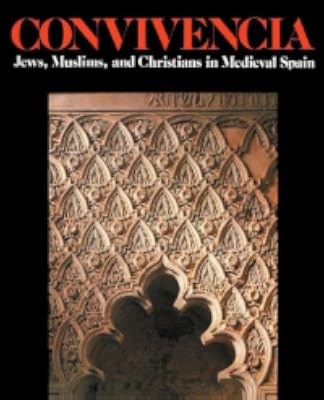
The Middle Ages in Spain--the the period from the Muslim conquest of 711 to the expulsion of the Jews and the defeat of the last Muslim ruler in 1492--witnessed an extraordinary Golden Age through the intermingling of its Jewish, Muslim, and Christian inhabitants. This volume explores the nature of their coexistence (termed convivencia by Spanish historians), which embraced not only ideological interchange and cultural influence, but also mutual friction, rivalry, and suspicion. The cultural show more and social dynamics underlying convivencia powerfully influenced the creation of poetry, art, architecture, and the material culture of Spain, as well as the transmission and absorption of scientific ideas and technology from East to West. Explored by leading scholars in each of these fields, the cultural treasures of convivencia range from Hebrew biblical manuscripts illuminated with Islamic stylistic motifs, to astrolabes with Latin inscriptions, to the first examples of secular Hebrew poetry. More than one hundred of the objects are united for the first time in an exhibition at the Jewish Museum, New York. At a time when the study of cultural fusion is receiving increasing attention, this volume offers a fresh and comprehensive view of Spain's pluralistic medieval society. Moreover, it celebrates an inspiring history of cultural achievement in the context of intergroup relations that were both negative and positive. 36 color and 60 b/w plates. show lessTags
Recommendations











Member Reviews
This excellently written and well-sourced book has inspired me, when I can find the time, to get back to my work on learning both the several versions of classical Hebrew and Arabic, and especially to read more of the poets and the Rambam's works in the wonderful medley of languages in which they were working. I suppose I will have to add Persian at some point to my toolbox in order to understand the original framework in which the earlier poetry was set.
I loved the way each set of cultural pieces was traced back to origins in the East, and then shown to have interacted in unique ways with the political environments in which the various competing kingdoms were seeking to attract talent and prestige to themselves, creating a unique show more environment (particularly starting around the reign of Alfonso X el Sabio, for the evolving Castilian language).
The Tahkemoni in particular is worth learning more about, and apparently in each of the relevant languages (I am also seeing poetry quoted in Turkish translation in the series Muhteşem Yüzyıl and the comments of modern Turkish readers on the need to read the poems in the original Persian).
A wonderful book to keep coming back to again and again.
21 May, 12017 HE
40th Day of the Omer, the 25th of Iyar 5777, which is the 24-Shaban-1438
Shira Dest. show less
I loved the way each set of cultural pieces was traced back to origins in the East, and then shown to have interacted in unique ways with the political environments in which the various competing kingdoms were seeking to attract talent and prestige to themselves, creating a unique show more environment (particularly starting around the reign of Alfonso X el Sabio, for the evolving Castilian language).
The Tahkemoni in particular is worth learning more about, and apparently in each of the relevant languages (I am also seeing poetry quoted in Turkish translation in the series Muhteşem Yüzyıl and the comments of modern Turkish readers on the need to read the poems in the original Persian).
A wonderful book to keep coming back to again and again.
21 May, 12017 HE
40th Day of the Omer, the 25th of Iyar 5777, which is the 24-Shaban-1438
Shira Dest. show less
This excellently written and well-sourced book has inspired me, when I can find the time, to get back to my work on learning both the several versions of classical Hebrew and Arabic, and especially to read more of the poets and the Rambam's works in the wonderful medley of languages in which they were working. I suppose I will have to add Persian at some point to my toolbox in order to understand the original framework in which the earlier poetry was set.
I loved the way each set of cultural pieces was traced back to origins in the East, and then shown to have interacted in unique ways with the political environments in which the various competing kingdoms were seeking to attract talent and prestige to themselves, creating a unique show more environment (particularly starting around the reign of Alfonso X el Sabio, for the evolving Castilian language).
The Tahkemoni in particular is worth learning more about, and apparently in each of the relevant languages (I am also seeing poetry quoted in Turkish translation in the series Muhteşem Yüzyıl and the comments of modern Turkish readers on the need to read the poems in the original Persian).
A wonderful book to keep coming back to again and again.
21 May, 12017 HE
40th Day of the Omer, the 25th of Iyar 5777, which is the 24-Shaban-1438
Shira Dest. show less
I loved the way each set of cultural pieces was traced back to origins in the East, and then shown to have interacted in unique ways with the political environments in which the various competing kingdoms were seeking to attract talent and prestige to themselves, creating a unique show more environment (particularly starting around the reign of Alfonso X el Sabio, for the evolving Castilian language).
The Tahkemoni in particular is worth learning more about, and apparently in each of the relevant languages (I am also seeing poetry quoted in Turkish translation in the series Muhteşem Yüzyıl and the comments of modern Turkish readers on the need to read the poems in the original Persian).
A wonderful book to keep coming back to again and again.
21 May, 12017 HE
40th Day of the Omer, the 25th of Iyar 5777, which is the 24-Shaban-1438
Shira Dest. show less
Ratings
Members
- Recently Added By
Author Information

6 Works 375 Members

Thomas F. Glick is a Professor of History at Boston University.

15+ Works 382 Members
Common Knowledge
- Important places
- Spain
- Original language
- English
Classifications
- Genres
- Nonfiction, History, Art & Design, Religion & Spirituality, General Nonfiction
- DDC/MDS
- 946.004924 — History & geography History of Europe Spain & Portugal Spain Spain - Ethnic groups
- LCC
- DS135 .S7 .C585 — History of Europe, Asia, Africa and Oceania Asia History of Asia Israel (Palestine). The Jews Jews outside of Palestine
- BISAC
Statistics
- Members
- 93
- Popularity
- 341,916
- Reviews
- 2
- Rating
- (4.22)
- Languages
- English
- Media
- Paper
- ISBNs
- 2
- ASINs
- 1