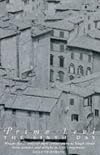
The Sixth Day and Other Tales
by Primo Levi
On This Page
Description
A collection of 23 stories in which the author creates a strangely familiar universe, transformed by the imagination. The stories include commentary on the human condition and the effect of a technological culture on people's daily lives.Tags
Recommendations


























Member Reviews
Science fiction is not what one would think of first when the name Primo Levi comes up. A trained chemist, he wrote mostly non-fiction - both in his professional space and memoirs as a Holocaust survivor. It is the latter that introduced me to his writing - his recollections are vivid and terrible and powerful. Which makes this collection even more surprising. I knew it is fiction (although the publisher called it fantasy for some reason) and I knew it is very different from everything else I had read by him but it still managed to surprise me.
If you are looking for beautiful writing and/or thrilling stories, look elsewhere. The collection contains 23 sparse stories - the longest is 17 pages and most of them are much shorter than that. show more 2 of them are what would be called 10-minutes play these days; the rest are prose ones. Most of them talk of a future Italy - with scientific advances showing the timeline (although as most SF of the 60s and 70s, some of them sound outdated now - while others are almost prophetic). The rest are set in different places and times - from Levi's version of the story of the Golem of Prague, through the title story set at the 6th day of Earth's creation according to the Bible) to an indefinite future where most of humanity seems to require assistance in surviving (the pair of stories dealing with that show the same event from two different perspectives which adds to the depth of the story but it all sounded a bit off for some reason - especially the viewpoint of the pilots). These two stories are not the only ones that are linked - there are also 6 stories which follow a narrator (with a habit of getting in trouble) and a salesman from a futuristic corporation that creates gadgets (some sounding like things we do have now, some... not so much) through their working relationship. They are not printed one after the other but dispersed throughout the first part of the book. I wonder if the Italian edition had them split like that.
The book as a whole is in an old-fashioned style of science fiction which I tend to enjoy - even if not all stories worked for me as well as others (mainly because some felt like a vignette or a partial idea and less as a complete story), the collection was worth reading - it is quiet and almost meditative in places and surprisingly fresh for its age.
There seems to be another collection of Levi's science fiction stories in English and I think I will read that one as well at one point. He is still not a name I would think of when thinking about science fiction but he is readable. show less
If you are looking for beautiful writing and/or thrilling stories, look elsewhere. The collection contains 23 sparse stories - the longest is 17 pages and most of them are much shorter than that. show more 2 of them are what would be called 10-minutes play these days; the rest are prose ones. Most of them talk of a future Italy - with scientific advances showing the timeline (although as most SF of the 60s and 70s, some of them sound outdated now - while others are almost prophetic). The rest are set in different places and times - from Levi's version of the story of the Golem of Prague, through the title story set at the 6th day of Earth's creation according to the Bible) to an indefinite future where most of humanity seems to require assistance in surviving (the pair of stories dealing with that show the same event from two different perspectives which adds to the depth of the story but it all sounded a bit off for some reason - especially the viewpoint of the pilots). These two stories are not the only ones that are linked - there are also 6 stories which follow a narrator (with a habit of getting in trouble) and a salesman from a futuristic corporation that creates gadgets (some sounding like things we do have now, some... not so much) through their working relationship. They are not printed one after the other but dispersed throughout the first part of the book. I wonder if the Italian edition had them split like that.
The book as a whole is in an old-fashioned style of science fiction which I tend to enjoy - even if not all stories worked for me as well as others (mainly because some felt like a vignette or a partial idea and less as a complete story), the collection was worth reading - it is quiet and almost meditative in places and surprisingly fresh for its age.
There seems to be another collection of Levi's science fiction stories in English and I think I will read that one as well at one point. He is still not a name I would think of when thinking about science fiction but he is readable. show less
Some sci-fi some not. Some really good some just O.K.
Levi, Primo Translations into English.
Ratings
Members
- Recently Added By
Author Information

167+ Works 25,355 Members
Primo Levi was born on July 31, 1919 in Turin, Italy. He pursued a career in chemistry, and spent the early years World War II as a research chemist in Milan. Upon the German invasion of northern Italy, Levi, an Italian Jew, joined an anti-fascist group and was captured and sent to the Auschwitz concentration camp in Poland. He was able to survive show more the camp, due in part to his value to the Nazis as a chemist. After the war ended, Levi did chemistry work in a Turin paint factory while beginning his writing career. His first book, If This Is a Man (title later was changed to Survival in Auschwitz) was published in 1947 and its sequel, The Truce (later retitled The Reawakening) came out in 1958. These two books recount Levi's story of surviving concentration camp life. Levi also published poetry, short stories, and novels, some under the pen name Damianos Malabaila. His 1985, largely autobiographical work, The Periodic Table, cemented his world fame. Awards in tribute to his writing included the Kenneth B. Smilen fiction award, presented by the Jewish Museum in New York. Ironically, despite his surviving Auschwitz, Primo Levi appears to have died by suicide, in Turin on April 11, 1987. (Bowker Author Biography) show less
Some Editions
Work Relationships
Contains
Common Knowledge
- Canonical title
- The Sixth Day and Other Tales
- Original title
- Storie naturali
- Original publication date
- 1966
- Important places
- Piedmont, Italy
- Disambiguation notice
- Original title: Storie naturali (as Damiano Malabaila). The sixth day also contains stories from 'Vizio di forma'.
Classifications
- Genres
- Fiction and Literature, General Fiction, Science Fiction
- DDC/MDS
- 853.914 — Literature & rhetoric Italian, Romanian & related literatures Italian fiction 1900- 20th Century 1945-1999
- LCC
- PQ4872 .E8 .A6 — Language and Literature French, Italian, Spanish and Portuguese literatures Italian literature Individual authors, 1961-2000
Statistics
- Members
- 310
- Popularity
- 103,043
- Reviews
- 3
- Rating
- (3.67)
- Languages
- Dutch, English
- Media
- Paper
- ISBNs
- 6
- ASINs
- 1