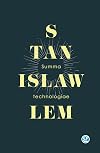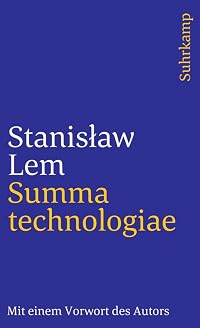
Summa technologiae
by Stanisław Lem
On This Page
Description
In Summa Technologiae, Stanislaw Lem produced an engaging and caustically logical philosophical treatise about human and nonhuman life in its past, present, and future forms. After five decades this work has lost none of its intellectual or critical significance, resonating with contemporary debates about information and new media, the life sciences, and the emerging relationship between technology and humanity.Tags
Recommendations











Member Reviews
There are a truly impressive number of potential sci-fi novels lurking in the pages of this speculative treatise, which covers such a huge range of subjects that it would seem incredible if this weren't by the famously imaginative Lem. Actually, given that it was originally published in 1964, it's still impressive, since only now are many of these topics coming to the light of day in the form of new technologies. Joanna Zylinska, who fills in ably for fan favorite translator Michael Kandel, sadly absent here, sums up the questions Lem was trying to explore at the beginning of her introduction:
"Is the human a typical phenomenon in the Universe or an exceptional one? Is there a limit to the expansion of a civilization? Would plagiarizing show more Nature count as fraud? Is consciousness a necessary component of human agency? Should we rather trust our thoughts or our perceptions? Do we control the development of technology, or is technology controlling us? Should we make machines moral? What do human societies and colonies of bacteria have in common? What can we learn from insects?"
Heavy stuff, and that's really only some of the subjects he discusses, at far greater depth (and length) than those teasers even hint at. A stumbling block is his blizzard of neologistic terminology ("theotechnologists", "phantomatics", "imitology", "ariadnology") or words that are just plain obscure ("biogeocenosis", "cybergnostic"), but regular readers should be used to his ability to dig deeply in the dictionary for a needed term or, should that fail, his unhesitating willingness to make a suitable term up. His style will be familiar from his other essay collections: dense in argument, assumption, and expansion. Here's a sample from the "Two Evolutions" chapter:
"The technologies that facilitate living are becoming a tool for life's impoverishment because the mass media are turning from their role of a compliant duplicator of spiritual goods to that of a producer of cultural junk. We are told that, culturally, technology is at best barren. I say 'at best' because the unification of humanity it promotes takes place at the expense of the spiritual heritage of the past centuries and also at the expense of the ongoing creative efforts. Subjugated by technology, art begins to be dominated by economic laws, showing signs of inflation and devaluation. Above the technical pool of mass entertainment - which has to be easily accessible because general accessibility is the mantra of Technologists - only a handful of creative types survive. Their efforts are focused on ignoring or deriding the stereotypes of mechanized life. Briefly put, technoevolution brings more evil than good, with man turning out to be a prisoner of what he himself has created. The growth of his knowledge is accompanied by the narrowing down of possibilities when it comes to deciding about his own fate."
So on a purely formal level, you have several overlapping economic and cultural arguments, wrapped up in a spiritual argument, which itself is only one part of a long, dense chapter comparing and contrasting biological and technological evolution. One can argue that he's right or wrong, but he's arguable regardless - many many hours of debate could be spawned just by that one paragraph.
Unfortunately, I feel like the whole of this vast treatise is more "arguable" than "enjoyable". I'm not sure if his primary goal with these writings was to provoke any particular reaction from his audience; to my mind, he's so effective in general at presenting his ideas in his fiction that perhaps in this case he felt like constructing narratives around these ideas was simply too difficult. But these ideas feel so hermetic that it's often very difficult to appreciate the nuance and vision, and all too easy to simply get lost. One example is the section "The Dangers of Electrocracy", which resembles an exceedingly condensed version of Isaac Asimov's short story "The Evitable Conflict", wherein robots tasked with ensuring the well-being of mankind slowly usurp more and more power over the world economy until a few executives realize that humanity has unwittingly ceded an important measure of control over its destiny to its servants - but possibly for the better. In Asimov's telling, this is a powerful moment of ambivalence for mankind, an illustration of how the aggregate of many small decisions can have an overall questionable effect; in Lem's description, it's simply a technical matter of odds, black boxes, and homeostatic equilibria.
However, once allowances have been made for the scope of Lem's ambition, the imposing edifice of Summa Technologiae can be seen for what it is, less an attempt to settle disputes than to spawn a whole literature of new ones. This is not the last word on anything, merely a first few hundred questions from one of the greatest science fiction authors of all time. I could wish that he had worked these into his novels, yet there are so many potential novels lurking within that this deserves a closer study by anyone interested in a pure work of ideas. show less
"Is the human a typical phenomenon in the Universe or an exceptional one? Is there a limit to the expansion of a civilization? Would plagiarizing show more Nature count as fraud? Is consciousness a necessary component of human agency? Should we rather trust our thoughts or our perceptions? Do we control the development of technology, or is technology controlling us? Should we make machines moral? What do human societies and colonies of bacteria have in common? What can we learn from insects?"
Heavy stuff, and that's really only some of the subjects he discusses, at far greater depth (and length) than those teasers even hint at. A stumbling block is his blizzard of neologistic terminology ("theotechnologists", "phantomatics", "imitology", "ariadnology") or words that are just plain obscure ("biogeocenosis", "cybergnostic"), but regular readers should be used to his ability to dig deeply in the dictionary for a needed term or, should that fail, his unhesitating willingness to make a suitable term up. His style will be familiar from his other essay collections: dense in argument, assumption, and expansion. Here's a sample from the "Two Evolutions" chapter:
"The technologies that facilitate living are becoming a tool for life's impoverishment because the mass media are turning from their role of a compliant duplicator of spiritual goods to that of a producer of cultural junk. We are told that, culturally, technology is at best barren. I say 'at best' because the unification of humanity it promotes takes place at the expense of the spiritual heritage of the past centuries and also at the expense of the ongoing creative efforts. Subjugated by technology, art begins to be dominated by economic laws, showing signs of inflation and devaluation. Above the technical pool of mass entertainment - which has to be easily accessible because general accessibility is the mantra of Technologists - only a handful of creative types survive. Their efforts are focused on ignoring or deriding the stereotypes of mechanized life. Briefly put, technoevolution brings more evil than good, with man turning out to be a prisoner of what he himself has created. The growth of his knowledge is accompanied by the narrowing down of possibilities when it comes to deciding about his own fate."
So on a purely formal level, you have several overlapping economic and cultural arguments, wrapped up in a spiritual argument, which itself is only one part of a long, dense chapter comparing and contrasting biological and technological evolution. One can argue that he's right or wrong, but he's arguable regardless - many many hours of debate could be spawned just by that one paragraph.
Unfortunately, I feel like the whole of this vast treatise is more "arguable" than "enjoyable". I'm not sure if his primary goal with these writings was to provoke any particular reaction from his audience; to my mind, he's so effective in general at presenting his ideas in his fiction that perhaps in this case he felt like constructing narratives around these ideas was simply too difficult. But these ideas feel so hermetic that it's often very difficult to appreciate the nuance and vision, and all too easy to simply get lost. One example is the section "The Dangers of Electrocracy", which resembles an exceedingly condensed version of Isaac Asimov's short story "The Evitable Conflict", wherein robots tasked with ensuring the well-being of mankind slowly usurp more and more power over the world economy until a few executives realize that humanity has unwittingly ceded an important measure of control over its destiny to its servants - but possibly for the better. In Asimov's telling, this is a powerful moment of ambivalence for mankind, an illustration of how the aggregate of many small decisions can have an overall questionable effect; in Lem's description, it's simply a technical matter of odds, black boxes, and homeostatic equilibria.
However, once allowances have been made for the scope of Lem's ambition, the imposing edifice of Summa Technologiae can be seen for what it is, less an attempt to settle disputes than to spawn a whole literature of new ones. This is not the last word on anything, merely a first few hundred questions from one of the greatest science fiction authors of all time. I could wish that he had worked these into his novels, yet there are so many potential novels lurking within that this deserves a closer study by anyone interested in a pure work of ideas. show less
I was very excited to read this new translation of a previously untranslated Lem philosophical treatise on technology. There's the occasional side comment that I found thoughtful, but I got really bogged down in this on the whole. I know many smart people have praised it, but I came to dread picking it up everyday and slogging through a few more pages. I guess I like Lem more when he expresses his complicated ideas through fiction, especially fiction with a lighter touch. Probably my favorite of his observations was this comment from near the end of the book:
What is therefore possible? Almost everything, with just one exception. Having conspired in advance, people could decide one day, many thousands of years from now, show more "Enough! Let things be the way they are now; let them remain like this forever. Let us not change, seek, or discover anything new, since things cannot be better than they are now, and even if they could, we do not want it."
Even though I have outlined many unlikely things in this book, this one seems to me to be the most unlikely of them all. show less
What is therefore possible? Almost everything, with just one exception. Having conspired in advance, people could decide one day, many thousands of years from now, show more "Enough! Let things be the way they are now; let them remain like this forever. Let us not change, seek, or discover anything new, since things cannot be better than they are now, and even if they could, we do not want it."
Even though I have outlined many unlikely things in this book, this one seems to me to be the most unlikely of them all. show less
A far reaching and comprehensive look at the future of technology and the autoevolution of mankind within that future. Even fifty years after its composition it seems very relevant. For me, Lem is a more compelling and thought provoking futurist than Kurzweil.
Talk about ' Way ahead of everyone else ... ' ( staggering )
Talk about ' Way ahead of everyone else ... ' ( staggering )
Ratings
Members
- Recently Added By
Author Information

359+ Works 32,230 Members
Polish science fiction writer Stanislaw Lem was born on September 12, 1921. A medical graduate of Cracow University, he is at home both in the sciences and in philosophy, and this broad erudition gives his writings genuine depth. He has published extensively, not only fiction, but also theoretical studies. His books have been translated into 41 show more languages and sold over 27 million copies. He gained international acclaim for The Cyberiad, a series of short stories, which was first published in 1974. A trend toward increasingly serious philosophical speculation is found in his later works, such as Solaris (1961), which was made into a Soviet film by Russian director Andrei Tarkovsky in 1972 and remade by Steven Soderbergh in 2002. He died on March 27, 2006 in Krakow at the age of 84. (Bowker Author Biography) show less
Some Editions
Series
Belongs to Publisher Series
Work Relationships
Is contained in
Common Knowledge
- Canonical title
- Summa technologiae
- Original publication date
- 1964
- Original language
- Polish
Classifications
- Genres
- Philosophy, Nonfiction, General Nonfiction
- DDC/MDS
- 306 — Society, government, & culture Social sciences, sociology & anthropology Social Behavior - Dating, Marriage, Divorce
- LCC
- CB478 .L4313 — Auxiliary Sciences of History History of Civilization History of Civilization Relation to special topics Technology
- BISAC
Statistics
- Members
- 295
- Popularity
- 108,676
- Reviews
- 5
- Rating
- (3.96)
- Languages
- 8 — Czech, English, German, Italian, Japanese, Polish, Russian, Spanish
- Media
- Paper, Ebook
- ISBNs
- 20
- ASINs
- 7