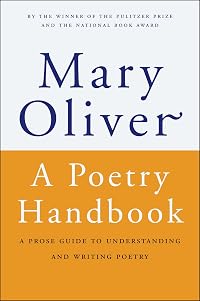
A Poetry Handbook: A Prose Guide to Understanding and Writing Poetry
by Mary Oliver
On This Page
Description
"Mary Oliver would probably never admit to anything so grandiose as an effort to connect the conscious mind and the heart (that's what she says poetry can do), but that is exactly what she accomplishes in this stunning little handbook."-Los Angeles Times From the beloved and acclaimed poet, an ultimate guide to writing and understanding poetry. With passion and wit, Mary Oliver skillfully imparts expertise from her long, celebrated career as a disguised poet. She walks readers through show more exactly how a poem is built, from meter and rhyme, to form and diction, to sound and sense, drawing on poems by Robert Frost, Elizabeth Bishop, and others. This handbook is an invaluable glimpse into Oliver's prolific mind-a must-have for all poetry-lovers. show lessTags
Recommendations


Member Reviews
I’m in awe of how much essential information Oliver managed to fit in so few pages without sacrificing reader-friendliness. Any budding poet should read and reread this book, but it would also be helpful to readers who’d like a better understanding of what poetry hopes to accomplish and how it aims to.
Oliver assumes that anyone interested in writing poetry will also read poems and a wide variety of other subjects and immerse herself in the natural world. I was struck by her image of poetry, collectively, as a river. Some might feel burdened by the thought of adding to such a rich tradition, but I found it liberating. She includes apt examples to illustrate the points she’s making. Some were poems I’ve read many times; others show more were new to me, and I was happy to become acquainted with them.
I liked the balance she strikes between participating in well-run workshops and pursuing solitude. She closes with two quotations, with her comments on them. In one, Flaubert names three requirements—patience, effort of will, and intense observation. A good recipe for a poet. Emerson, meanwhile, calls a poem a confession of faith. To this, Oliver adds: “Poetry is a life-cherishing force. . . . For poems are not words, after all, but fires for the cold, ropes let down to the lost, something as necessary as bread in the pockets of the hungry.” show less
Oliver assumes that anyone interested in writing poetry will also read poems and a wide variety of other subjects and immerse herself in the natural world. I was struck by her image of poetry, collectively, as a river. Some might feel burdened by the thought of adding to such a rich tradition, but I found it liberating. She includes apt examples to illustrate the points she’s making. Some were poems I’ve read many times; others show more were new to me, and I was happy to become acquainted with them.
I liked the balance she strikes between participating in well-run workshops and pursuing solitude. She closes with two quotations, with her comments on them. In one, Flaubert names three requirements—patience, effort of will, and intense observation. A good recipe for a poet. Emerson, meanwhile, calls a poem a confession of faith. To this, Oliver adds: “Poetry is a life-cherishing force. . . . For poems are not words, after all, but fires for the cold, ropes let down to the lost, something as necessary as bread in the pockets of the hungry.” show less
I will come back to this many times for the examples, for the wisdom, for the reminder that I'm writing for myself and no one else—so it's OK if my poetry is bad and derivative and poorly imitating the experts because it is mine. (And it is bad, if I published a poetry collection I would call it Bad Poetry.) I do all the things Oliver says not to do: stale language, clichés, terrible inversion, and way too much telling. Alas, that is why I came to her book to learn all the things I'm doing wrong and to find the language of poetry. It includes great examples of poetry to illustrate her point (line, verse, meter, imagery, etc) along with her excellent advice. This is a great little guide, it's like a workshop of one, if you're trying show more to understand poetry that you're reading or write your own. show less
The one word review below calling to mind feces suggests that the reviewer should have read the book more closely, especially the chapter on Diction, Tone, and Voice.
Mary Oliver is a favorite poet, and author, as I love her rare prose offerings. Under her tutelage, I have picked up Wordsworth and been enjoying his epic biographical poem, The Prelude, which is probably primarily known to literature professors now. Without her encouragement, I wouldn't have tried to immerse myself in the classics and would have missed much of the foundational writings of the form. The reviewers who see the book as useful to any author, not just poets, are the ones who came to this book open-minded and open-hearted. For those of us who resisted the show more lyrical, this book is like a baptism in pure, refreshing waters.
Oliver's poetry alone should lend the credibility necessary to greet this slim treatise with loving arms. But, if you're not familiar with her writing and you're interested in the form and function of poetry, the history of it, the music of it, I can't recommend this book enough.
5 bones!!!!!
Highly recommended!!!! show less
Mary Oliver is a favorite poet, and author, as I love her rare prose offerings. Under her tutelage, I have picked up Wordsworth and been enjoying his epic biographical poem, The Prelude, which is probably primarily known to literature professors now. Without her encouragement, I wouldn't have tried to immerse myself in the classics and would have missed much of the foundational writings of the form. The reviewers who see the book as useful to any author, not just poets, are the ones who came to this book open-minded and open-hearted. For those of us who resisted the show more lyrical, this book is like a baptism in pure, refreshing waters.
Oliver's poetry alone should lend the credibility necessary to greet this slim treatise with loving arms. But, if you're not familiar with her writing and you're interested in the form and function of poetry, the history of it, the music of it, I can't recommend this book enough.
5 bones!!!!!
Highly recommended!!!! show less
I was a little concerned when I read the first sentence of this book: "Everyone knows that poets are born and not made in school." I was concerned because I thought I was in for a glorification of the artist, someone gifted with the divine power of the muse, or whatever. But, as I continued reading, I discovered that it is not at all about this. On the same page, she writes, "This book is about the things that can be learned. It is about matters of craft, primarily. It is about the part of the poem that is a written document, as opposed to a mystical document...."
It is a book explaining the fundamentals of poetry. While I believe Oliver (who is one of my favorite poets) targeted the book at beginning poets, it is also very useful for show more someone who simply reads poetry, and does not necessarily create it.
After finishing the book I went back and looked at the first chapter, and figured out more what she meant in that first sentence. She writes on page 8, about the part of one's psyche that is necessary to create poetry: "Say you promise to be at your desk in the evenings, from seven to nine. It waits, it watches. If you are reliably there, it begins to show itself - soon it begins to arrive when you do. But if you are only there sometimes and are frequently late or inattentive, it will appear fleetingly, or it will not appear at all."
And that is what she means by a poet, or any artist, being born not made in school. The kind of person who dedicates themselves to the craft of their art by regularly showing up and doing the work is not someone who has simply studied it in a classroom. There is something in them that needs to create that specific kind of art.
A Poetry Handbook is one of the best books I've read about the fundamentals of poetry. I have added it to my permanent bookshelf as a reference, and as something I will read again. show less
It is a book explaining the fundamentals of poetry. While I believe Oliver (who is one of my favorite poets) targeted the book at beginning poets, it is also very useful for show more someone who simply reads poetry, and does not necessarily create it.
After finishing the book I went back and looked at the first chapter, and figured out more what she meant in that first sentence. She writes on page 8, about the part of one's psyche that is necessary to create poetry: "Say you promise to be at your desk in the evenings, from seven to nine. It waits, it watches. If you are reliably there, it begins to show itself - soon it begins to arrive when you do. But if you are only there sometimes and are frequently late or inattentive, it will appear fleetingly, or it will not appear at all."
And that is what she means by a poet, or any artist, being born not made in school. The kind of person who dedicates themselves to the craft of their art by regularly showing up and doing the work is not someone who has simply studied it in a classroom. There is something in them that needs to create that specific kind of art.
A Poetry Handbook is one of the best books I've read about the fundamentals of poetry. I have added it to my permanent bookshelf as a reference, and as something I will read again. show less
"To interrupt the writer from the line of thought is to wake the dreamer from a dream."
This line is not found until a hundred some pages into the book, but it was absolutely my favorite one. It was like that awesome line from a movie or TV show that you love. That moment of feeling when nothing before or after ever quite ellicits the same build up to wow.
It is no surprise then that I found Mary Oliver: A Poetry Handbook to be quite the gem for me. I learned so much more about sound than I ever gave time to think about before, and I appreciated the way she talked about turning the line, repetitions, verses, variations, diction, tone, voice, imagery, personification, revision, and more.
But, it was not all about making sure the literary show more foundation was there. The handbook also touched on practice, taking notes, imitation, application, workshops, emotional freedom, solitude, integrity, etc. While these parts were not the focus of the book, I did find they supported the base in their own meaningful ways to help the reader start or adjust their own process of any kind of writing and get closer to that memorable connection in at last catching the flame.
Ultimately, I loved how Mary Oliver: A Poetry Handbook ended up reminding me of standing back and looking at a stained glass window and appreciating all the time, love, and patience that went into sharing the creation of its warmth with others. show less
This line is not found until a hundred some pages into the book, but it was absolutely my favorite one. It was like that awesome line from a movie or TV show that you love. That moment of feeling when nothing before or after ever quite ellicits the same build up to wow.
It is no surprise then that I found Mary Oliver: A Poetry Handbook to be quite the gem for me. I learned so much more about sound than I ever gave time to think about before, and I appreciated the way she talked about turning the line, repetitions, verses, variations, diction, tone, voice, imagery, personification, revision, and more.
But, it was not all about making sure the literary show more foundation was there. The handbook also touched on practice, taking notes, imitation, application, workshops, emotional freedom, solitude, integrity, etc. While these parts were not the focus of the book, I did find they supported the base in their own meaningful ways to help the reader start or adjust their own process of any kind of writing and get closer to that memorable connection in at last catching the flame.
Ultimately, I loved how Mary Oliver: A Poetry Handbook ended up reminding me of standing back and looking at a stained glass window and appreciating all the time, love, and patience that went into sharing the creation of its warmth with others. show less
'A poem that is composed without the sweet and correct formalities of language, which are what sets it apart from the dailiness of ordinary writing, is doomed. It will not fly. It will be raucous and sloppy -the work of an amateur.'
And here's to another book on the craft of writing poetry! This one, though, being by a talented practitioner of the art that is, Mary Oliver, celebrated American poetess winner (among other acclaimed recognitions) of the National Book Award (1992) and the Pulitzer Prize (1984).
As an introduction, there is absolutely nothing wrong with it. Explaining forms, verses, accentuations and else she is clear, informative, and straight to the point. It's just that, in between the lines, one can read she has show more convictions on what constitute poetry; and I would have loved these convictions to be hammered more forcefully instead of being shyly relegated into the background. I believe indeed her views to be common sense, yet in our dreadful poetical landscape (who read poetry nowadays?... Exactly!) way more than relevant and needed.
For a start, she gently reminds that one cannot write decent poetry without having a clue about the technical side of the craft. She even goes further, by suggesting that one cannot built anything strong and original if it's not built upon the established canon that is, traditional poetry.
That may sound like obvious. Yet when most of our established literary intelligentsia proudly sneers at traditional and/ or formal writing (e.g. see how many dismiss even rhymes...) and then nag about poetry readers being scarce these days (duh!) here's indeed a strong point that, I think, would have deserved to be yelled.
Now, don't get it wrong! 'A Poetry Handbook' doesn't bash on free verse as opposed to metrical form! It's just that, in my opinion, she is too gentle nailing crucial points that many came to overlook:
'Is poetry language that is spontaneous, impulsive? Yes, it is. Is it also language that is composed, considerate, appropriate, and effective, though you read the poem a hundred times? Yes, it is. And this is as true of free verse as it is of metrical verse.'
I know, some will appreciate such lack of patronising attitude and haughtiness. I just personally believe that, in regard to how poetry turned to be during the past few decades, being brutally blunt is exactly the tone that's needed to put the art back on track. Considering who she is, Mary Oliver of all people, would have been entitled to do just that.
After all, it's not complicated to write a good and decent poem. It's all about prosody on the one hand, and images on the other. About, she dedicates whole chapters to rhythm, choice of words (sound, accuracy, connotation...) and, most importantly, figurative language (figures of speech) that are straight to the point.
In a word, this short yet relevant little book will be useful, not only to whose aspiring to write poetry but, also, any poetry reader in general so as to get a better understanding and hence appreciation of the craft. Enjoy! show less
And here's to another book on the craft of writing poetry! This one, though, being by a talented practitioner of the art that is, Mary Oliver, celebrated American poetess winner (among other acclaimed recognitions) of the National Book Award (1992) and the Pulitzer Prize (1984).
As an introduction, there is absolutely nothing wrong with it. Explaining forms, verses, accentuations and else she is clear, informative, and straight to the point. It's just that, in between the lines, one can read she has show more convictions on what constitute poetry; and I would have loved these convictions to be hammered more forcefully instead of being shyly relegated into the background. I believe indeed her views to be common sense, yet in our dreadful poetical landscape (who read poetry nowadays?... Exactly!) way more than relevant and needed.
For a start, she gently reminds that one cannot write decent poetry without having a clue about the technical side of the craft. She even goes further, by suggesting that one cannot built anything strong and original if it's not built upon the established canon that is, traditional poetry.
That may sound like obvious. Yet when most of our established literary intelligentsia proudly sneers at traditional and/ or formal writing (e.g. see how many dismiss even rhymes...) and then nag about poetry readers being scarce these days (duh!) here's indeed a strong point that, I think, would have deserved to be yelled.
Now, don't get it wrong! 'A Poetry Handbook' doesn't bash on free verse as opposed to metrical form! It's just that, in my opinion, she is too gentle nailing crucial points that many came to overlook:
'Is poetry language that is spontaneous, impulsive? Yes, it is. Is it also language that is composed, considerate, appropriate, and effective, though you read the poem a hundred times? Yes, it is. And this is as true of free verse as it is of metrical verse.'
I know, some will appreciate such lack of patronising attitude and haughtiness. I just personally believe that, in regard to how poetry turned to be during the past few decades, being brutally blunt is exactly the tone that's needed to put the art back on track. Considering who she is, Mary Oliver of all people, would have been entitled to do just that.
After all, it's not complicated to write a good and decent poem. It's all about prosody on the one hand, and images on the other. About, she dedicates whole chapters to rhythm, choice of words (sound, accuracy, connotation...) and, most importantly, figurative language (figures of speech) that are straight to the point.
In a word, this short yet relevant little book will be useful, not only to whose aspiring to write poetry but, also, any poetry reader in general so as to get a better understanding and hence appreciation of the craft. Enjoy! show less
This slim volume is by one of my favorite poets, Mary Oliver. I suppose I had high expectations for this book for that reason, but I found it was oriented toward beginners and was fairly dry but for the poems. I didn't get anything new or revelatory out of it.
Members
- Recently Added By
Lists

Craft Books
41 works; 1 member
Author Information

54+ Works 21,173 Members
Mary Oliver was born in Cleveland, Ohio on September 10, 1935. She attended Ohio State University and Vassar College, but did not receive a degree. Her first collection of poems, No Voyage and Other Poems, was published in 1963. She wrote more than 20 volumes of poetry including The River Styx, Ohio; The Leaf and the Cloud; Evidence; Blue Horses; show more and Felicity. She received several awards including the Pulitzer Prize for American Primitive, the Christopher Award and the L. L. Winship/PEN New England Award for House of Light, and the National Book Award for New and Selected Poems. Her books of prose include A Poetry Handbook, Rules for the Dance: A Handbook for Writing and Reading Metrical Verse, and Long Life: Essays and Other Writings. She held the Catharine Osgood Foster Chair for Distinguished Teaching at Bennington College from 1995 to 2001. She died on January 17, 2019 at the age of 83. (Bowker Author Biography) show less
Awards and Honors
Distinctions
Common Knowledge
- Canonical title
- A Poetry Handbook: A Prose Guide to Understanding and Writing Poetry
- Original publication date
- 1994
- Epigraph
- The temple bell stops -
but the sound keeps coming
out of the flowers.
Bashō (1644-94)
(translated by Robert Bly) - First words
- Everyone knows that poets are born and not made in school.
- Last words
- (Click to show. Warning: May contain spoilers.)For poems are not words, after all, but fires for the cold, ropes let down to the lost, something as necessary as bread in the pockets of the hungry. Yes, indeed.
Classifications
- Genres
- Poetry, Literature Studies and Criticism, Fiction and Literature
- DDC/MDS
- 808.1 — Literature & rhetoric Literature, rhetoric & criticism Rhetoric and collections of literary texts from more than two literatures Rhetoric of poetry
- LCC
- PE1505 .O35 — Language and Literature English language English Modern English
- BISAC
Statistics
- Members
- 2,210
- Popularity
- 9,220
- Reviews
- 25
- Rating
- (3.93)
- Languages
- English
- Media
- Paper, Audiobook, Ebook
- ISBNs
- 6
- ASINs
- 8