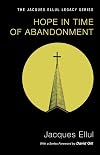
Hope in time of abandonment
by Jacques Ellul
93 Members (4.25)
On This Page
Description
The writings of Jacques Ellul have brought him into the first rank as theologian and social critic. Martin Marty commented that if he had to introduce one man from the Protestant world to tell the church what its agenda should be, that man would be Ellul. The eminent Frenchman now brings us his most profound, most moving theological statement. For years, Jacques Ellul tells us in his preface, he had wanted to write a book on The Age of Abandonment, for it seemed to him that both society and show more the church had reached that point described in Scripture when God turns his back and is silent. But when he came to elaborate this theme, Ellul found himself inexplicably writing on the theme of hope, despite the fact that his analysis of society remained unchanged. Hope was now no longer a matter of intellect, but a word asked by God of the heart for its salvation. More than ever before, in this book Jacques Ellul shares with readers not only the darkest forebodings of contemporary man's soul, but also his own struggle to emerge from despair to a stronger level of Christian faith--and hope. He writes of hope, not in the vein of Moltmann and Metz, but in a highly original and penetrating manner. show lessTags
Recommendations

























Member Reviews
Members
- Recently Added By
Author Information

122+ Works 5,946 Members
Jacques Ellul, historian, theologian, and sociologist, is one of the foremost and widely known contemporary critics of modern technological society. Born in Bordeaux, France, Ellul received a doctorate in the history of law and social science in 1936 from the University of Bordeaux. In 1947 he was appointed professor of social history at the show more University of Bordeaux, remaining there until his retirement in 1980. Although influenced strongly by his early reading of the Bible Marx, Ellul has been unable to synthesize Marxist doctrine with Christianity. These readings and experiences have influenced his later philosophy and writing. Ellul has taught and written extensively in his areas of specialization - Roman law, the history and sociology of institutions, Marxism, propaganda, and technique in society. He also served in the French Resistance during World War II, worked as a lay pastor, and has been active with various theological organizations, including the World Council of Churches. In addition, Ellul has been active in the environmental movement and has worked to prevent juvenile delinquency and violence. Since 1969, he has been editor of Foi et Vie (Faith and Life). Although retired as a teacher, Ellul has continued writing. One of his writing projects is an autobiography to be published after his death. Ellul has provided a sociopolitical as well as a theological analysis of contemporary society in more than 40 books and 800 articles. The Technological Society (1954) established Ellul as a social critic. The book has had a major impact on the collective consciousness of a society just beginning to recognize the central role and force of technology. Here Ellul develops the notion of "technique," a concept much broader than technology: "Technique is the totality of methods rationally arrived at." In Ellul's view, technology in this sense tends to become all-encompassing. His subsequent books, especially The Political Illusion (1965) and Propaganda (1962), further develop and refine elements of this central theme. This "trilogy" of books reflects Ellul's desire to alert readers to the dangers of technological determinism and thereby help them transcend it. Because of a dialectical approach separating his sociopolitical and theological studies, Ellul has often been criticized as overly pessimistic in his sociologically based writings. His theological works, however, provide a more positive perspective and counterpoint to his sociological work. Most notable are The Politics of God and the Politics of Man (1966), The Meaning of the City (1970), and especially The Ethics of Freedom (1973). The main body of Ellul's sociopolitical critique of technical society is reflected by The Technological Society, The Political Illusion, Propaganda, and The Technological System. Among his other works are Autopsy of Revolution (1969), which questions what kind of revolution is realistically possible, The Humiliation of the Word (1981), which expands upon the concept of "human techniques", and The Technological Bluff (1990), which discusses the state of contemporary society, especially in regard to such technologies as computers and genetic engineering and the progressive "discourse" that surrounds their societal incorporation. (Bowker Author Biography) show less
Classifications
Statistics
- Members
- 93
- Popularity
- 345,862
- Rating
- (4.25)
- Languages
- English, French
- Media
- Paper
- ISBNs
- 5
- ASINs
- 3