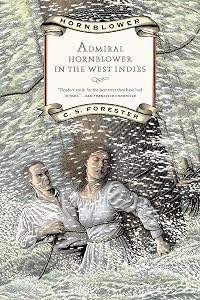
Hornblower in the West Indies
by C. S. Forester
Horatio Hornblower (11), Horatio Hornblower: Chronological Order (11)
On This Page
Description
As commander-in-chief of His Majesty's ships and vessels in the West Indies, Admiral Hornblower faces pirates, revolutionaries, and a blistering hurricane in the chaotic aftermath of the Napoleonic Wars.Tags
Recommendations
















Member Reviews
This is the last complete novel in the chronology of its leading character, the redoubtable Horatio Hornblower of the British Navy. (Other Hornblower books were written, but they were either incomplete novels or they were written out of chronology with the narrative.) Though not quite the end of Hornblower's life story as chronicled by C.S. Forester, it is a bit of a farewell, nonetheless. Comprising several novellas all set in the Caribbean Sea, the book is episodic but well tied together. Hornblower is still a master sailor and still filled with self-doubt, and Forester's nautical prose is still as clear and musical as ever. Each of the sequences is rich in detail, and a last segment dealing with a storm at sea is an utterly brilliant show more word-picture of nature at its most terrifying. It's becoming clear that there are only superb Hornblower books. It is one of the most consistent and enjoyable characters ever put into print over several books, and I am sorry to see the series nearing its end. show less
This is the last Hornblower novel chronologically, the second last by publication order, and the last that was not a reread for me. I was a little apprehensive going in, because the post-Flying Colours novels had been disappointing to me, because things seemed too good for Hornblower, who works best as a character when he's on the back foot. (I'm convinced that if Forester knew he was going to write more than the original trilogy, he wouldn't have married Hornblower off at the end of Flying Colours.) Additionally, Forester occasionally struggles to bring cohesion to some Hornblower novels (e.g., Commodore Hornblower, Hornblower and the Atropos).
Well, I need not have worried, because Admiral Hornblower is one of the best Hornblower show more books, a great way for the series to end (or almost end). Hornblower feels much less overly accomplished in this one-- sure, he's an admiral, but when you're an admiral essentially on your own in the West Indies, that often constrains you more than it enables you. Much moreso than Commodore or Lord, Admiral captures how more responsibility makes things more difficult. So in some ways this is a return to the Hornblower of old, the captain we met in Beat to Quarters and Ship of the Line, and the wily young officer of Mr. Midshipman Hornblower and Lieutenant, but he's been successfully transposed to a new setting. One supposes it would have been possible to do the Star Trek thing, and have Hornblower technically be an admiral but still facing captain's problems, like in The Motion Picture or The Wrath of Khan, but Forester gives him admiral's problems that he deals with in his usual fashion: rogue French armies, diplomatic relations with Spain, sailors who need executing, and so on.
The book also benefits from being, like Mr. Midshipman, a series of short stories (or probably novellas, as there are just five of them) rather than a novel, though they don't have individual titles (in my edition at least; I see titles listed on Wikipedia). Forester doesn't struggle to unite disparate incidents, but can simply show the reader a series of problems across two years of being stationed overseas. There are a lot of great individual stories here, such as Hornblower having to violate his word for the first time in his career, or Hornblower's inventive solution to catching a slave ship when treaty forbids him to set sail immediately, or Hornblower facing a band of pirates, or accidentally supporting the wrong side in a revolution.
The very best one, though, is the last one, which covers Hornblower's need to enforce discipline by death (moreso than ever before, but for the most trivial of disobediences), his insecurities in his marriage, and a dramatic hurricane. It's great stuff, Hornblower at his most human as he doesn't quite believe in Barbara's love for him, and at his most superhuman as he tries to keep a tiny ship afloat in a gigantic storm, needing all his cleverness and charisma. The storm itself is some of Forester's very best writing, and I found the whole thing an emotional and fulfilling wrap-up to the Hornblower saga. Whether it's since Mr. Midshipman or Beat to Quarters, he's come a long way, no matter how you look at it. show less
Well, I need not have worried, because Admiral Hornblower is one of the best Hornblower show more books, a great way for the series to end (or almost end). Hornblower feels much less overly accomplished in this one-- sure, he's an admiral, but when you're an admiral essentially on your own in the West Indies, that often constrains you more than it enables you. Much moreso than Commodore or Lord, Admiral captures how more responsibility makes things more difficult. So in some ways this is a return to the Hornblower of old, the captain we met in Beat to Quarters and Ship of the Line, and the wily young officer of Mr. Midshipman Hornblower and Lieutenant, but he's been successfully transposed to a new setting. One supposes it would have been possible to do the Star Trek thing, and have Hornblower technically be an admiral but still facing captain's problems, like in The Motion Picture or The Wrath of Khan, but Forester gives him admiral's problems that he deals with in his usual fashion: rogue French armies, diplomatic relations with Spain, sailors who need executing, and so on.
The book also benefits from being, like Mr. Midshipman, a series of short stories (or probably novellas, as there are just five of them) rather than a novel, though they don't have individual titles (in my edition at least; I see titles listed on Wikipedia). Forester doesn't struggle to unite disparate incidents, but can simply show the reader a series of problems across two years of being stationed overseas. There are a lot of great individual stories here, such as Hornblower having to violate his word for the first time in his career, or Hornblower's inventive solution to catching a slave ship when treaty forbids him to set sail immediately, or Hornblower facing a band of pirates, or accidentally supporting the wrong side in a revolution.
The very best one, though, is the last one, which covers Hornblower's need to enforce discipline by death (moreso than ever before, but for the most trivial of disobediences), his insecurities in his marriage, and a dramatic hurricane. It's great stuff, Hornblower at his most human as he doesn't quite believe in Barbara's love for him, and at his most superhuman as he tries to keep a tiny ship afloat in a gigantic storm, needing all his cleverness and charisma. The storm itself is some of Forester's very best writing, and I found the whole thing an emotional and fulfilling wrap-up to the Hornblower saga. Whether it's since Mr. Midshipman or Beat to Quarters, he's come a long way, no matter how you look at it. show less
Hornblower was the inspiration for Star Trek's Captain James Kirk, as well as Cornwell's Sharpe. Hornblower is more cerebral and socially awkward than Kirk (or O'Brien's Aubrey), more educated and refined than Sharpe. In his own right, Hornblower is certainly an engaging and complex character and the series is an interesting study in leadership, and a fascinating portrait of life at sea in the age of sail.
In the course of reading several books in the series Hornblower begins to feel real in a way few fictional characters do. I'd say he's easily as indelible and remarkable a literary creation as Sherlock Holmes--and just as brilliant in his field as Holmes was as a detective. And one of the great pleasures of the series is seeing show more Hornblower through the course of his career, from callow Midshipman to Admiral. Like the first book chronologically, Mr Midshipman Hornblower, this is more a collection of related short stories than a true novel. I think for that reason few Hornblower fans would name it among the best in the series. For me, though, it's among the most memorable. I remember the first story/chapter especially well--even after decades. Not to mention the picture of the hurricane later on. This may not be among the best in the series--but it's still greatly enjoyable. show less
In the course of reading several books in the series Hornblower begins to feel real in a way few fictional characters do. I'd say he's easily as indelible and remarkable a literary creation as Sherlock Holmes--and just as brilliant in his field as Holmes was as a detective. And one of the great pleasures of the series is seeing show more Hornblower through the course of his career, from callow Midshipman to Admiral. Like the first book chronologically, Mr Midshipman Hornblower, this is more a collection of related short stories than a true novel. I think for that reason few Hornblower fans would name it among the best in the series. For me, though, it's among the most memorable. I remember the first story/chapter especially well--even after decades. Not to mention the picture of the hurricane later on. This may not be among the best in the series--but it's still greatly enjoyable. show less
This is the best of the books on Hornblower that I have read so far. This book is really a series of about 5 short stories which are bound together as part of his experience as Admiral in the West Indies. I especially liked the capture of the slave ship, being captured by pirates and the last one on his way home with Lady Barbara when they encounter a hurricane. You really feel you understand the man and his motives...his relationships with his fellow sailors is amazing in the distant but obvious affection by his men with the resolve to do their best under his command.
I have read three novels about Hornblower now...all of them in the latter part of his career....I am looking for the first novel now and will read them in order. It is show more nice to find a relaxing, exciting, knowledgeable read show less
I have read three novels about Hornblower now...all of them in the latter part of his career....I am looking for the first novel now and will read them in order. It is show more nice to find a relaxing, exciting, knowledgeable read show less
Rear Admiral Hornblower has taken up his last command as commander of His Majesty's fleet in the West Indies. With his small fleet Hornblower does his best to rid the Caribbean of pirates and slavers, foil a desperate French plot to free Napoleon, and save his good name from an impostor using his authority to meddle in the delicate political situation in the Americas. Even on his way home Hornblower finds himself facing a desperate peril that may take from him what he loves most.
I was sad to see this series end, but this was a definite step up from Lord Hornblower. There are plenty of adventures at sea as Hornblower polices the West Indies, and even the scenes with Barbara turn out well as Hornblower finally comes to peace with his show more emotions. I liked Hornblower's awkward but paternal relationship with his young secretary. What better way to round out Hornblower's adventures than pirates, revolutionaries, and a desperate hurricane? show less
I was sad to see this series end, but this was a definite step up from Lord Hornblower. There are plenty of adventures at sea as Hornblower polices the West Indies, and even the scenes with Barbara turn out well as Hornblower finally comes to peace with his show more emotions. I liked Hornblower's awkward but paternal relationship with his young secretary. What better way to round out Hornblower's adventures than pirates, revolutionaries, and a desperate hurricane? show less
The last of Forester's Hornblower novels and the first that I've read. An easy read about a time and place that I've never thought about. The story lines and the characters are not the most complicated but the settings and descriptions of action were well done. My father read these as a kid and actually gave me a couple years ago but I never read them. I was given this copy a few years ago after turning MM onto Raymond Chandler. Well worth the read and good enough to start the first book of the series and to see how that reads.
As I've been reading through the Hornblower Novels, I've wondered what this book would be like. In the midst of tales of action and adventure, the thought of the hero as a middle-aged admiral doesn't seem all that appealing. Fortunately, Mr. Forester's imagination is better than mine. Admiral Hornblower in the West Indies is a satisfying end to the series. In this book, Horatio Hornblower, is more of a trickster than an action hero. He still has his skirmishes, but saves the day with strategy rather than brute strength. (Well, his own brute strength that is. He does employ the more vigorous men under his command.) Unlike the previous books, the tale is less of a day to day account of a particular mission, but rather tells the highlights show more of a three year posting in the Caribbean. It ends with a final sea voyage, and a battle against nature rather than enemy ships.
--J. show less
--J. show less
Members
- Recently Added By
Lists

Huxley's Reading Log 2020
24 works; 1 member

Books Read in 2013
1,630 works; 51 members
Author Information

182+ Works 34,711 Members
Born Cecil Louis Troughton Smith on August 27, 1899, in Cairo, Egypt, where his father was a government official, C. S. Forester grew up mainly in England. He was educated at Dulwich College, studying medicine briefly before decidint to become a writer. Forester moved to the United States before the start of World War II, and lived in Berkeley, show more California, until his death in 1966. Although Forester was a journalist, a novelist and a Hollywood scriptwriter, he is probably best known for his historical fiction, particularly the series of novels that feature Horatio Hornblower. The eleven-book series begins with Mr. Midshipmen Hornblower, in which the seventeen-year old Hornblower joins the British navy in 1793, just as the Napoleonic Wars are about to begin. Hornblower's continuing adventures, as well as his advancement to the highest ranks of the navy, are chronicled in further books, including Beat to Quarters, Flying Colours, Commodore Hornblower, Lord Hornblower, The Happy Return, and A Ship of the Line, for which Forester recived the James Tait Black Memorial Prize in 1939. Several of Forester's novels were made into films, most notably Payment Deferred (his first novel published in 1926), Eagle Squadron, The Commandos (the movie title was The Commandos Strike at Dawn), Captain Horatio Hornblower, Sink the Bismarck!, and The African Queen, starring Katharine Hepburn and Humphrey Bogart. Forester's nonfiction includes The Age of Fighting Sail: The Story of the Naval War of 1812, as well as biographies of Lord Nelson, Napoleon, Josephine, and King Louis XIV. He also wrote an autobiography, Long Before Forty. (Bowker Author Biography) show less
Some Editions
Awards and Honors
Distinctions
Notable Lists
Series


Belongs to Publisher Series
Ullstein Buch (598)
Gallimard, Folio (7226)
Work Relationships
Is contained in
Admiral Hornblower Omnibus: Flying Colours / The Commodore / Lord Hornblower / Hornblower in the West Indies by C. S. Forester
Common Knowledge
- Canonical title
- Hornblower in the West Indies
- Original title
- Hornblower in the West Indies
- Alternate titles
- Admiral Hornblower in the West Indies
- Original publication date
- 1958
- People/Characters
- Horatio Hornblower (Admiral); Barbara Wellesley; Cloudesley Sharpe; Gerard; Giles; Erasmus Spendlove (show all 10); Thomas Fell; Miguel Gomez y Gonzalez; Charles Ramsbottom; Ned Johnson
- Important places
- Caribbean Region; Jamaica; Louisiana, USA; New Orleans, Louisiana, USA; Venezuela; West Indies (show all 8); Kingston, Jamaica; San Juan, Puerto Rico
- Important events
- Age of Sail; Exile of Napoleon; Death of Napoleon Bonaparte
- First words
- Rear admiral Lord Hornblower, for all his proud appointments as commander-in-chief of His Majesty's ships and vessels in the West Indies, paid his official visit to New Orleans in H. M. schooner Crab, mounting only two... (show all) six-pounders and with a crew of no more than sixteen men, not counting supernumeraries.
- Last words
- (Click to show. Warning: May contain spoilers.)He could not help smiling, though, smiling as he kissed.
- Original language
- English
Classifications
Statistics
- Members
- 1,859
- Popularity
- 11,626
- Reviews
- 25
- Rating
- (3.93)
- Languages
- 9 — Dutch, English, Finnish, French, German, Italian, Norwegian (Bokmål), Spanish, Swedish
- Media
- Paper, Audiobook, Ebook
- ISBNs
- 40
- ASINs
- 48