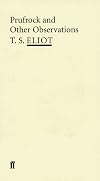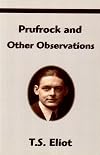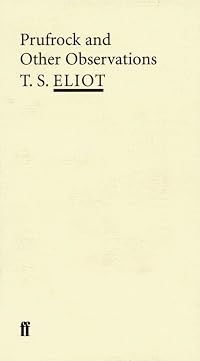
Prufrock and Other Observations
by T. S. Eliot
On This Page
Description
Let us go then, you and I, When the evening is spread out against the sky Like a patient etherized upon a table; Let us go, through certain half-deserted streets, The muttering retreats Of restless nights in one-night cheap hotels.Tags
Recommendations








Member Reviews
I love Preludes and Prufrock, two of my all-time favorites. Others are not so impressive. Portrait of a Lady is beautiful in its language but otherwise bland. Rhapsody on a Windy Night is more or less a weaker, for me, version of Preludes.
Nothing in the collection touches the vividness and power of expression shown in Prufrock and Preludes, but those two poems alone make the book fairly good.
Nothing in the collection touches the vividness and power of expression shown in Prufrock and Preludes, but those two poems alone make the book fairly good.
This collection stands the test of time 100 years later
One hundred years after they appeared, these poems still resonate both in their diction and stance of social criticism. I return again and again to reread Eliot
One hundred years after they appeared, these poems still resonate both in their diction and stance of social criticism. I return again and again to reread Eliot
I admit that T.S. Eliot confuses me and I have a difficult time understanding his poetry. Saying that, I do love the way he uses the words. Though I may not fully understand what he is saying, the image reception is pretty clear.
I love this passage from 'Rhapsody on a Windy Night':
Every street lamp that I pass
Beats like a fatalistic drum,
And through the spaces of the dark
Midnight shakes the memory
As a madman shakes a dead geranium.
I love this passage from 'Rhapsody on a Windy Night':
Every street lamp that I pass
Beats like a fatalistic drum,
And through the spaces of the dark
Midnight shakes the memory
As a madman shakes a dead geranium.
I am not a fan of most poetry, but a friend of mine loves T.S. Eliot's poems, so I decided to give Eliot's works a try. I enjoyed some of the phrases and descriptions he used in this work of poetry, but it did not turn me into a T.S. Eliot fan.
Early poems by Eliot. The most significant of these being the much-anthologised title poem. Eliot was one of the most important poets writing in English in the twentieth century, and his younger self shows a power and a perception that are extraordinary.
I hate to rate this book because I am not a poetry reader by nature. Some of the poetry was thought provoking but most of it was blah. I would rather read a book that pulls me in than a poem that makes me contemplate. I will try other poetry books in the future because I think I would like to understand it more.
Ratings
Members
- Recently Added By
Lists

One Book, Many Authors
441 works; 40 members

Tonikat reading completed on Librarything journals
329 works; 2 members

Poetry Collections
79 works; 6 members

Blue Pyramid 1,276 Best Books of All Time
1,248 works; 32 members

First published in 1917
132 works; 3 members

Books Read in 2018
4,360 works; 110 members

Favourite Books
1,819 works; 316 members

Books We Want To Read Again For The First Time
384 works; 160 members
Author Information

504+ Works 47,881 Members
T. S. Eliot is considered by many to be a literary genius and one of the most influential men of letters during the half-century after World War I. He was born on September 26, 1888, in St. Louis, Missouri. Eliot attended Harvard University, with time abroad pursuing graduate studies at the Sorbonne, Marburg, and Oxford. The outbreak of World War show more I prevented his return to the United States, and, persuaded by Ezra Pound to remain in England, he decided to settle there permanently. He published his influential early criticism, much of it written as occasional pieces for literary periodicals. He developed such doctrines as the "dissociation of sensibility" and the "objective correlative" and elaborated his views on wit and on the relation of tradition to the individual talent. Eliot by this time had left his early, derivative verse far behind and had begun to publish avant-garde poetry (including "The Love Song of J. Alfred Prufrock" (1915), which exploited fresh rhythms, abrupt juxtapositions, contemporary subject matter, and witty allusion. This period of creativity also resulted in another collection of verse (including "Gerontian") and culminated in The Waste Land, a masterpiece published in 1922 and produced partly during a period of psychological breakdown while married to his wife, Vivienne Haigh-Wood Eliot. In 1922, Eliot became a director of the Faber & Faber publishing house, and in 1927 he became a British citizen and joined the Church of England. Thereafter, his career underwent a change. With the publication of Ash Wednesday in 1930, his poetry became more overtly Christian. As editor of the influential literary magazine The Criterion, he turned his hand to social as well as literary criticism, with an increasingly conservative orientation. His religious poetry culminated in Four Quartets, published individually from 1936 onward and collectively in 1943. This work is often considered to be his greatest poetic achievement. Eliot also wrote poetry in a much lighter vein, such as Old Possum's Book of Practical Cats (1939), a collection that was used during the early 1980s as the basis for the musical, Cats. In addition to his contributions in poetry and criticism, Eliot is the pivotal verse dramatist of this century. He followed the lead of William Butler Yeats in attempting to revive metrical language in the theater. But, unlike Yeats, Eliot wanted a dramatic verse that would be self-effacing, capable of expressing the most prosaic passages in a play, and an insistent, undetected presence capable of elevating itself at a moment's notice. His progression from the pageant The Rock (1934) and Murder in the Cathedral (1935), written for the Canterbury Festival, through The Family Reunion (1939) and The Cocktail Party (1949), a West End hit, was thus a matter of neutralizing obvious poetic effects and bringing prose passages into the flow of verse. Recent critics have seen Eliot as a divided figure, covertly attracted to the very elements (romanticism, personality, heresy) he overtly condemned. His early attacks on romantic poets, for example, often reveal him as a romantic against the grain. The same divisions carry over into his verse, where violence struggles against restraint, emotion against order, and imagination against ironic detachment. This Eliot is more human and more attractive to contemporary taste. During his lifetime, Eliot received many honors and awards, including the Nobel Prize for literature in 1948. (Bowker Author Biography) show less
Awards and Honors
Work Relationships
Common Knowledge
- Canonical title
- Prufrock and Other Observations
- Original publication date
- 1917-06
- Dedication
- To Jean Verdenal 1889-1915
- First words
- Let us go then, you and I,
When the evening is spread out against the sky
Like a patient etherized upon a table; - Last words
- (Click to show. Warning: May contain spoilers.)Sometimes these cogitations still amaze
The troubled midnight and the noon’s repose.
Classifications
Statistics
- Members
- 243
- Popularity
- 133,826
- Reviews
- 6
- Rating
- (4.12)
- Languages
- 5 — Dutch, English, German, Portuguese, Spanish
- Media
- Paper, Ebook
- ISBNs
- 30
- ASINs
- 10