On This Page
Description
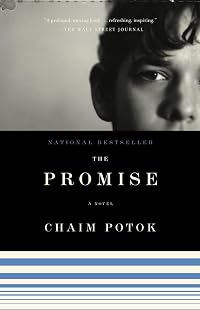
In a passionate, energetic narrative, The Promise brilliantly dramatizes what it is to master and use knowledge to make one’s own way in the world.Reuven Malter lives in Brooklyn, he’s in love, and he’s studying to be a rabbi. He also keeps challenging the strict interpretations of his teachers, and if he keeps it up, his dream of becoming a rabbi may die.
One day, worried about a disturbed, unhappy boy named Michael, Reuven takes him sailing and cloud-watching. Reuven also show more introduces him to an old friend, Danny Saunders—now a psychologist with a growing reputation. Reconnected by their shared concern for Michael, Reuven and Danny each learns what it is to take on life—whether sacred truths or a troubled child—according to his own lights, not just established authority.
. show less
Tags
Recommendations




















Member Reviews
For me this was a glimpse in at a moment in time and a world or clash of worlds. Orthodox-but-assimilated Judaism in repressed-but-optimistic postwar America, leafy walks and healthy physical activity and a chair in theology and Cornell and marrying a girl with chestnut hair and you don't know if McCarthy and Red China are gonna presage the end of it all but you feel like in the end, after all, humanity has weathered its storms; and up against it the new arrivals from the old world, both the awakened Orthodox with their living (and livid) HaShem and their dead world and the Hasids, whose disengagement from the mainstream lets them reanimate that dead world in their hermetic communities in places like Brooklyn. And then, a live wire show more around which the characters are all so careful and that periodically lights up and makes the narrative writhe and dance, historical trauma--and its nauseous blossoming over the generations and the inevitable laying open of the tradition and the history by that peculiar Jewish–gentile discipline, psychoanalysis. The intellectual content here was hard to get purchase on, since I lack the level of conversancy to approach it from within while from without, too often, it yields only platitudes like "People need people, people need shared experience." So for me, this was a very well done rendering of a place-time-ethos, let us say a period piece, and one that gave rise to that familiar uncomfortable envy that I always feel at that that serious, prosperous, intellectual Central European Jewish culture--uncomfortable because while that urban Danubian thing is the part of my Austrian heritage I've always identified with, it's a part I can't illegitimately, genealogically claim: I come instead from the Alpine matrix that produced both courtly Grüß-Gotting old men and brownshirts, and given the history that we all know it's queasy of me at best and deeply twisted at worst to be--what I guess I am!--any kind of Judaeophile. Potok did me a solid in that sense, reminding me that the "Wien ist anders"/"wir Patrioten im Urwald" kind of divide that queers my heritage is paralleled by a kind of shtetl/shul divide, and I should just sit with it and not be a weirdo and remember that everyone's relationship with their heritage (like everyone's with their parents, a fact I'm only sort of belatedly acknowledging in my own regard, stay tuned for a future review perhaps) is complicated and ambivalent. This book is a drama of complicated ambivalence. show less
I knew this was going to seem dated, but I picked it up anyway because I'd heard of the author quite a while ago and never got around to reading any of his works. It was fairly interesting as I was learning about a culture (Jews in NY in the 1950's--a time when survivors from the concentration camps were trying to restart their lives in America) that I had only gotten glimpses of from my friends. Reuven's challenge is to remain respectful to his Talmud teacher, who is very rigid in his expectations of Jews maintaining their traditions, and to accept the love of his platonic girl friend Rachel for his best friend Danny.. It was intriguing to read about a society in which a grad student acts with love/respect/attention toward his father, show more spends his spare time doing logic problems in his head, has memorized scads of medieval tracts and religious documents and can hold his own in an argument about them. I can understand, in some measure, his dissatisfaction with traditional ritual countered by his belief. Potok generally did a good job of translating Hebrew or Yiddish terms within the text, but I admit I sometimes forgot the meaning the next time that word came up. Potok also gave me an excellent understanding of the different strains of Judaisim, and how WWII experience reinforced some aspects. "They were the remnants, the zealous guardians of the spark...and no one at Hirsch would fight them because the spark was precious, it was all that was left after the blood and the slaughter, and you dimmed it when you fought its defenders." (p.195-6)
Potok gives me more to think about when these grad students are discussing "The Death of a Salesman", where the 'hero' of this modern tragedy is the common man. "That's what life is all about, the way we cheat and hurt each other and still try to live together somehow." "A person can do one of two things [when everything he works for is cracking apart]assuming that he isn't [delusional]. He can stay inside his world and try to reshape it somehow, or he can leave it and make his life over again elsewhere. Either choice involves further suffering, but it would be a creative suffering that might ultimately give rise to something worthwhile....He could, of course, try to destroy his world and then attempt to build a new world out of the rubble. But it probably wouldn't work. No modern revolution ever really succeeded." (p.282) "Why are people so full of rage? [Would a lecture help?] ...It would begin to teach you how to become aware of yourself. That's what the soul is...the crust is self-delusion. The soul is self-awareness." (p.283)
And more thoughts to ponder from an older man (is this his rationalization of his own behavior, or a general truth?): "Rebellion...is a conscious act of the will directed toward the remolding of ideas or institutions whether by force or by persuasion. Turning one's back upon ideas or institutions is therefore not an act of rebellion but an act of disengagement. The old is considered dead." (p.295)
Or this statement by the Director "The concentration camps destroyed a lot more than European Jewry. They destroyed man's faith in himself...There are going to be decades of chaos until we learn to believe again in man." (p.315) And Reuven's father's comment on the Hasidic Jews "Will new ideas enable them to go on singing and dancing?" (p.325)
There is also an entanglement with Rachel's cousin Michael, a 14-yr old with emotional problems, being treated by Danny. This aspect of the book seemed more contrived. Michael is described early on as "precocious", but he seems immature to 14-yr olds nowadays. The resolution of that situation seems rather lame, but I found the psychoanalytical jargon interesting to read about as a kind of cultural artifact. show less
Potok gives me more to think about when these grad students are discussing "The Death of a Salesman", where the 'hero' of this modern tragedy is the common man. "That's what life is all about, the way we cheat and hurt each other and still try to live together somehow." "A person can do one of two things [when everything he works for is cracking apart]assuming that he isn't [delusional]. He can stay inside his world and try to reshape it somehow, or he can leave it and make his life over again elsewhere. Either choice involves further suffering, but it would be a creative suffering that might ultimately give rise to something worthwhile....He could, of course, try to destroy his world and then attempt to build a new world out of the rubble. But it probably wouldn't work. No modern revolution ever really succeeded." (p.282) "Why are people so full of rage? [Would a lecture help?] ...It would begin to teach you how to become aware of yourself. That's what the soul is...the crust is self-delusion. The soul is self-awareness." (p.283)
And more thoughts to ponder from an older man (is this his rationalization of his own behavior, or a general truth?): "Rebellion...is a conscious act of the will directed toward the remolding of ideas or institutions whether by force or by persuasion. Turning one's back upon ideas or institutions is therefore not an act of rebellion but an act of disengagement. The old is considered dead." (p.295)
Or this statement by the Director "The concentration camps destroyed a lot more than European Jewry. They destroyed man's faith in himself...There are going to be decades of chaos until we learn to believe again in man." (p.315) And Reuven's father's comment on the Hasidic Jews "Will new ideas enable them to go on singing and dancing?" (p.325)
There is also an entanglement with Rachel's cousin Michael, a 14-yr old with emotional problems, being treated by Danny. This aspect of the book seemed more contrived. Michael is described early on as "precocious", but he seems immature to 14-yr olds nowadays. The resolution of that situation seems rather lame, but I found the psychoanalytical jargon interesting to read about as a kind of cultural artifact. show less
This continues Reuven and Danny's story from The Chosen. Reuven's at Hirsch University studying to be a rabbi, and Danny's is studying to be a psychologist while interning at a mental hospital.They’re both interested in Rachel, the attractive daughter of a liberal analyst of the Talmud (his writings are considered a danger to Orthodoxy), and both become involved with her troubled nephew Michael, who ends up in the mental hospital where Danny is. Reuven has to square off against his teacher Reb Kalman, a Holocaust-survivor fiercely attached to established views of the Talmud, and opposed to more progressive views of Reuven and Reuven's learned father. Kalman has the power to deny Reuven his becoming a Rabbi, and that battle is high show more energy. I liked that story thread a good bit more than Michael's.
The second half of the book was much more involving, and the book ended up being a very good read, even if it falls short of the exceptional The Chosen. The contrast between Hasidic Jews, Orthodox Jews, and more progressive Jews is fascinating, and Potok is so good at steeping us in the conflicts. Here's a quote from Reuven as he reacts to being among the Hasidim:
"It was strange enough being on those streets during the week. But on Shabbat, when I could feel them making the very air tremulous with exultation, when I could see them in their respective garbs, most of them in fur-trimmed caps, some in dark suits, some in white knickers, all of them walking quickly, sometimes in groups, sometimes alone, sometimes the father accompanied by a troop of male children - on Shabbat it was particularly strange, and I felt myself to be an uncomfortable outsider who had somehow been transported to a world I once thought had only existed in the small towns of Eastern Europe or in books about Jewish history. They were my own people, but we were as far apart from one another as we could possibly be and still call ourselves by the name 'Jew' - and I never felt as distant from them as I felt that evening walking along Lee Avenue with my father to the synagogue where we prayed." show less
The second half of the book was much more involving, and the book ended up being a very good read, even if it falls short of the exceptional The Chosen. The contrast between Hasidic Jews, Orthodox Jews, and more progressive Jews is fascinating, and Potok is so good at steeping us in the conflicts. Here's a quote from Reuven as he reacts to being among the Hasidim:
"It was strange enough being on those streets during the week. But on Shabbat, when I could feel them making the very air tremulous with exultation, when I could see them in their respective garbs, most of them in fur-trimmed caps, some in dark suits, some in white knickers, all of them walking quickly, sometimes in groups, sometimes alone, sometimes the father accompanied by a troop of male children - on Shabbat it was particularly strange, and I felt myself to be an uncomfortable outsider who had somehow been transported to a world I once thought had only existed in the small towns of Eastern Europe or in books about Jewish history. They were my own people, but we were as far apart from one another as we could possibly be and still call ourselves by the name 'Jew' - and I never felt as distant from them as I felt that evening walking along Lee Avenue with my father to the synagogue where we prayed." show less
The word that I always associated with The Promise is "disturbing", and I mean that in the best possible sense. In some ways, I liked this book more than The Chosen (which I feel is slightly heretical). It takes on a considerably darker tone than its prequel, and introduces someone is far more of an unambiguous antagonist than existed in The Chosen. It is a testament to the author's exceptional ability that Rav Kalman manages to be full, robust character despite the fact that he is in so many ways utterly repulsive. Beyond that, there is little to say -- the book is stellar and I can't recommend it highly enough.
The sequel to The Chosen follows Reuven Malter as he studies for ordination (smicha). It’s the summer of 1950, 5 years after the end of World War II. On vacation, Reuven continues dating Rachel Gordon, the niece of a famous Jewish teacher and author who is considered heretical by the more traditional wing of Orthodox Jewry. Rachel, along with her 14 year old cousin Michael, is also vacationing at the same area as Reuven and his father. Rachel persuades Reuven to accompany her and and her 14 year old cousin Michael to a county fair. But the “fair” is in reality a carnival, and Michael, cleverly caught by a huckster in a con game run by an old Jewish man and realizing that the game is crooked, turns violent; Reuven and Rachel show more restrain him. Learning that Michael ha emotional problems, Reuven lout of compassion and a sincere liking for Michael, invites Michael to go sailing with him, and the boy forms a close bond with the quietly empathetic Reuven.
Back in New York, Reuven starts a Talmudic class under Rav Kalman, an extremely conservative teacher who is a survivor of the Shoah. Kalman is one of many such teachers brought over to the US as a way of preserving the Eastern European Jewish remnant; they and the Hasidim, also survivors, re changing radically both the daily life and the atmosphere in the yeshivas of the Orthodox Jewish community. Reuven immediately is repelled by what he sees as Kalamn’s fanaticism and rigidity, but the class he is taking is required for ordination, and he has to not just endure but win Rav Kalman’s approval if he wishes to obtain smicha.
Meanwhile, the Gordon family has requested that Reuven introduce them to Danny Saunders, who, even though he is still in graduate school at Columbia, is gaining a reputation as a brilliant clinical psychologist. Danny, Reuven’s oldest and best friend, becomes involved in Michael’s care as Michael’s condition deteriorates.
These two main threads—Reuven’s struggle with Rav Kalman and Danny’s treatment of Michael--become entangled.
The most remarkable thing about Chaim Potok's works is that he is concerned, not with the world without but totally with the world within Orthodox Judaism. The US can go through a world war, McCarthy can wreak his destruction from which we still have not completely recovered, but these are events that have meaning, yes, but are tangential to the world in which Reuven , his father, Rav Kalman, Danny, and others live. It is a world concerned nearly totally with morality--different views of how to live it, but that's the topic, and nothing else really matters.
Potok's language is gentle and utterly beautiful. It's a style that is dreamlike except when discussing Torah, and then a clean austerity enters. Potok is incredibly good at showing a gentile world what such Torah study is and what it means especially to Orthodox Jewry. Just as in other religions, there are struggles within the Orthodox world; Potok shows compassionate understanding for all sides involved. It is remarkable writing, done with great insight.
The resolution of the plot is utterly gripping; I have been less fascinated by best-selling thrillers or police procedurals. Again, Potok knows and loves the world of which he is writing and has the remarkable ability to make that world come alive and be real for those of us who would otherwise never know it existed.
Highly recommended. show less
Back in New York, Reuven starts a Talmudic class under Rav Kalman, an extremely conservative teacher who is a survivor of the Shoah. Kalman is one of many such teachers brought over to the US as a way of preserving the Eastern European Jewish remnant; they and the Hasidim, also survivors, re changing radically both the daily life and the atmosphere in the yeshivas of the Orthodox Jewish community. Reuven immediately is repelled by what he sees as Kalamn’s fanaticism and rigidity, but the class he is taking is required for ordination, and he has to not just endure but win Rav Kalman’s approval if he wishes to obtain smicha.
Meanwhile, the Gordon family has requested that Reuven introduce them to Danny Saunders, who, even though he is still in graduate school at Columbia, is gaining a reputation as a brilliant clinical psychologist. Danny, Reuven’s oldest and best friend, becomes involved in Michael’s care as Michael’s condition deteriorates.
These two main threads—Reuven’s struggle with Rav Kalman and Danny’s treatment of Michael--become entangled.
The most remarkable thing about Chaim Potok's works is that he is concerned, not with the world without but totally with the world within Orthodox Judaism. The US can go through a world war, McCarthy can wreak his destruction from which we still have not completely recovered, but these are events that have meaning, yes, but are tangential to the world in which Reuven , his father, Rav Kalman, Danny, and others live. It is a world concerned nearly totally with morality--different views of how to live it, but that's the topic, and nothing else really matters.
Potok's language is gentle and utterly beautiful. It's a style that is dreamlike except when discussing Torah, and then a clean austerity enters. Potok is incredibly good at showing a gentile world what such Torah study is and what it means especially to Orthodox Jewry. Just as in other religions, there are struggles within the Orthodox world; Potok shows compassionate understanding for all sides involved. It is remarkable writing, done with great insight.
The resolution of the plot is utterly gripping; I have been less fascinated by best-selling thrillers or police procedurals. Again, Potok knows and loves the world of which he is writing and has the remarkable ability to make that world come alive and be real for those of us who would otherwise never know it existed.
Highly recommended. show less
This novel is set in the 50s, in the era of Joseph McCarthy, but it deals with another area of reactionary thought. It's about the Orthodox Jewish community in NYC, and how it is changed by the concentration camp survivors who make their way there after WWII.
The narrator, Reuven Malter, is a Talmudic student who is caught between the orthodox European Jews (who, after so much loss, can't accept any threat to their traditions) and the more liberal threads developing in the U.S. During his stormy education, Reuven befriends a young man who has been driven mad by the conflict between love and hate.
This book, a dramatic account of a community in flux, keeps returning to the relationships between sons and fathers. Reuven has the courage to show more move beyond rage into an acceptance of human frailty, which perhaps includes forgiveness of a god who has wronged his people.
The writing style is a bit sparse and Hemingway-esque, but the feel of the characters and the community comes through. show less
This novel is set in the 50s, in the era of Joseph McCarthy, but it deals with another area of reactionary thought. It's about the Orthodox Jewish community in NYC, and how it is changed by the concentration camp survivors who make their way there after WWII.
The narrator, Reuven Malter, is a Talmudic student who is caught between the orthodox European Jews (who, after so much loss, can't accept any threat to their traditions) and the more liberal threads developing in the U.S. During his stormy education, Reuven befriends a young man who has been driven mad by the conflict between love and hate.
This book, a dramatic account of a community in flux, keeps returning to the relationships between sons and fathers. Reuven has the courage to show more move beyond rage into an acceptance of human frailty, which perhaps includes forgiveness of a god who has wronged his people.
The writing style is a bit sparse and Hemingway-esque, but the feel of the characters and the community comes through. show less
Members
- Recently Added By
Lists

Jewish Books
367 works; 24 members

1960s, Best books published therein
254 works; 22 members

jewish themed novels
25 works; 5 members

Amanda's Guaranteed Books
110 works; 5 members

Publisher's Weekly Bestsellers - Part II - 1940 - 1979
355 works; 6 members
Favourite Books
1,820 works; 316 members
Author Information

36+ Works 24,742 Members
Chaim Potok was born in New York City in 1929. He graduated summa cum laude (with highest honors) from Yeshiva University in 1950, and received an advanced degree from Jewish Theological Seminary in 1954, when he also became an ordained Conservative rabbi. After two years of military service as a chaplain in Korea, Potok married Adena Sarah show more Mosevitsky in 1958. The couple had three children. Eventually Potok returned to school and received his Ph.D. from the University of Pennsylvania in 1965. Potok has held a variety of positions within the Jewish community, including directing a camp in Los Angeles, teaching at the University of Judaism in Los Angeles at a Jewish Theological Seminary in New York, and working as an editor on various religious publications, Potok's first novel, The Chosen, was published in 1967, and he quickly won acclaim for this best-selling book about tensions within the Orthodox and Hasidic Jewish communities. This and later books have been both critically and popularly successful. Many of them explore the meaning of Judaism in the modern era, focusing on the conflict between traditional teachings and the pressures of modern life. The Chosen was nominated for a National Book Award in 1967 and made into a successful film in 1982. Its sequel, The Promise (1969) was the winner of an Athenaeum Award. Potok is also the author of a nonfiction volume, Wanderings: Chaim Potok's History of the Jews (1978), as well as several short stories and articles that have been published in both religious and secular magazines. (Bowker Author Biography) show less
Some Editions
Awards and Honors
Awards
Series

Work Relationships
Is contained in
Common Knowledge
- Canonical title
- The Promise
- Original title
- The promise
- Original publication date
- 1969
- People/Characters
- Danny Saunders; Reuven Malter
- Important places
- Brooklyn, New York, New York, USA
- Epigraph
- If the book we are reading does not wake us, as with a fist hammering on our skull, why then do we read it? Good God, we would also be happy if we had no books, and such books as make us happy we could, if need be, write our... (show all)selves. But what we must have are those books which come upon us like ill-fortune, and distress us deeply, like the death of one we love better than ourselves, like suicide. A book must be an ince-axe to break the sea frozen inside us.
--Franz Kafka
Master of the Universe, send us our Messiah, for we have no more strength to suffer. Show me a sign, O God. Otherwise...otherwise...I rebel against Thee. If Thou dost not keep Thy Covenant, then neither will I keep that Pr... (show all)omise, and it is all over, we are through being Thy chosen people, Thy peculiar treasure.
--The Rebbe of Kotzk
Yes; but you must wager. It is not optional. You are embarked.
--Pascal - Dedication
- VOOR
DE KINDEREN
Rena, Naama, Akiva
To The Children Rena, Naama, Akiva - First words
- All around us everything was changing in the order of things we had fashioned for ourselves.
- Quotations
- "It is inconceivable to me that Rachel finds anything sensible in Daniel's God."
"There is a great deal of beauty in that sort of faith," Abraham Gordon murmured.
"I find no beauty in nonsense," she said coldly. - Last words
- (Click to show. Warning: May contain spoilers.)"Clouds," he said.
- Original language
- English
Classifications
Statistics
- Members
- 2,425
- Popularity
- 8,096
- Reviews
- 28
- Rating
- (4.06)
- Languages
- 8 — Czech, Dutch, English, French, German, Hungarian, Italian, Spanish
- Media
- Paper, Ebook
- ISBNs
- 32
- ASINs
- 39