Ecce Homo: How One Becomes What One Is
by Friedrich Nietzsche 
On This Page
Description
Ecce Homo is an autobiography like no other. Nietzsche passes under review all his previous books and reaches a final reckoning with his many enemies. Ecce Homo is the summation of an extraordinary philosophical career. - ;'I am not a man, I am dynamite.'. Ecce Homo is an autobiography like no other. Deliberately provocative, Nietzsche subverts the conventions of the genre and pushes his philosophical positions to combative extremes, constructing a genius-hero whose life is a chronicle of show more incessant self-overcoming. Written in 1888, a few weeks before his descent into madness, the book sub-titl show lessTags
Recommendations




Member Reviews
For whom am I writing this review? If Nietzsche were by my side I suspect he would want me to start with the following quote from Ecce Homo: "To you, the bold venturers and adventurers, and whoever has embarked with cunning sails upon dreadful seas, to you who are intoxicated with riddles, who take pleasure in twilight, whose soul is lured with flutes to every treacherous abyss." If you are, in fact, intoxicated with riddles, take pleasure in twilight, and your soul is lured with flutes to every treacherous abyss (note - Nietzsche says `every' treacherous abyss not `some' or `most'), then this book is for you.
We all know there is a time of transition hovering about age nineteen when the emotions of sensitive souls are heightened and show more experience is intensified, intensified to such a point that even thoughts and concepts have a highly-charged emotional tone; one's life deepens, exaggerates, strengthens, amplifies, ignites and one borders on becoming an inflamed madman, even if the madness is only known internally. This time of disequilibrium and hormonal topsy-turvy ordinarily settles down into the next phase of life: early adulthood, where the soul pursues a more specialized field of study and then earnestly begins a profession or career.
But for Nietzsche this transitional phase didn't stop; quite the contrary, rather than settling into any conventional groove, the gap of spiritual and artistic disequilibrium grew progressively wider over the years and was eons away from any semblance of `civilized' balance. Additionally, to add fuel to the emotional and philosophical fire, Nietzsche was not only sensitive but hyper-sensitive to music and the arts and had extraordinary linguistic and literary abilities. Thus, we are well to remember all of this when we read in Ecce Homo: "Philosophy as I have hitherto understood and lived it, is a voluntary living in ice and high mountains - a seeking after everything strange and questionable in existence, all that has hitherto been excommunicated by morality."
After an impassioned forward and two intoxicatingly stunning chapters, Why I Am So Wise' and Why I Am So Clever, (each line of these chapters deserve an underline and is worthy of committing to memory) we come to the chapter, Why I Write Such Good Books, and read: "Ultimately, no one can extract from things, books included, more than he already knows. What one has no access to through experience one has no ear for." So, how can one `understand' Nietzsche when living a conventional life, since living according to convention is itself a life of compromise, that is, not living with full, passion-soaked intensity but life as humdrum routine? This is a question any aspiring reader of Nietzsche must ask.
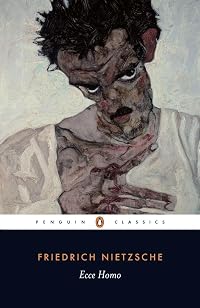
A self-portrait of Egon Schiele appears on the cover of this Penguin edition, which is most appropriate since this artist courageously and without compromise created a deeply personal expressive style of art causing much controversy in his brief life (he died at 28). Here are a few of the artist's quotes: "I am so rich I must give myself away." -- "To restrict the artist is a crime. It is to restrict germinating life." -- "Art is not modern. Art is primordially eternal."
By his commitment to living with intense zeal in his art and his life, Egon Schiele climbed the Nietzschean high mountains cleanly and fully. This is what it takes. What commitment are you making to live with passion and intensity in your life? If you have not been deeply moved by art and music and have not transformed yourself again and again, what chance do you think you stand in understanding Nietzsche? Perhaps it would be better for you to go on the academic head trip: read Kant and Quine and Rorty and then write papers with all the properly formatted footnotes.
Nietzsche devotes a short chapter to each of his books and then ends with a chapter entitled Why I Am A Destiny. Since this review is of Nietzsche's autobiography, Nietzsche gets the last word, but being Nietzsche, the last word is three quotes. Here they are::
--From the chapter The Birth of Tragedy: "`Rationality' at any price as dangerous, as a force undermining life!"
-- From the chapter Twilight of the Idols: "If you want to get a quick idea of how everything was upsidedown before me, make a start with this writing. That which is called idol on the titlepage is quite simply that which has hitherto been called truth."
--From the chapter Why I am a Destiny: "The concept `sin' invented together with the instrument of torture which goes with it, the concept of `free will', so as to confuse the instincts, so as to make mistrust of the instincts into second nature." show less
Reading Nietzsche is an acquired taste at the best of times; his frantic mix of poetry and prose and philosophy on far-sighted and hard-to-grasp concepts a fraught but rewarding experience. In a lesser book such as Ecce Homo, the taste often doesn't seem worth acquiring. Ecce Homo is as potent and frantic as Nietzsche's philosophy always is, but the brew is more caustic, the drink harder to swallow. It is disorderly, but not in the exhilarating, brawling, chaos-revelling manner of previous books, instead seeming unfocused, rambling and occasionally incoherent. It is bold, but in the manner of being self-regarding and arrogant, rather than the vivid power emitted by earlier works.
While Ecce Homo is often labelled Nietzsche's show more autobiography, it is too slight and unfocused to be sufficient for that. Instead, the book, written in the weeks before his final mental breakdown, which would effectively end his career even if he would live another ten years, seems like the final will and testament of a singular writer as he looks back on what he has written and achieved. From this perspective, the book's self-assessed summary of Nietzsche's life and works is valuable, but it remains the case that the experience of reading it is a frustrating one, in which its energy escapes into the world rather than is released directly into the reader. There's nothing in here that feels as earth-shaking as a single page of Thus Spoke Zarathustra. show less
While Ecce Homo is often labelled Nietzsche's show more autobiography, it is too slight and unfocused to be sufficient for that. Instead, the book, written in the weeks before his final mental breakdown, which would effectively end his career even if he would live another ten years, seems like the final will and testament of a singular writer as he looks back on what he has written and achieved. From this perspective, the book's self-assessed summary of Nietzsche's life and works is valuable, but it remains the case that the experience of reading it is a frustrating one, in which its energy escapes into the world rather than is released directly into the reader. There's nothing in here that feels as earth-shaking as a single page of Thus Spoke Zarathustra. show less
For whom am I writing this review? If Nietzsche were by my side I suspect he would want me to start with the following quote from Ecce Homo: "To you, the bold venturers and adventurers, and whoever has embarked with cunning sails upon dreadful seas, to you who are intoxicated with riddles, who take pleasure in twilight, whose soul is lured with flutes to every treacherous abyss." If you are, in fact, intoxicated with riddles, take pleasure in twilight, and your soul is lured with flutes to every treacherous abyss (note - Nietzsche says `every' treacherous abyss not `some' or `most'), then this book is for you.
We all know there is a time of transition hovering about age nineteen when the emotions of sensitive souls are heightened and show more experience is intensified, intensified to such a point that even thoughts and concepts have a highly-charged emotional tone; one's life deepens, exaggerates, strengthens, amplifies, ignites and one borders on becoming an inflamed madman, even if the madness is only known internally. This time of disequilibrium and hormonal topsy-turvy ordinarily settles down into the next phase of life: early adulthood, where the soul pursues a more specialized field of study and then earnestly begins a profession or career,
But for Nietzsche this transitional phase didn't stop; quite the contrary, rather than settling into any conventional groove, the gap of spiritual and artistic disequilibrium grew progressively wider over the years and was eons away from any semblance of `civilized' balance. Additionally, to add fuel to the emotional and philosophical fire, Nietzsche was not only sensitive but hyper-sensitive to music and the arts and had extraordinary linguistic and literary abilities. Thus, we are well to remember all of this when we read in Ecce Homo: "Philosophy as I have hitherto understood and lived it, is a voluntary living in ice and high mountains - a seeking after everything strange and questionable in existence, all that has hitherto been excommunicated by morality."
After an impassioned forward and two intoxicatingly stunning chapters, `Why I Am So Wise' and `Why I Am So Clever', (each line of these chapters deserve an underline and is worthy of committing to memory) we come to the chapter, `Why I Write Such Good Books', and read: "Ultimately, no one can extract from things, books included, more than he already knows. What one has no access to through experience one has no ear for." So, how can one `understand' Nietzsche when living a conventional life, since living according to convention is itself a life of compromise, that is, not living with full, passion-soaked intensity but life as humdrum routine? This is a question any aspiring reader of Nietzsche must ask.
A self-portrait of Egon Schiele appears on the cover of this Penguin edition, which is most appropriate since this artist courageously and without compromise created a deeply personal expressive style of art causing much controversy in his brief life (he died at 28). Here are a few of the artist's quotes: "I am so rich I must give myself away." -- "To restrict the artist is a crime. It is to restrict germinating life." -- "Art is not modern. Art is primordially eternal."
By his commitment to living with intense zeal in his art and his life, Egon Schiele climbed the Nietzschean high mountains cleanly and fully. This is what it takes. What commitment are you making to live with passion and intensity in your life? If you have not been deeply moved by art and music and have not transformed yourself again and again, what chance do you think you stand in understanding Nietzsche? Perhaps it would be better for you to go on the academic head trip: read Kant and Quine and Rorty and then write papers with all the properly formatted footnotes.
Nietzsche devotes a short chapter to each of his books and then ends with a chapter entitled `Why I Am A Destiny'. Since this review is of Nietzsche's autobiography, Nietzsche gets the last word, but being Nietzsche, the last word is three quotes. Here they are::
--From the chapter `The Birth of Tragedy': "`Rationality' at any price as dangerous, as a force undermining life!"
-- From the chapter `Twilight of the Idols': "If you want to get a quick idea of how everything was upsidedown before me, make a start with this writing. That which is called idol on the titlepage is quite simply that which has hitherto been called truth."
--From the chapter `Why I am a Destiny': "The concept `sin' invented together with the instrument of torture which goes with it, the concept of `free will', so as to confuse the instincts, so as to make mistrust of the instincts into second nature." show less
We all know there is a time of transition hovering about age nineteen when the emotions of sensitive souls are heightened and show more experience is intensified, intensified to such a point that even thoughts and concepts have a highly-charged emotional tone; one's life deepens, exaggerates, strengthens, amplifies, ignites and one borders on becoming an inflamed madman, even if the madness is only known internally. This time of disequilibrium and hormonal topsy-turvy ordinarily settles down into the next phase of life: early adulthood, where the soul pursues a more specialized field of study and then earnestly begins a profession or career,
But for Nietzsche this transitional phase didn't stop; quite the contrary, rather than settling into any conventional groove, the gap of spiritual and artistic disequilibrium grew progressively wider over the years and was eons away from any semblance of `civilized' balance. Additionally, to add fuel to the emotional and philosophical fire, Nietzsche was not only sensitive but hyper-sensitive to music and the arts and had extraordinary linguistic and literary abilities. Thus, we are well to remember all of this when we read in Ecce Homo: "Philosophy as I have hitherto understood and lived it, is a voluntary living in ice and high mountains - a seeking after everything strange and questionable in existence, all that has hitherto been excommunicated by morality."
After an impassioned forward and two intoxicatingly stunning chapters, `Why I Am So Wise' and `Why I Am So Clever', (each line of these chapters deserve an underline and is worthy of committing to memory) we come to the chapter, `Why I Write Such Good Books', and read: "Ultimately, no one can extract from things, books included, more than he already knows. What one has no access to through experience one has no ear for." So, how can one `understand' Nietzsche when living a conventional life, since living according to convention is itself a life of compromise, that is, not living with full, passion-soaked intensity but life as humdrum routine? This is a question any aspiring reader of Nietzsche must ask.
A self-portrait of Egon Schiele appears on the cover of this Penguin edition, which is most appropriate since this artist courageously and without compromise created a deeply personal expressive style of art causing much controversy in his brief life (he died at 28). Here are a few of the artist's quotes: "I am so rich I must give myself away." -- "To restrict the artist is a crime. It is to restrict germinating life." -- "Art is not modern. Art is primordially eternal."
By his commitment to living with intense zeal in his art and his life, Egon Schiele climbed the Nietzschean high mountains cleanly and fully. This is what it takes. What commitment are you making to live with passion and intensity in your life? If you have not been deeply moved by art and music and have not transformed yourself again and again, what chance do you think you stand in understanding Nietzsche? Perhaps it would be better for you to go on the academic head trip: read Kant and Quine and Rorty and then write papers with all the properly formatted footnotes.
Nietzsche devotes a short chapter to each of his books and then ends with a chapter entitled `Why I Am A Destiny'. Since this review is of Nietzsche's autobiography, Nietzsche gets the last word, but being Nietzsche, the last word is three quotes. Here they are::
--From the chapter `The Birth of Tragedy': "`Rationality' at any price as dangerous, as a force undermining life!"
-- From the chapter `Twilight of the Idols': "If you want to get a quick idea of how everything was upsidedown before me, make a start with this writing. That which is called idol on the titlepage is quite simply that which has hitherto been called truth."
--From the chapter `Why I am a Destiny': "The concept `sin' invented together with the instrument of torture which goes with it, the concept of `free will', so as to confuse the instincts, so as to make mistrust of the instincts into second nature." show less
de man is compleet gestoord als hij dit schrijft, nergens een argument enkel grootheidswaanzin, desalnietemin, zeer originele scherpe ideeen op een pakkende manier verwoord, wel de moeite van het lezen waard; 0
Nietzsche's autobiography is bewildering. The title, Ecce Homo, means "Behold the Man" in Latin, and is ascribed to Pontius Pilate when he presented Jesus to the mob. The title is clever in that Nietzsche, in concluding, is "Dionysus versus Christ" (p. 143). But this seems to me to be misleading when the subtitle (which is absent from this Dover version), reads "How One Becomes What One Is". Without the subtitle, one might justify an off-handed rejection of Ecce Homo as little more than vanity given too much regard by posterity. Indeed, I wonder had Nietzsche written this today, would he have ever been known? At times I felt that Nietzsche was of a privileged class and was able to publish at will, but this is not entirely the case. show more Nietzsche's father, a Lutheran pastor, had worked for the state and, following his premature death, this qualified Nietzsche for a scholarship. Hardly peak bourgeoisie, yet Nietzsche was a polymath; surely symptomatic of genius. If the subtitle is considered during the reading, then "how Nietzsche became Nietzsche" is less troubling to the modern mind. At the same time, Nietzsche goes out of his way to tell us that the effeminate, decaying, degenerative way perpetuated by Christianity is a denial of nature, of the body, of the present - so why would he be all meek and modest? Hence my bewilderment. Believe "neither in 'ill-luck' nor 'guilt'" - this is the opposite of a decadent (it is Nietzsche) (p. 13). "Unselfishness" and "neighbourly love" are conditions of the decadent, these are signs of weakness; pity is not a virtue (p. 18). Nietzsche tells us how he has never felt bad about himself, no guilt, no self-flagellation. The basic argument is that Christianity has poisoned us against ourselves - not faith, not God per se, but the religion of Christianity. Undoing this decadence is therefore essential. But atheists find no solace, either: Socrates is no role model. Nietzsche hints at Heraclitus as one of the few who understood (at least through the Stoics) (p. 73). This is interesting in that Heraclitus had a particular view of God and the gods that one steeped in the atheistic view of Nietzsche will struggle to comprehend. The most important words from Ecce Homo outline Nietzsche's philosophy for living: amor fati (p. 54):
My formula for greatness in man is amor fati: the fact that a man wishes nothing to be different, either in front of him or behind him, or for all eternity. Not only must the necessary be borne, and on no account concealed,- all idealism is falsehood in the face of necessity,- but it must also be loved...Nietzsche writes disapprovingly of equal rights, particularly for women (p. 65), yet, at the same time, in addition to his view of the "opiate of the masses", betrays a Marxian loathing for the decadence of the "false economy" of "the division of labour" (p. 76). He goes on to address the problem of our current times: the "large number of young men... all in... [a] state of distress" because of the false "calling" to vocations that are unnatural and lead to a "feeling of emptiness and hunger" (p. 87). With so much going on, it is unlikely that a reading of Nietzsche's work in its entirety is enough to comprehend his insights from the rabbit hole of the human soul. But if I have taken away just one thing from Ecce Homo, it is a deeper understanding of the concept of amor fati. Its opposite can be seen in those who reject the body (interesting that Nietzsche says he can "smell" the decadents), where the golden arrow of consumption masks much of the truth (that many could not face if it were revealed, but can happily consume while it is well-masked), and I take it that Nietzsche meant both the corporeal and spiritual aspects of the analogy. But I will let Nietzsche have the last word:
...that which is necessary does not offend me. Amor fati is the core of my nature.show less
When I was fifteen I read one of the Penguin "Great Ideas" mini-books, [b:Why I Am So Wise|83276|Why I Am So Wise (Great Ideas)|Friedrich Nietzsche|https://d.gr-assets.com/books/1389301430s/83276.jpg|1109333], which excerpted parts of Ecce Homo. I really loved it then, as all self-centred fifteen-year-olds really love and relate to Nietzsche. It's quite a different experience reading it ten years later and in context and knowing a little more of Nietzsche, and I definitely didn't identify as much this time (and not just for the blatant misogyny and anti-feminism that pops up out of nowhere). I think even at fifteen I was cautious about the fact that the Great Ideas books were philosophy in palatable, bite-sized bits with the potential show more of losing quite a lot of information and context. To read it in full as a biography--a very strange biography--brought as much difference to my reading of it as ten years did. (Geobiographical note: this was another plane read because I still had some time before landing in Calgary and it's short.) show less
Ecce Homo ("Behold the Man"; though Nietzsche claims "I am not a man, I am dynamite"), published in 1888, is Nietzsche's passionate and eccentric autobiographical examination of the evolution of his thought through personal introspection and reflection on his literary accomplishments. He offers final insights into the philosophical relationships between himself and other major thinkers who have impacted his own thought processes, dares to imagine the results his ideas will have on the future of humanity, and seeks to harmonize his primary views into a conclusive self-interpretation. His wild and confrontational style frames the content of his expression with vigor and firm conviction, overflowing with charisma and expressive power, as show more well as a few striking prophecies: "there will be wars such as there have never yet been on earth." show less
Members
- Recently Added By
Lists

Well-Educated Mind
150 works; 3 members

German Literature
518 works; 55 members

Art of Reading
188 works; 5 members

covers with paintings / paintings as covers .
37 works; 1 member

The Well-Educated Mind, Susan Wise Bauer, 2016
179 works; 3 members

el
1,139 works; 1 member
Author Information

1,378+ Works 78,214 Members
The son of a Lutheran pastor, Friedrich Wilhelm Nietzsche was born in 1844 in Roecken, Prussia, and studied classical philology at the Universities of Bonn and Leipzig. While at Leipzig he read the works of Schopenhauer, which greatly impressed him. He also became a disciple of the composer Richard Wagner. At the very early age of 25, Nietzsche show more was appointed professor at the University of Basel in Switzerland. In 1870, during the Franco-Prussian War, Nietzsche served in the medical corps of the Prussian army. While treating soldiers he contracted diphtheria and dysentery; he was never physically healthy afterward. Nietzsche's first book, The Birth of Tragedy Out of the Spirit of Music (1872), was a radical reinterpretation of Greek art and culture from a Schopenhaurian and Wagnerian standpoint. By 1874 Nietzsche had to retire from his university post for reasons of health. He was diagnosed at this time with a serious nervous disorder. He lived the next 15 years on his small university pension, dividing his time between Italy and Switzerland and writing constantly. He is best known for the works he produced after 1880, especially The Gay Science (1882), Thus Spake Zarathustra (1883-85), Beyond Good and Evil (1886), On the Genealogy of Morals (1887), The Antichrist (1888), and Twilight of the Idols (1888). In January 1889, Nietzsche suffered a sudden mental collapse; he lived the last 10 years of his life in a condition of insanity. After his death, his sister published many of his papers under the title The Will to Power. Nietzsche was a radical questioner who often wrote polemically with deliberate obscurity, intending to perplex, shock, and offend his readers. He attacked the entire metaphysical tradition in Western philosophy, especially Christianity and Christian morality, which he thought had reached its final and most decadent form in modern scientific humanism, with its ideals of liberalism and democracy. It has become increasingly clear that his writings are among the deepest and most prescient sources we have for acquiring a philosophical understanding of the roots of 20th-century culture. (Bowker Author Biography) show less
Friedrich Nietzsche has a Legacy Library. Legacy libraries are the personal libraries of famous readers, entered by LibraryThing members from the Legacy Libraries group.
Some Editions
Series
Belongs to Publisher Series
Work Relationships
Is contained in
The Philosophy of Nietzsche: Thus Spake Zarathustra; Beyond Good and Evil; The Genealogy of Morals; Ecce Homo; The Birth of Tragedy by Friedrich Nietzsche
Contains
Has as a student's study guide
Common Knowledge
- Canonical title
- Ecce Homo: How One Becomes What One Is
- Original title
- Ecce homo: Wie man wird, was man ist
- Original publication date
- 1888
- People/Characters
- Friedrich Nietzsche
- Quotations
- The man of knowledge must be able not only to love his enemies but also to hate his friends.
- Last words
- (Click to show. Warning: May contain spoilers.)--Have I been understood? -- Dionysus against the Crucified ...
- Original language
- German
Classifications
Statistics
- Members
- 2,486
- Popularity
- 7,763
- Reviews
- 23
- Rating
- (3.73)
- Languages
- 23 — Catalan, Czech, Danish, Dutch, English, Estonian, Finnish, French, German, Greek, Hungarian, Indonesian, Italian, Japanese, Latvian, Norwegian (Bokmål), Polish, Russian, Slovak, Spanish, Turkish, Yiddish, Portuguese (Portugal)
- Media
- Paper, Audiobook, Ebook
- ISBNs
- 183
- UPCs
- 1
- ASINs
- 39