
R. J. Hollingdale (1930–2001)
Author of Essays and Aphorisms
About the Author
Image credit: Wikipedia
Works by R. J. Hollingdale
A NIETZSCHE READER 2 copies
Associated Works
Thus Spoke Zarathustra (1883) — Editor, some editions; Translator, some editions — 15,525 copies, 121 reviews
Ecce Homo: How One Becomes What One Is (1888) — Translator, some editions — 2,484 copies, 23 reviews
Twilight of the Idols / The Anti-Christ (1888) — Translator, some editions; Introduction, some editions — 2,350 copies, 12 reviews
Human, All Too Human: A Book for Free Spirits (1878) — Editor, some editions — 2,274 copies, 15 reviews
Nietzsche: Thus Spoke Zarathustra — some editions — 1 copy
Tagged
Common Knowledge
- Legal name
- Hollingdale, Reginald John
- Birthdate
- 1930-10-20
- Date of death
- 2001-09-28
- Gender
- male
- Education
- Bec Grammar School, Tooting, London, England, UK
- Occupations
- journalist
translator
biographer - Nationality
- UK
- Birthplace
- London, England, UK
- Places of residence
- London, England, UK
- Associated Place (for map)
- London, England, UK
Members
Reviews
Although the German philosopher Arthur Schopenhauer died in 1860, I could almost see him as an essayist writing today. Or more likely he’d be a blogger, since he disapproved of those that wrote for money. “Every writer writes badly as soon as he starts writing for gain.”
He’d definitely be considered a curmudgeon. Schopenhauer disapproved of many things. Some you can agree with – he was against cruelty to animals and felt religion was a substitute for the truth.
His attitude toward show more woman wouldn’t fly today. “They themselves are childish, silly and shortsighted.” And “one must accordingly say that the fundamental defect of the female character is a lack of a sense of justice.”
He could be almost charmingly pessimistic. On aging: “Today it is bad, and day by day it will get worse – until at last the worst of all arrives.” They won’t be posting that above the entrance of retirement homes anytime soon.
On suicide: “It will generally be found that where the terrors of life come to outweigh the terrors of death a man will put an end to his life.”
He had strange ideas on some issues: “You should read only when your own thoughts dry up.” He considered monarchies as a more natural form of government than republics.
An intriguing look into the thoughts of one of the most influential philosophers of the nineteenth century. show less
He’d definitely be considered a curmudgeon. Schopenhauer disapproved of many things. Some you can agree with – he was against cruelty to animals and felt religion was a substitute for the truth.
His attitude toward show more woman wouldn’t fly today. “They themselves are childish, silly and shortsighted.” And “one must accordingly say that the fundamental defect of the female character is a lack of a sense of justice.”
He could be almost charmingly pessimistic. On aging: “Today it is bad, and day by day it will get worse – until at last the worst of all arrives.” They won’t be posting that above the entrance of retirement homes anytime soon.
On suicide: “It will generally be found that where the terrors of life come to outweigh the terrors of death a man will put an end to his life.”
He had strange ideas on some issues: “You should read only when your own thoughts dry up.” He considered monarchies as a more natural form of government than republics.
An intriguing look into the thoughts of one of the most influential philosophers of the nineteenth century. show less
Arthur Schopenhauer wrote his essays and aphorisms in the financial hub city of Frankford, Germany during the mid-nineteenth century, a world where business owners and financiers ruthlessly competed against one another to amass fortunes, clerks chained to their desks toiled twelve hours a day, uneducated day laborers ground themselves down into faceless, mindless cogs of the urban wheel, and upper class ladies strolled the streets with parasols as they chattered incessantly over petty show more concerns - but, no matter what one's station in life - ruthless financial baron, toiling clerk, chattering lady or manual drudge - the monotonous hum of this bustling society gave few people encouragement or mental space to think independently or reflect philosophically. But no hustle and bustle for Arthur. Inheriting the family fortune and thus freed from any obligation to work for a living, Schopenhauer became a life-long bachelor and independent scholar, keeping his distance from other people as if they were a colony of doltish, novel-reading lepers.
And, thus, after rousing in the morning and before playing the flute, partaking of lunch, and going for his two hour walk with his pet poodle, Schopenhauer sat at his desk, completely dedicating his time to writing. And this collection is Schopenhauer at his hyper-arrogant best, as self-appointed genius and highbrow aesthete, shooting verbal barbs and passing harsh judgment on everyone and everything in sight - would-be philosophers, journalists, bookworms, scholars, literati, historians, women, among numerous others.
This book is great literature as well as original philosophy, the writing is so incredibly clear, crystal clear, actually - a straightforward, easy-to-follow, elegant prose. What a switch from hopelessly dry, turgid, stale academic philosophy with its endless references, footnotes and qualifications.
On the topic of books and writing, here is a quote which is vintage Schopenhauer: "The thoughts a man is capable of always express themselves in clear, comprehensible and unambiguous words. Those who put together difficult, obscure, involved, ambiguous discourses do not really know what they want to say: they have no more than a vague consciousness of it which is only struggling towards a thought; often, however, they also want to conceal from themselves and others that they actually have nothing to say." Keep this in mind the next time you read an incomprehensible piece of writing - in truth, the burden is on the writer to make their thoughts clear, no matter how impressive the author's credentials.
Among the topics address is aesthetics. As always, Schopenhauer never dances around an issue but goes right to the heart of the matter and tells it like it is. Here is what he has to say on opera: "Strictly speaking one could call opera an unmusical invention for the benefit of unmusical minds." For anybody with a keen interest in listening to music, these words have a very honest ring.
Here is a quote that is especially appropriate to our current age of information: "Students and learned men of every kind and every ago go as a rule in search of information, not insight. They make it a point of honor to have information about everything . . . When I see how much these well-informed people know, I sometimes say to myself: Oh, how little such a one must have had to think about, since he has had so much time for reading!" The truth of this statement is compounded with the omnipresence of the internet.
One more quote, this one capsulizing Schopenhauer's famous pessimistic view of life: "No rose without a thorn. But many a thorn without a rose." Even if you don't agree, you have to admire a brilliant, memorable metaphor.
If you are new to Schopenhauer or philosophy, R. J. Hollindale provides an introduction which includes a mini-history of philosophy leading up to Schopenhauer, the cultural, literary and social context of Germany in the nineteenth century, as well as a mini-biography of Schopenhauer. This is all you will need to have a rich appreciation for one of the most lucid and influential philosophers in the Western tradition. show less
Arthur Schopenhauer wrote his essays and aphorisms in the financial hub city of Frankford, Germany during the mid-nineteenth century, a world where business owners and financiers ruthlessly competed against one another to amass fortunes, clerks chained to their desks toiled twelve hours a day, uneducated day laborers ground themselves down into faceless, mindless cogs of the urban wheel, and upper class ladies strolled the streets with parasols as they chattered incessantly over petty show more concerns - but, no matter what one's station in life - ruthless financial baron, toiling clerk, chattering lady or manual drudge - the monotonous hum of this bustling society gave few people encouragement or mental space to think independently or reflect philosophically. But no hustle and bustle for Arthur. Inheriting the family fortune and thus freed from any obligation to work for a living, Schopenhauer became a life-long bachelor and independent scholar, keeping his distance from other people as if they were a colony of doltish, novel-reading lepers.
And, thus, after rousing in the morning and before playing the flute, partaking of lunch, and going for his two hour walk with his pet poodle, Schopenhauer sat at his desk, completely dedicating his time to writing. And this collection is Schopenhauer at his hyper-arrogant best, as self-appointed genius and highbrow aesthete, shooting verbal barbs and passing harsh judgment on everyone and everything in sight - would-be philosophers, journalists, bookworms, scholars, literati, historians, women, among numerous others.
This book is great literature as well as original philosophy, the writing is so incredibly clear, crystal clear, actually - a straightforward, easy-to-follow, elegant prose. What a switch from hopelessly dry, turgid, stale academic philosophy with its endless references, footnotes and qualifications.
On the topic of books and writing, here is a quote which is vintage Schopenhauer: "The thoughts a man is capable of always express themselves in clear, comprehensible and unambiguous words. Those who put together difficult, obscure, involved, ambiguous discourses do not really know what they want to say: they have no more than a vague consciousness of it which is only struggling towards a thought; often, however, they also want to conceal from themselves and others that they actually have nothing to say." Keep this in mind the next time you read an incomprehensible piece of writing - in truth, the burden is on the writer to make their thoughts clear, no matter how impressive the author's credentials.
Among the topics address is aesthetics. As always, Schopenhauer never dances around an issue but goes right to the heart of the matter and tells it like it is. Here is what he has to say on opera: "Strictly speaking one could call opera an unmusical invention for the benefit of unmusical minds." For anybody with a keen interest in listening to music, these words have a very honest ring.
Here is a quote that is especially appropriate to our current age of information: "Students and learned men of every kind and every ago go as a rule in search of information, not insight. They make it a point of honor to have information about everything . . . When I see how much these well-informed people know, I sometimes say to myself: Oh, how little such a one must have had to think about, since he has had so much time for reading!" The truth of this statement is compounded with the omnipresence of the internet.
One more quote, this one capsulizing Schopenhauer's famous pessimistic view of life: "No rose without a thorn. But many a thorn without a rose." Even if you don't agree, you have to admire a brilliant, memorable metaphor.
If you are new to Schopenhauer or philosophy, R. J. Hollindale provides an introduction which includes a mini-history of philosophy leading up to Schopenhauer, the cultural, literary and social context of Germany in the nineteenth century, as well as a mini-biography of Schopenhauer. This is all you will need to have a rich appreciation for one of the most lucid and influential philosophers in the Western tradition. show less
And, thus, after rousing in the morning and before playing the flute, partaking of lunch, and going for his two hour walk with his pet poodle, Schopenhauer sat at his desk, completely dedicating his time to writing. And this collection is Schopenhauer at his hyper-arrogant best, as self-appointed genius and highbrow aesthete, shooting verbal barbs and passing harsh judgment on everyone and everything in sight - would-be philosophers, journalists, bookworms, scholars, literati, historians, women, among numerous others.
This book is great literature as well as original philosophy, the writing is so incredibly clear, crystal clear, actually - a straightforward, easy-to-follow, elegant prose. What a switch from hopelessly dry, turgid, stale academic philosophy with its endless references, footnotes and qualifications.
On the topic of books and writing, here is a quote which is vintage Schopenhauer: "The thoughts a man is capable of always express themselves in clear, comprehensible and unambiguous words. Those who put together difficult, obscure, involved, ambiguous discourses do not really know what they want to say: they have no more than a vague consciousness of it which is only struggling towards a thought; often, however, they also want to conceal from themselves and others that they actually have nothing to say." Keep this in mind the next time you read an incomprehensible piece of writing - in truth, the burden is on the writer to make their thoughts clear, no matter how impressive the author's credentials.
Among the topics address is aesthetics. As always, Schopenhauer never dances around an issue but goes right to the heart of the matter and tells it like it is. Here is what he has to say on opera: "Strictly speaking one could call opera an unmusical invention for the benefit of unmusical minds." For anybody with a keen interest in listening to music, these words have a very honest ring.
Here is a quote that is especially appropriate to our current age of information: "Students and learned men of every kind and every ago go as a rule in search of information, not insight. They make it a point of honor to have information about everything . . . When I see how much these well-informed people know, I sometimes say to myself: Oh, how little such a one must have had to think about, since he has had so much time for reading!" The truth of this statement is compounded with the omnipresence of the internet.
One more quote, this one capsulizing Schopenhauer's famous pessimistic view of life: "No rose without a thorn. But many a thorn without a rose." Even if you don't agree, you have to admire a brilliant, memorable metaphor.
If you are new to Schopenhauer or philosophy, R. J. Hollindale provides an introduction which includes a mini-history of philosophy leading up to Schopenhauer, the cultural, literary and social context of Germany in the nineteenth century, as well as a mini-biography of Schopenhauer. This is all you will need to have a rich appreciation for one of the most lucid and influential philosophers in the Western tradition. show less
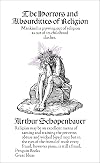
I have second-hand knowledge of Schopenhauer's "the will to live is consecrated in the act of procreation" thesis, and while it makes a brief appearance, much of this collection is focused on religion. The "On Various Subjects" section reads a little like La Rochefoucauld's Maxims, and makes some interesting assertions about genius (it is OK to make mistakes, just your masterpiece ought to be inimitable); on the farcical nature of higher education (perception must precede concept, not the show more other way around); an early statement concerning animal rights (p. 77); and that great works have to wait until enough idiots agree that it is great - such insight is possessed by the majority in the same way that a "castrate possesses of the power to beget children". Now to religion. Some of my favourites:
All religion is antagonistic towards culture; The absurdities of dogma... arise from the need to link together two heterogeneous doctrines as those of the Old and the New Testaments; Hatred and contempt are decidedly antagonistic to one another and mutually exclusive (p. 52); The more prudent rulers enter into an alliance with [priests]; and Faith and knowledge are totally different.The latter explains the dialogue On Religion, which, although I understand Schopenhauer was atheistic, appeared on the surface to be bombastic, but might otherwise resonate with court judges who have been confronted with decisions concerning the existence of God, and have deferred on the grounds that, in effect, "faith and knowledge" are different. Nevertheless, there is in this work the attitude (of The Enlightenment) that rational individuals cannot possibly believe in God. I have heard this sentiment expressed by senior academics, in addition to the buffoons who drool over the Facebook echo-chamber "I F***ing Love Science" which confirms empirically that God does not exist because it has 25 million "likes" (see quote above about "castrates"). That said, there is little to surprise the modern reader, but Schopenhauer was one of the few Western students of India and Buddhism, and his insights demonstrate that the glory days Conservatives dream about did not really exist in the nineteenth century, the counterfactuals were simply hidden from majority view. But to disclose the real gem in this work, I found another piece to the riddle of Benjamin Franklin. One of his "virtues" is "moderation". This is not a riddle in itself, but when "temperance" is also one of the virtues, what is so special about moderation that it should stand alone? Schopenhauer explains in the essay On Ethics by setting out some of the differences between Eastern and Western virtues and vices. For Schopenhauer, "virtues are qualities of will", which means that cowardice cannot be a vice if we have the "will to live"! The Platonic virtues closely align with Franklin's,one of which Cicero translated as temperantia, which is"in English moderation". Schopenhauer states:
[Moderation] is a very vague and ambiguous expression under which many different things can be subsumed, such as prudence, sobriety, keeping one's head.Prudence. Cautious. To Franklin, "avoiding extremes". "Sobriety", therefore, belongs with "temperance". But "prudence" and "keeping one's head", then, belong to moderation. Whether "keeping one's head" is the same thing as to "forbear resenting injuries so much as one is able" remains to be seen, but I daresay Schopenhauer and Franklin were conversant in the literature on virtues, and eventually I will solve the riddle. But what of Schopenhauer? Religion is something we believe because we are indoctrinated as children, but as humanity "grows up", religion must inevitably die because it doesn't make sense (irrational). Yet the final paragraph tells the story of adolescents throwing out the baby with the bathwater - Aesop's fables are too childish because everybody knows foxes, wolves, and ravens can't talk! Thus, Schopenhauer ends with a real noodle-baker (about the boy who was too grown up to read Aesop):
Who cannot see in this hopeful lad the future enlightened Rationalist?show less
Lists
Awards

You May Also Like


Associated Authors
Statistics
- Works
- 8
- Also by
- 12
- Members
- 1,853
- Popularity
- #13,887
- Rating
- 3.9
- Reviews
- 11
- ISBNs
- 23
- Languages
- 3
