

Rüdiger Safranski
Author of Nietzsche: A Philosophical Biography
About the Author
Rudiger Safranski, a freelance writer living in Berlin, is the author of Schopenhauer and the Wild Years of Philosophy (Harvard).
Image credit: by Hans Weingartz (Wikipedia user Leonce49)
Works by Rüdiger Safranski
Nietzsche für Zeitgenossen: "Wo immer ich gehe, folgt mir ein Hund namens Ego" (2002) — Editor — 4 copies
Associated Works
Tagged
Common Knowledge
- Canonical name
- Safranski, Rüdiger
- Other names
- Safranski, Ruediger
Safranski, Rudiger - Birthdate
- 1945-01-01
- Gender
- male
- Education
- Goethe University, Frankfurt-am-Main, Germany
Freie Universität Berlin - Occupations
- philosopher
author - Organizations
- Deutsche Akademie für Sprache und Dichtung
- Awards and honors
- Ludwig-Börne-Preis (2017)
Literaturpreis der Konrad-Adenauer-Stiftung (2014)
WELT-Literaturpreis (2006) - Short biography
- Safranski, RüdigerRüdiger Safranski, geboren 1945, studierte Germanistik, Philosophie, Geschichte und Kunstgeschichte und arbeitete danach als Wissenschaftlicher Assistent am Fachbereich Germanistik der Freien Universität Berlin und in der Erwachsenenbildung. Seit 1985 ist er als freier Autor tätig, dessen Werke mittlerweile in 26 Sprachen übersetzt sind. Er wurde mit dem Friedrich-Märker-Preis, dem Ernst-Robert-Curtius-Preis für Essayistik und dem Friedrich-Nietzsche-Preis ausgezeichnet.
- Nationality
- Germany
- Birthplace
- Rottweil, Germany
- Places of residence
- Rottweil, Germany (birth)
Frankfurt am Main, Germany
Berlin, Germany
Badenweiler, Germany - Associated Place (for map)
- Germany
Members
Reviews

Safranski is an old hand at writing biographies about great Germans and this book about Goethe is a joy to read. The author's main interest are Goethe's work and his relations with his peers. His copious affairs and travels are reported rather quickly if at all. Safranski is also keen in presenting the not so attractive side of Goethe as a bully, such as when he nailed the (bad) work of a colleague to a tree. A petty and mean public "crucification" of a minor writer by the bullying shooting show more star of German literature. Goethe always cared about his personal power and glory - quite a contrast to the idealistic Schiller. No wonder Goethe admired Napoleon greatly. One ghastly episode has Goethe fondling the skull of Schiller who died much too young.
As Safranski isn't a young man himself, Goethe as an old man is a major focus of the biography. His ailing and decline are quite drastically told. No "more light" but intense pain and a ghastly struggle at the end when Death finally defeated the near immortal Goethe who outlived his much younger wife, his son, his duke and almost anyone else. Born in 1749, Goethe lived to 1832 - through the style periods of baroque/rococo, the classic era and Biedermeier. Safranski's presentation of many of Goethe's lesser works shows that he was at his best when some personal crisis triggered deeper involvement in a work whereas he churned out many now justly almost forgotten works over the years in regular production mode. show less
As Safranski isn't a young man himself, Goethe as an old man is a major focus of the biography. His ailing and decline are quite drastically told. No "more light" but intense pain and a ghastly struggle at the end when Death finally defeated the near immortal Goethe who outlived his much younger wife, his son, his duke and almost anyone else. Born in 1749, Goethe lived to 1832 - through the style periods of baroque/rococo, the classic era and Biedermeier. Safranski's presentation of many of Goethe's lesser works shows that he was at his best when some personal crisis triggered deeper involvement in a work whereas he churned out many now justly almost forgotten works over the years in regular production mode. show less
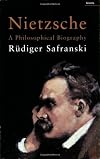
One of the problems in studying philosophy historically is that philosophers are taken as an 'event' rather than as a 'process'. A master work is chosen as exemplar or the writer of a book tries to set down the philosophy of a thinker as if it was a thing out of time or out of cultural place.
This forgets that philosophers are thinking in time and over a life-cycle of their own from birth (as incipient personality) to culmination in death and that philosophers are not only responding to the show more past but to the shifting politics and social and cultural changes of their own era.
Safranski's 'Nietzsche' is very much the story of a process of thought, a 'philosophical biography', that lodges Nietzsche's thinking within a life (less so within a culture) and tracks how his thinking changed over decades until madness overtook him.
Seen in this way, his thought unfolds in three broad phases that match the way a man thinks as he grows and matures. How Nietzsche took something in his core personality and expanded it into something that changed our whole culture is the story of this book.
I write 'in his core personality' because, from a very early age, Nietzsche is thinking 'differently' and showing a driven quality to pursue thought to its limits. His life is 'thinking to its limits' in ways that were literally 'unthinkable' to his contemporaries and to the vast majority of our species even today.
The first phase of his thought is that largely of his twenties until his final breach with Wagner (1876, Age 32). Influenced by Schopenhauer, his early philosophy might be seen as interesting more in its potential rather than the actual. It is a philosophy of over-enthusiastic late romantic aesthetics.
A man of high intelligence drawn into academicism, he rebels because his thought processes see how dessicated was the world that he had joined professionally. Art (not art but Art) as a total Dionysian experience appeared to be a way out as he developed a theory of culture.
'The Birth of Tragedy' provides a grounding for his later thought, situated between his own reaction to Greek thought and what will become an emergent psychology - the bicameral tension between Dionysiac excess and Apollonian order.
The disillusion with Wagner (when he sees Bayreuth as just another example of what we might call 'show business') permits the second phase of his thinking which, in my view, is the most important of all - from 1876 until his transcendent peak experience in August 1881.
This relatively brief period in his mid-thirties allows him to escape German Idealism entirely and think, without restraint, about the relationship between himself and the world and so, more generally, about what it is to be human in relation to existence.
This is a period of both personal misery and sometimes ecstatic insight. He is making profound contributions to epistemology but also to psychology in ways that not merely anticipate Freud but, frankly, are vastly superior to the thinking of the later founder of the psychoanalytic wrong turn.
Above all, Nietzsche is a phenomenologist, observing with care how his own mind works in relation to the world and drawing general conclusions about the human condition. From there, he draws, less reliably, further conclusions about culture and society.
It is at this point that we might have hoped he would retain his full sanity and come to terms with the 'world-shattering' vision he was developing. But the link to personal misery, much of it expressed psychosomatically, and manic depression meant that things were not going to end well.
Given the culture into which he was born and his undoubtedly unstable personality, the idea that he could have somehow transformed himself into Heidegger 'avant la lettre' and explored his thinking about our relation to Being with dogged academic determination is absurd.
Nietzsche simply did not have the all the mental tools to sit back and observe his own thought in the way that he seemed to demand as necessary. He 'lived' his thought. His body 'lived' his thought. And he never found a way of conquering the psychological conflicts that his thought created.
One of the most interesting aspects of that thought is the transfer of his initially academic Dionysian-Apollonian analysis of culture and the human condition to psychology. Bicamerality is today seen as neuroscientifically real as our minds try to cope with balancing two hemispheres in the brain.
Nietzsche's intuitions about bicameral conflict, extended beyond the individual to society and culture as a whole, now look remarkably astute. Attempts to reconcile the impulses in one part of our brain with the cognitive apparatus of the other raise fundamental questions about perceived reality.
Our relationship to Being is complicated by physical responses to the fact of our being in Being (questions for Heidegger to deal with although he lost this bicameral psychological assessment in doing so). Nietzsche's real physical reaction to the process of thinking is part of the thought.
At the Surej boulder in 1881 (age 37), Nietzsche goes on a very different path. We might consider that the final phase before his collapse into madness in 1889 (Age 45) is one extended mid-life crisis in which he attempts to resolve his contradictions through assertion.
What we see is a drive towards self-expression as the 'will to power' amidst a new mythology of the 'eternal recurrence' and the promotion of his poetic character of Zarathustra. It is fertile stuff culturally but often hard to pin down as reliable 'philosophy'.
This final phase (if we discount the subsequent decade of insanity) is nevertheless of immense cultural importance although (I would argue) more philosophically barren. Sometimes it seems like a constant scream of egoistic 'look at me', increasingly monomaniac as time passes.
This is not to say that these powerful final works are not important but only that the thinking, which is often contradictory and extreme, sometimes has the feel of a tormented man letting rip on the psychologist's couch. Yet it is these works that mostly define what Nietzsche is to the public.
The power of these late works (which Safranski significantly spends relatively little time analysing) lies in the effect that their no-holds-barred narcissism has on Europeans looking for an excuse for high emotional expression in a repressive culture. Humans always need excuses.
A final chapter on the way Nietzsche's work came to be employed after his death is invaluable in this context especially because of its German focus, indicating how his thoughts came to be used before Heidegger, Adorno/Horkheimer and Foucault employed them as seeds for their own thought.
Can Nietzsche be 'blamed' for national socialism? Only a fool would not see that Nietzsche's late thought leads inexorably to its use as a tormented brutalism that follows logically from his refusal to compromise on his vision of the human condition. But 'blame' is absurd.
Indeed, it is hard to fault Nietzsche's logic (such as it is). Or, in some respects, even Hitler's and that of the national socialist philosophers like Bauemler, a rival to Rosenberg, who Safranski recognises as sophisticated. Nietzsche's brutal logic can imply national socialism without much difficulty.
Yes, his sister and brother-in-law twisted his legacy to serve German nationalism and, no, Nietzsche was anti-anti-semitic and highly critical of nationalism but special pleading cannot hide the continuity between the philosophy of existence and anti-Christian Nazi Darwinian struggle.
It is at this deeper (the scientific, in its time) level of existential skirting of nihilism with an invented commitment to will that we see the affinity between Nietzsche and National Socialism and not at the secondary level of antisemitism, militarism, nationalism and imperialism.
This is the problem with Nietzsche. The more you read his brute analysis of the human condition (the thinking of Truth including the non-Truth of Truth), the more plausible it becomes although there is no doubt that his struggle was always against the consequent logic arising from this of nihilism.
To avoid the nihilistic interpretation of reality, Nietzsche required a will to something, a human engagement in Life and this engagement in Life married to the darkness of Being resulted in a cruel and vicious view of life that failed to live up to the fanatic expectations for Life itself.
That this Truth troubled Nietzsche despite his attempt to think things through according to the facts of the matter becomes clear in snatches and it strikes me as no accident that he finally goes mad in response to the beating of a horse which could stand for inner revolt against his own philosophy.
It is as if he thought himself into a corner from which there was no escape but insanity and at times, being an honest man intellectually, he could see the way of the meek as a form of will to power whose conquest of the brute might perhaps be part of the Truth too.
Whenever he comes close to systematising his thought, his intellectual honesty (which is undoubted) would periodically break through in force to ask an awkward question of himself that might unravel the psychological scaffolding that held him together.
If we accept that Nietzsche describes our condition accurately once God is recognised to be dead (God stands for all past solutions to the human condition invented to avoid the Truth), then we are left with decisions about what to invent in its place.
Making the invention consonant with science as it was understood in the 1870s and 1880s in Europe means over-accepting science in the construction of the Overman (Ubermensch) and allowing Darwinism to become over-privileged in defining the human condition.
In other words, a correct assessment of our relation to the world as material existence (a different issue than the relation to Being as Heidegger would attempt to understand the problem) can get bogged down in inadequate assumptions about our scientific understanding of that world.
Nietzschean thought is literally 'beyond good and evil' because it can end up anywhere. Much of non-analytical philosophy since Nietzsche has, therefore, been spent trying to analyse the world in ways that restore some sort of value or re-jigs Truth to be more palatable (that is, not-Truth).
Each attempt to do so must be of its time and place much as Nietzsche's own solutions, which were less 'truthful' than the Truth, were bound by its (or rather his) conditions of existence. At this level, all philosophy is personal and about knowing where to sever derivative truths from the Truth itself.
In Nietzsche's case (Safranski is very informative on this), our philosopher was embedding his truth in the fact of science (the Appollonian/left hemisphere) in tension with the Dionysiac and so scientific materialism (not the Marxist version) became central to his will to power.
This is where Truth becomes problematic for our species - the innocent Darwin set off a chain of events that led to Auschwitz and Nietzsche was no more responsible for that than Darwin was. In both cases, ideas that were true became tools and weapons in the struggle for human meaning.
So, Nietzsche sits as a child of mid-century Germany trying to cope with personal turmoil, the death of God (which Heidegger found equally problematic), the rise of science, cultural philistinism, the chatter of the blind and the conventional and he came to certain conclusions.
For example, his analysis of Christianity in 'On The Genealogy of Morals' was only too accurate although his assesssment of socialism remained that of a spoiled bourgeois brat. What we do with his analyses is what counts and that includes fundamental criticism of the limitations of his thought.
Where Nietzsche 'went wrong' is only in failing to continue to think along the lines he was thinking in his second phase - phenomenologically, psychologically, epistemologically as well as existentially - and jumping into the cultural fray with a form of 'revelation' that over-privileged the Dionysiac.
This seems to be core to Nietzsche and to Nietzscheans - the centrality of the rational Apollonian in their assessment of reality but under conditions where they desperately yearn for the Dionysiac, the animal spirits of music, poetry and religion and try to force an older animal brain into action.
At a certain point, like an 'old man in a hurry' as if he knew time was limited, Nietzsche wanted to make a mark on the world, to be 'important, the centre of attention, a prophet, perhaps (through Zarathustra) a founder of new world religion or at least national culture.
In fact, Nietzsche was not inherently Dionysiac. He wanted it desperately. He thought himself into this state out of this desperation and perhaps it helped tip him over the edge into insanity. Certainly, the psychosomatic aspects of the second phase merge into near-monomania in the third.
He never stopped writing important things in that third phase but we, the reader, find ourselves shifting from the thought as a whole to abstracting the thoughts we find useful from a huge corpus of ranting and aphoristic position-taking which is exhausting and time-consuming to say the least.
Nietzsche must be counted a true genius if an unstable one but one around which we should be careful to retain our critical faculties. Safranski has thus done us a great service by showing his thought as a process within a particular context underpinned by a very definite personality.
What exactly we do with Nietzsche is down to our particular contexts and our particular personalities but one thing is clear. If we are at all serious about thinking, we have to start, in effect, from the Truth of our situation in relation to the world that this genius exposed to us.
His thought is only the beginning of our own thought and is not for the faint-hearted. It was always potentially very dangerous to individual and society alike. The continuing denial of its truth may indicate just how deluded about our condition we necessarily have to be in order to be human. show less
This forgets that philosophers are thinking in time and over a life-cycle of their own from birth (as incipient personality) to culmination in death and that philosophers are not only responding to the show more past but to the shifting politics and social and cultural changes of their own era.
Safranski's 'Nietzsche' is very much the story of a process of thought, a 'philosophical biography', that lodges Nietzsche's thinking within a life (less so within a culture) and tracks how his thinking changed over decades until madness overtook him.
Seen in this way, his thought unfolds in three broad phases that match the way a man thinks as he grows and matures. How Nietzsche took something in his core personality and expanded it into something that changed our whole culture is the story of this book.
I write 'in his core personality' because, from a very early age, Nietzsche is thinking 'differently' and showing a driven quality to pursue thought to its limits. His life is 'thinking to its limits' in ways that were literally 'unthinkable' to his contemporaries and to the vast majority of our species even today.
The first phase of his thought is that largely of his twenties until his final breach with Wagner (1876, Age 32). Influenced by Schopenhauer, his early philosophy might be seen as interesting more in its potential rather than the actual. It is a philosophy of over-enthusiastic late romantic aesthetics.
A man of high intelligence drawn into academicism, he rebels because his thought processes see how dessicated was the world that he had joined professionally. Art (not art but Art) as a total Dionysian experience appeared to be a way out as he developed a theory of culture.
'The Birth of Tragedy' provides a grounding for his later thought, situated between his own reaction to Greek thought and what will become an emergent psychology - the bicameral tension between Dionysiac excess and Apollonian order.
The disillusion with Wagner (when he sees Bayreuth as just another example of what we might call 'show business') permits the second phase of his thinking which, in my view, is the most important of all - from 1876 until his transcendent peak experience in August 1881.
This relatively brief period in his mid-thirties allows him to escape German Idealism entirely and think, without restraint, about the relationship between himself and the world and so, more generally, about what it is to be human in relation to existence.
This is a period of both personal misery and sometimes ecstatic insight. He is making profound contributions to epistemology but also to psychology in ways that not merely anticipate Freud but, frankly, are vastly superior to the thinking of the later founder of the psychoanalytic wrong turn.
Above all, Nietzsche is a phenomenologist, observing with care how his own mind works in relation to the world and drawing general conclusions about the human condition. From there, he draws, less reliably, further conclusions about culture and society.
It is at this point that we might have hoped he would retain his full sanity and come to terms with the 'world-shattering' vision he was developing. But the link to personal misery, much of it expressed psychosomatically, and manic depression meant that things were not going to end well.
Given the culture into which he was born and his undoubtedly unstable personality, the idea that he could have somehow transformed himself into Heidegger 'avant la lettre' and explored his thinking about our relation to Being with dogged academic determination is absurd.
Nietzsche simply did not have the all the mental tools to sit back and observe his own thought in the way that he seemed to demand as necessary. He 'lived' his thought. His body 'lived' his thought. And he never found a way of conquering the psychological conflicts that his thought created.
One of the most interesting aspects of that thought is the transfer of his initially academic Dionysian-Apollonian analysis of culture and the human condition to psychology. Bicamerality is today seen as neuroscientifically real as our minds try to cope with balancing two hemispheres in the brain.
Nietzsche's intuitions about bicameral conflict, extended beyond the individual to society and culture as a whole, now look remarkably astute. Attempts to reconcile the impulses in one part of our brain with the cognitive apparatus of the other raise fundamental questions about perceived reality.
Our relationship to Being is complicated by physical responses to the fact of our being in Being (questions for Heidegger to deal with although he lost this bicameral psychological assessment in doing so). Nietzsche's real physical reaction to the process of thinking is part of the thought.
At the Surej boulder in 1881 (age 37), Nietzsche goes on a very different path. We might consider that the final phase before his collapse into madness in 1889 (Age 45) is one extended mid-life crisis in which he attempts to resolve his contradictions through assertion.
What we see is a drive towards self-expression as the 'will to power' amidst a new mythology of the 'eternal recurrence' and the promotion of his poetic character of Zarathustra. It is fertile stuff culturally but often hard to pin down as reliable 'philosophy'.
This final phase (if we discount the subsequent decade of insanity) is nevertheless of immense cultural importance although (I would argue) more philosophically barren. Sometimes it seems like a constant scream of egoistic 'look at me', increasingly monomaniac as time passes.
This is not to say that these powerful final works are not important but only that the thinking, which is often contradictory and extreme, sometimes has the feel of a tormented man letting rip on the psychologist's couch. Yet it is these works that mostly define what Nietzsche is to the public.
The power of these late works (which Safranski significantly spends relatively little time analysing) lies in the effect that their no-holds-barred narcissism has on Europeans looking for an excuse for high emotional expression in a repressive culture. Humans always need excuses.
A final chapter on the way Nietzsche's work came to be employed after his death is invaluable in this context especially because of its German focus, indicating how his thoughts came to be used before Heidegger, Adorno/Horkheimer and Foucault employed them as seeds for their own thought.
Can Nietzsche be 'blamed' for national socialism? Only a fool would not see that Nietzsche's late thought leads inexorably to its use as a tormented brutalism that follows logically from his refusal to compromise on his vision of the human condition. But 'blame' is absurd.
Indeed, it is hard to fault Nietzsche's logic (such as it is). Or, in some respects, even Hitler's and that of the national socialist philosophers like Bauemler, a rival to Rosenberg, who Safranski recognises as sophisticated. Nietzsche's brutal logic can imply national socialism without much difficulty.
Yes, his sister and brother-in-law twisted his legacy to serve German nationalism and, no, Nietzsche was anti-anti-semitic and highly critical of nationalism but special pleading cannot hide the continuity between the philosophy of existence and anti-Christian Nazi Darwinian struggle.
It is at this deeper (the scientific, in its time) level of existential skirting of nihilism with an invented commitment to will that we see the affinity between Nietzsche and National Socialism and not at the secondary level of antisemitism, militarism, nationalism and imperialism.
This is the problem with Nietzsche. The more you read his brute analysis of the human condition (the thinking of Truth including the non-Truth of Truth), the more plausible it becomes although there is no doubt that his struggle was always against the consequent logic arising from this of nihilism.
To avoid the nihilistic interpretation of reality, Nietzsche required a will to something, a human engagement in Life and this engagement in Life married to the darkness of Being resulted in a cruel and vicious view of life that failed to live up to the fanatic expectations for Life itself.
That this Truth troubled Nietzsche despite his attempt to think things through according to the facts of the matter becomes clear in snatches and it strikes me as no accident that he finally goes mad in response to the beating of a horse which could stand for inner revolt against his own philosophy.
It is as if he thought himself into a corner from which there was no escape but insanity and at times, being an honest man intellectually, he could see the way of the meek as a form of will to power whose conquest of the brute might perhaps be part of the Truth too.
Whenever he comes close to systematising his thought, his intellectual honesty (which is undoubted) would periodically break through in force to ask an awkward question of himself that might unravel the psychological scaffolding that held him together.
If we accept that Nietzsche describes our condition accurately once God is recognised to be dead (God stands for all past solutions to the human condition invented to avoid the Truth), then we are left with decisions about what to invent in its place.
Making the invention consonant with science as it was understood in the 1870s and 1880s in Europe means over-accepting science in the construction of the Overman (Ubermensch) and allowing Darwinism to become over-privileged in defining the human condition.
In other words, a correct assessment of our relation to the world as material existence (a different issue than the relation to Being as Heidegger would attempt to understand the problem) can get bogged down in inadequate assumptions about our scientific understanding of that world.
Nietzschean thought is literally 'beyond good and evil' because it can end up anywhere. Much of non-analytical philosophy since Nietzsche has, therefore, been spent trying to analyse the world in ways that restore some sort of value or re-jigs Truth to be more palatable (that is, not-Truth).
Each attempt to do so must be of its time and place much as Nietzsche's own solutions, which were less 'truthful' than the Truth, were bound by its (or rather his) conditions of existence. At this level, all philosophy is personal and about knowing where to sever derivative truths from the Truth itself.
In Nietzsche's case (Safranski is very informative on this), our philosopher was embedding his truth in the fact of science (the Appollonian/left hemisphere) in tension with the Dionysiac and so scientific materialism (not the Marxist version) became central to his will to power.
This is where Truth becomes problematic for our species - the innocent Darwin set off a chain of events that led to Auschwitz and Nietzsche was no more responsible for that than Darwin was. In both cases, ideas that were true became tools and weapons in the struggle for human meaning.
So, Nietzsche sits as a child of mid-century Germany trying to cope with personal turmoil, the death of God (which Heidegger found equally problematic), the rise of science, cultural philistinism, the chatter of the blind and the conventional and he came to certain conclusions.
For example, his analysis of Christianity in 'On The Genealogy of Morals' was only too accurate although his assesssment of socialism remained that of a spoiled bourgeois brat. What we do with his analyses is what counts and that includes fundamental criticism of the limitations of his thought.
Where Nietzsche 'went wrong' is only in failing to continue to think along the lines he was thinking in his second phase - phenomenologically, psychologically, epistemologically as well as existentially - and jumping into the cultural fray with a form of 'revelation' that over-privileged the Dionysiac.
This seems to be core to Nietzsche and to Nietzscheans - the centrality of the rational Apollonian in their assessment of reality but under conditions where they desperately yearn for the Dionysiac, the animal spirits of music, poetry and religion and try to force an older animal brain into action.
At a certain point, like an 'old man in a hurry' as if he knew time was limited, Nietzsche wanted to make a mark on the world, to be 'important, the centre of attention, a prophet, perhaps (through Zarathustra) a founder of new world religion or at least national culture.
In fact, Nietzsche was not inherently Dionysiac. He wanted it desperately. He thought himself into this state out of this desperation and perhaps it helped tip him over the edge into insanity. Certainly, the psychosomatic aspects of the second phase merge into near-monomania in the third.
He never stopped writing important things in that third phase but we, the reader, find ourselves shifting from the thought as a whole to abstracting the thoughts we find useful from a huge corpus of ranting and aphoristic position-taking which is exhausting and time-consuming to say the least.
Nietzsche must be counted a true genius if an unstable one but one around which we should be careful to retain our critical faculties. Safranski has thus done us a great service by showing his thought as a process within a particular context underpinned by a very definite personality.
What exactly we do with Nietzsche is down to our particular contexts and our particular personalities but one thing is clear. If we are at all serious about thinking, we have to start, in effect, from the Truth of our situation in relation to the world that this genius exposed to us.
His thought is only the beginning of our own thought and is not for the faint-hearted. It was always potentially very dangerous to individual and society alike. The continuing denial of its truth may indicate just how deluded about our condition we necessarily have to be in order to be human. show less

The fact that this book is about the 'German affair' means that the ultimate question of this book is about the relation of those wonderful free spirits around 1800 and Hitler and his friends.
However, we are not there jet. Safranksi takes up the job to describe the romantics as epoch and attitude in a relative short book. He does this marvellously by taking key concepts of the epoch (like fantasy, religion, reading etc) and make one or two of the thinkers involved exemplary. Safranski's show more power to choose illustrative quotes seems to show his expert knowledge on the German history of thought. Sometimes he seems even to eager to tell us all the ins and outs of someone's work (as with the chapter on E.T.A. Hoffman). This is easily forgiven because the book is an easy read.
The second part has the post epoch romantic as subject. We see thinkers like Hegel an Marx who change the individualistic fantasies of early romantics to communal and practical statements. Later we have Nietzsche who connects a romantic vision of feeling for the extreme and irrational with a moral based on biology. We all now what happened during the reign of National-socialism. Where this feeling for the extreme, biological racism and technological thinking is mixed in a danger soup that led to one of the horrors of the 20th century.
So, according to Safranski, romantic and personal life is a good idea. Romantic and politics... not so smart. Because politics needs realism and compromise instead of extremes (a lesson for all you fundamentalist and populist out there).
On the whole this work is impressive as an introduction. The only thing I missed was a better description of the turning to Catholicism of many romantics round 1830. Still, this book is a must read for everyone who has romantic sentiments and wants to contemplate one the do's and don'ts of this great feeling of unease with reality and normality and to play in this with fantasy and experiment. show less
However, we are not there jet. Safranksi takes up the job to describe the romantics as epoch and attitude in a relative short book. He does this marvellously by taking key concepts of the epoch (like fantasy, religion, reading etc) and make one or two of the thinkers involved exemplary. Safranski's show more power to choose illustrative quotes seems to show his expert knowledge on the German history of thought. Sometimes he seems even to eager to tell us all the ins and outs of someone's work (as with the chapter on E.T.A. Hoffman). This is easily forgiven because the book is an easy read.
The second part has the post epoch romantic as subject. We see thinkers like Hegel an Marx who change the individualistic fantasies of early romantics to communal and practical statements. Later we have Nietzsche who connects a romantic vision of feeling for the extreme and irrational with a moral based on biology. We all now what happened during the reign of National-socialism. Where this feeling for the extreme, biological racism and technological thinking is mixed in a danger soup that led to one of the horrors of the 20th century.
So, according to Safranski, romantic and personal life is a good idea. Romantic and politics... not so smart. Because politics needs realism and compromise instead of extremes (a lesson for all you fundamentalist and populist out there).
On the whole this work is impressive as an introduction. The only thing I missed was a better description of the turning to Catholicism of many romantics round 1830. Still, this book is a must read for everyone who has romantic sentiments and wants to contemplate one the do's and don'ts of this great feeling of unease with reality and normality and to play in this with fantasy and experiment. show less
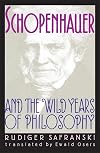
For those within whom passion for the experience of life rushes vigorously, much of philosophy comes across cold and sterile, disturbingly lacking in humanness in its schematic generality, emphasis on rationality and logicality over emotional concerns. The systematic and elaborate presentation of a single idea or simple truth, expressed in mechanistic articulation as if churned out by a machine, devoid of distinguishable personality, with only the known ideas of a particular thinker serving show more as distinction, is alienating to the passionate souls sensitive to the fluctuation of existence that awards pain and pleasure in unequal measure, that beats down and lifts up unexpectedly, that fills with love and hate without any identifiable reason, and that kills in tragedy all that is noble, heroic, and beautiful. The few lovers of wisdom and truth blessed with the gift of articulation of the abstract who are the exception to this tradition are thus considered mavericks who infuse their lust for life, sensitivity to pain, and adoration of beauty into their explications, not for the sake of rebellion, but because their humanness shines that much brighter than the rest who present their ideas in lifeless safety either to mask their apathy for existence or to honor tradition like a good servant. One such philosophical renegade is Arthur Schopenhauer, who expressed this very same sentiment in this striking passage:
"A philosophy in between the pages of which one does not hear the tears, the weeping and gnashing of teeth and the terrible din of mutual universal murder is no philosophy."
From this, it is no wonder why a number of prominent artists and musicians have been so drawn to the works of Schopenhauer. Not only did Schopenhauer express a profound affection for the arts, and especially music, but he did so through one of the most compelling and convincing aesthetic theories in the history of philosophy. Not only this, but his clear and powerful reasoning and gift of eloquent expression allow his ideas a clarity of deliverance, making him one of the most palatable and readable philosophers, particularly in comparison with his contemporaries in 19th Century Germany. But most of all, it is his amazing penetration into the nature of humanity, from a combination of acute observation, careful reflection, sensitivity to experience, with a brilliant logical reasoning, along with a strangely endearing curmudgeonly and broody character, that arouses an affection in his readers, which moves them to want to know, as much as possible, the life of this intriguing man.
In Schopenhauer And The Wild Years Of Philosophy, Rudiger Safranski vividly chronicles the life of Arthur Schopenhauer, paralleling the events of his life with the development of his work, presenting an engaging account of how the philosopher's experiences influenced his ideas, and how those ideas contrasted with the intellectual flavor of 19th‑Century Germany. Defiantly opposed to the Absolutism and appeal to universal Rationalism that reigned supreme in the leading philosophical minds of the era (Hegel, Fichte, Schelling etc..), Schopenhauer's pessimistic Idealism alienated him from and left him largely ignored by the philosophical academy of his time. Safranski details how Schopenhauer's resulting bitterness and frustration affected his associations with colleagues and family. Yet, despite this wide‑spread neglect towards his work, Schopenhauer never once compromises his values and beliefs to acquire his highly sought‑after recognition, all the while, to the very final years of his life, maintaining an unwavering self‑confidence and allegiance to his philosophy worthy of fullest respect and admiration. Through years of being overlooked, Schopenhauer stands firm in his belief that his genuine pursuit of truth, and original presentation of that truth, will one day meet with its worthy acceptance. During his last years, and as the tide of intellectual culture in Germany turned in the aftermath of a series of political and social dissatisfactions, Schopenhauer's work finally began to gather interest, devoted followers, and influential merit.
Safranski tells the story of Schopenhauer's life in the context of the political and social climate of 19th Century Germany. The significant events and cultural character of Weimar, Berlin, Hamburg, and other surrounding locations are relayed in detail, and shown to serve as an interesting backdrop to Schopenhauer's development through the ages of his life. Accounts of his travels through Europe as a youth with his family, his struggles with accepting the inheritance of his father's merchant business, his reaction to the death of his father, followed by years of a tumultuous relationship with his mother, romantic affairs, and his turn away from mercantile life to a philosophical one ("Life is an unpleasant business; I have resolved to spend it reflecting upon it"), are all successively delivered in glorious detail by Safranski, assisted by quotes directly from Schopenhauer's own diary and letters. The wonderful result of this narrative approach is that the book reads less like a traditional biography and more as a classic novel as perhaps could have been written during the Romanticist era during which Schopenhauer himself lived for much of his life.
The development of Schopenhauer's philosophy through the events of his life is explored throughout the book in such a way that, while reading, one has the sense that they are witnessing the gradual blossoming of a magnificent creation. It is also made clear by Safranski that Schopenhauer's personal experiences and observations played a significant role in this development. The reader gains a deeper understanding of how Schopenhauer came to view the world as he did, through his youthful struggles with the freedom of choice, his melancholy nature which made him greatly moved by the pain and misery he witnessed through his travels, and his resulting conclusion that such a world as this could never have been made by an all‑loving God, but rather by a Devil. Safranski also writes of young Schopenhauer's struggles with the lusts of the flesh, his disappointments in intimate relationships, and the isolation he felt through those experiences; "...my richer experience and my totally different nature at all times led me into isolation and solitude." A solitary and brooding character, yet overly‑confident to the point of offensive arrogance, or perhaps simply that much aware of his intellectual superiority combined with his extreme intolerance and eccentricity, Schopenhauer seemed to have lived a lifetime before even seriously considering the thought of a philosophical life, which he began in the radical ages of his early twenties, completing his chief work, The World As Will And Representation, before he hit the age of thirty. His was an untraditional journey to philosophical immortality. Much of his work has come from the experience of real human living, which he held as the ultimate test of truth, and an important reason why he felt that the leading thinkers of his time were so far off the mark with their dialectic thinking and optimistic theories of "Rational Spirit" and "the Absolute". Schopenhauer saw these ideas as theology in disguise, developed by professional philosophers (Schopenhauer, having been blessed with a wealthy inheritance from his father, was freed from having to live by philosophy, and instead lived for philosophy) who were more concerned with honoring the wishes and traditions of the academy than with the sincere pursuit of truth. In his view, there was no "terrible din of universal murder" in such "sham‑philosophies".
"Arthur Schopenhauer, "blessed with the fruit", turned his back on the battleground of the great trends of his day in order to give birth to his work in some quiet corner"
In his departure from philosophical tradition, Schopenhauer was a true free spirit. As he knew, and as other free spirits have also known (particularly Nietzsche, the freest spirit in all of philosophy, who was greatly influenced by Schopenhauer), free spirits are a threat to the established tradition, and as such, must face a stiffer challenge than shackled spirits who see their safety and convenience in the honor of tradition as their source of sustenance. Every attempt is made to silence the free spirit. Yet, Schopenhauer's voice was far too strong, his conviction much too firm, and in the end he did arrive, and remains highly relevant to those who seek for a meaning in this mad suffering in a purposeless world, and those creative free spirits who know the meaning of "aesthetic contemplation" and "will‑less knowing subject".
"The style of his philosophy...marked Schopenhauer as an outsider. The attitude of the individual thinker is emphasized too aggressively."
For those who have been touched in some form by Arthur Schopenhauer's work, or those who simply have an attraction to 19th‑century European intellectual, political, and social culture, this book is an essential read. Safranski has provided the closest opportunity one will discover to getting to know Schopenhauer as the man he was. The reader will find this a thoroughly captivating and moving experience, having gained such an intimate glimpse into the life of one of the most important thinkers in the history of philosophy. show less
"A philosophy in between the pages of which one does not hear the tears, the weeping and gnashing of teeth and the terrible din of mutual universal murder is no philosophy."
From this, it is no wonder why a number of prominent artists and musicians have been so drawn to the works of Schopenhauer. Not only did Schopenhauer express a profound affection for the arts, and especially music, but he did so through one of the most compelling and convincing aesthetic theories in the history of philosophy. Not only this, but his clear and powerful reasoning and gift of eloquent expression allow his ideas a clarity of deliverance, making him one of the most palatable and readable philosophers, particularly in comparison with his contemporaries in 19th Century Germany. But most of all, it is his amazing penetration into the nature of humanity, from a combination of acute observation, careful reflection, sensitivity to experience, with a brilliant logical reasoning, along with a strangely endearing curmudgeonly and broody character, that arouses an affection in his readers, which moves them to want to know, as much as possible, the life of this intriguing man.
In Schopenhauer And The Wild Years Of Philosophy, Rudiger Safranski vividly chronicles the life of Arthur Schopenhauer, paralleling the events of his life with the development of his work, presenting an engaging account of how the philosopher's experiences influenced his ideas, and how those ideas contrasted with the intellectual flavor of 19th‑Century Germany. Defiantly opposed to the Absolutism and appeal to universal Rationalism that reigned supreme in the leading philosophical minds of the era (Hegel, Fichte, Schelling etc..), Schopenhauer's pessimistic Idealism alienated him from and left him largely ignored by the philosophical academy of his time. Safranski details how Schopenhauer's resulting bitterness and frustration affected his associations with colleagues and family. Yet, despite this wide‑spread neglect towards his work, Schopenhauer never once compromises his values and beliefs to acquire his highly sought‑after recognition, all the while, to the very final years of his life, maintaining an unwavering self‑confidence and allegiance to his philosophy worthy of fullest respect and admiration. Through years of being overlooked, Schopenhauer stands firm in his belief that his genuine pursuit of truth, and original presentation of that truth, will one day meet with its worthy acceptance. During his last years, and as the tide of intellectual culture in Germany turned in the aftermath of a series of political and social dissatisfactions, Schopenhauer's work finally began to gather interest, devoted followers, and influential merit.
Safranski tells the story of Schopenhauer's life in the context of the political and social climate of 19th Century Germany. The significant events and cultural character of Weimar, Berlin, Hamburg, and other surrounding locations are relayed in detail, and shown to serve as an interesting backdrop to Schopenhauer's development through the ages of his life. Accounts of his travels through Europe as a youth with his family, his struggles with accepting the inheritance of his father's merchant business, his reaction to the death of his father, followed by years of a tumultuous relationship with his mother, romantic affairs, and his turn away from mercantile life to a philosophical one ("Life is an unpleasant business; I have resolved to spend it reflecting upon it"), are all successively delivered in glorious detail by Safranski, assisted by quotes directly from Schopenhauer's own diary and letters. The wonderful result of this narrative approach is that the book reads less like a traditional biography and more as a classic novel as perhaps could have been written during the Romanticist era during which Schopenhauer himself lived for much of his life.
The development of Schopenhauer's philosophy through the events of his life is explored throughout the book in such a way that, while reading, one has the sense that they are witnessing the gradual blossoming of a magnificent creation. It is also made clear by Safranski that Schopenhauer's personal experiences and observations played a significant role in this development. The reader gains a deeper understanding of how Schopenhauer came to view the world as he did, through his youthful struggles with the freedom of choice, his melancholy nature which made him greatly moved by the pain and misery he witnessed through his travels, and his resulting conclusion that such a world as this could never have been made by an all‑loving God, but rather by a Devil. Safranski also writes of young Schopenhauer's struggles with the lusts of the flesh, his disappointments in intimate relationships, and the isolation he felt through those experiences; "...my richer experience and my totally different nature at all times led me into isolation and solitude." A solitary and brooding character, yet overly‑confident to the point of offensive arrogance, or perhaps simply that much aware of his intellectual superiority combined with his extreme intolerance and eccentricity, Schopenhauer seemed to have lived a lifetime before even seriously considering the thought of a philosophical life, which he began in the radical ages of his early twenties, completing his chief work, The World As Will And Representation, before he hit the age of thirty. His was an untraditional journey to philosophical immortality. Much of his work has come from the experience of real human living, which he held as the ultimate test of truth, and an important reason why he felt that the leading thinkers of his time were so far off the mark with their dialectic thinking and optimistic theories of "Rational Spirit" and "the Absolute". Schopenhauer saw these ideas as theology in disguise, developed by professional philosophers (Schopenhauer, having been blessed with a wealthy inheritance from his father, was freed from having to live by philosophy, and instead lived for philosophy) who were more concerned with honoring the wishes and traditions of the academy than with the sincere pursuit of truth. In his view, there was no "terrible din of universal murder" in such "sham‑philosophies".
"Arthur Schopenhauer, "blessed with the fruit", turned his back on the battleground of the great trends of his day in order to give birth to his work in some quiet corner"
In his departure from philosophical tradition, Schopenhauer was a true free spirit. As he knew, and as other free spirits have also known (particularly Nietzsche, the freest spirit in all of philosophy, who was greatly influenced by Schopenhauer), free spirits are a threat to the established tradition, and as such, must face a stiffer challenge than shackled spirits who see their safety and convenience in the honor of tradition as their source of sustenance. Every attempt is made to silence the free spirit. Yet, Schopenhauer's voice was far too strong, his conviction much too firm, and in the end he did arrive, and remains highly relevant to those who seek for a meaning in this mad suffering in a purposeless world, and those creative free spirits who know the meaning of "aesthetic contemplation" and "will‑less knowing subject".
"The style of his philosophy...marked Schopenhauer as an outsider. The attitude of the individual thinker is emphasized too aggressively."
For those who have been touched in some form by Arthur Schopenhauer's work, or those who simply have an attraction to 19th‑century European intellectual, political, and social culture, this book is an essential read. Safranski has provided the closest opportunity one will discover to getting to know Schopenhauer as the man he was. The reader will find this a thoroughly captivating and moving experience, having gained such an intimate glimpse into the life of one of the most important thinkers in the history of philosophy. show less
Lists
Awards


You May Also Like


Associated Authors
Statistics
- Works
- 25
- Also by
- 1
- Members
- 2,848
- Popularity
- #9,011
- Rating
- 3.8
- Reviews
- 40
- ISBNs
- 264
- Languages
- 17
- Favorited
- 12