
Robert C. Solomon (1942–2007)
Author of A Short History of Philosophy
About the Author
Robert C. Solomon is Quincy Lee Centennial Professor of Philosophy and Business and Distinguished Teaching Professor at the University of Texas at Austin.
Works by Robert C. Solomon
Morality and the Good Life: An Introduction to Ethics Through Classical Sources (1984) 127 copies, 1 review
From Rationalism to Existentialism: The Existentialists and Their Nineteenth-century Backgrounds (1972) 87 copies
Introducing the Existentialists: Imaginary Interviews with Sartre, Heidegger, and Camus (1981) 50 copies
Introducing the German Idealists Mock Interviews with Kant, Hegel and Others and a Letter from Schopenhauer (1981) 34 copies
A Better Way to Think About Business: How Personal Integrity Leads to Corporate Success (1999) 34 copies
Dark Feelings, Grim Thoughts: Experience and Reflection in Camus and Sartre (2006) 23 copies, 1 review
History and Human Nature: A Philosophical Review of European Philosophy and Culture, 1750-1850 (1979) 19 copies
The Bully Culture: Enlightenment, Romanticism, and the Transcendental Pretense, 1750-1850 (1992) 3 copies
How Emotions are Intelligent 1 copy
What is Existentialism ? 1 copy
Associated Works
Great Minds of the Western Intellectual Tradition, Part 6 of 7: Modernism and the Age of Analysis (2001) — Contributor — 7 copies
Tagged
Common Knowledge
- Canonical name
- Solomon, Robert C.
- Legal name
- Solomon, Robert Charles
- Birthdate
- 1942-09-14
- Date of death
- 2007-01-02
- Gender
- male
- Education
- University of Michigan (MA | 1965 | Ph.D | 1967 | philosophy and psychology)
University of Pennsylvania (BS | 1963 | Molecular Biology) - Occupations
- professor of philosophy (University of Texas, Austin)
Business Ethicist - Organizations
- University of Texas at Austin
- Relationships
- Higgins, Kathleen (wife)
- Short biography
- Robert C. Solomon was hoogleraar filosofie en lid van de Academy of Distinguished Teachers aan de universiteit van Texas in Austin. Hij heeft gedoceerd in Princeton, Pittsburgh, UCLA, Michigan, Auckland en Melbourne.
- Cause of death
- pulmonary hypertension
- Nationality
- USA
- Birthplace
- Detroit, Michigan, USA
- Places of residence
- Austin, Texas, USA
- Place of death
- Zurich, Switzerland
- Associated Place (for map)
- USA
Members
Reviews
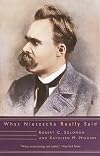
Having recommended this book recently, I thought I'd better re-read it. It's a fantastic introduction to Nietzsche's thought. It debunks myths and misconceptions, gives an overview of his works and main theories, and basically provides all that anyone coming to his philosophy for the first time can need - and more. Actually, it's a good read even for those familiar with his work. It also gives a balanced view - Nietzsche's somewhat misogynistic attitudes are not spared, and it provides a show more good basis for further criticism. Clearly and accessibly written, so ideal for any serious beginner, but especially recommended to anyone studying philosophy.
Gareth Southwell is a philosopher, writer and illustrator. show less
Gareth Southwell is a philosopher, writer and illustrator. show less
Continental Philosophy since 1750: The Rise and Fall of the Self (A History of Western Philosophy, Vol. 7) by Robert C. Solomon
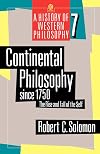
This quarter century old basic introduction to the history of continental philosophy still stands up to scrutiny. Robert Solomon has a mildly polemical intent in that (in my opinon quite correctly) he clearly wants us to be unpersuaded by the transcendental claims of the great essentialists - Rousseau, Kant, Hegel and their followers.
The book's narrative perhaps hinges on the great anti-philosopher and so the greatest philosopher of the continental tradition, Nietzsche. It is as if progress show more was not possible until he had spoken though we can offer some thanks to the intellect of Kierkegaard.
Looking back, everything before Nietzsche looks increasingly like ideology and everything after him an attempt at science, the striving towards a philosophy that had the measure of man as he is in relation to the world or a somewhat futile attempt to salvage what he wrecked.
Of course, ideology returns in the synthesis between it and existentialism of the flawed genius Sartre, the squabbles with Camus (untreated here) and the important explorations of identity of De Beauvoir but it has to take account of the existential impulse in order to salvage a somewhat intense and over-wrought version of meaning.
By the time we get to the last chapter, we are too close to the period in which Solomon is writing. He is wisely cautious about what will and will not matter to future generations. In the mid-1980s he can reasonably judge that Althusser and Lacan were effectively damp squibs and have the jury out on Derrida and Foucault (though the last is clearly joining the greats as time passes).
In fact, what does strike us is just how good Solomon's judgment is in nearly every case. Even today, we would give Marx the due given by Solomon and we have since thrown Freud over board as influence on philosophy perhaps too easily.
But (given the closing of the story in effect in the middle of the twentieth century) what remains striking is that the long tail of Kantian and Hegelian nonsense is still so culturally dominant today outside philosophy itself.
We can push to one side the clowning of Zizek but philosophy today is either soundly analytical but increasingly sceptical of itself, striving to give up bits of itself to the cognitive sciences, or it is attempting to find out what it is to be human (the followers of Heidegger) or how power, text, language and the social actually operate (Foucault) rather than piddle around with non-existent universals.
Philosophy remains dynamic and questioning and yet our political and artistic culture, having disposed of both Freud and Marx, seems stuck in the world created by the absolutist transcendentalists.
My own theory on this relates to psychology. The class that sits in a manipulative position over the masses has no tools left but an invented idealism in order to guide and control them.
It is not that Kantian rights theory or Hegelian dialectic (shorn of its Marxist overlay now) are true but that, as tools, they are useful, whereas the insights on what it is to be human of Heidegger (after Nietzsche) or Foucault may be true but they are not useful except to individuals and (were they but to know it) the masses themselves.
The search for meaning thus intersects with a struggle over power and the Absolute has become a pragmatically useful replacement for God. It can both give a spurious meaning to people desperate for meaning (even if it not be true) and be a tool for power while posturing as progressive or advanced thought.
No wonder the liberal intelligentsia and administrative classes find it difficult to give these essentialisms up - it would be like the cynical Constantine giving up Christianity even after someone had pointed out that it was based on invented nonsense.
The invented nonsenses of Christianity were too obvious by the Enlightenment so the arrival of Rousseau and his ilk was like (excuse the joke) a 'deus ex machina', ready and waiting for the new 'democratic' ideologies of conscription and manipulation.
Heidegger and Sartre drifted into the same trap in different ways (and were unlike Kierkegaard, Schopenhauer and Nietzsche, even if a perverted form of the last was utilised by evil forces later).
Heidegger, whose early and core philosophy stands as the most profoundly 'realistic' account of how we humans exist in the world, drifted into a mystical stance later that might easily have become transcendental in its own right if taken further.
Sartre, a true manipulative genius, merged existentialism with Cartesianism to turn philosophy into a weapon once again but (as Marx did) one for the damned and discontented of the earth to use if they were so minded. That Sartre turned to Marx as tool to hand should occasion no surprise.
Neither 'turn' was persuasive because both wanted to reinvent meaning where there was no necessity for it, either for the individual in the world or as a tool for action in the world. Neither seemed to be able to reconstruct sufficient 'pagan virtue' but had to invent alienations where none need have existed. The theory of alienation, of course, actually being at its worse in the hysterically ridiculous value judgments emerging in the 'horreur' of commodification and objectification from the dimmer type of late Marxist.
Today, we seem to live in a world where philosophy exists in three layers: a top layer of serious investigation that informs how science is being done and how people may live in the world; an intermediate layer of celebrity performance whose sole purpose appears to be pander to the prejudices of a certain type of graduate terrified of becoming declasse; and the level below this where liberal rights activism and administrative conservatism rely on philosophical systems that are outdated and, bluntly, plain wrong.
Below these three layers are the population at large, controlled by the layer immediately above (and half persuaded where they are not holding to traditional world views of their rightness), confused by and disconnected from the layer above that and not realising that the things that will decide their future and their world live in that fertile top layer.
What we have as the world trundles towards a revolutionary situation based on technological change is a cultural milieu in which rights and the dialectic have simply replaced traditional religion. It is no surprise to see, equally threatened by the new world, faith-based groups and many intellectual 'Leftists' converging in conservative opposition to the technological and freedom agenda emerging (albeit mostly accidentally) out of much current philosophy.
We are entering a time of struggle. The reactionary forces in this struggle include Enlightenment absolutism as much as people who believe in supernatural forces - both the Absolute and God are really simply variations on the same theme. However, that is looking at things a quarter of a century on from this book.
In the meantime, Solomon's narrative should be taken as one of the best short and very readable guides to the continental tradition, from Rousseau to the existentialists and phenomenologists, and is recommended. show less
The book's narrative perhaps hinges on the great anti-philosopher and so the greatest philosopher of the continental tradition, Nietzsche. It is as if progress show more was not possible until he had spoken though we can offer some thanks to the intellect of Kierkegaard.
Looking back, everything before Nietzsche looks increasingly like ideology and everything after him an attempt at science, the striving towards a philosophy that had the measure of man as he is in relation to the world or a somewhat futile attempt to salvage what he wrecked.
Of course, ideology returns in the synthesis between it and existentialism of the flawed genius Sartre, the squabbles with Camus (untreated here) and the important explorations of identity of De Beauvoir but it has to take account of the existential impulse in order to salvage a somewhat intense and over-wrought version of meaning.
By the time we get to the last chapter, we are too close to the period in which Solomon is writing. He is wisely cautious about what will and will not matter to future generations. In the mid-1980s he can reasonably judge that Althusser and Lacan were effectively damp squibs and have the jury out on Derrida and Foucault (though the last is clearly joining the greats as time passes).
In fact, what does strike us is just how good Solomon's judgment is in nearly every case. Even today, we would give Marx the due given by Solomon and we have since thrown Freud over board as influence on philosophy perhaps too easily.
But (given the closing of the story in effect in the middle of the twentieth century) what remains striking is that the long tail of Kantian and Hegelian nonsense is still so culturally dominant today outside philosophy itself.
We can push to one side the clowning of Zizek but philosophy today is either soundly analytical but increasingly sceptical of itself, striving to give up bits of itself to the cognitive sciences, or it is attempting to find out what it is to be human (the followers of Heidegger) or how power, text, language and the social actually operate (Foucault) rather than piddle around with non-existent universals.
Philosophy remains dynamic and questioning and yet our political and artistic culture, having disposed of both Freud and Marx, seems stuck in the world created by the absolutist transcendentalists.
My own theory on this relates to psychology. The class that sits in a manipulative position over the masses has no tools left but an invented idealism in order to guide and control them.
It is not that Kantian rights theory or Hegelian dialectic (shorn of its Marxist overlay now) are true but that, as tools, they are useful, whereas the insights on what it is to be human of Heidegger (after Nietzsche) or Foucault may be true but they are not useful except to individuals and (were they but to know it) the masses themselves.
The search for meaning thus intersects with a struggle over power and the Absolute has become a pragmatically useful replacement for God. It can both give a spurious meaning to people desperate for meaning (even if it not be true) and be a tool for power while posturing as progressive or advanced thought.
No wonder the liberal intelligentsia and administrative classes find it difficult to give these essentialisms up - it would be like the cynical Constantine giving up Christianity even after someone had pointed out that it was based on invented nonsense.
The invented nonsenses of Christianity were too obvious by the Enlightenment so the arrival of Rousseau and his ilk was like (excuse the joke) a 'deus ex machina', ready and waiting for the new 'democratic' ideologies of conscription and manipulation.
Heidegger and Sartre drifted into the same trap in different ways (and were unlike Kierkegaard, Schopenhauer and Nietzsche, even if a perverted form of the last was utilised by evil forces later).
Heidegger, whose early and core philosophy stands as the most profoundly 'realistic' account of how we humans exist in the world, drifted into a mystical stance later that might easily have become transcendental in its own right if taken further.
Sartre, a true manipulative genius, merged existentialism with Cartesianism to turn philosophy into a weapon once again but (as Marx did) one for the damned and discontented of the earth to use if they were so minded. That Sartre turned to Marx as tool to hand should occasion no surprise.
Neither 'turn' was persuasive because both wanted to reinvent meaning where there was no necessity for it, either for the individual in the world or as a tool for action in the world. Neither seemed to be able to reconstruct sufficient 'pagan virtue' but had to invent alienations where none need have existed. The theory of alienation, of course, actually being at its worse in the hysterically ridiculous value judgments emerging in the 'horreur' of commodification and objectification from the dimmer type of late Marxist.
Today, we seem to live in a world where philosophy exists in three layers: a top layer of serious investigation that informs how science is being done and how people may live in the world; an intermediate layer of celebrity performance whose sole purpose appears to be pander to the prejudices of a certain type of graduate terrified of becoming declasse; and the level below this where liberal rights activism and administrative conservatism rely on philosophical systems that are outdated and, bluntly, plain wrong.
Below these three layers are the population at large, controlled by the layer immediately above (and half persuaded where they are not holding to traditional world views of their rightness), confused by and disconnected from the layer above that and not realising that the things that will decide their future and their world live in that fertile top layer.
What we have as the world trundles towards a revolutionary situation based on technological change is a cultural milieu in which rights and the dialectic have simply replaced traditional religion. It is no surprise to see, equally threatened by the new world, faith-based groups and many intellectual 'Leftists' converging in conservative opposition to the technological and freedom agenda emerging (albeit mostly accidentally) out of much current philosophy.
We are entering a time of struggle. The reactionary forces in this struggle include Enlightenment absolutism as much as people who believe in supernatural forces - both the Absolute and God are really simply variations on the same theme. However, that is looking at things a quarter of a century on from this book.
In the meantime, Solomon's narrative should be taken as one of the best short and very readable guides to the continental tradition, from Rousseau to the existentialists and phenomenologists, and is recommended. show less
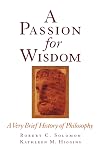
If you are like me and are looking for a way into the intriguing world of Philosophy, then this would be a good place to start. Jumping into this genre is a bit like going for a swim in a violent, tempestuous ocean. There are many different thinkers and many diverse schools of thought that it can be intimidating and overwhelming. I'm happy to say this book served as a sturdy raft.
As the title suggests, this is indeed a very brief overview of Philosophy. Solomon introduces all the big names show more in the field and gives a crisp summary of their outlooks and the questions they were asking.
Solomon's writing is easy to follow; the thoughts and beliefs of the philosophers however? Not so much. These men* were really thinking beyond. Philosophy isn't "thinking outside the box." It's taking that box and studying its dimensions, its size and weight, measuring its corners. It's about taking the box apart and then rebuilding it.
I look at it this way; imagine non-philosophers living on a planet where it was extremely bright, and they walk around squinting and shielding their eyes. It's difficult to see. Philosophers are the ones that put on sunglasses and view the world in a different way. If that makes sense.
I plan on reading more books like this so I can better my understanding. I think it helps to build a foundation first before jumping into the source texts.
Maybe one day I can put on a pair of sunglasses too.
*Solomon introduces one female philosopher, Simone de Beauvoir. He goes on to say that women weren't taken seriously in this field of study and so no publications exist. If a great female philosopher lived, her work was not recorded. Quite unfortunate. show less
As the title suggests, this is indeed a very brief overview of Philosophy. Solomon introduces all the big names show more in the field and gives a crisp summary of their outlooks and the questions they were asking.
Solomon's writing is easy to follow; the thoughts and beliefs of the philosophers however? Not so much. These men* were really thinking beyond. Philosophy isn't "thinking outside the box." It's taking that box and studying its dimensions, its size and weight, measuring its corners. It's about taking the box apart and then rebuilding it.
I look at it this way; imagine non-philosophers living on a planet where it was extremely bright, and they walk around squinting and shielding their eyes. It's difficult to see. Philosophers are the ones that put on sunglasses and view the world in a different way. If that makes sense.
I plan on reading more books like this so I can better my understanding. I think it helps to build a foundation first before jumping into the source texts.
Maybe one day I can put on a pair of sunglasses too.
*Solomon introduces one female philosopher, Simone de Beauvoir. He goes on to say that women weren't taken seriously in this field of study and so no publications exist. If a great female philosopher lived, her work was not recorded. Quite unfortunate. show less
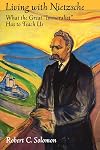
I noted in my review of “Twilight of the Ideals” and “The Anti-Christ” how a figure like Nietzsche seems to draw perennial criticism that denies him the charitable, broad reading that he needs to be fully understood. There are apparently those who continue to find some sort of satisfaction in identifying Nietzsche as a moral or ethical nihilist, a prototypical Nazi, or some sort of right-wing monster generally speaking. For those interested in a wonderful, articulate, and fully show more historicized refutation of these views, I would recommend Walter Kaufmann’s “Nietzsche: Philosopher, Psychologist, Antichrist.” Robert Solomon’s “Living with Nietzsche,” while lacking the biographical nature of Kaufmann’s work, also serves as an extended apology for the continued relevance and centrality of Nietzsche’s thought.
Solomon doesn’t bother with much of the territory that many people might want him to cover: his discontent with Christianity, for example. Instead, he focuses on a small number of issues which run more fully through his thought, including Nietzsche’s defense of the passions, moral perspectivism, and concept of resentment (or, as Nietzsche always says “ressentiment”). There are also incisively funny sections which defend Nietzsche’s penchant for ad hominem attacks, with Solomon suggesting that in some circumstances the ad hominem isn’t at all a logical fallacy. I won’t spell out the details of the argument here, but it’s not wholly unconvincing. Central to Solomon’s arguments throughout the book is that Nietzsche is not in fact a moral nihilist at all, but instead actually rests very closely to Aristotle’s conception of “virtue ethics,” that overused phrase now all too often thrown around in the circles of moral philosophy. In fact, it’s very difficult to imagine Nietzsche’s unabashed elitism without this.
Solomon does a great job at showing how Nietzsche’s thought works in concert with the history of philosophy. This book would be more appreciated by someone at least passingly familiar with Nietzsche’s work; the topics Solomon chooses will seem somewhat random otherwise, since they aren’t necessarily the ones that are most connected with the name of Nietzsche in the popular imagination. Of course, if you’re already familiar with his work and have given it the charitable reading that I mentioned above, the chances aren’t nearly as high that you will need Solomon’s corrective approach in fully appreciating Nietzsche in the first place. However, judging from some of the kooky things that are still shamelessly said about him, I would recommend this for those who think, as I do, that it’s best to err on the side of caution. Nietzsche, even with all of his rhetorical Sturm und Drang, and perhaps because of it, always repays judicious reading. show less
Solomon doesn’t bother with much of the territory that many people might want him to cover: his discontent with Christianity, for example. Instead, he focuses on a small number of issues which run more fully through his thought, including Nietzsche’s defense of the passions, moral perspectivism, and concept of resentment (or, as Nietzsche always says “ressentiment”). There are also incisively funny sections which defend Nietzsche’s penchant for ad hominem attacks, with Solomon suggesting that in some circumstances the ad hominem isn’t at all a logical fallacy. I won’t spell out the details of the argument here, but it’s not wholly unconvincing. Central to Solomon’s arguments throughout the book is that Nietzsche is not in fact a moral nihilist at all, but instead actually rests very closely to Aristotle’s conception of “virtue ethics,” that overused phrase now all too often thrown around in the circles of moral philosophy. In fact, it’s very difficult to imagine Nietzsche’s unabashed elitism without this.
Solomon does a great job at showing how Nietzsche’s thought works in concert with the history of philosophy. This book would be more appreciated by someone at least passingly familiar with Nietzsche’s work; the topics Solomon chooses will seem somewhat random otherwise, since they aren’t necessarily the ones that are most connected with the name of Nietzsche in the popular imagination. Of course, if you’re already familiar with his work and have given it the charitable reading that I mentioned above, the chances aren’t nearly as high that you will need Solomon’s corrective approach in fully appreciating Nietzsche in the first place. However, judging from some of the kooky things that are still shamelessly said about him, I would recommend this for those who think, as I do, that it’s best to err on the side of caution. Nietzsche, even with all of his rhetorical Sturm und Drang, and perhaps because of it, always repays judicious reading. show less
Lists
You May Also Like


Associated Authors
Statistics
- Works
- 74
- Also by
- 4
- Members
- 4,716
- Popularity
- #5,342
- Rating
- 3.9
- Reviews
- 32
- ISBNs
- 266
- Languages
- 9
- Favorited
- 4