
Georg Wilhelm Friedrich Hegel (1770–1831)
Author of The Phenomenology of Mind
About the Author
Born the son of a government clerk in Stuttgart, Germany, George Wilhelm Friedrich Hegel received his education at Tubingen in theology. Arguably the most influential philosopher of the nineteenth century, Hegel's lectures---most notably at the University of Berlin from 1818 to his death---deeply show more influenced not only philosophers and historians but generations of political activists of both the Right and Left, champions of the all-powerful nation-state on the one hand and Karl Marx on the other. His lectures at Berlin were the platform from which he set forth the system elaborated in his writings. At the heart of Hegel's philosophy is his philosophy of history. In his view, history works in a series of dialectical steps---thesis, antithesis, synthesis. His whole system is founded on the great triad---the Idea as thesis, Nature as antithesis, and the Spirit as synthesis. The Idea is God's will; Nature is the material world, including man; Spirit is man's self-consciousness of the Idea, his coming to an understanding of God's will. The formation over time of this consciousness is History. Spirit does not exist in the abstract for Hegel, but is comprehended in "peoples," cultures, or civilizations, in practice states. Hegelian Freedom is only possible in organized states, where a National Spirit can be realized. This National Spirit, a part of the World Spirit, is realized in History largely through the actions of World Historical Individuals, heroes such as Napoleon, who embody that Spirit. A profound misunderstanding of this doctrine led many German intellectuals to subvert it into a narrow, authoritarian nationalism that glorified the "state" as an end in itself. Although Hegel saw his philosophy as universal, applicable throughout the world, the focus and inspiration of his thought was European. And in his own even smaller world, he was content to support and work for the Prussian state, which he believed to be the highest development of history up to that time. (Bowker Author Biography) show less
Image credit: Jakob Schlesinger (1792-1855)
Series
Works by Georg Wilhelm Friedrich Hegel
Britannica Great Books: Hegel - The Philosophy of Right & The Philosophy of History (1821) 359 copies, 1 review
The Encyclopaedia Logic: Part I of the Encyclopaedia of the Philosophical Sciences with the Zustze (Hackett Classics) (1975) 322 copies, 2 reviews
Lectures on the Philosophy of Religion: One-Volume Edition - The Lectures of 1827 (1832) 150 copies, 1 review
Lectures on the History of Philosophy, Volume 3: Medieval and Modern Philosophy (1955) 106 copies, 1 review
Hegel's Philosophy of Nature: Encyclopaedia of the Philosophical Sciences (1830), Part II (1817) 102 copies, 1 review
Lectures on the Philosophy of Religion, Vol. I: Introduction and The Concept of Religion (1984) 94 copies
Lectures on the History of Philosophy, Volume 1: Greek Philosophy to Plato (1966) 91 copies, 1 review
Lectures on the Philosophy of Religion, Vol. III: The Consummate Religion (1979) 78 copies, 1 review
Natural Law: The Scientific Ways of Treating Natural Law, Its Place in Moral Philosophy, and Its Relation to the Positive Sciences of Law (Works in Continental Philosophy) (1972) 62 copies, 1 review
Encyclopedia of the Philosophical Sciences in Outline and Critical Writings: G.W.F. Hegel (German Library) (1990) 38 copies, 1 review
Werke in 20 Bänden und Register, Bd.16, Vorlesungen über die Philosophie der Religion I. (1986) 25 copies
Werke in 20 Bänden und Register, Bd.17, Vorlesungen über die Philosophie der Religion II. (1986) 25 copies
Werke in 20 Bänden und Register, Bd.19, Vorlesungen über die Geschichte der Philosophie II. (1982) 23 copies
Werke in 20 Bänden und Register, Bd.5, Wissenschaft der Logik I. Die objektive Logik. (1978) 22 copies
Werke in 20 Bänden und Register, Bd.20, Vorlesungen über die Geschichte der Philosophie III. (1982) 22 copies
Werke in 20 Bänden und Register, Bd.18, Vorlesungen über die Geschichte der Philosophie I. (1980) 21 copies
Lectures on the philosophy of religion : together with a work on the proofs of the existence of God (1895) 19 copies
Werke in 20 Bänden und Register, Bd.6, Wissenschaft der Logik II. Die subjektive Logik. (1986) 18 copies
Georg Wilhelm Friedrich Hegel: Heidelberg Writings: Journal Publications (Cambridge Hegel Translations) (2009) 18 copies
Three Essays, 1793-1795: the Tubingen Essay, Berne Fragments, and the Life of Jesus (1984) 17 copies
Lineamenti di filosofia del diritto. Diritto naturale e scienza dello stato in compendio (2004) 16 copies
Lectures on natural right and political science : the first philosophy of right : Heidelberg, 1817-1818, with additions from the lectures of 1818-1819 (1996) 16 copies
Diferencia entre los sistemas de filosofía de Fichte y Schelling ; Lecciones de la filosofía de la historia (2015) 15 copies, 1 review
Delphi Collected Works of Georg Wilhelm Friedrich Hegel (Illustrated) (Delphi Series Ten Book 2) (2019) 14 copies
Vorlesungen über die Philosophie der Weltgeschichte I: Die Vernunft in der Geschichte (1994) 13 copies
Hegel on the Arts: Selections from G.W F. Hegel's Aesthetics, or the Philosophy of Fine Art (Milestones of Thought in th (1979) 13 copies
Hegel: Lectures on the Philosophy of World History. Volume I: Manuscripts of the Introduction and the Lectures of 1822-1823 (2011) 10 copies
Hegel: System of Ethical Life and First Philosophy of Spirit (Part III of the System of Speculative Philosophy 1803/04) (1986) 10 copies
Filosofía del arte o Estética (verano de 1826): Apuntes de F. C. H. V. von Kehler (LECTURAS DE FILOSOFÍA) (Spanish Edition) (2006) 9 copies
Logiikan tiede. Ensimmäinen osa, Ensimmäinen nide, Objektiivinen logiikka. Oppi olemisesta (1998) 8 copies, 1 review
PHILOSOPHY OF MIND: Translated from the encyclopedia of the philosophical sciences with five introductory essays by William Wallace (2008) 8 copies
Leçons sur l'histoire de la philosophie, tome I : Système et histoire de la philosophie (1990) 7 copies
Hegel and the human spirit : a translation of the Jena lectures on the philosophy of spirit (1805-6) with commentary (1983) 7 copies
Ciencia de la lógica II. La lógica subjetiva: 3. La doctrina del concepto (1816) (LECTURAS DE FILOSOFÍA) (Spanish Edition) (2015) 7 copies
Scritti politici (1798-1806) 7 copies
Der Geist des Christentums: Schriften 1796 - 1800; mit bislang unveröffentlichten Texten (1978) 7 copies
Zelfbewustzijn, begeerte en de ander het hoofdstuk over zelfbewustzijn als begeerte in Hegels Phänomenologie des Geistes (2004) 6 copies
Leçons sur l'Histoire de la Philosophie : Tome 2 : Introduction, système et histoire de la philosophie (1991) 6 copies
Samtliche Werke 5 copies
Hegel: Lectures on the Philosophy of World History, Volume II: The Lectures of 1830–1831 (2025) 5 copies
Mantik Bilimi - Büyük Mantik 5 copies
@ 5 copies
Philosophische Bibliothek, Bd.376, Wissenschaft der Logik I. Die objektive Logik, 2, Die Lehre vom Wesen (1813) (1999) 4 copies
I principi di Hegel: frammenti giovanili, scritti del periodo jenense, prefazione alla Fenomenologia 4 copies
Fundamentos de la Filosofía del Derecho: o Compendio de Derecho Natural y Ciencia Política (Clásicos - Clásicos Del Pensamiento) (1987) 4 copies
G.W.F. Hegel on Art, Religion, and Philosophy — Author — 4 copies
Leçons sur l'histoire de la philosophie : introduction : système et histoire de la philosophie (2007) 4 copies
Wissenschaft der Logik. Die Lehre vom Sein (1832) / Erster Teil, Erster Band, Die objektive Logik (2008) 4 copies
Introducción general y especial a las "Lecciones sobre la filosofía de la historia universal" (2013) 4 copies
Scienza della logica Tomo secondo 3 copies
Die Philosophie des Rechts: Vorlesung von 1821/22 (suhrkamp taschenbuch wissenschaft) (2005) 3 copies
Philosophische Bibliothek, Bd.375, Wissenschaft der Logik I. Die objektive Logik, 1, Das Sein (1812) (1999) 3 copies
Der Alteren Dante -- Commentare 3 copies
Vorlesungen über die Geschichte der Philosophie: Zweiter und dritter Teil (German Edition) (2013) 3 copies
Vorlesungen über die Geschichte der Philosophie. Teil 4, Philosophie des Mittelalters und der neueren Zeit (1986) 3 copies
Philosophische Bibliothek, Bd.385, Wissenschaft der Logik I. Die objektive Logik, 1, Die Lehre vom Sein (1832). (1990) 3 copies
Scienza della logica, tomo primo 3 copies
Philosophische Bibliothek, Bd.319a, Jenaer Kritische Schriften I, Differenz des Fichteschen und Schellingschen Systems d (1979) 3 copies
Leçons sur l'histoire de la philosophie : Introduction, bibliographie, philosophie orientale (2004) 3 copies
Prefácios 2 copies
Lógica (I) 2 copies
Dějiny filosofie 2 copies
Lecons sur la philosophie de la religion, tome II: les religions antiques, africaines et orientales (2010) 2 copies
Fenomenologia ducha. T. 2 2 copies
La razón en la historia 2 copies
Estética Livro 1 2 copies
Grundlinien der Philosophie des Rechts (Großdruck): Naturrecht und Staatswissenschaft im Grundrisse (2020) 2 copies
Hegel's Philosophy of Mind: How the Mind Experiences Art, Aesthetics and the Christian Religion (Hardcover) (2018) 2 copies
Vorlesungen über die Philosophie der Religion : Einleitung in die philosophie der religion : der begriff der religion (2014) 2 copies
Philosophie der Weltgeschicte / 2 copies
El concepto del Estado 2 copies
Nalar Dalam Sejarah 2 copies
La Philosophie de l'esprit, 1805 : La Philosophie de l'esprit de la « Realphilosophie » (1982) 2 copies
Précis de l'Encyclopédie des sciences philosophiques: La logique, la philosophie de la nature, la philosophie de l'esprit (1990) 2 copies, 1 review
Die Orientalische Welt 2 copies
G.W.F. Hegel: Esthetique.: Manuscrit de Victor Cousin (Bibliotheque Des Textes Philosophiques) (French Edition) (2005) 2 copies, 1 review
L'Ironie romantique. Compte rendu des "écrits posthumes et correspondance" de Solger (1997) 2 copies
Wykłady o filozofii dziejów 2 copies
Aristotele: (secondo l'edizione postuma del 1833 delle Lezioni sulla storia della filosofia curate da Karl Ludwig Michelet) (1999) 2 copies
Vorlesungen über die philosophie der religion. Teil 1, Einleitung : der begriff der religion (2014) 2 copies
Estética: A ideia e o ideal 2 copies
Estética: a ideia e o ideal 2 copies
Werke in zwanzig Bänden Band 6 - Wissenschaft der Logik II - Theorie Werkausgabe Autor/in: Hegel 2 copies
Hegel. Esthétique de la peinture figurative : . Textes réunis et présentés par Bernard Teyssèdre (1964) 2 copies
Wissenschaft der Logie 2 vols. 2 copies
Ästhetik 2 copies
La razón en la historia 2 copies
Lecons Sur Le Droit Naturel Et La Science De L'etat: Heidelberg, Semestre D'hiver 1817-1818 (2002) 2 copies
Philosophie der Geschicte 2 copies
Encyclopedia of Philosophy. 3 vols. 2 copies
Schriften 2 copies
Aesthetik (3 vols.) 2 copies
Ästhetik Band 2 2 copies
Ästhetik Band 1 2 copies
The Phenomenology of Mind 1 copy
On Art, Religion, Philosophy 1 copy
歴史哲学〈上〉 (1971年) (岩波文庫) 1 copy
歴史哲学〈中〉 (1971年) (岩波文庫) 1 copy
歴史哲学〈下〉 (1971年) (岩波文庫) 1 copy
Il sistema filosofico. Estratti dal l'enciclopedia delle scienze filosofiche e dai lineamenti della filosofia del diritto. (1967) 1 copy
Hegel’s Complete Philosophy of the Fine Arts: Lectures of Aesthetics: English Language Compilation of Five GWF Hegel Books (2021) 1 copy
小邏輯 1 copy
Ästhetik III. Die Poesie 1 copy
The phenomenology of mind 1 copy
Werke in 20 Bänden 1 copy
Estetik 1 copy
Quem pensa abstratamente? 1 copy
Sobre o ensino da filosofia 1 copy
Leçons sur l'histoire de la philosophie, Tome 1 La Philosophie Grecque, Des Origines à Anaxagore 1 copy
Il sistema filosofico 1 copy
Volk, Staat, Geschichte. Eine Auswahl aus seinen Werken. Bearbeitet und eingeleitet von Friedrich Bülow. (1939) 1 copy
Estética. 2 volúmenes 1 copy
Политические произведения 1 copy
HEGEL ESTHETIQUE - LES GRANDS TEXTES BIBLIOTHEQUE CLASSIQUE DE PHILOSOPHIE DIRIGEE PAR C. KHODOSS ET J. LAUBIER (1964) 1 copy, 1 review
Poética 1 copy
SHKRIME POLITIKE 1 copy
ARISTOTELI 1 copy
PLATONI 1 copy
History of Philosophy 1 copy
Introduction a l’esthétique 1 copy
Science of Logic vol 1 1 copy
Hegel I 1 copy
Science of Logic vol 2 1 copy
SHKENCA E LOGJIKËS 1 copy
Esztétika III. 1 copy
Esztétika II. 1 copy
Hegel - Vita di Gesù 1 copy
Hegel's Philosophy of Mind 1 copy
Studienausgabe, v.2 1 copy
Studienausgabe, v.3 1 copy
Estética [Excertos] 1 copy
Asthetik 1 copy
vita di gesù 1 copy
Bütün Yapıtları (Seçmeler) 1 1 copy
Werke in zwanzig Bänden. 8. Enzyklopädie der philosophischen Wissenschaften im Grundrisse (1830) 1. 1 copy
Werke in zwanzig Bänden. 9. Enzyklopädie der philosophischen Wissenschaften im Grundrisse (1830). 2. 1 copy
Logique et Métaphysique 1 copy
Filosofia da História 1 copy
Hegel's Science of logic 1 copy
Fenomenologia do espírito 1 copy
Frühe Schriften, 1 copy
Estética: poesia 1 copy
La philosophie de l'esprit 1 copy
Hegel- Vita di Gesù 1 copy
Hegel [Opere di] 1 copy
hegel dizionario delle idee 1 copy
Phanomenologie des Geistes 1 copy
Estética - Pintura e Música 1 copy
La filosofia della natura 1 copy
Textos dialéticos 1 copy
Estetica, tomo II 1 copy
Der Staat 1 copy
Prefácios 1 copy
Vorlesungen über die Geschichte der Philosophie (Philosophische Bibliothek) (German Edition) (1993) 1 copy
Estetica, tomo I 1 copy
Esthétique, v. 2 1 copy
Wykłady o estetyce. T. 3 1 copy
La vie de Jésus : Précédé de Dissertations et fragments de l'époque de Stuttgart et de Tübingen (2009) 1 copy
Correspondance 1 copy
Estetika. Zv. 1 1 copy
Estetika. Sv. 1 1 copy
Estetika. Sv. 2 1 copy
Studienausgabe in 3 Bänden 1 copy
Esthétique, v. 3 1 copy
Wykłady o estetyce. T. 1 1 copy
Tinin Görüngübilimi 1 copy
Logika ako veda I : 1. diel 1 copy
The Letters 1 copy
The Philosophy of Hisotry 1 copy
Logika ako veda II : 2. diel 1 copy
Leçons sur l'histoire de la philosophie: Tome 4. le dogmatisme et le scepticisme: les néoplatoniciens (1975) 1 copy
Esthétique, v.4 1 copy
I : ENCICLOPEDIA DELLE SCIENZE FILOSOFICHE IN COMPENDIO - II: FILOSOFIA DELLA STORIA UNIVERSALE - SCRITTI POLITICI (2008) 1 copy
Aristoteli 1 copy
Lógica III 1 copy
Wissenschaft der Logik II. Die objektive Logik. Zweites Buch. - Die subjektive Logik (Werke Bd. 6) 1 copy
Die Vernunft in der Geschichte. Einleitung in die Philosophie der Weltgeschichte (erster Band). (1917) 1 copy
The Philosphy of Right 1 copy
Wykłady o estetyce. T. 2 1 copy
Hegel und wir 1 copy
Estetica dell'architettura 1 copy
Eticita assoluta e diritto positivo: le maniere di trattare scientificamente il diritto naturale (2011) 1 copy
Correspondance III 1823-1831 1 copy
Esthétique, L'art romantique 1 copy
Esthétique. L'Art symbolique 1 copy
Kopstukken filosofie : Hegel 1 copy
A logika tudománya Első rész 1 copy
Die Lehre vom Sein 1 copy
Történelem és társadalom 1 copy
Vorlesungen uber Logik und Metaphysik: Heidelberg 1817 (Vorlesungen / Georg Wilhelm Friedrich Hegel) (German Edition) (1992) 1 copy
Wer denkt abstrakt? 1 copy
Hegel in seinen Briefen 1 copy
Werke 1 copy
Scritti politici 1 copy
Hegelova dialektika 1 copy
Epistolario I 1785-1808 1 copy
Systemfragment von 1800 1 copy
2: Il mondo orientale 1 copy
3: Il mondo greco-romano 1 copy
4: Il mondo germanico 1 copy
2: Dai sofisti agli scettici 1 copy
3.2: La filosofia moderna 1 copy
Jenaer Systementwürfe 1 copy
Scritti teologici giovanili 1 copy
Esztétikai előadások 1 copy
Lezioni di filosofia del diritto : secondo il manoscritto di Wannemann, Heidelberg, 1817/1818 1 copy, 1 review
Philosophical Dictionary, Selections / Philosophy of History, Introduction (The Great Books, Sixth Year, Volume 6) (1957) 1 copy
Philosophy of Fine Art by Georg Wilhelm Friedrich Hegel: The Complete Work Plus an Overview, Chapter by Chapter Summary and Author Biography! (2017) — Author — 1 copy
La poésie 1 copy
Leibnitz 1 copy
G.W.F Hegel - Werke in zwanzig Bänden - Band 2 - Jenaer Schriften 1801-1807 - Theorie Werkausgabe 1 copy
Tragödie, Komödie, Drama 1 copy
Filosofia del diritto 1 copy
La lógica de la enciclopedia 1 copy
Esthétique. Tome II. Développement de l'idéal et sa différenciation en formes d'art particiulières 1 copy
Sa mtliche Werke 1 copy
By Georg Wilhelm Friedrich Hegel - Introductory Lectures on Aesthetics (Penguin Classics) (Reprint) 1 copy
Ästhetik 2 [...] 1 copy
Hamann's Writings 1 copy
Förnuftet i historien 1 copy
Werke in zwanzig Bänden, Bd. 9. Enzyklopädie der philosophischen Wissenschaften im Grundrisse II 1 copy
Il metodo della filosofia. La prefazione alla «Scienza della logica» e alla «Filosofia del diritto» (2012) 1 copy
Briefe von und an Hegel.: Dokumente und Materialien zur Biographie: Dokumente und Materialien zur Bibliographie (1977) 1 copy
Философия истории 1 copy
Associated Works
Philosophies of Art and Beauty: Selected Readings in Aesthetics from Plato to Heidegger (1976) — Contributor — 400 copies, 2 reviews
The Philosopher's Handbook: Essential Readings from Plato to Kant (2000) — Contributor — 235 copies, 1 review
The intellectual tradition of modern Germany : A collection of writings from the eighteenth to the twentieth century (1973) — Contributor — 3 copies
Tagged
Common Knowledge
- Legal name
- Hegel, Georg Wilhelm Friedrich
- Birthdate
- 1770-08-27
- Date of death
- 1831-11-14
- Gender
- male
- Education
- Gymnasium Illustre, Stuttgart, Germany
Tübinger Stift, Tübingen, Germany - Occupations
- philosopher
headmaster
professor - Relationships
- Hölderlin, Friedrich (friend)
Schelling, Friedrich Wilhelm Joseph (friend) - Nationality
- Germany
- Birthplace
- Stuttgart, Duchy of Württemberg
- Places of residence
- Berlin, Germany
Stuttgart, Germany
Heidelberg, Germany
Nuremberg, Germany
Tübingen, Germany
Bern, Switzerland (show all 9)
Frankfurt am Main, Germany
Jena, Germany
Bamberg, Germany - Place of death
- Berlin, Kingdom of Prussia
- Burial location
- Dorotheenstädtischer Friedhof, Berlin, Germany
- Associated Place (for map)
- Germany
Members
Discussions
Hegel for Just-Past-the-Dummy-Stagers? in Philosophy and Theory (November 2016)
Reviews
Lectures on the Philosophy of Religion, Vol. III: The Consummate Religion (Lectures on the Philosophy of Religion) by Georg Wilhelm Friedrich Hegel
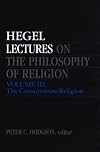
Hegel, Religion and Christianity Today: A Thought Experiment
Why read Hegel on Christianity and Religion when, according to the Zeitgeist, all three are thought to be almost equally passé? After all, most educated people today believe that modern enlightened thinking has obviously refuted them. But can we say that modern times has achieved such a level of tranquility and satisfaction that past philosophical views can be dismissed with such thoughtless certainty? A glimpse at any newspaper show more would show that there is perhaps some room for doubt...
If one believes, as some even now do, that the Hegelian Dialectic is both a genuine philosophical method and also that the progressive emancipatory dialectic that first becomes fully conscious in Hegel has somehow 'gotten lost' then one must go back and try to figure out why, and also where, this dialectic got derailed. A possible contender for the cause of derailment is the claim that Christianity failed to be *in fact* the Universal World Religion that Hegelian Theory both believed and expected it to be. Thus the 'education' that this specific Religion was to provide Mankind was never *in fact* provided. (I do not understand this 'failure', btw, to be fundamentally a failure of either Dialectical Theory or Christianity; rather, the numerous obstacles Christianity faced on the road to an actual global universality were merely practical and included differences in language, culture, family type [i.e., kinship, an anthropological category] and also, of course, politics and geography. It was simply not possible in practice for any premodern religious movement to overcome these and other contingencies and be truly universal.) Now, this is why I believe it would not be merely an error for someone steeped in Hegelian dialectical thought (and I mean either left or right Hegelian thought) to come to think that the best Humanity can hope for today (in these precise circumstances) is the rise of a new Universal Religion.
Thanks to modern technology (e.g., airlines, television, the internet) a Religion could now rise everywhere and thus *in fact* be Universal. - But hasn't the Universal Religion already risen? It is, according to Hegel, Christianity. And didn't he, after all, call it 'absolute'? But Hegel himself said that everything happens twice in History; and yes, yes, ...we are, of course, always here reminded that Marx observed that the second time was farce. Now, this last observation, in my opinion, is not, strictly speaking, dialectical. For Hegel, the fact of this 'twiceness' is itself a part of the process of the education of Man in History. It is the educative value of (ahem) 'dialectical repetition' that is of philosophical importance. Indeed, dialectically speaking, the same lesson could occur 100 times instead of merely twice, and so long as the lesson was eventually learned a dialectical sublation would have occurred. Some are coming to think that the rise of a new Universal Religion today would be an educational repetition in this precise dialectical sense. A close study of all three volumes of Hegel's 'Lectures on the Philosophy of Religion' would perhaps clarify (for Hegelianism) what is and what is not to be expected of this endeavor. This small review cannot even pretend to rise to that level of depth and detail. Instead, in this review I will concentrate on how Hegel chose to end his Lectures on Christianity in order to bring out some of what he meant by Spirit - and Community. Specifically, the situation of the Christian Community in his time. And also, a little on the Relation between Spirit and Christ. But first,
A Note on the Text:
This book is comprised of four lectures given by Hegel in 1821, 1824, 1827 and 1831. These separate lectures have been redacted by our team of editors and translators from Hegel's own Manuscript (Ms.) of the 1821 lecture, "auditor's' notebooks or transcripts of the 1824 lectures", the 1827 lecture is the Lasson edition compared and checked against other sources, while the 1831 lecture is derived from a transcript of D. F. Strauss. Hegel published very few books. (- Only the "Phenomenology of Spirit", 1807; "Science of Logic", 1812, 1813, 1816; "Encyclopedia of the Philosophical Sciences", 1817, 1827, 1830; and the "Philosophy of Right", 1821.) Much of the material that we have today regarding Aesthetics, History, Philosophy and Religion comes from various editions of his manuscripts and also the notes and transcripts of students. We are told that Hegel titled these lectures on Christianity either "Die vollendete Religion" (The Consummate Religion) or "Die offenbare Religion" (The Revelatory Religion), or some variation/combination of these two. He never titles these lectures "Die absolute Religion". Why is any of this important? Our editor explains as follows:
"[...] while the object or content of religion is the absolute, religion itself does not entail absolute knowledge of the absolute: that is the role of philosophy. The representational forms of religious expression, even of the Christian religion, must be "sublated" (annulled and preserved) in philosophical concepts. Thus in Hegel's scheme of things there is an absolute knowledge (the science of speculative philosophy) but a consummate religion. Whether religion as such is to be superseded by philosophy is another question..." (Editorial Introduction, p. 4)
Religion is not Philosophy; therefore it cannot rise to Hegelian 'Absolute Knowledge'. Now, in the course of these lectures, Hegel does occasionally use the phrase 'absolute religion' regarding Christianity. Thus, while for Hegel only Philosophy can attain Absolute Knowledge, the term 'absolute' when applied to a Religion, or so I would maintain, is, and can only be, an honorific that philosophy occasionally elects to bestow. Another decision that I found particularly interesting is the decision of our editor's to never translate Vorstellung as either 'picture-thinking' or 'conceptual-picture'. We are told that:
"Some adjustments in the translation of specific terms have occurred in Volume 3 as compared with Volume 1, occasioned partly by the different context in which they occur and partly by the experience of the translation team." (Editorial Introduction, p. 8)
Now, our Volume III first appears in 1985 as a hardcover. (I have the 1998 paperback. And all page numbers in this review refer to this paperback edition.) Volume I, as a hardcover, appears in 1984. One finds oneself wishing for a fuller discussion of the 'experiences' that occurred which led to changes in the translation of certain words in the third Volume...
"In the case of Vorstellung we have found it necessary to be more flexible when it is used in non-technical contexts, as it often is in Volume 3. We have employed 'image' and 'imagination' (as when one has a hundred thalers in one's 'imagination'), 'view' (e.g., the Reformed 'view' of the sacrament of Communion) and even 'notion,' although rarely (such 'notions' are not worthy of further consideration). To maintain the distinction between Vorstellung, Begriff, and Idee, we never use 'notion' for Begriff, or 'idea' for Vorstellung, and we avoid such expressions as 'conceptual picture' or 'picture thinking' for Vorstellung. Begriff is consistently translated as 'concept,' Idee as 'Idea,' and in its technical sense Vorstellung remains 'representation'." (p. 8-9)
I do not understand the point of saying that the terms "conceptual picture" and "picture thinking" are merely avoided as translations of Vorstellung instead of admitting they were never used; I do not recall one instance of the term 'picture thinking' being used in this volume. I am not blaming the editors for anything here. Choices naturally have to be made between readability and painstaking accuracy. But every translation is an interpretation, whether it wants to be or not. For instance, the mere identification by the editors of 'non-technical contexts' requires an interpretation of the text. Now, everywhere Hegel used the term 'Vorstellung' in these lectures he would have been well aware that the resonances of its previous uses were available to the attentive student. However, when Vorstellung is translated as representation, image/imagination, view, and even notion(!), those resonances are necessarily lost to the reader of this translated text. Again, this is not a criticism of this translating team. All translation involves this risk. For instance, my copy of the Bilingual edition of the 1964 Musa translation of Machiavelli's Prince admits to using twelve different English words to translate the crucial Machiavellian term 'virtù'! But Musa very helpfully provides a list, in his Introduction, of each place in the text that the word virtù was used. I really would have liked to have seen that done here (at least) for the equally crucial term 'Vorstellung'...
In any case, what one ends up suspecting is that just as the Philosopher Hegel 'honors' Christianity by occasionally calling it 'absolute' so too our editors, here in the third volume, have elected to 'honor' Christianity (the 'Consummate Religion'!) by never translating 'vorstellung' as 'picture-thinking'.
Note that the following symbols are used throughout by the editors of these lectures:
[...] Editorial insertions
< ... > marginalia
| page number and/or page break
- indicates a grammatical break between sentence fragments in the MS.
-...- textual variants
A Note on Christianity, Community, and Spirit:
In this section of the review I will concentrate only on the 1821 manuscript since that can be assumed to most accurately reflect Hegel's view.
Now, what will perhaps first surprise the modern reader most is the extent to which, according to Hegel, philosophy stands alone in the world. It is radically distinguished from both the faithful common people and the 'Enlightened' throughout the concluding remarks (on Spirit and Community) of each of our four lectures. The next surprise is the crucial importance of the believing community for religion. It is no accident that these lectures always end with the Community (and Spirit). And perhaps the last surprise is how greatly Hegel feared Christianity, thanks to her Theologians, failing this very Community!
Now, this Community, according to Hegel, must be thought of as virtually (that is to say, possibly) endless! In the 1821 manuscript we read the following:
"In a formal sense [the following sequence applies to historical phenomena]: origin, preservation, and perishing, with the latter following upon the former. But ought we to speak here of this sequence [if] the kingdom of God [has been] established eternally? If so, then perishing or going under would [in fact] be a passing over to the | kingdom of heaven [and would apply] only for single subjects, not for the community; the Holy Spirit as such has eternal life in its community. <Christ [says]: 'The gates of hell shall not prevail against my teaching' [Matt. 16:18].> To speak of a passing away would mean to end on a discordant note. (p. 158, Hegel's Lecture Manuscript)"
The Holy Spirit has Eternal Life in the (or, if you prefer, His) Community! While the Risen Christ merely saves individual souls... Now, for Hegel, Spirit is always a living moving thing. By saying that the 'Spirit has eternal life in its community' Hegel has 'immortalized' the community and has thus transformed each of its sublimations (i.e., its changes) into a passing over into a 'new heaven'. So, while individuals merely die and go to Heaven, the Community Itself sublimates itself into a higher form - it is eternally becoming its own heaven. Well then, it's 'all good' right? - Wrong!
At this point in the margins of the manuscript Hegel unexpectedly compares modern times (that is, his time) to ancient Rome.
"<[The Roman age was one] when rationality necessarily took refuge solely in the form of private rights and private goods because the universal unity based on religion had disappeared, along with a universal political life. [Ordinary people,] helpless and inactive, with nothing to trust, left the universal alone and took care for themselves. [It was an age] when what subsists in and for itself was abandoned even in the realm of thought. Just as Pilate asked, 'What is truth?' [John 18:38], similarly in our time the quest for private welfare and enjoyment [is] the order of the day; moral insight, [the basis] of personal actions, opinions and convictions, [is] without objective truth, and truth is the opposite. I acknowledge only what I believe subjectively. [For some time,] the teaching of the philosophers has corresponded [to this view]: we know and cognize nothing of God, [having] at best a dead and merely historical sort of information.> (p. 159, Hegel's Lecture Manuscript)"
As it was yesterday in Hegel's time and in ancient Rome so it is today. With Universalism, both secular (either liberal or socialist) and religious (Christianity most especially), abandoned in our postmodern times there is only 'bread and circuses'; that is to say, the market and entertainment. By 'philosophers' Hegel here means most especially the Kantian view but also the whole of contemporary 'enlightened' philosophy. This comparison with Rome is no mere aside. It was in Rome, in the milieux aptly described here by Hegel, that Christianity itself rose to prominence and became a World Religion. Perhaps one could be forgiven for drawing the conclusion that whenever a genuine lived universalism evaporates from the scene of history into a sky bereft of all save private obsessions, then the world is ripe for the rise of a new universalism.
But certainly the common people of Hegel's time and also the theologians were fighting against this decadence? Well, yes and no:
"Although among the people, i.e., the lower classes, [there is still] faith <in objective truth, the teaching of this truth is no longer justified in terms of faith, once the time has come when what is demanded is justification by the concept; nor is justification achieved by harshness, objective commands, and external supports, nor by the power of the state.> [If] the clergy, whose office [is] always to stimulate religion, [renounces] this service,[it falls into] mere argumentation, a particular [i.e., not universal] history, i.e., something past. When [religious truth is] treated as historical, that spells an end [to it]; then it no longer [lives] in immediate consciousness, i.e., in actuality, [as] the unity of the inner and the outer. {When] moralistic views and motivations , moralistic or subjective feelings and virtuosities, [prevail], then [something else] is put in its place - certainly not the speculative truth! (p. 159 - 160, Hegel's Lecture Manuscript)"
Hegel is arguing here that faith cannot be justified philosophically ('by the concept') or even by the force of church rules and laws of the state. Justification comes by faith alone, that is to say, a living active faith. Thus the theologians (insofar as they are trying to imitate philosophy) are actually aiding the destruction of their religion. Their arguments no longer stimulate religious belief and, as argumentative particularities, only add to the further fragmentation of Christianity. Everything they say is 'past'; it no longer lives in the heart or soul of anyone. Now, ...does any of this sound familiar?
And so, what follows?
<[when every] foundation, security, the substantive bonds of the world, [have been] tacitly removed; when [we are left] inwardly empty of objective truth, of its form and content-[then] one thing alone [remains] certain: finitude [turned] in upon itself, arrogant barrenness and lack of content, the extremity of self-satisfied dis-enlightenment.> (p. 160, Hegel's Lecture Manuscript)"
Of course, the German word for enlightenment is Aufklärung. The word translated as dis-enlightenment is Ausklärung. Noting this wordplay our editor explains that there might be another meaning. He delicately explains that a "more vulgar overtone may also be intended since Aus-klärung means literally 'clearing out,' suggesting perhaps a kind of intellectual diarrhea. (see p. 160-161, note 255)" The 'Enlightenment' as mere criticism has drowned the world in sh*t! Hegel, at times, really is too funny!
Note that this particular lecture ends in a most memorable fashion:
"Instead [of allowing] reason and religion to contradict themselves, [we must] resolve the discord in the manner [appropriate] to us - [namely,] reconciliation in [the form of] philosophy. How the present day is to solve its problems must be left up to it. In philosophy itself [the resolution is only] partial. These lectures have attempted to offer guidance to this end.
Religion [must] take refuge in philosophy. (For [the theologians of the present day], the world [is] a passing away into [subjective reflection because it has as its] form merely the externality of contingent occurrence.) | But philosophy, [as we have said, is also] partial: [it forms] an isolated order of priests--a sanctuary--[who are] untroubled about how it goes with the world, [who need] not mix with it, [and whose work is to preserve] this possession of truth. How things turn out [in the world] is not our affair. (p. 162, Hegel's Lecture Manuscript)"
Karl Barth once asked “why did Hegel not become for the Protestant world something similar to what Thomas Aquinas was for Roman Catholicism?” Well, one reason is that try as I might, I can't imagine Aquinas writing a sentence indicating that the outcome of theological strife was 'not our affair'. But sentences that are unavailable to philosophy in medieval circumstances became unavoidable in high modernity...
For some of us, perhaps the most stunning admission at the end of this lecture is the 'partiality' of philosophy. The implication (to me) is that Thought (i.e., Philosophy) and Being (or Actuality) are not and perhaps can never be exactly the same! By comparison, even the apathy of that final sentence should not shock us. After all, in his Preface to the "Philosophy of Right" Hegel says:
"A further word on the subject of issuing instructions on how the world ought to be: philosophy, at any rate, always comes too late to perform this function. As the thought of the world, it only appears at a time when actuality has gone through its formative process and attained its completed state. This lesson of the concept is necessarily also apparent from history, namely that it is only when actuality has reached maturity that the ideal appears opposite the real and reconstructs this real world, which it has grasped in its substance, in the shape of an intellectual realm. When philosophy paints its grey in grey, a shape of life has grown old, and it cannot be rejuvenated, but only recognized, by the grey in grey of philosophy; the Owl of Minerva begins its flight only with the onset of dusk." (H.B. Nisbet translation)
This philosophical Owl devours (that is to say, knows) only the dead. Now, if Christianity (like every other existing Religion) is past rejuvenation and only recognized in philosophy then - ...what?
Let's review. Religion cannot be Absolute. But if historical circumstances continue to change then Religion (as vorstellung, representation), any religion, must change to be equal to the changed circumstance. Hegel, I believe, always hoped that the inherent tension between moving world and immovable dogma could be relaxed (and perhaps, at the very best, even tamed) by his taking up some elements of Trinitarian theology into his dialectically philosophical concept of Spirit. You see, Spirit moves, and, or so Hegel seemed to hope, that this 'movement' might have allowed Christianity (i.e., the Christian Community) to itself change as the world changed around it. Of course, this never happened. All Christianity has done is continue to fragment. But Hegel was not merely fantasizing; the resources available to Trinitarian thought (see especially, in this regard, Joachim of Floris, e.g.) are still there. But we are now certain (as one can be) regarding the future; no Christian 'Third Age' will rise because the inertia of the various Christian Institutions blocks it.
And since these Institutions refuse to move they will die. But is this the end of Hegelian 'transcendental universalism'? Well, with all roads to secular universalism seemingly blocked, I certainly hope not. - Any universalism is better than no universalism! Now, before concluding, some remarks on
Spirit, Community ... and Christ?
What is the relation between the risen Christ and Hegel's always moving 'Holy' Spirit? Isn't the Crucifixion (cum Resurrection) Itself an unsurpassable miracle, a Moment that cannot be sublated?
"...the nature of God is spirit, and that being so, negation is an essential moment. (p. 220, The Lectures of 1824)"
Negation is essential; this means that so long as there is Spirit there will be negation. But can everything, even the highest miracles, be negated and surpassed?
Hegel notes that Christ Himself "says, 'You wish to see signs and wonders.' It is not a matter of signs and wonders; Christ renounced them. In any event, this is by its very nature an external, spiritless mode of attestation.We are rightly aware that God and his power are present in nature in and according to eternal laws; | ~the true miracle is spirit itself. Even the animal is already a miracle vis-à-vis plant life, and still more spirit vis-à-vis life, vis-à-vis merely sentient nature.~ However, the genuine mode of verification is quite different - it is through power over minds. We must insist that this is the genuine [proof]. (p. 221, The Lectures of 1824)"
It seems that every 'miracle', thanks to the never-ending movement of Spirit, is destined to be sublated by an even greater miracle. This is why Spirit is the 'True' (or perpetual) Miracle. Also note that it is faith, the living faith of a community (i.e., multiple minds), and not miracles, that is the genuine proof. (I am here tempted to type 'proof'.) But even the living faith of the community, insofar as it is not and can never be philosophy, must always be, to some extent, mere vorstellung (representation). But again we ask, what is Sprit to Hegel?
It "is the transition from externality, from appearance, to inwardness. (p. 223, The Lectures of 1824)"
"This is the turning to the inward path, and in this third realm we find ourselves on the soil of spirit as such - this is the community, the cultus, faith. (p. 223, The Lectures of 1824)"
Note that the "inward path" Hegel here has in mind absolutely does not lead to 'me'; it leads to 'us'. But this community lives in faith. So who, according to Hegel, are 'we'?
"A story -an intuition, a portrayal, an appearance of this kind- can also be raised by spirit to the level of the universal, and thus the history of the seed or the sun becomes a symbol of the idea, but only a symbol; these are configurations that, in terms of their peculiar content or specific quality, are not adequate to the idea. What is known in them lies outside of them; their meaning does not exist in them as meaning.
The object that does exist in itself as the concept is spiritual subjectivity, human being. As thinking being it is in itself meaningful; meaning does not lie outside of it. It is all-interpreting, all-knowing, it is not a symbol. Human consciousness, what is specific to humanity, is essentially history itself, and the history of the spiritual does not take place in an existence that is not adequate to the idea. Thus what is necessary in regard to humanity is that the thought, the idea, should become objective in the community. (p. 225-226, The Lectures of 1824)"
So you see, 'we' (subjectivity lived as Spirit, as Community) are not symbols; but everything that is merely past certainly is... 'We' are 'all-intepreting', 'all-knowing'; and, according to Hegel, the unfolding of the human community (cum Spirit) shall not prove inadequate to this task! But we must never forget that the faith of this community, "began from the individual [founder]; that single | human being is transformed by the community, he is known as God -characterized as the Son of God, but entangled in everything finite that pertains to subjectivity as such. ~Subjectivity itself, the form that is finite, then disappears in the face of substantiality. This is the transformation of the sensible appearance into something spiritual and the knowledge of what is spiritual.~ It is the community as it begins from faith; but on the other hand, it is the faith that is brought forth as spirit, so faith is at the same time the result." (p. 226, The Lectures of 1824)"
Everything that is finite, including symbols 'transformed by the community' and 'subjectivity itself' (as finite), passes away... But it is the Human Community as Spirit that lives! And the 'work' of this community (i.e., its result) is faith. ...Does this work really entail the transformation of Everything?
"Since faith begins from the sensible mode, it has a temporal history before it. (p. 226, The Lectures of 1824)" But any sensible content can be doubted. "A sensible content is in fact one that cannot be certain in itself because it is not certain by virtue of spirit as such, because it stands on a different soil and is not posited by the concept. (p. 227, The Lectures of 1824)" Verification cannot be based on the sensible, but it "is the concept, and sensible existence is reduced to the level of a dream image, above which there is a higher region with its own enduring content. (p. 229, The Lectures of 1824)"
Spirit is above all; but what is Its origin? "...God is spirit. This is the spiritual element of religion, and this content is what the community brings forth. It is evident that the community brings forth this doctrine, this relationship within itself, that it cannot be brought forth, so to speak, from the words, from the mouth of Christ, but is produced through the community, through the church. (p. 232, The Lectures of 1824)" A variant reading of this passage ends as follows:
"Nor is it sensible presence but the Spirit that teaches the community that Christ is the Son of God and sits eternally at the right hand of the Father in heaven. That is the interpretation, the testimony and decree of the Spirit. When grateful peoples placed their benefactors only among the stars, that was how spirit recognized subjectivity as an absolute moment of the divine nature. The person of Christ is made the Son of God by the decree of the Church. (p. 232, note 187, The Lectures of 1824)"
So then, are the common people and their extraordinary community enough? No. We must not forget Philosophy. "What is the content in and for itself? Only by philosophy can ~this simple present content~ be justified, not by history [Geschichte]. What spirit does is no history [Historie]. Spirit is concerned only with what is in and for itself, not something past, but simply what is present. This is the origin of the community. (p. 232-233, The Lectures of 1824)"
Spirit is concerned with nothing that is past!
And then add to this that the "community is a process of eternal becoming" (p. 233, The Lectures of 1824) and one wonders helplessly what will be left of 'us' (and our ideals) tomorrow, when the Spirit moves again...
And just one more time we ask, what is Spirit to Hegel? Well, in contradistinction from/to Kantian philosophy, where 'resolution is put off to infinity' and where, regarding the sensible and the rational, the 'two realms remain independent':
"Here the power belongs to spirit; but spirit is the absolute and is what is here known - the awareness that what has happened as such, what has been found to be the case, the natural being of humanity, can be undone. Here there is the awareness that, just as the natural will can be given up, so there is no sin that cannot be forgiven, except for the sin against the Holy Spirit, the denial of spirit itself; for spirit alone is the power that can itself sublate everything. (p. 234-235, The Lectures of 1824)"
Everything can be undone; and the endless sublations of the 'Holy' Spirit are the cause of this. Spirit has now become that last God standing; and It is only Movement. A most peculiar Trinitarianism!
Our Revelatory Religions (Judaism, Christianity, Islam) all begin with sensible content; therefore, as particularities, they are all doomed... Hegel certainly hoped things would be different for Trinitarian Christianity, thanks to its living Spirit. But this, or so it seems to me, is no longer possible. Moving Spirit isn't a symbol, nor is it a shrine. Even the man Jesus is overcome by Time. Each and every particularity must be destroyed; but the whole (Spirit, community) to which each particularity once belonged ceaselessly transforms itself. Hegel names this all-devouring process: 'Spirit'. And he is very grateful for each and every opportunity to call it 'Holy'. It is in this devout and lyrical manner that Hegel hopes to both obfuscate and indicate the fact that Spirit is the graveyard of every particularity, even Jesus and His Sacrifice...
Of course, Hegel doesn't anywhere repudiate the Risen Christ, but it is pretty clear that while He has become a mere symbol it is only the Spirit Who truly lives. Everything past is, and can only be, a symbol; but it is the Spirit (cum community) that alone forever lives! And the question that Hegelian philosophy must today resolve is whether or not this moving Spirit can survive without Christianity itself. Now, they know better than any of us that there is no Absolute Religion; therefore every representational form of religion can be, from the perspective of philosophy, replaced.
Christ saves individual souls, Spirit saves the community (through sublation). Philosophy is interested in the general, the necessary and the universal. And so Hegel is (and can only be) the philosopher of Spirit. But I must insist that the decision to either sustain Christianity or destroy it is, for Hegel, a sub-philosophical question; the philosopher qua philosopher only wishes to know Actuality. But for Hegel to admit, in effect (at the end of the 1821 manuscript), that philosophy cannot (=will not?) save Christianity is already to put the possibility of a new religion on the table. "What happens in the world is not our affair" Hegel says! One may wish that Hegel never said this regarding Der Untergang des Christentums; - but that doesn't change the fact that he did say it...
To recapitulate: the history of actual religions is the history of increasingly adequate instantiations of the Spirit as Community. None of these representations are ever fully adequate; so there can be no final representation (no Absolut Vorstellung). Therefore Philosophy itself is not tied to any representation and can even favor a new representation if it is more adequate than existing ones.
In closing I want to say that no brief review could ever do justice to the richness of these lectures by Hegel. One can say without exaggeration that there are pages here that could easily be turned into books! All these lectures were superb. In the discussion of Community and Spirit I concentrated on Hegel's manuscript in order to avoid the notes of his students and any perspective they might introduce. However, I found Hegel most succinct on the relation between Christ and Spirit in the 1824 lecture. In my reading I found that I was mostly drawn to the final sections of of each these lectures where Hegel discusses Spirit and Community. But I do want to mention how much I enjoyed, in the 1827 Lecture, the rich and suggestive "Survey of Previous Developments", where Hegel discussed the relation of Christianity to previous religions. It too should not be missed. Five stars only because I could not give six!
Addendum:
A Note on 'Dialectical Repetition'
Now, why did Hegel 'forget' to say 'farce' regarding his example of dialectical repetition?
Since it now seems to me that regarding the question of 'dialectical repetition' some may well doubt that the point, for Hegel, was merely education and not also exasperation at having to wait for the inevitable learning of the dialectical lesson I have decided to add this note. And, yes of course, I do agree that Marx was quite exasperated. He says that,
"Hegel remarks somewhere that all facts and personages of great importance in world history occur, as it were, twice. He forgot to add: the first time as tragedy, the second as farce. Caussidière for Danton, Louis Blanc for Robespierre, the Montagne of 1848 to 1851 for the Montagne of 1793 to 1795, the Nephew for the Uncle. And the same caricature occurs in the circumstances of the second edition of the Eighteenth Brumaire!" (Marx, "The Eighteenth Brumaire of Louis Bonaparte", Section I, p. 15. International Publishers, 1975. No Editor or Translator listed.)
Yes, here there is exasperation; and also wonderful humor: "Louis Blanc for Robespierre, the Montagne of 1848 to 1851 for the Montagne of 1793 to 1795, the Nephew for the Uncle". It is impossible not to burst out laughing when you read that! Marx is writing propaganda, and he was certainly superb at it. But Hegel is only trying to understand the past, while Marx is attempting to make the future. The exasperation of Marx is therefore quite understandable...
Let us now turn to Hegel. He is here speaking of the transition, the necessary transition, from Republic to Empire in Ancient Rome.
"... Spite of this we see the noblest men of Rome supposing Caesar’s rule to be a merely adventitious thing, and the entire position of affairs to be dependent on his individuality. So thought Cicero, so Brutus and Cassius. They believed that if this one individual were out of the way, the Republic would be ipso facto restored. Possessed by this remarkable hallucination, Brutus, a man of highly noble character, and Cassius, endowed with greater practical energy than Cicero, assassinated the man whose virtues they appreciated. But it became immediately manifest that only a single will could guide the Roman State, and now the Romans were compelled to adopt that opinion; since in all periods of the world a political revolution is sanctioned in men’s opinions, when it repeats itself. Thus Napoleon was twice defeated, and the Bourbons twice expelled. By repetition that which at first appeared merely a matter of chance and contingency becomes a real and ratified existence." (Hegel, "The Philosophy of History", Part III. The Roman World, Section II: 'Rome from the Second Punic War to the Emperors', p. 313. The J. Sibree Translation, Dover, 1956.)
(Now, there is some question as to exactly which text in the Hegelian corpus Marx was alluding to. I think the most likely contender is the one above. I do not for a moment doubt there are other defendable possibilities. But, the fact that Napoleon and the Bourbons were mentioned in the penultimate sentence makes this passage, in my opinion, the most likely contender for the Hegelian text that Marx had in mind.)
What stands out here, to my mind, is the necessity of repetition, not any great contempt for that repetition. Yes, yes, I of course see that there is some exasperation: "Possessed by this remarkable hallucination". But note that while the bon mot of Marx "Louis Blanc for Robespierre, the Montagne of 1848 to 1851 for the Montagne of 1793 to 1795, the Nephew for the Uncle" is quite comical, the above passage by Hegel is not.
Marx intends us to compare the first revolutionaries with their avatars and then to burst out laughing. And we do. But does Hegel intend this? After all, are Cato (the hero of the first civil war) and Pompey really all that superior to Cicero, Brutus and Cassius? ...Well, no, not really. Without a hint of irony Hegel calls these three the 'noblest men of Rome'. There is no great drop in intelligence or admirable talent from the first instance to its later 'repetition' in the example here offered by Hegel. Therefore, Hegel cannot be said to intimate (or intend us to believe) that here there is 'farce'.
It is by repetition that what could be thought to be mere chance is shown to be solid reason. Repetition is how 'the new' often (perhaps even most usually) enters the world. And yes, all this is still quite dialectical. That really is Hegel's only point.
And that is why it did not occur to Hegel to use the word 'farce'. It all comes down to the problem of making, that is to say, the philosophical problem of World Creation. There are two possibilities for philosophy, and they are nicely represented by Hegel and Marx:
Hegel: How things turn out [in the world] is not our affair. (p. 162, Lectures on the Philosophy of Religion, Vol. III: The Consummate Religion)
Marx: The philosophers have only interpreted the world, in various ways; the point is to change it. (From the so-called 'Theses on Feuerbach', included in my edition of "The German Ideology", 1978, p. 123.)
Hegel rejects philosophical world-making long before Marx (and indeed, albeit in a very different manner, Nietzsche) embrace it. If you only wish to phenomenologically see the actuality of the world then an event that otherwise might be considered 'farcical' is but another moment within the dialectical unfolding of actuality. But if you are in the midst of 'making' then those events that prevent, or even merely hinder, this creation will naturally be considered contemptible. Now, if you add to that a belief in necessary, inevitable progress then this contemptible delaying event must also be 'the farcical' because the farcical event in question only delays the inevitable... show less
Why read Hegel on Christianity and Religion when, according to the Zeitgeist, all three are thought to be almost equally passé? After all, most educated people today believe that modern enlightened thinking has obviously refuted them. But can we say that modern times has achieved such a level of tranquility and satisfaction that past philosophical views can be dismissed with such thoughtless certainty? A glimpse at any newspaper show more would show that there is perhaps some room for doubt...
If one believes, as some even now do, that the Hegelian Dialectic is both a genuine philosophical method and also that the progressive emancipatory dialectic that first becomes fully conscious in Hegel has somehow 'gotten lost' then one must go back and try to figure out why, and also where, this dialectic got derailed. A possible contender for the cause of derailment is the claim that Christianity failed to be *in fact* the Universal World Religion that Hegelian Theory both believed and expected it to be. Thus the 'education' that this specific Religion was to provide Mankind was never *in fact* provided. (I do not understand this 'failure', btw, to be fundamentally a failure of either Dialectical Theory or Christianity; rather, the numerous obstacles Christianity faced on the road to an actual global universality were merely practical and included differences in language, culture, family type [i.e., kinship, an anthropological category] and also, of course, politics and geography. It was simply not possible in practice for any premodern religious movement to overcome these and other contingencies and be truly universal.) Now, this is why I believe it would not be merely an error for someone steeped in Hegelian dialectical thought (and I mean either left or right Hegelian thought) to come to think that the best Humanity can hope for today (in these precise circumstances) is the rise of a new Universal Religion.
Thanks to modern technology (e.g., airlines, television, the internet) a Religion could now rise everywhere and thus *in fact* be Universal. - But hasn't the Universal Religion already risen? It is, according to Hegel, Christianity. And didn't he, after all, call it 'absolute'? But Hegel himself said that everything happens twice in History; and yes, yes, ...we are, of course, always here reminded that Marx observed that the second time was farce. Now, this last observation, in my opinion, is not, strictly speaking, dialectical. For Hegel, the fact of this 'twiceness' is itself a part of the process of the education of Man in History. It is the educative value of (ahem) 'dialectical repetition' that is of philosophical importance. Indeed, dialectically speaking, the same lesson could occur 100 times instead of merely twice, and so long as the lesson was eventually learned a dialectical sublation would have occurred. Some are coming to think that the rise of a new Universal Religion today would be an educational repetition in this precise dialectical sense. A close study of all three volumes of Hegel's 'Lectures on the Philosophy of Religion' would perhaps clarify (for Hegelianism) what is and what is not to be expected of this endeavor. This small review cannot even pretend to rise to that level of depth and detail. Instead, in this review I will concentrate on how Hegel chose to end his Lectures on Christianity in order to bring out some of what he meant by Spirit - and Community. Specifically, the situation of the Christian Community in his time. And also, a little on the Relation between Spirit and Christ. But first,
A Note on the Text:
This book is comprised of four lectures given by Hegel in 1821, 1824, 1827 and 1831. These separate lectures have been redacted by our team of editors and translators from Hegel's own Manuscript (Ms.) of the 1821 lecture, "auditor's' notebooks or transcripts of the 1824 lectures", the 1827 lecture is the Lasson edition compared and checked against other sources, while the 1831 lecture is derived from a transcript of D. F. Strauss. Hegel published very few books. (- Only the "Phenomenology of Spirit", 1807; "Science of Logic", 1812, 1813, 1816; "Encyclopedia of the Philosophical Sciences", 1817, 1827, 1830; and the "Philosophy of Right", 1821.) Much of the material that we have today regarding Aesthetics, History, Philosophy and Religion comes from various editions of his manuscripts and also the notes and transcripts of students. We are told that Hegel titled these lectures on Christianity either "Die vollendete Religion" (The Consummate Religion) or "Die offenbare Religion" (The Revelatory Religion), or some variation/combination of these two. He never titles these lectures "Die absolute Religion". Why is any of this important? Our editor explains as follows:
"[...] while the object or content of religion is the absolute, religion itself does not entail absolute knowledge of the absolute: that is the role of philosophy. The representational forms of religious expression, even of the Christian religion, must be "sublated" (annulled and preserved) in philosophical concepts. Thus in Hegel's scheme of things there is an absolute knowledge (the science of speculative philosophy) but a consummate religion. Whether religion as such is to be superseded by philosophy is another question..." (Editorial Introduction, p. 4)
Religion is not Philosophy; therefore it cannot rise to Hegelian 'Absolute Knowledge'. Now, in the course of these lectures, Hegel does occasionally use the phrase 'absolute religion' regarding Christianity. Thus, while for Hegel only Philosophy can attain Absolute Knowledge, the term 'absolute' when applied to a Religion, or so I would maintain, is, and can only be, an honorific that philosophy occasionally elects to bestow. Another decision that I found particularly interesting is the decision of our editor's to never translate Vorstellung as either 'picture-thinking' or 'conceptual-picture'. We are told that:
"Some adjustments in the translation of specific terms have occurred in Volume 3 as compared with Volume 1, occasioned partly by the different context in which they occur and partly by the experience of the translation team." (Editorial Introduction, p. 8)
Now, our Volume III first appears in 1985 as a hardcover. (I have the 1998 paperback. And all page numbers in this review refer to this paperback edition.) Volume I, as a hardcover, appears in 1984. One finds oneself wishing for a fuller discussion of the 'experiences' that occurred which led to changes in the translation of certain words in the third Volume...
"In the case of Vorstellung we have found it necessary to be more flexible when it is used in non-technical contexts, as it often is in Volume 3. We have employed 'image' and 'imagination' (as when one has a hundred thalers in one's 'imagination'), 'view' (e.g., the Reformed 'view' of the sacrament of Communion) and even 'notion,' although rarely (such 'notions' are not worthy of further consideration). To maintain the distinction between Vorstellung, Begriff, and Idee, we never use 'notion' for Begriff, or 'idea' for Vorstellung, and we avoid such expressions as 'conceptual picture' or 'picture thinking' for Vorstellung. Begriff is consistently translated as 'concept,' Idee as 'Idea,' and in its technical sense Vorstellung remains 'representation'." (p. 8-9)
I do not understand the point of saying that the terms "conceptual picture" and "picture thinking" are merely avoided as translations of Vorstellung instead of admitting they were never used; I do not recall one instance of the term 'picture thinking' being used in this volume. I am not blaming the editors for anything here. Choices naturally have to be made between readability and painstaking accuracy. But every translation is an interpretation, whether it wants to be or not. For instance, the mere identification by the editors of 'non-technical contexts' requires an interpretation of the text. Now, everywhere Hegel used the term 'Vorstellung' in these lectures he would have been well aware that the resonances of its previous uses were available to the attentive student. However, when Vorstellung is translated as representation, image/imagination, view, and even notion(!), those resonances are necessarily lost to the reader of this translated text. Again, this is not a criticism of this translating team. All translation involves this risk. For instance, my copy of the Bilingual edition of the 1964 Musa translation of Machiavelli's Prince admits to using twelve different English words to translate the crucial Machiavellian term 'virtù'! But Musa very helpfully provides a list, in his Introduction, of each place in the text that the word virtù was used. I really would have liked to have seen that done here (at least) for the equally crucial term 'Vorstellung'...
In any case, what one ends up suspecting is that just as the Philosopher Hegel 'honors' Christianity by occasionally calling it 'absolute' so too our editors, here in the third volume, have elected to 'honor' Christianity (the 'Consummate Religion'!) by never translating 'vorstellung' as 'picture-thinking'.
Note that the following symbols are used throughout by the editors of these lectures:
[...] Editorial insertions
< ... > marginalia
| page number and/or page break
- indicates a grammatical break between sentence fragments in the MS.
-...- textual variants
A Note on Christianity, Community, and Spirit:
In this section of the review I will concentrate only on the 1821 manuscript since that can be assumed to most accurately reflect Hegel's view.
Now, what will perhaps first surprise the modern reader most is the extent to which, according to Hegel, philosophy stands alone in the world. It is radically distinguished from both the faithful common people and the 'Enlightened' throughout the concluding remarks (on Spirit and Community) of each of our four lectures. The next surprise is the crucial importance of the believing community for religion. It is no accident that these lectures always end with the Community (and Spirit). And perhaps the last surprise is how greatly Hegel feared Christianity, thanks to her Theologians, failing this very Community!
Now, this Community, according to Hegel, must be thought of as virtually (that is to say, possibly) endless! In the 1821 manuscript we read the following:
"In a formal sense [the following sequence applies to historical phenomena]: origin, preservation, and perishing, with the latter following upon the former. But ought we to speak here of this sequence [if] the kingdom of God [has been] established eternally? If so, then perishing or going under would [in fact] be a passing over to the | kingdom of heaven [and would apply] only for single subjects, not for the community; the Holy Spirit as such has eternal life in its community. <Christ [says]: 'The gates of hell shall not prevail against my teaching' [Matt. 16:18].> To speak of a passing away would mean to end on a discordant note. (p. 158, Hegel's Lecture Manuscript)"
The Holy Spirit has Eternal Life in the (or, if you prefer, His) Community! While the Risen Christ merely saves individual souls... Now, for Hegel, Spirit is always a living moving thing. By saying that the 'Spirit has eternal life in its community' Hegel has 'immortalized' the community and has thus transformed each of its sublimations (i.e., its changes) into a passing over into a 'new heaven'. So, while individuals merely die and go to Heaven, the Community Itself sublimates itself into a higher form - it is eternally becoming its own heaven. Well then, it's 'all good' right? - Wrong!
At this point in the margins of the manuscript Hegel unexpectedly compares modern times (that is, his time) to ancient Rome.
"<[The Roman age was one] when rationality necessarily took refuge solely in the form of private rights and private goods because the universal unity based on religion had disappeared, along with a universal political life. [Ordinary people,] helpless and inactive, with nothing to trust, left the universal alone and took care for themselves. [It was an age] when what subsists in and for itself was abandoned even in the realm of thought. Just as Pilate asked, 'What is truth?' [John 18:38], similarly in our time the quest for private welfare and enjoyment [is] the order of the day; moral insight, [the basis] of personal actions, opinions and convictions, [is] without objective truth, and truth is the opposite. I acknowledge only what I believe subjectively. [For some time,] the teaching of the philosophers has corresponded [to this view]: we know and cognize nothing of God, [having] at best a dead and merely historical sort of information.> (p. 159, Hegel's Lecture Manuscript)"
As it was yesterday in Hegel's time and in ancient Rome so it is today. With Universalism, both secular (either liberal or socialist) and religious (Christianity most especially), abandoned in our postmodern times there is only 'bread and circuses'; that is to say, the market and entertainment. By 'philosophers' Hegel here means most especially the Kantian view but also the whole of contemporary 'enlightened' philosophy. This comparison with Rome is no mere aside. It was in Rome, in the milieux aptly described here by Hegel, that Christianity itself rose to prominence and became a World Religion. Perhaps one could be forgiven for drawing the conclusion that whenever a genuine lived universalism evaporates from the scene of history into a sky bereft of all save private obsessions, then the world is ripe for the rise of a new universalism.
But certainly the common people of Hegel's time and also the theologians were fighting against this decadence? Well, yes and no:
"Although among the people, i.e., the lower classes, [there is still] faith <in objective truth, the teaching of this truth is no longer justified in terms of faith, once the time has come when what is demanded is justification by the concept; nor is justification achieved by harshness, objective commands, and external supports, nor by the power of the state.> [If] the clergy, whose office [is] always to stimulate religion, [renounces] this service,[it falls into] mere argumentation, a particular [i.e., not universal] history, i.e., something past. When [religious truth is] treated as historical, that spells an end [to it]; then it no longer [lives] in immediate consciousness, i.e., in actuality, [as] the unity of the inner and the outer. {When] moralistic views and motivations , moralistic or subjective feelings and virtuosities, [prevail], then [something else] is put in its place - certainly not the speculative truth! (p. 159 - 160, Hegel's Lecture Manuscript)"
Hegel is arguing here that faith cannot be justified philosophically ('by the concept') or even by the force of church rules and laws of the state. Justification comes by faith alone, that is to say, a living active faith. Thus the theologians (insofar as they are trying to imitate philosophy) are actually aiding the destruction of their religion. Their arguments no longer stimulate religious belief and, as argumentative particularities, only add to the further fragmentation of Christianity. Everything they say is 'past'; it no longer lives in the heart or soul of anyone. Now, ...does any of this sound familiar?
And so, what follows?
<[when every] foundation, security, the substantive bonds of the world, [have been] tacitly removed; when [we are left] inwardly empty of objective truth, of its form and content-[then] one thing alone [remains] certain: finitude [turned] in upon itself, arrogant barrenness and lack of content, the extremity of self-satisfied dis-enlightenment.> (p. 160, Hegel's Lecture Manuscript)"
Of course, the German word for enlightenment is Aufklärung. The word translated as dis-enlightenment is Ausklärung. Noting this wordplay our editor explains that there might be another meaning. He delicately explains that a "more vulgar overtone may also be intended since Aus-klärung means literally 'clearing out,' suggesting perhaps a kind of intellectual diarrhea. (see p. 160-161, note 255)" The 'Enlightenment' as mere criticism has drowned the world in sh*t! Hegel, at times, really is too funny!
Note that this particular lecture ends in a most memorable fashion:
"Instead [of allowing] reason and religion to contradict themselves, [we must] resolve the discord in the manner [appropriate] to us - [namely,] reconciliation in [the form of] philosophy. How the present day is to solve its problems must be left up to it. In philosophy itself [the resolution is only] partial. These lectures have attempted to offer guidance to this end.
Religion [must] take refuge in philosophy. (For [the theologians of the present day], the world [is] a passing away into [subjective reflection because it has as its] form merely the externality of contingent occurrence.) | But philosophy, [as we have said, is also] partial: [it forms] an isolated order of priests--a sanctuary--[who are] untroubled about how it goes with the world, [who need] not mix with it, [and whose work is to preserve] this possession of truth. How things turn out [in the world] is not our affair. (p. 162, Hegel's Lecture Manuscript)"
Karl Barth once asked “why did Hegel not become for the Protestant world something similar to what Thomas Aquinas was for Roman Catholicism?” Well, one reason is that try as I might, I can't imagine Aquinas writing a sentence indicating that the outcome of theological strife was 'not our affair'. But sentences that are unavailable to philosophy in medieval circumstances became unavoidable in high modernity...
For some of us, perhaps the most stunning admission at the end of this lecture is the 'partiality' of philosophy. The implication (to me) is that Thought (i.e., Philosophy) and Being (or Actuality) are not and perhaps can never be exactly the same! By comparison, even the apathy of that final sentence should not shock us. After all, in his Preface to the "Philosophy of Right" Hegel says:
"A further word on the subject of issuing instructions on how the world ought to be: philosophy, at any rate, always comes too late to perform this function. As the thought of the world, it only appears at a time when actuality has gone through its formative process and attained its completed state. This lesson of the concept is necessarily also apparent from history, namely that it is only when actuality has reached maturity that the ideal appears opposite the real and reconstructs this real world, which it has grasped in its substance, in the shape of an intellectual realm. When philosophy paints its grey in grey, a shape of life has grown old, and it cannot be rejuvenated, but only recognized, by the grey in grey of philosophy; the Owl of Minerva begins its flight only with the onset of dusk." (H.B. Nisbet translation)
This philosophical Owl devours (that is to say, knows) only the dead. Now, if Christianity (like every other existing Religion) is past rejuvenation and only recognized in philosophy then - ...what?
Let's review. Religion cannot be Absolute. But if historical circumstances continue to change then Religion (as vorstellung, representation), any religion, must change to be equal to the changed circumstance. Hegel, I believe, always hoped that the inherent tension between moving world and immovable dogma could be relaxed (and perhaps, at the very best, even tamed) by his taking up some elements of Trinitarian theology into his dialectically philosophical concept of Spirit. You see, Spirit moves, and, or so Hegel seemed to hope, that this 'movement' might have allowed Christianity (i.e., the Christian Community) to itself change as the world changed around it. Of course, this never happened. All Christianity has done is continue to fragment. But Hegel was not merely fantasizing; the resources available to Trinitarian thought (see especially, in this regard, Joachim of Floris, e.g.) are still there. But we are now certain (as one can be) regarding the future; no Christian 'Third Age' will rise because the inertia of the various Christian Institutions blocks it.
And since these Institutions refuse to move they will die. But is this the end of Hegelian 'transcendental universalism'? Well, with all roads to secular universalism seemingly blocked, I certainly hope not. - Any universalism is better than no universalism! Now, before concluding, some remarks on
Spirit, Community ... and Christ?
What is the relation between the risen Christ and Hegel's always moving 'Holy' Spirit? Isn't the Crucifixion (cum Resurrection) Itself an unsurpassable miracle, a Moment that cannot be sublated?
"...the nature of God is spirit, and that being so, negation is an essential moment. (p. 220, The Lectures of 1824)"
Negation is essential; this means that so long as there is Spirit there will be negation. But can everything, even the highest miracles, be negated and surpassed?
Hegel notes that Christ Himself "says, 'You wish to see signs and wonders.' It is not a matter of signs and wonders; Christ renounced them. In any event, this is by its very nature an external, spiritless mode of attestation.We are rightly aware that God and his power are present in nature in and according to eternal laws; | ~the true miracle is spirit itself. Even the animal is already a miracle vis-à-vis plant life, and still more spirit vis-à-vis life, vis-à-vis merely sentient nature.~ However, the genuine mode of verification is quite different - it is through power over minds. We must insist that this is the genuine [proof]. (p. 221, The Lectures of 1824)"
It seems that every 'miracle', thanks to the never-ending movement of Spirit, is destined to be sublated by an even greater miracle. This is why Spirit is the 'True' (or perpetual) Miracle. Also note that it is faith, the living faith of a community (i.e., multiple minds), and not miracles, that is the genuine proof. (I am here tempted to type 'proof'.) But even the living faith of the community, insofar as it is not and can never be philosophy, must always be, to some extent, mere vorstellung (representation). But again we ask, what is Sprit to Hegel?
It "is the transition from externality, from appearance, to inwardness. (p. 223, The Lectures of 1824)"
"This is the turning to the inward path, and in this third realm we find ourselves on the soil of spirit as such - this is the community, the cultus, faith. (p. 223, The Lectures of 1824)"
Note that the "inward path" Hegel here has in mind absolutely does not lead to 'me'; it leads to 'us'. But this community lives in faith. So who, according to Hegel, are 'we'?
"A story -an intuition, a portrayal, an appearance of this kind- can also be raised by spirit to the level of the universal, and thus the history of the seed or the sun becomes a symbol of the idea, but only a symbol; these are configurations that, in terms of their peculiar content or specific quality, are not adequate to the idea. What is known in them lies outside of them; their meaning does not exist in them as meaning.
The object that does exist in itself as the concept is spiritual subjectivity, human being. As thinking being it is in itself meaningful; meaning does not lie outside of it. It is all-interpreting, all-knowing, it is not a symbol. Human consciousness, what is specific to humanity, is essentially history itself, and the history of the spiritual does not take place in an existence that is not adequate to the idea. Thus what is necessary in regard to humanity is that the thought, the idea, should become objective in the community. (p. 225-226, The Lectures of 1824)"
So you see, 'we' (subjectivity lived as Spirit, as Community) are not symbols; but everything that is merely past certainly is... 'We' are 'all-intepreting', 'all-knowing'; and, according to Hegel, the unfolding of the human community (cum Spirit) shall not prove inadequate to this task! But we must never forget that the faith of this community, "began from the individual [founder]; that single | human being is transformed by the community, he is known as God -characterized as the Son of God, but entangled in everything finite that pertains to subjectivity as such. ~Subjectivity itself, the form that is finite, then disappears in the face of substantiality. This is the transformation of the sensible appearance into something spiritual and the knowledge of what is spiritual.~ It is the community as it begins from faith; but on the other hand, it is the faith that is brought forth as spirit, so faith is at the same time the result." (p. 226, The Lectures of 1824)"
Everything that is finite, including symbols 'transformed by the community' and 'subjectivity itself' (as finite), passes away... But it is the Human Community as Spirit that lives! And the 'work' of this community (i.e., its result) is faith. ...Does this work really entail the transformation of Everything?
"Since faith begins from the sensible mode, it has a temporal history before it. (p. 226, The Lectures of 1824)" But any sensible content can be doubted. "A sensible content is in fact one that cannot be certain in itself because it is not certain by virtue of spirit as such, because it stands on a different soil and is not posited by the concept. (p. 227, The Lectures of 1824)" Verification cannot be based on the sensible, but it "is the concept, and sensible existence is reduced to the level of a dream image, above which there is a higher region with its own enduring content. (p. 229, The Lectures of 1824)"
Spirit is above all; but what is Its origin? "...God is spirit. This is the spiritual element of religion, and this content is what the community brings forth. It is evident that the community brings forth this doctrine, this relationship within itself, that it cannot be brought forth, so to speak, from the words, from the mouth of Christ, but is produced through the community, through the church. (p. 232, The Lectures of 1824)" A variant reading of this passage ends as follows:
"Nor is it sensible presence but the Spirit that teaches the community that Christ is the Son of God and sits eternally at the right hand of the Father in heaven. That is the interpretation, the testimony and decree of the Spirit. When grateful peoples placed their benefactors only among the stars, that was how spirit recognized subjectivity as an absolute moment of the divine nature. The person of Christ is made the Son of God by the decree of the Church. (p. 232, note 187, The Lectures of 1824)"
So then, are the common people and their extraordinary community enough? No. We must not forget Philosophy. "What is the content in and for itself? Only by philosophy can ~this simple present content~ be justified, not by history [Geschichte]. What spirit does is no history [Historie]. Spirit is concerned only with what is in and for itself, not something past, but simply what is present. This is the origin of the community. (p. 232-233, The Lectures of 1824)"
Spirit is concerned with nothing that is past!
And then add to this that the "community is a process of eternal becoming" (p. 233, The Lectures of 1824) and one wonders helplessly what will be left of 'us' (and our ideals) tomorrow, when the Spirit moves again...
And just one more time we ask, what is Spirit to Hegel? Well, in contradistinction from/to Kantian philosophy, where 'resolution is put off to infinity' and where, regarding the sensible and the rational, the 'two realms remain independent':
"Here the power belongs to spirit; but spirit is the absolute and is what is here known - the awareness that what has happened as such, what has been found to be the case, the natural being of humanity, can be undone. Here there is the awareness that, just as the natural will can be given up, so there is no sin that cannot be forgiven, except for the sin against the Holy Spirit, the denial of spirit itself; for spirit alone is the power that can itself sublate everything. (p. 234-235, The Lectures of 1824)"
Everything can be undone; and the endless sublations of the 'Holy' Spirit are the cause of this. Spirit has now become that last God standing; and It is only Movement. A most peculiar Trinitarianism!
Our Revelatory Religions (Judaism, Christianity, Islam) all begin with sensible content; therefore, as particularities, they are all doomed... Hegel certainly hoped things would be different for Trinitarian Christianity, thanks to its living Spirit. But this, or so it seems to me, is no longer possible. Moving Spirit isn't a symbol, nor is it a shrine. Even the man Jesus is overcome by Time. Each and every particularity must be destroyed; but the whole (Spirit, community) to which each particularity once belonged ceaselessly transforms itself. Hegel names this all-devouring process: 'Spirit'. And he is very grateful for each and every opportunity to call it 'Holy'. It is in this devout and lyrical manner that Hegel hopes to both obfuscate and indicate the fact that Spirit is the graveyard of every particularity, even Jesus and His Sacrifice...
Of course, Hegel doesn't anywhere repudiate the Risen Christ, but it is pretty clear that while He has become a mere symbol it is only the Spirit Who truly lives. Everything past is, and can only be, a symbol; but it is the Spirit (cum community) that alone forever lives! And the question that Hegelian philosophy must today resolve is whether or not this moving Spirit can survive without Christianity itself. Now, they know better than any of us that there is no Absolute Religion; therefore every representational form of religion can be, from the perspective of philosophy, replaced.
Christ saves individual souls, Spirit saves the community (through sublation). Philosophy is interested in the general, the necessary and the universal. And so Hegel is (and can only be) the philosopher of Spirit. But I must insist that the decision to either sustain Christianity or destroy it is, for Hegel, a sub-philosophical question; the philosopher qua philosopher only wishes to know Actuality. But for Hegel to admit, in effect (at the end of the 1821 manuscript), that philosophy cannot (=will not?) save Christianity is already to put the possibility of a new religion on the table. "What happens in the world is not our affair" Hegel says! One may wish that Hegel never said this regarding Der Untergang des Christentums; - but that doesn't change the fact that he did say it...
To recapitulate: the history of actual religions is the history of increasingly adequate instantiations of the Spirit as Community. None of these representations are ever fully adequate; so there can be no final representation (no Absolut Vorstellung). Therefore Philosophy itself is not tied to any representation and can even favor a new representation if it is more adequate than existing ones.
In closing I want to say that no brief review could ever do justice to the richness of these lectures by Hegel. One can say without exaggeration that there are pages here that could easily be turned into books! All these lectures were superb. In the discussion of Community and Spirit I concentrated on Hegel's manuscript in order to avoid the notes of his students and any perspective they might introduce. However, I found Hegel most succinct on the relation between Christ and Spirit in the 1824 lecture. In my reading I found that I was mostly drawn to the final sections of of each these lectures where Hegel discusses Spirit and Community. But I do want to mention how much I enjoyed, in the 1827 Lecture, the rich and suggestive "Survey of Previous Developments", where Hegel discussed the relation of Christianity to previous religions. It too should not be missed. Five stars only because I could not give six!
Addendum:
A Note on 'Dialectical Repetition'
Now, why did Hegel 'forget' to say 'farce' regarding his example of dialectical repetition?
Since it now seems to me that regarding the question of 'dialectical repetition' some may well doubt that the point, for Hegel, was merely education and not also exasperation at having to wait for the inevitable learning of the dialectical lesson I have decided to add this note. And, yes of course, I do agree that Marx was quite exasperated. He says that,
"Hegel remarks somewhere that all facts and personages of great importance in world history occur, as it were, twice. He forgot to add: the first time as tragedy, the second as farce. Caussidière for Danton, Louis Blanc for Robespierre, the Montagne of 1848 to 1851 for the Montagne of 1793 to 1795, the Nephew for the Uncle. And the same caricature occurs in the circumstances of the second edition of the Eighteenth Brumaire!" (Marx, "The Eighteenth Brumaire of Louis Bonaparte", Section I, p. 15. International Publishers, 1975. No Editor or Translator listed.)
Yes, here there is exasperation; and also wonderful humor: "Louis Blanc for Robespierre, the Montagne of 1848 to 1851 for the Montagne of 1793 to 1795, the Nephew for the Uncle". It is impossible not to burst out laughing when you read that! Marx is writing propaganda, and he was certainly superb at it. But Hegel is only trying to understand the past, while Marx is attempting to make the future. The exasperation of Marx is therefore quite understandable...
Let us now turn to Hegel. He is here speaking of the transition, the necessary transition, from Republic to Empire in Ancient Rome.
"... Spite of this we see the noblest men of Rome supposing Caesar’s rule to be a merely adventitious thing, and the entire position of affairs to be dependent on his individuality. So thought Cicero, so Brutus and Cassius. They believed that if this one individual were out of the way, the Republic would be ipso facto restored. Possessed by this remarkable hallucination, Brutus, a man of highly noble character, and Cassius, endowed with greater practical energy than Cicero, assassinated the man whose virtues they appreciated. But it became immediately manifest that only a single will could guide the Roman State, and now the Romans were compelled to adopt that opinion; since in all periods of the world a political revolution is sanctioned in men’s opinions, when it repeats itself. Thus Napoleon was twice defeated, and the Bourbons twice expelled. By repetition that which at first appeared merely a matter of chance and contingency becomes a real and ratified existence." (Hegel, "The Philosophy of History", Part III. The Roman World, Section II: 'Rome from the Second Punic War to the Emperors', p. 313. The J. Sibree Translation, Dover, 1956.)
(Now, there is some question as to exactly which text in the Hegelian corpus Marx was alluding to. I think the most likely contender is the one above. I do not for a moment doubt there are other defendable possibilities. But, the fact that Napoleon and the Bourbons were mentioned in the penultimate sentence makes this passage, in my opinion, the most likely contender for the Hegelian text that Marx had in mind.)
What stands out here, to my mind, is the necessity of repetition, not any great contempt for that repetition. Yes, yes, I of course see that there is some exasperation: "Possessed by this remarkable hallucination". But note that while the bon mot of Marx "Louis Blanc for Robespierre, the Montagne of 1848 to 1851 for the Montagne of 1793 to 1795, the Nephew for the Uncle" is quite comical, the above passage by Hegel is not.
Marx intends us to compare the first revolutionaries with their avatars and then to burst out laughing. And we do. But does Hegel intend this? After all, are Cato (the hero of the first civil war) and Pompey really all that superior to Cicero, Brutus and Cassius? ...Well, no, not really. Without a hint of irony Hegel calls these three the 'noblest men of Rome'. There is no great drop in intelligence or admirable talent from the first instance to its later 'repetition' in the example here offered by Hegel. Therefore, Hegel cannot be said to intimate (or intend us to believe) that here there is 'farce'.
It is by repetition that what could be thought to be mere chance is shown to be solid reason. Repetition is how 'the new' often (perhaps even most usually) enters the world. And yes, all this is still quite dialectical. That really is Hegel's only point.
And that is why it did not occur to Hegel to use the word 'farce'. It all comes down to the problem of making, that is to say, the philosophical problem of World Creation. There are two possibilities for philosophy, and they are nicely represented by Hegel and Marx:
Hegel: How things turn out [in the world] is not our affair. (p. 162, Lectures on the Philosophy of Religion, Vol. III: The Consummate Religion)
Marx: The philosophers have only interpreted the world, in various ways; the point is to change it. (From the so-called 'Theses on Feuerbach', included in my edition of "The German Ideology", 1978, p. 123.)
Hegel rejects philosophical world-making long before Marx (and indeed, albeit in a very different manner, Nietzsche) embrace it. If you only wish to phenomenologically see the actuality of the world then an event that otherwise might be considered 'farcical' is but another moment within the dialectical unfolding of actuality. But if you are in the midst of 'making' then those events that prevent, or even merely hinder, this creation will naturally be considered contemptible. Now, if you add to that a belief in necessary, inevitable progress then this contemptible delaying event must also be 'the farcical' because the farcical event in question only delays the inevitable... show less
Lectures on the History of Philosophy, Volume 1: Greek Philosophy to Plato by Georg Wilhelm Friedrich Hegel
I may have put off reading Hegel’s History of Philosophy too long, regarding it (along with his Philosophy of History) as minor works derived from lecture notes rather than actual published works. I think his History of Philosophy is a great contribution to his conception of philosophy, complementing and even explaining discussions in his major works, especially the Phenomenology of Spirit.
That said, this is definitely not the place to start a reading of Hegel’s work. As tough as it is, show more I would still start with the Phenomenology. This plays a much better complementary role than a starting point.
The translation is Elizabeth S. Haldane’s 1892 translation. It would be nice to get a newer translation, reflecting other newer translations of Hegel’s work. Frederick Beiser’s 1995 Introduction is helpful.
I think Hegel’s greatest contribution to our understanding of philosophy may be his historicism — his insistence that every philosopher is the embodiment of the self-consciousness of his own age. Often histories of philosophy are just a relatively unordered collection of attempts and themes — rationalists, empiricists, idealists, . . . . Or as Hegel says here, “histories of Philosophy in which the succession of its systems are represented simply as a number of opinions, errors, and freaks of thought.”
By contrast, Hegel’s history of philosophy follows the path of “reason in history” that he has laid out elsewhere. A minimal version of “reason in history” is only a matter of how we make sense of things. A history of philosophy as just a random sequence of theories and ideas would be like a random collection of animals with no rhyme or reason behind it. Just as we make sense of the relationships among species we make sense of the relationship among philosophical thoughts. Intelligibility requires it.
Hegel’s stronger claim to have reached the culmination of this history, such that it all leads up to his own philosophy, seems a bit presumptuous, but I think both his historicism itself and his thoughts on the philosophers discussed here are extractable from that claim.
This volume begins with a quick discussion of “oriental philosophy” and then turns to the western tradition, beginning with Thales and running up to the post-Socratic Cynics. His dismissal of “oriental philosophy” is only interesting for his reasoning — his knowledge of Indian and Chinese philosophy was certainly limited.
His reasoning is that philosophy begins when knowledge truly begins, which requires that the knowing subject comprehend its object as itself. This is a transformed Kantianism — so long as the object of knowledge (let’s call it “nature’) is regarded as simply other than the knowing subject, we have an inadequate working conception of knowledge — we do not see the intelligible structure of the world as our own.
Philosophy itself starts, for Hegel as traditionally, with Thales. Thales famously posits water as the basis of all things. What is remarkable in Thales’ thought, for Hegel, is that, for the first time, the world of things is imbued with an intelligibility contributed by thought. The objects of the world are not obviously water, or made of water. Thales makes the distinctively philosophical move of making the world intelligible to us by positing the world itself to contain its intelligibility — we understand the world by discerning the principle behind it, in Thales’ instance, that all things are in some way a modification of water or wetness. We understand life as coming from moisture, we understand air as a rarefaction of water. Hegel says, “The simple proposition of Thales therefore, is Philosophy, because in it water, though sensuous, is not looked at in the particularly as opposed to other natural things, but as Thought in which everything is resolved and comprehended.” (p. 179)
What Thales does in distinct from myths, in which gods or other characters create the world or determine events — those are actors and forces outside of us. We are at best witnesses and at worst victims. Nor is it like a simply practical knowledge of the world, like Thale’s own supposed prediction of eclipses. It goes beyond observation and noting of regularities to the principle behind it all, the “universal” in Hegel’s terms.
Equally as interesting is Hegel’s insistence that philosophy requires a social/political context in which to arise. Freedom is required for the knowing subject to see its own thought imbuing the world around it. The connection is central to Hegel’s thought in general — knowledge is historical, in that the form that it takes is dependent upon the world, political and social, in which it arises and thrives. In the despotic world that Hegel placed in history (including the “oriental” world) before the time of the Greeks, philosophical knowledge, discerning the intelligibility of the world in terms of our own thought about it, could not happen. That was a world in which social and political reality was imposed upon the knower. In that context, the knower could know only something entirely outside of himself, or something entirely inside of himself, never the imbuing of the one with the other.
Although Hegel says that philosophy begins with Thales, he distinguishes “Philosophy proper” as beginning only with Parmenides. “Since in this an advance into the region of the ideal is observable, Parmenides begins Philosophy proper. A man now constitutes himself free from all ideas and opinions, denies their truth, and says necessity alone, Being, is the truth.” This is freedom of thought, untethered to a given in the empirical world, as water was still in Thales’ thought.
Heraclitus stands out as well in Hegel’s history. Parmenides and the other Eleatics had articulated the opposition of Being and Non-Being, and ordained Being as truth and Non-Being as untruth. Heraclitus squares the circle by uniting the two in Becoming. Hegel credits Heraclitus as a strong influence on his own thinking — the very same movement is at the foundations of his own Logic. Hegel says of Heraclitus’ s thought, “Here we see land; there is no proposition of Heraclitus which I have not adopted in my Logic.”
Hegel discusses and doesn’t deny that Socrates was the first to conceive moral philosophy. And Socrates fits Hegel’s reconstruction of the history of philosophy well, as thought turns to social and political life in enacting itself in reality. Socrates is appropriately presaged by the Sophists, who, in Hegel’s positive portrayal, taught “culture” to the Greek people.
Hegel finds Socrates’ daemon especially critical. He says that, up until the time of Socrates, Greek morality was “natural”, that is, unreflective. The great contribution of Socrates is to bring morality into the province of the minds of the Greek citizens, as morally self-determining. Self-determination though must be universal, not up to the whims of individual interests and passions. But when we test universal morality (e.g., a universal principle of not deceiving others), you run up against circumstances in which the universal really doesn’t appear to work (e.g., deceiving in order to benefit the person you are deceiving).
Socrates then turns to his daemon for judgment. In Hegel’s account, Socrates’ daemon is an odd in-between in the development of self-determination. What preceded it was the oracle, an external handing down of law. The daemon is not external to Socrates, but it isn’t his own mind either — it’s an “other” speaking to him internally. Self-determination then isn’t complete with Socrates, in so far as it is still dependent, in judgement, on something other than his own mind, working from universal principles.
Hegel also gives a detailed analysis of Socrates’ judgment and punishment. He sees Socrates, not only his thought but his life, as a “turning point” — a turn from unreflective “natural” morality to reflective morality, in which the self-legislation of the rational person rises in opposition to the prevailing moral culture. He defends, on those grounds (internal to the historical Athens), Socrates’ conviction. But his death is “tragic”, in a technical sense, of embodying an historical clash of justified standpoints. Socrates is the future colliding with the present.
The intelligibility of the history that Hegel describes is this movement toward thought imbuing reality with itself — his idealism has always been a peculiar idealism, one that is post-Kantian in that it doesn’t deny the metaphysical reality of the objective world, but only finds it “real” in a sense in which it is infused with thought. His history of philosophy, at least in this first volume, contributes substantially to telling that story. show less
That said, this is definitely not the place to start a reading of Hegel’s work. As tough as it is, show more I would still start with the Phenomenology. This plays a much better complementary role than a starting point.
The translation is Elizabeth S. Haldane’s 1892 translation. It would be nice to get a newer translation, reflecting other newer translations of Hegel’s work. Frederick Beiser’s 1995 Introduction is helpful.
I think Hegel’s greatest contribution to our understanding of philosophy may be his historicism — his insistence that every philosopher is the embodiment of the self-consciousness of his own age. Often histories of philosophy are just a relatively unordered collection of attempts and themes — rationalists, empiricists, idealists, . . . . Or as Hegel says here, “histories of Philosophy in which the succession of its systems are represented simply as a number of opinions, errors, and freaks of thought.”
By contrast, Hegel’s history of philosophy follows the path of “reason in history” that he has laid out elsewhere. A minimal version of “reason in history” is only a matter of how we make sense of things. A history of philosophy as just a random sequence of theories and ideas would be like a random collection of animals with no rhyme or reason behind it. Just as we make sense of the relationships among species we make sense of the relationship among philosophical thoughts. Intelligibility requires it.
Hegel’s stronger claim to have reached the culmination of this history, such that it all leads up to his own philosophy, seems a bit presumptuous, but I think both his historicism itself and his thoughts on the philosophers discussed here are extractable from that claim.
This volume begins with a quick discussion of “oriental philosophy” and then turns to the western tradition, beginning with Thales and running up to the post-Socratic Cynics. His dismissal of “oriental philosophy” is only interesting for his reasoning — his knowledge of Indian and Chinese philosophy was certainly limited.
His reasoning is that philosophy begins when knowledge truly begins, which requires that the knowing subject comprehend its object as itself. This is a transformed Kantianism — so long as the object of knowledge (let’s call it “nature’) is regarded as simply other than the knowing subject, we have an inadequate working conception of knowledge — we do not see the intelligible structure of the world as our own.
Philosophy itself starts, for Hegel as traditionally, with Thales. Thales famously posits water as the basis of all things. What is remarkable in Thales’ thought, for Hegel, is that, for the first time, the world of things is imbued with an intelligibility contributed by thought. The objects of the world are not obviously water, or made of water. Thales makes the distinctively philosophical move of making the world intelligible to us by positing the world itself to contain its intelligibility — we understand the world by discerning the principle behind it, in Thales’ instance, that all things are in some way a modification of water or wetness. We understand life as coming from moisture, we understand air as a rarefaction of water. Hegel says, “The simple proposition of Thales therefore, is Philosophy, because in it water, though sensuous, is not looked at in the particularly as opposed to other natural things, but as Thought in which everything is resolved and comprehended.” (p. 179)
What Thales does in distinct from myths, in which gods or other characters create the world or determine events — those are actors and forces outside of us. We are at best witnesses and at worst victims. Nor is it like a simply practical knowledge of the world, like Thale’s own supposed prediction of eclipses. It goes beyond observation and noting of regularities to the principle behind it all, the “universal” in Hegel’s terms.
Equally as interesting is Hegel’s insistence that philosophy requires a social/political context in which to arise. Freedom is required for the knowing subject to see its own thought imbuing the world around it. The connection is central to Hegel’s thought in general — knowledge is historical, in that the form that it takes is dependent upon the world, political and social, in which it arises and thrives. In the despotic world that Hegel placed in history (including the “oriental” world) before the time of the Greeks, philosophical knowledge, discerning the intelligibility of the world in terms of our own thought about it, could not happen. That was a world in which social and political reality was imposed upon the knower. In that context, the knower could know only something entirely outside of himself, or something entirely inside of himself, never the imbuing of the one with the other.
Although Hegel says that philosophy begins with Thales, he distinguishes “Philosophy proper” as beginning only with Parmenides. “Since in this an advance into the region of the ideal is observable, Parmenides begins Philosophy proper. A man now constitutes himself free from all ideas and opinions, denies their truth, and says necessity alone, Being, is the truth.” This is freedom of thought, untethered to a given in the empirical world, as water was still in Thales’ thought.
Heraclitus stands out as well in Hegel’s history. Parmenides and the other Eleatics had articulated the opposition of Being and Non-Being, and ordained Being as truth and Non-Being as untruth. Heraclitus squares the circle by uniting the two in Becoming. Hegel credits Heraclitus as a strong influence on his own thinking — the very same movement is at the foundations of his own Logic. Hegel says of Heraclitus’ s thought, “Here we see land; there is no proposition of Heraclitus which I have not adopted in my Logic.”
Hegel discusses and doesn’t deny that Socrates was the first to conceive moral philosophy. And Socrates fits Hegel’s reconstruction of the history of philosophy well, as thought turns to social and political life in enacting itself in reality. Socrates is appropriately presaged by the Sophists, who, in Hegel’s positive portrayal, taught “culture” to the Greek people.
Hegel finds Socrates’ daemon especially critical. He says that, up until the time of Socrates, Greek morality was “natural”, that is, unreflective. The great contribution of Socrates is to bring morality into the province of the minds of the Greek citizens, as morally self-determining. Self-determination though must be universal, not up to the whims of individual interests and passions. But when we test universal morality (e.g., a universal principle of not deceiving others), you run up against circumstances in which the universal really doesn’t appear to work (e.g., deceiving in order to benefit the person you are deceiving).
Socrates then turns to his daemon for judgment. In Hegel’s account, Socrates’ daemon is an odd in-between in the development of self-determination. What preceded it was the oracle, an external handing down of law. The daemon is not external to Socrates, but it isn’t his own mind either — it’s an “other” speaking to him internally. Self-determination then isn’t complete with Socrates, in so far as it is still dependent, in judgement, on something other than his own mind, working from universal principles.
Hegel also gives a detailed analysis of Socrates’ judgment and punishment. He sees Socrates, not only his thought but his life, as a “turning point” — a turn from unreflective “natural” morality to reflective morality, in which the self-legislation of the rational person rises in opposition to the prevailing moral culture. He defends, on those grounds (internal to the historical Athens), Socrates’ conviction. But his death is “tragic”, in a technical sense, of embodying an historical clash of justified standpoints. Socrates is the future colliding with the present.
The intelligibility of the history that Hegel describes is this movement toward thought imbuing reality with itself — his idealism has always been a peculiar idealism, one that is post-Kantian in that it doesn’t deny the metaphysical reality of the objective world, but only finds it “real” in a sense in which it is infused with thought. His history of philosophy, at least in this first volume, contributes substantially to telling that story. show less
Georg Wilhelm Friedrich Hegel: The Phenomenology of Spirit (Cambridge Hegel Translations) by Georg Wilhelm Friedrich Hegel
This is the third translation of the Phenomenology that I’ve read, starting with Baillie’s translation (which dates back to 1910), then the Miller translation from 1977, and now this new one from Terry Pinkard. No translation will make the Phenomenology readable. There’s actually something to be said for reading multiple translations, to get more perspectives on what Hegel is doing.
What makes the Phenomenology hard is, at its core, the revolution that Hegel is attempting in philosophy, show more both in philosophical method and in the philosophical positions he takes.
I wouldn’t deny either that Hegel just was not a writer with understandability at the top of his priorities. The Phenomenology in particular reads as if it were written as much for self-clarification as for communication. This stands to reason, given that this was Hegel’s first major philosophical work, written when his thought was very much still in formation.
Hegel is inventing a new philosophical method. Even in Plato’s dialogues, often characterized as “dialectical” in method, a question is taken up, a position (or more than one) examined, objections raised, refinements made and/or a new position proposed, and a result presented. With the Phenomenology, Hegel superficially does something similar. He undertakes one motivating question: what is knowledge? And he examines innumerable positions, historically taken, finding each lacking or failing, but each leading to the next, which is also found to be lacking or failing, but leading again to another. It is the entire “movement” from initial position to ultimate position that is the argument.
His method presents a philosophical position as an outcome. “Wrong” positions are part of the process of reaching each new position. As far as I’m aware, Hegel is the first to place historical genealogy at the heart of philosophical thinking — no philosophical position is what it is outside the context of its historical genealogy.
That method has implications not just for philosophical thought, but for what thinking and knowledge themselves are, and for the very nature of conceptual thinking entirely. Thought and rationality, from Hegel’s perspective, are inherently socio-historical in nature. To say that everyone is a product of their age is a superficiality that covers an important Hegelian insight — not a simple relativistic one, but one that does volatilize and historicize concepts and standards of argument, presaging modern debates on conceptual schemes, constructivism, scientific revolutions, and the nature of meaning.
For Hegel himself, the stages or “moments” of the development of knowledge are a progression, not a wandering from historical era to era or an unordered jumble.
That sense of order is, I think, a key to understanding why Hegel’s actual position, which is often oversimplified as “rationalist” or “idealist,” is itself so revolutionary.
No actual position taken by a philosopher is really simple. But Hegel’s idealism stands out from the crowd. Idealism can be construed as a relatively straightforward metaphysical claim that reality is made up of some sort of mental stuff — a world constructed of thoughts or ideas. As an epistemological position, idealism can leave the metaphysical question of what the world in itself is ultimately composed of open. Kant arguably does this, with an account of knowledge as knowledge of a world formed by rational cognition, but any world of “things-in-themselves” outside the reach of understanding.
Hegel’s own idealism brings another level of complexity altogether, I think. What is most distinctive is that, for Hegel, idealism is something that has to be achieved — it isn’t simply “true.”
The Phenomenology begins with a naive account of knowledge as “Sensuous-Certainty” (in Pinkard’s translation). “Sensuous-Certainty” is a kind of simple model of knowing, a philosophical position but also a stage in the evolution of what knowing is, that doesn’t stand up to scrutiny. Its failure to stand up isn’t the result (again referring to Hegel’s method) of holding up an independent standard of validity against the position and finding it lacking. It fails to stand up to its own tests — it doesn’t make the kind of sense of knowledge that it tries to make. It collapses.
To advance beyond that collapse, knowledge as “Sensuous Certainty” has to evolve. And this pattern of movement from stage to stage, of the “shapes” that knowledge takes, repeats. Each stage develops in response and in continuity with the previous stage, and each tests itself, only to find itself lacking but leading on to the next stage, the next shape that knowing takes.
That’s the sense in which I think that idealism, as an epistemological position in the Phenomenology, has to achieve itself. Knowledge must change and evolve to the point at which it becomes possible. Knowing must become something that, borrowing an Hegelian term, is “adequate” to its object. And this adequacy itself it not so different from a Kantian-inspired insight that for the world to be intelligible to us, it must be made intelligible by and for us. In rough Hegelian jargon, knowing must recognize itself in its object.
Just about the first half of the Phenomenology is that evolution of what knowing is, and it progresses towards Hegel’s nuanced idealist epistemology. But then Hegel makes an interesting turn. Pinkard, in his Introduction, calls attention to this turn, even saying that Hegel appears to have thought the work complete before making it but then deciding otherwise.
The succeeding parts of the book are much more tied to historical periods and events than the previous ones. In the previous sections we could recognize, often explicitly by name, philosophical positions taken in historical contexts, e.g.., stoicism. But now entire historical periods step onto the stage — the Enlightenment, the French Revolution, . . .
I think that this turn is part of another distinctive sense in which Hegel’s idealism is something that must be achieved. Knowing, in Hegel’s epistemological idealism, has become knowledge of the knower itself, us. In making knowledge of ourselves adequate to ourselves, we undertake the task of making knowledge of ourselves knowledge of ourselves as we really are, as opposed to misperceptions or misrepresentations of ourselves. To do so requires that we square ourselves and the world we create around us with an adequate conception of ourselves.
Trying to shed at least some of the awkward, jargony dressing, Hegel’s epistemology has joined the knower and the object of knowing together — to reach knowledge of the world, the knower must recognize himself in the world. This world contains both the world of nature — familiar objects — and the world that is explicitly of human making — the world of morality, politics, art, and religion. In order for us, the knowers, to recognize ourselves in that human-made world, that human-made world must adequately reflect us.
If you’re still following my tortured reconstruction, you can understand why then Hegel takes us on a journey through an evolution of the human-made world. Each stage now takes us through a self-understanding, as embodied in the social-political-moral world, that again stands or falls on its own. These self-understandings are not just thoughts per se but actual historical stages in which we, historically, build those social-political-moral worlds — doing so is our attempt to understand ourselves, and, to put it in terms that draw Hegel closer to the existentialists who come after him, become ourselves.
The Phenomenology thus becomes something much bigger and more ambitious than it looked like it was going to be, and probably bigger and more ambitious than Hegel had initially planned. We set out with the question, what is knowledge? And we were led to a theory of human history, morality, politics, art, and religion. What had been an “introduction” to a philosophical system looks like a system in itself.
I can’t pretend to do justice to Hegel — the Phenomenology is difficult to understand, but rewarding to try. Hopefully, on reading Pinkard’s translation, my review might be helpful.
I won’t try to evaluate Pinkard’s translation as a translation. That would be pretty arrogant, in my own case. I do think that every translation, including Baillie’s, is helpful. Each gives you some sometimes subtly different views on what Hegel is saying, and in the case of the Phenomenology in particular, it’s probably more helpful to get multiple provocations to explore what Hegel is thinking than it is to strive after something definitive. show less
What makes the Phenomenology hard is, at its core, the revolution that Hegel is attempting in philosophy, show more both in philosophical method and in the philosophical positions he takes.
I wouldn’t deny either that Hegel just was not a writer with understandability at the top of his priorities. The Phenomenology in particular reads as if it were written as much for self-clarification as for communication. This stands to reason, given that this was Hegel’s first major philosophical work, written when his thought was very much still in formation.
Hegel is inventing a new philosophical method. Even in Plato’s dialogues, often characterized as “dialectical” in method, a question is taken up, a position (or more than one) examined, objections raised, refinements made and/or a new position proposed, and a result presented. With the Phenomenology, Hegel superficially does something similar. He undertakes one motivating question: what is knowledge? And he examines innumerable positions, historically taken, finding each lacking or failing, but each leading to the next, which is also found to be lacking or failing, but leading again to another. It is the entire “movement” from initial position to ultimate position that is the argument.
His method presents a philosophical position as an outcome. “Wrong” positions are part of the process of reaching each new position. As far as I’m aware, Hegel is the first to place historical genealogy at the heart of philosophical thinking — no philosophical position is what it is outside the context of its historical genealogy.
That method has implications not just for philosophical thought, but for what thinking and knowledge themselves are, and for the very nature of conceptual thinking entirely. Thought and rationality, from Hegel’s perspective, are inherently socio-historical in nature. To say that everyone is a product of their age is a superficiality that covers an important Hegelian insight — not a simple relativistic one, but one that does volatilize and historicize concepts and standards of argument, presaging modern debates on conceptual schemes, constructivism, scientific revolutions, and the nature of meaning.
For Hegel himself, the stages or “moments” of the development of knowledge are a progression, not a wandering from historical era to era or an unordered jumble.
That sense of order is, I think, a key to understanding why Hegel’s actual position, which is often oversimplified as “rationalist” or “idealist,” is itself so revolutionary.
No actual position taken by a philosopher is really simple. But Hegel’s idealism stands out from the crowd. Idealism can be construed as a relatively straightforward metaphysical claim that reality is made up of some sort of mental stuff — a world constructed of thoughts or ideas. As an epistemological position, idealism can leave the metaphysical question of what the world in itself is ultimately composed of open. Kant arguably does this, with an account of knowledge as knowledge of a world formed by rational cognition, but any world of “things-in-themselves” outside the reach of understanding.
Hegel’s own idealism brings another level of complexity altogether, I think. What is most distinctive is that, for Hegel, idealism is something that has to be achieved — it isn’t simply “true.”
The Phenomenology begins with a naive account of knowledge as “Sensuous-Certainty” (in Pinkard’s translation). “Sensuous-Certainty” is a kind of simple model of knowing, a philosophical position but also a stage in the evolution of what knowing is, that doesn’t stand up to scrutiny. Its failure to stand up isn’t the result (again referring to Hegel’s method) of holding up an independent standard of validity against the position and finding it lacking. It fails to stand up to its own tests — it doesn’t make the kind of sense of knowledge that it tries to make. It collapses.
To advance beyond that collapse, knowledge as “Sensuous Certainty” has to evolve. And this pattern of movement from stage to stage, of the “shapes” that knowledge takes, repeats. Each stage develops in response and in continuity with the previous stage, and each tests itself, only to find itself lacking but leading on to the next stage, the next shape that knowing takes.
That’s the sense in which I think that idealism, as an epistemological position in the Phenomenology, has to achieve itself. Knowledge must change and evolve to the point at which it becomes possible. Knowing must become something that, borrowing an Hegelian term, is “adequate” to its object. And this adequacy itself it not so different from a Kantian-inspired insight that for the world to be intelligible to us, it must be made intelligible by and for us. In rough Hegelian jargon, knowing must recognize itself in its object.
Just about the first half of the Phenomenology is that evolution of what knowing is, and it progresses towards Hegel’s nuanced idealist epistemology. But then Hegel makes an interesting turn. Pinkard, in his Introduction, calls attention to this turn, even saying that Hegel appears to have thought the work complete before making it but then deciding otherwise.
The succeeding parts of the book are much more tied to historical periods and events than the previous ones. In the previous sections we could recognize, often explicitly by name, philosophical positions taken in historical contexts, e.g.., stoicism. But now entire historical periods step onto the stage — the Enlightenment, the French Revolution, . . .
I think that this turn is part of another distinctive sense in which Hegel’s idealism is something that must be achieved. Knowing, in Hegel’s epistemological idealism, has become knowledge of the knower itself, us. In making knowledge of ourselves adequate to ourselves, we undertake the task of making knowledge of ourselves knowledge of ourselves as we really are, as opposed to misperceptions or misrepresentations of ourselves. To do so requires that we square ourselves and the world we create around us with an adequate conception of ourselves.
Trying to shed at least some of the awkward, jargony dressing, Hegel’s epistemology has joined the knower and the object of knowing together — to reach knowledge of the world, the knower must recognize himself in the world. This world contains both the world of nature — familiar objects — and the world that is explicitly of human making — the world of morality, politics, art, and religion. In order for us, the knowers, to recognize ourselves in that human-made world, that human-made world must adequately reflect us.
If you’re still following my tortured reconstruction, you can understand why then Hegel takes us on a journey through an evolution of the human-made world. Each stage now takes us through a self-understanding, as embodied in the social-political-moral world, that again stands or falls on its own. These self-understandings are not just thoughts per se but actual historical stages in which we, historically, build those social-political-moral worlds — doing so is our attempt to understand ourselves, and, to put it in terms that draw Hegel closer to the existentialists who come after him, become ourselves.
The Phenomenology thus becomes something much bigger and more ambitious than it looked like it was going to be, and probably bigger and more ambitious than Hegel had initially planned. We set out with the question, what is knowledge? And we were led to a theory of human history, morality, politics, art, and religion. What had been an “introduction” to a philosophical system looks like a system in itself.
I can’t pretend to do justice to Hegel — the Phenomenology is difficult to understand, but rewarding to try. Hopefully, on reading Pinkard’s translation, my review might be helpful.
I won’t try to evaluate Pinkard’s translation as a translation. That would be pretty arrogant, in my own case. I do think that every translation, including Baillie’s, is helpful. Each gives you some sometimes subtly different views on what Hegel is saying, and in the case of the Phenomenology in particular, it’s probably more helpful to get multiple provocations to explore what Hegel is thinking than it is to strive after something definitive. show less
It’s hard to judge a translation of The Phenomenology. Did I understand better? Well, it’s almost as if every time I read the book, it’s the first time. So much strikes me as new and impenetrable. Every time I read it the scope of my not-understanding shifts. Maybe it decreases, but maybe I just come to understand that there’s more that I don’t understand.
Since this is the latest translation of the book, I read it from the standpoint of translation, although it’s impossible, for show more me at least, not to be drawn into re-thinking my understanding of Hegel’s project here. I’ll talk about that first, and then I’ll get to some comments about the translation.
What is Hegel’s core insight in The Phenomenology? I think his insight comes in response to the same question that motivated Kant’s thought — how is it that we (subjects) understand a world (objects) that, at least at first pass, appears utterly different from us? Why is the way in which we understand and “know” reality successful, given the world’s apparently utter otherness?
And, famously, for Kant the answer was that we supply the conditions of the world’s knowability — the structures, if we can accept that unKantian word — that tie perceptions into coherent, intelligible experience.
Hegel’s insight takes Kant’s answer much farther. The world is knowable because it is not alien to us, because what it is, its intelligible structure, is exactly the structure of human reason. But not, as for Kant, as something contributed by a knowing subject to the world, rather as something constitutive of the world itself. The world simply IS rational, whereas for Kant it was (merely) experienced as rational.
For Kant, that implied a leftover that wasn’t knowable — the world as “thing-in-itself,” independently of the conditions of knowledge provided by knowing subjects becomes something outside the knowable, in fact entirely unintelligible.
For Hegel, there is no leftover, no world as “thing-in-itself” to be contrasted with the knowable world, since the conditions of knowledge inhere in the world itself.
This line of argument certainly makes Hegel an “idealist” in some sense, in that the stuff of mind and the stuff of the world are one and the same — the world is “ideal” in that it is made of the same stuff as the knower.
But Hegel’s idealism isn’t so simple. This is where one of Hegel’s unique contributions comes into play — his historicism. The knower must become a knower — knowing isn’t simply given to us. And hence in the early chapters of The Phenomenology, we see an evolving conception of knowledge in action. Knowing fails, and it evolves itself in its failures.
In the succeeding chapters, this evolving conception of knowledge becomes truly historical, in that it must test itself against the world of its own making — the human world of communities, cultures, religions, sciences, and politics. In that evolution, both sides evolve, as the knower evolves both what knowing is and the (human) reality that it knows.
“Absolute Knowing” then at the end of the process presents us with both an evolved sense of what knowing is and an evolved world that is known.
That known world is, despite our classifying Hegel as an “idealist,” fully real, solid, and tangible. This is not Berkeley’s idealism, or even Fichte’s (as Hegel often implicitly points out). What has happened is that each side of knowledge, the knower and the known, has evolved to become fully conformable with the other. As Hegel is commonly quoted, “The real is the rational, and the rational is the real” (see the Preface to Hegel’s The Philosophy of Right for the quote).
A very interesting and provocative takeaway from Hegel’s treatment of knowledge in The Phenomenology (particularly in the Preface) is, to put it in catchy Hegel-ish style, all knowledge is also theory of knowledge — in the sense that knowing something requires knowing what the activity of knowing that something is. This is in fact the task he puts before himself in The Phenomenology — to in Hegelian terms, make knowledge adequate to its object.
Hegel contrasts knowing as “external” to its object with what he calls “science.” Knowing as external to its object is an application of something (a measuring device, a categorization scheme, or even rules of inference or calculation) to the object. Knowing a thing as “science” begins with the discovery of what it is to know such a thing as it comes to be itself and builds knowledge in accordance with what it is to know such a thing.
For example, world history might be “known” any number of ways. You can count centuries, list populations, categorize events, etc. Or, more preferably, you could begin with an investigation of what historical knowledge is, how someone in the present apprehends something in the past at all, and then build a knowledge of the past on that basis.
Knowing world history as “science” (for Hegel) means discerning the conceptual movement that world history actually is. This is what he attempts in his own Lectures on the Philosophy of History. There is no accounting there of dates and even little of events as such, but rather an account of the rational, conceptual flow that history follows, in Hegel’s understanding at least.
Okay, that’s enough on the content of Hegel’s thought. I had to do that. But now, the translation.
One problem with translations of Hegel is to decide who you are translating for. Translating for a “Hegel scholar” is one thing, and translating for someone reading the book for the first time is another. The latter is a special problem for Hegel’s work, given its inherent complexity and its uncomfortable style. Reading Hegel for the first time is a climb up a very steep ramp. The question is whether this translation helps.
I think it might. Have a look below at one sentence I chose from the concluding chapter on “Absolute Knowing”. It’s just one sentence, and I’m not a German scholar, but we can use it to illustrate some points.
Here is the German: “Die Bewegung, die Form seines Wissens von sich hervorzutreiben, is die Arbeit, die er als wirkliche Geschichte vollbringt.”
Here is the Fuss and Dobbins translation that I’m reviewing: “The process of advancing the form of its self-knowledge is the work that spirit accomplishes as actual history.”
And here are the available previous translations that I have read (I haven’t read Inwood's translation yet) :
Pinkard — “The movement of propelling forward the form of its self-knowing is the work which spirit accomplishes as actual history.”
Miller — “The movement of carrying forward the form of its self-knowledge is the labour which it accomplishes as actual History.”
Baillie — “The process of carrying forward this form of knowledge of itself is the task which spirit accomplishes as actual History.”
Notice a couple of things. While German word order just doesn’t transfer to English, Fuss and Dobbins did their best to transform Hegel’s chunky style into a relatively simple English sentence. For example, they translate “hervorzutreiben” simply as “advancing.” The other three attempt to render the word in a way that retains some of the nuance of the term’s components but that becomes awkward — “carrying forward” or “propelling forward.” From a scholarly perspective, Fuss and Dobbins may be letting something drop from the term, but they do, I think, make the overall sentence more readable.
Notice also that Fuss and Dobbins don’t mess with the typically Hegelian construction, “die Form seines Wissens von sich.” That would be sacrilege, as well as probably misleading to a student of Hegel. In fact, all four translations follow a pretty literal read.
It’s interesting that Pinkard here and elsewhere indulges a more dynamic way of speaking, using the present participle “knowing” for “Wissens” while the others all translate it as a straightforward noun, “knowledge.” He also chooses a more forceful word, “propelling” in translating “hervorzutreiben” than Miller or Baillie.
Okay enough wonkiness. The point is that Fuss and Dobbins do attempt to smooth Hegel out a bit for the reader. It doesn’t make The Phenomenology readable. Nothing could do that and still be The Phenomenology.
Like I said in a review of the Pinkard translation, I think if you are a student of Hegel, it’s worth reading more than one, even all, of the translations, to get various grips on the content.
I’m glad Fuss and Dobbins had their go at it. show less
Since this is the latest translation of the book, I read it from the standpoint of translation, although it’s impossible, for show more me at least, not to be drawn into re-thinking my understanding of Hegel’s project here. I’ll talk about that first, and then I’ll get to some comments about the translation.
What is Hegel’s core insight in The Phenomenology? I think his insight comes in response to the same question that motivated Kant’s thought — how is it that we (subjects) understand a world (objects) that, at least at first pass, appears utterly different from us? Why is the way in which we understand and “know” reality successful, given the world’s apparently utter otherness?
And, famously, for Kant the answer was that we supply the conditions of the world’s knowability — the structures, if we can accept that unKantian word — that tie perceptions into coherent, intelligible experience.
Hegel’s insight takes Kant’s answer much farther. The world is knowable because it is not alien to us, because what it is, its intelligible structure, is exactly the structure of human reason. But not, as for Kant, as something contributed by a knowing subject to the world, rather as something constitutive of the world itself. The world simply IS rational, whereas for Kant it was (merely) experienced as rational.
For Kant, that implied a leftover that wasn’t knowable — the world as “thing-in-itself,” independently of the conditions of knowledge provided by knowing subjects becomes something outside the knowable, in fact entirely unintelligible.
For Hegel, there is no leftover, no world as “thing-in-itself” to be contrasted with the knowable world, since the conditions of knowledge inhere in the world itself.
This line of argument certainly makes Hegel an “idealist” in some sense, in that the stuff of mind and the stuff of the world are one and the same — the world is “ideal” in that it is made of the same stuff as the knower.
But Hegel’s idealism isn’t so simple. This is where one of Hegel’s unique contributions comes into play — his historicism. The knower must become a knower — knowing isn’t simply given to us. And hence in the early chapters of The Phenomenology, we see an evolving conception of knowledge in action. Knowing fails, and it evolves itself in its failures.
In the succeeding chapters, this evolving conception of knowledge becomes truly historical, in that it must test itself against the world of its own making — the human world of communities, cultures, religions, sciences, and politics. In that evolution, both sides evolve, as the knower evolves both what knowing is and the (human) reality that it knows.
“Absolute Knowing” then at the end of the process presents us with both an evolved sense of what knowing is and an evolved world that is known.
That known world is, despite our classifying Hegel as an “idealist,” fully real, solid, and tangible. This is not Berkeley’s idealism, or even Fichte’s (as Hegel often implicitly points out). What has happened is that each side of knowledge, the knower and the known, has evolved to become fully conformable with the other. As Hegel is commonly quoted, “The real is the rational, and the rational is the real” (see the Preface to Hegel’s The Philosophy of Right for the quote).
A very interesting and provocative takeaway from Hegel’s treatment of knowledge in The Phenomenology (particularly in the Preface) is, to put it in catchy Hegel-ish style, all knowledge is also theory of knowledge — in the sense that knowing something requires knowing what the activity of knowing that something is. This is in fact the task he puts before himself in The Phenomenology — to in Hegelian terms, make knowledge adequate to its object.
Hegel contrasts knowing as “external” to its object with what he calls “science.” Knowing as external to its object is an application of something (a measuring device, a categorization scheme, or even rules of inference or calculation) to the object. Knowing a thing as “science” begins with the discovery of what it is to know such a thing as it comes to be itself and builds knowledge in accordance with what it is to know such a thing.
For example, world history might be “known” any number of ways. You can count centuries, list populations, categorize events, etc. Or, more preferably, you could begin with an investigation of what historical knowledge is, how someone in the present apprehends something in the past at all, and then build a knowledge of the past on that basis.
Knowing world history as “science” (for Hegel) means discerning the conceptual movement that world history actually is. This is what he attempts in his own Lectures on the Philosophy of History. There is no accounting there of dates and even little of events as such, but rather an account of the rational, conceptual flow that history follows, in Hegel’s understanding at least.
Okay, that’s enough on the content of Hegel’s thought. I had to do that. But now, the translation.
One problem with translations of Hegel is to decide who you are translating for. Translating for a “Hegel scholar” is one thing, and translating for someone reading the book for the first time is another. The latter is a special problem for Hegel’s work, given its inherent complexity and its uncomfortable style. Reading Hegel for the first time is a climb up a very steep ramp. The question is whether this translation helps.
I think it might. Have a look below at one sentence I chose from the concluding chapter on “Absolute Knowing”. It’s just one sentence, and I’m not a German scholar, but we can use it to illustrate some points.
Here is the German: “Die Bewegung, die Form seines Wissens von sich hervorzutreiben, is die Arbeit, die er als wirkliche Geschichte vollbringt.”
Here is the Fuss and Dobbins translation that I’m reviewing: “The process of advancing the form of its self-knowledge is the work that spirit accomplishes as actual history.”
And here are the available previous translations that I have read (I haven’t read Inwood's translation yet) :
Pinkard — “The movement of propelling forward the form of its self-knowing is the work which spirit accomplishes as actual history.”
Miller — “The movement of carrying forward the form of its self-knowledge is the labour which it accomplishes as actual History.”
Baillie — “The process of carrying forward this form of knowledge of itself is the task which spirit accomplishes as actual History.”
Notice a couple of things. While German word order just doesn’t transfer to English, Fuss and Dobbins did their best to transform Hegel’s chunky style into a relatively simple English sentence. For example, they translate “hervorzutreiben” simply as “advancing.” The other three attempt to render the word in a way that retains some of the nuance of the term’s components but that becomes awkward — “carrying forward” or “propelling forward.” From a scholarly perspective, Fuss and Dobbins may be letting something drop from the term, but they do, I think, make the overall sentence more readable.
Notice also that Fuss and Dobbins don’t mess with the typically Hegelian construction, “die Form seines Wissens von sich.” That would be sacrilege, as well as probably misleading to a student of Hegel. In fact, all four translations follow a pretty literal read.
It’s interesting that Pinkard here and elsewhere indulges a more dynamic way of speaking, using the present participle “knowing” for “Wissens” while the others all translate it as a straightforward noun, “knowledge.” He also chooses a more forceful word, “propelling” in translating “hervorzutreiben” than Miller or Baillie.
Okay enough wonkiness. The point is that Fuss and Dobbins do attempt to smooth Hegel out a bit for the reader. It doesn’t make The Phenomenology readable. Nothing could do that and still be The Phenomenology.
Like I said in a review of the Pinkard translation, I think if you are a student of Hegel, it’s worth reading more than one, even all, of the translations, to get various grips on the content.
I’m glad Fuss and Dobbins had their go at it. show less
Lists
Awards


You May Also Like


Associated Authors
Statistics
- Works
- 889
- Also by
- 18
- Members
- 16,642
- Popularity
- #1,359
- Rating
- 3.7
- Reviews
- 106
- ISBNs
- 1,180
- Languages
- 26
- Favorited
- 32


