
Edmund Husserl (1859–1938)
Author of Ideas I: General Introduction to a Pure Phenomenology
About the Author
Born to Jewish parents in what is now the Czech Republic, Edmund Husserl began as a mathematician, studying with Karl Theodor Weierstrass and receiving a doctorate in 1881. He went on to study philosophy and psychology with Franz Brentano and taught at Halle (1887--1901), Gottingen (1901--16), and show more Freiburg (1916--29). Because of his Jewish background, he was subject to persecution by the Nazis, and after his death his unpublished manuscripts had to be smuggled to Louvain, Belgium, to prevent their being destroyed. Husserl is the founder of the philosophical school known as phenomenology. The history of Husserl's philosophical development is that of an endless philosophical search for a foundational method that could serve as a rational ground for all the sciences. His first major book, Philosophy of Arithmetic (1891), was criticized by Gottlob Frege for its psychologism, which changed the whole direction of Husserl's thinking. The culmination of his next period was the Logical Investigations (1901). His views took an idealistic turn in the Ideas Toward a Pure Phenomenology (1911). Husserl wrote little from then until the late 1920s, when he developed his idealism in a new direction in Formal and Transcendental Logic (1929) and Cartesian Meditations (1932). His thought took yet another turn in his late lectures published as Crisis of the European Sciences (1936), which emphasize the knowing I's rootedness in "life world." Husserl's influence in the twentieth century has been great, not only through his own writings, but also through his many distinguished students, who included Martin Heidegger, Maurice Merleau-Ponty, Jean-Paul Sartre, Eugen Fink, Emmanuel Levinas, and Roman Ingarden. (Bowker Author Biography) show less
Series
Works by Edmund Husserl
Cartesianische Meditationen und Pariser Vortrage (Husserliana: Edmund Husserl - Gesammelte Werke) (German Edition) (1950) 36 copies
The Basic Problems of Phenomenology: From the Lectures, Winter Semester, 1910-1911 (Husserliana: Edmund Husserl - Collected Works) (1977) 32 copies
Ding und Raum: Vorlesungen 1907 (Husserliana: Edmund Husserl - Gesammelte Werke) (German Edition) (1973) 26 copies
Phantasy, Image Consciousness, and Memory (1898-1925) (Husserliana: Edmund Husserl Collected Works) (1980) 22 copies
Investigações lógicas : sexta investigação : (elementos de uma elucidação fenomenológica do conhecimento) (1996) 21 copies
Psychological and Transcendental Phenomenology and the Confrontation with Heidegger (1927-1931) (1997) 16 copies
Early Writings in the Philosophy of Logic and Mathematics (Husserliana: Edmund Husserl - Collected Works) (1993) 11 copies
Introduction to Logic and Theory of Knowledge: Lectures 1906/07 (Husserliana: Edmund Husserl – Collected Works, 13) (1985) 9 copies
Ideas Pertaining to a Pure Phenomenology and to a Phenomenological Philosophy (Vol. 2-3) (1952) 8 copies
Logiska undersökningar. Bd 2, Undersökningar kring kunskapens fenomenologi och teori I-IV (1900) 8 copies
Introduction to the Logical investigations : a draft of a preface to the Logical investigations (1913) (1975) 8 copies
Logiska undersökningar. Bd 3, Undersökningar kring kunskapens fenomenologi och teori V-VI (2002) 7 copies
First Philosophy Lectures 1923/24 and Related Texts from the Manuscripts (1920-1925) (2019) 6 copies
Grenzprobleme der Phänomenologie : Analysen des Unbewusstseins und der Instinkte, Metaphysik, Späte Ethik : Texte aus dem Nachlass (1908-1937) (2013) 4 copies
Zur Lehre vom Wesen und zur Methode der eidetischen Variation Texte aus dem Nachlass, (1891-1935) (2011) 3 copies
Ergzende Texte (1912 - 1929) 3 copies
L' obiettivismo moderno: riflessioni storico-critiche sul pensiero europeo dall'eta di Galileo 2 copies
Las conferencias de Londres: Método y filosofía fenomenológicos (Hemeneia) (Spanish Edition) (2012) 2 copies
1859-1959. Recueil commémoratif publié á l'occasion du centenaire de la naissance du philosophe (Phaenomenologica, 4) (French Edition) (1960) 2 copies
Die Krisis des europäischen Menschentums und die Philosophie: Mit einer Einführung von Bernhard Waldenfels (2012) 2 copies
Erste Philosophie : 1. Teil, Kritische Ideengeschichte ; 2. Teil, Theorie der phänomenologischen Reduktion (1992) 2 copies
Naturaleza y espíritu : conferenca de 1919 y curso del semestre de verano de 1919 / Edmund Husserl (2024) 1 copy, 1 review
Cartesianische Meditationen und Pariser Vorträge: Eine Einleitung in die Phänomenologie (German Edition) (2022) 1 copy
Logische Untersuchungen. Band 2, Teil 2: Elemente einer phänomenologischen Aufklärung der Erkenntnis 1 copy
Edmund Husserl Gesammelte Schriften 3-4 : Logische Untersuchungen Zweiter Band I. Teil, II. Teil 1 copy
LOGISCHE UNTERSUCHUNGEN I 1 copy
Recherches logiques, Tome Troisième, Eléments d'une élucidation phénoménologique de la connaissance. 1 copy
Phénoménologie des émotions 1 copy
1914, Edmund Husserl, Henri Bergson, Bertrand Russell, Sigmund Freud: L'entrée en guerre de quelques philosophes (2014) 1 copy
Husserl [opere di] 1 copy
Izraz in pomen 1 copy
Studien zur Struktur des Bewusstseins Teilband II Gefühl und Wert Texte aus dem Nachlass (1896-1925) (2020) 1 copy
Recherches logiques, Eléments d'une élucidation phénoménologique de la connaissance, recherche VI 1 copy
Studien zur Struktur des Bewusstseins Teilband I Verstand und Gegenstand Texte aus dem Nachlass (1909-1927) (2020) 1 copy
Studien zur Struktur des Bewusstseins Teilband III Wille und Handlung Texte aus dem Nachlass (1902-1934) (2020) 1 copy
Einleitung in die Phänomenologie: Vorlesung 1912 (Husserliana: Edmund Husserl – Materialien, 10) (German Edition) (2023) 1 copy
Il destino della filosofia 1 copy
Ricerche logiche. Volume secondo: Terza ricerca, Quarta ricerca, Quinta ricerca, Sesta ricerca 1 copy
Husserl: Investigações Lógicas: Sexta Investigação. Hegel: A Fenomenologia do Espírito (1992) 1 copy
Associated Works
The Philosopher's Handbook: Essential Readings from Plato to Kant (2000) — Contributor — 235 copies, 1 review
Sixth Cartesian Meditation: The Idea of a Transcendental Theory of Method (1994) — Textual Notations — 25 copies
Tagged
Common Knowledge
- Legal name
- Husserl, Edmund Gustav Albrecht
- Other names
- هوسرل، ادموند
- Birthdate
- 1859-04-08
- Date of death
- 1938-04-27
- Gender
- male
- Education
- University of Leipzig
University of Berlin
University of Vienna (PhD|1883)
University of Halle - Occupations
- mathematician
philosopher
professor - Organizations
- Heidelberg Academy for Sciences and Humanities
University of Halle
University of Göttingen
University of Freiburg - Relationships
- Carnap, Rudolf (student)
Brentano, Franz (teacher)
Heidegger, Martin (student) - Cause of death
- pleurisy
- Nationality
- Germany
- Birthplace
- Proßnitz, Margraviate of Moravia, Austrian Empire
- Places of residence
- Prossnitz, Austrian Empire (now Prostějov, Czech Republic)
Freiburg, Germany - Place of death
- Freiburg im Breisgau, Baden-Württemberg, Germany
- Burial location
- Friedhof Günterstal, Freiburg im Breisgau, Baden-Württemberg, Germany
- Map Location
- Germany
Members
Reviews
I can't even attempt a summary of this entire volume. But my main takeaway is that the book is centrally concerned with our ability to observe and experience a "real" world, and more specifically with how we experience that "real" world both psychologically, materially, and empirically. An essential part of this investigation is in recognizing that our experience of the world takes places on three levels of Being: one where we experience an object as a thing in the world, one where we show more experience the object in terms of various frames of meaning (e.g., value, pleasure, utility, etc.) and another on which we experience the object as ‘Object’. The first two encounters are limited by spatial perspective and the availability of frames of reference respectively. As our spatial orientation to the object changes and as our available frames of reference change or improve or deepen, we add information and meaning to our stream of experience. In this sense, an object potentially holds limitless meaning except in so far as it is ultimately constrained by our shared, human faculties for engaging with it. The last aspect of experiential Being is one where we intuit the essence of that object as ‘Object’ -- that ideal holds the full potential and limits of meaning that can be experienced in reality. When we experience anything, we are experiencing that object through all modes of Being at once; they mingle and contribute to our stream of overall experience. It is through phenomenological methods that we can separate those layers of Being.
That's just scratching the surface. There is so much in this volume that is just going to take many more hours of reviewing my notes and reading some secondary sources. Also, some of the concepts in here (and there are oh so many!) are simply mindbogglingly complex. There are stretches of the book where I might as well have been reading with the lights off. But I got the gist and the Husserl references that I have run across elsewhere appear to make more (or just any sense) sense now that I have engaged with the source material.
I was a little skeptical of the mission of separating experience into the realm of direct/mediated experience and the Ideal, but I think there is some value in taking this position. If we assume that there is an ideal and that it is separate from our mediated understanding of the world, then this argues that no person or field or methodology can lay exclusive claim to a True understanding of the world (I'm looking at you Mathematics ... and Science!) However there is value in attempting to strive for an intuitive understanding of the Ideal if only to engage in the work of "bracketing" off our experiences that are, by necessity, limited and constrained by our spatial orientation and frames of reference. Because we inhabit reality in the form of corporeal bodies, we are always limited in our understanding. We cannot take another's point of view or inhabit their stream of experience. “Bracketing” is a process by which he attempt to isolate the sources of our understanding and remove or bracket those that are ultimately reducible to our particular frame of reference. The value I see in this perspective, even if the method itself is somewhat foggy to me, is in recognizing that no matter how sure we are that we are right or that someone else is wrong, all of our understandings are ultimately impoverished by our lack of access to the ideal. The best we can hope for is to expand our understanding of the object or concept or source of experience by incorporating the experiences of others into our own experiences. We become better knowers by listening to and empathizing with one another – and that feels like a valuable and timeless lesson. show less
That's just scratching the surface. There is so much in this volume that is just going to take many more hours of reviewing my notes and reading some secondary sources. Also, some of the concepts in here (and there are oh so many!) are simply mindbogglingly complex. There are stretches of the book where I might as well have been reading with the lights off. But I got the gist and the Husserl references that I have run across elsewhere appear to make more (or just any sense) sense now that I have engaged with the source material.
I was a little skeptical of the mission of separating experience into the realm of direct/mediated experience and the Ideal, but I think there is some value in taking this position. If we assume that there is an ideal and that it is separate from our mediated understanding of the world, then this argues that no person or field or methodology can lay exclusive claim to a True understanding of the world (I'm looking at you Mathematics ... and Science!) However there is value in attempting to strive for an intuitive understanding of the Ideal if only to engage in the work of "bracketing" off our experiences that are, by necessity, limited and constrained by our spatial orientation and frames of reference. Because we inhabit reality in the form of corporeal bodies, we are always limited in our understanding. We cannot take another's point of view or inhabit their stream of experience. “Bracketing” is a process by which he attempt to isolate the sources of our understanding and remove or bracket those that are ultimately reducible to our particular frame of reference. The value I see in this perspective, even if the method itself is somewhat foggy to me, is in recognizing that no matter how sure we are that we are right or that someone else is wrong, all of our understandings are ultimately impoverished by our lack of access to the ideal. The best we can hope for is to expand our understanding of the object or concept or source of experience by incorporating the experiences of others into our own experiences. We become better knowers by listening to and empathizing with one another – and that feels like a valuable and timeless lesson. show less

As lições foram construídas a partir de notas e embora as partes 1 e 2 sejam bastante coerentes e estruturadas, o texto como um todo é um pouco truncado e técnico demais, técnico em um sentido que dá a constante impressão, especialmente nos apêndices, de "poder ser reescrito de modo compreensível", sem que seja imediatamente aparente como. De resto o modelo retensional do tempo de Husserl é apresentado, traçando o precedente em Brentano e elaborando as categorias fenomenológicas show more relacionadas (dados primários, retenção, protenção, adumbramento, presentação, presentificação, recordação, fantasia etc). De todo modo, é bastante difícil precisar a teoria sem auxílio a materiais complementares (que aliás é o que eu pretendo fazer). A introdução e os fragmentos pós apêndices são parte de uma ideia de edição crítica completamente voltada para especialistas e são plenamente dispensáveis. show less

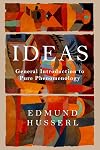
Husserl's Ideas is one of the most important works of twentieth-century philosophy, offering a detailed introduction to the phenomenological method, including the reduction, and outlining the overall scope of phenomenological philosophy. Husserl's explorations of the a priori structures of intentionality, consciousness, perceptual experience, evidence and rationality continue to challenge contemporary philosophy of mind. Dan Dahlstrom's accurate and faithful translation, written in pellucid show more prose and in a fluid, modern idiom, brings this classic work to life for a new generation. --Dermot Moran, University College, Dublin show less
Ideas Pertaining to a Pure Phenomenology and to a Phenomenological Philosophy: First Book: General Introduction to a Pure Phenomenology (Husserliana: Edmund Husserl – Collected Works, 2) by Edmund Husserl
Although I think this book has a few really great ideas (the depsychologization of the ego in particular), it's really outshone by a LOT of stuff that came after it. I got 60% through and put it down out of boredom.
Lists
Awards


You May Also Like


Associated Authors
Statistics
- Works
- 167
- Also by
- 9
- Members
- 4,321
- Popularity
- #5,808
- Rating
- 3.9
- Reviews
- 36
- ISBNs
- 490
- Languages
- 24
- Favorited
- 7


