
Jacques Derrida (1930–2004)
Author of Of Grammatology
About the Author
Jacques Derrida was born in El-Biar, Algeria on July 15, 1930. He graduated from the École Normal Supérieure in 1956. He taught philosophy and logic at both the University of Paris and the École Normal Supérieure for around 30 years. His works of philosophy and linguistics form the basis of the show more school of criticism known as deconstruction. This theory states that language is an inadequate method to give an unambiguous definition of a work, as the meaning of text can differ depending on reader, time, and context. During his lifetime, he wrote more than 40 books on various aspects of deconstruction including Of Grammatology, Glas, The Postcard: From Socrates to Freud and Beyond, and Ulysses Gramophone: Hear Say Yes in Joyce. He died of pancreatic cancer on October 9, 2004 at the age of 74. (Bowker Author Biography) show less
Image credit: Jacques Derrida, 1994
Series
Works by Jacques Derrida
Specters of Marx: The State of the Debt, The Work of Mourning & the New International (1993) 867 copies, 5 reviews
Philosophy in a Time of Terror: Dialogues with Jurgen Habermas and Jacques Derrida (2003) 290 copies, 6 reviews
Questioning Judaism: Interviews by Elisabeth Weber (Cultural Memory in the Present) (2004) 20 copies
Ulysse gramophone ; Deux mots pour Joyce (Collection La Philosophie en effet) (French Edition) (1987) 20 copies, 1 review
Deconstruction in a Nutshell: A Conversation with Jacques Derrida, With a New Introduction (Perspectives in Continental Philosophy) (2020) 12 copies
Einige Statements und Binsenweisheiten über Neologismen, New-Ismen, Post-Ismen, Parasitismen und andere kleine Seismen (1997) 9 copies
El tiempo de una tesis: puntuaciones Desconstrucción e implicaciones conceptuales ANTHROPOS BOOKS (Spanish Edition) (1997) 7 copies
FIRMA, ACONTECIMIENTO, CONTEXTO 4 copies
Sob Palavra Instantâneos Filosóficos 3 copies
Carta a un amigo japonés 3 copies
Las artes del espacio 3 copies
Derrida 3 copies
Racism's last word 3 copies
TEOLOGÍA DE LA TRADUCCIÓN 2 copies
PSYCHÉ: INVENCIONES DEL OTRO 2 copies
Entrevista con Christian Descamps 2 copies
Del materialismo no dialéctico 2 copies
ENVÍO 2 copies
El filósofo y los arquitectos 2 copies
NOMBRE DE PILA DE BENJAMIN 2 copies
Yo - el psicoanálisis 2 copies
SOBRE UNA TRAMA GRIS 2 copies
LA RETIRADA DE LA METÁFORA 2 copies
+ R (además) 2 copies
MALLARMÉ 2 copies
LOS FINES DEL HOMBRE 2 copies
LINGÜÍSTICA Y GRAMATOLOGÍA 2 copies
EXERGO 2 copies
ESPERARSE (EN) LA LLEGADA 2 copies
Dos ensayos 2 copies
DECONSTRUIR LA ACTUALIDAD 2 copies
ESCOGER SU HERENCIA 2 copies
SOBRE LA MENTIRA EN POLÍTICA 2 copies
SOBRE LA FENOMENOLOGÍA 2 copies
EL CINE Y SUS FANTASMAS 2 copies
A CORAZÓN ABIERTO 2 copies
FREUD Y LA ESCENA DE LA ESCRITURA 2 copies
TÍMPANO 2 copies
ELIPSIS 2 copies
LA PALABRA SOPLADA 2 copies
L'Ethique du don : Jacques Derrida et la pensée du don : colloque de Royaumont, décembre 1990 (1992) 2 copies
Sopra-vivere 2 copies
Jacques Derrida 2 copies
Torres De Babel 2 copies
COGITO E HISTORIA DE LA LOCURA 2 copies
La conférence de Heidelberg (1988) : Heidegger, portée philosophique et politique de sa pensée (2014) 2 copies
واسازی هگل 1 copy
Given Time II 1 copy
EL PAPEL O YO, ¡QUÉ QUIERE QUE LE DIGA...! (NUEVAS ESPECULACIONES SOBRE UN LUJO DE LOS POBRES) 1 copy
Elogio del psicoanálisis 1 copy
EL ‘TRATAMIENTO’ DEL TEXTO 1 copy
Adis̤ 1 copy
Perjury and pardon 1 copy
EL SACRIFICIO 1 copy
Le siècle et le pardon 1 copy
DIRE L'ÉVÉNEMENT, EST-CE POSSIBLE ?: Séminaire de Montréal, pour Jacques Derrida (French Edition) (2001) 1 copy
Útisetur : samband geðlækninga, bókmennta og siðmenningar : greinar — Author — 1 copy
Morada 1 copy
Davet - Konukseverlik Üstüne: Dufourmantelle Derrida'yi Konukseverligin Sorumlulugunu Almaya Davet Ediyor (2020) 1 copy
Thinking What Comes, Volume 1: Essays, Interviews, and Interventions (The Frontiers of Theory) (2024) 1 copy
Mal de archivo 1 copy
La Voce E Il Fenomeno 1 copy
Verita Figura Visione 1 copy
Arkivfeber 1 copy
EN FAVOR DE MUMIA ABU-JAMAL 1 copy
La lingüística de Rousseau 1 copy
Résistances 1 copy
promesse 1 copy
Der Meineid, vielleicht: ("jähe syntaktische Sprünge") (Passagen forum) (German Edition) (2020) 1 copy
Scrittura e rivoluzione 1 copy
Ki az anya? 1 copy
Jacques Derrida studies 1 copy
Razmisliti subjektil 1 copy
Economimesis — Author — 1 copy
Derrida en castellano 1 copy
Izbrani spisi o religiji 1 copy
Come non essere postmoderni 1 copy
A Maurice Blanchot 1 copy
IR DESPACIO 1 copy
HOY EN DÍA 1 copy
Implicaciones 1 copy
Index 1 copy
JUSTICIA Y PERDÓN 1 copy
EL LIBRO POR VENIR 1 copy
AMISTAD INCOMBUSTIBLE 1 copy
LOS ÚLTIMOS MARRANOS 1 copy
MARX NO ES UN DON NADIE 1 copy
UNA FILOSOFÍA DECONSTRUCTIVA 1 copy
Desde el otro lado del mundo 1 copy
UN TEMOIN DE TOUJOURS 1 copy
RÉFLEXION SUR L’ÉTAT ACTUEL ET LES PERSPECTIVES DE L’ENSEIGNEMENT DE LA PHILOSOPHIE EN FRANCE 1 copy
Derrida - Cronologia 1 copy
Jacques Derrida index 1 copy
LOUIS ALTHUSSER 1 copy
LA METÁFORA ARQUITECTÓNICA 1 copy
Las voces de Artaud 1 copy
carta 1 copy
LA LENGUA NO PERTENECE 1 copy
TENDRÉ QUE ERRAR SOLO 1 copy
LA DEMOCRACIA COMO PROMESA 1 copy
LA DEMOCRACIA, PARA OTRO DÍA 1 copy
Entrevista 1 copy
Associated Works
Storming the Reality Studio: A Casebook of Cyberpunk and Postmodern Science Fiction (1991) — Contributor — 263 copies
Ghostly Demarcations: A Symposium on Jacques Derrida's Specters of Marx (1999) — Contributor — 134 copies
Die "Spur" im Werk Paul Celans:. Eine 'wiederholte' Lesung Jacques Derridas (2001) — Associated Name — 2 copies
On Distsance and Intimacy — Contributor — 1 copy
Spindel Conference 1993 : Derrida's interpretation of Husserl (Southern journal of philosophy; 32. Supplement) — Contributor — 1 copy
詩と思想 1989年 03月号 — Contributor — 1 copy
Tagged
Common Knowledge
- Canonical name
- Derrida, Jacques
- Legal name
- Derrida, Jacques
- Other names
- Derrida, Jackie Élie (birth)
- Birthdate
- 1930-07-15
- Date of death
- 2004-10-09
- Gender
- male
- Education
- University of Paris (doctorat d'État|1980)
École Normale Supérieure (BA|MA)
Lycée Louis-le-Grand, Paris, France - Occupations
- philosopher
professor
literary critic
linguist
historian - Organizations
- Ecole des hautes études en sciences sociales (Professeur, Directeur d'études, Philosophie, 1984 (Professeur, Directeur d'études, Philosophie, 19 84)
Ecole normale supérieure, Paris (Maître-assistant, Histoire, 1964 | 1984)
Faculté des lettres de Paris (Assistant, Philosophie, 1960 | 1964)
Lycée Montesquieu, Mans, Sarthe (Professeur, Philosophie, 1959 1960)
Armée française, Service militaire (Enseignant à Alger, 1957 | 1959)
Université Yale, New Haven, Connecticut, Etats-Unis (Professeur invité, 19 75) (show all 9)
Université Cornell, New York, Etats-Unis (A. D. White Professor-at-large, 19 75)
Université de Californie à Irvine (Distinguished Professor, 19 86 | )
Collège international de philosophie (Co-fondateur, 19 83) - Awards and honors
- Theodor Adorno Prize (2001)
Foreign Honorary Member, American Academy of Arts & Sciences (1985) - Relationships
- Derrida, Marguerite (spouse/widow)
Alferi, Pierre (child) - Short biography
- Jacques Derrida was the third of five children born in French Algeria to a Sephardic Jewish family originally from Spain. His studies were interrupted when the Vichy regime banned Jewish children from education during World War II. Derrida was fascinated by philosophy from a young age. In 1949, he moved to Paris, where he attended lycée and prepared for the entrance exam for the prestigious École Normale Supérieure. He failed his first attempt at this exam, but passed on his second try in 1952. Derrida entered the École Normale as part of a remarkable generation that included Foucault, Althusser, Lyotard, Barthes, and Marin. At the École Normale, Derrida studied philosophy and focused on the work of Edmund Husserl. He became particularly interested in analyzing the writing of philosophy itself. In the 1960s, he published several articles in Tel Quel, France's forum for leftist avant-garde theory, and wrote reviews of books on history and the nature of writing for the journal Critique. He developed a method of identifying patterns within the act of writing, which he termed "deconstruction." These would be the foundation of Derrida's highly influential work Of Grammatology (1967). Derrida was invited to the USA in 1967 by Johns Hopkins University, where he delivered his lecture "Structure, Sign, and Play in the Discourse of the Human Sciences," which won him international acclaim. He taught at the Ecole Normale Supérieur from 1965 to 1984, and divided much of his time between Paris and American universities such as Johns Hopkins, New York University, and Yale. He became the director of the École des Hautes Études en Science Sociales in Paris. In 1986, he was named Professor of Philosophy, French and Comparative Literature at the University of California, Irvine, where he taught until shortly before his death in 2004. He was involved in numerous political causes, fighting for the rights of Algerian immigrants in France, against apartheid, and for the rights of Czech dissidents. His works are among the most frequently-cited by other academics in a wide range of fields, particularly in literary criticism and philosophy.
- Cause of death
- pancreatic cancer
- Nationality
- France
- Birthplace
- El-Biar, French Algeria
- Places of residence
- El-Biar, Algeria (birth)
Paris, France - Place of death
- Paris, France
- Burial location
- Cimetière communal, Ris-Orangis, Essonne, Île-de-France, France
- Associated Place (for map)
- France
Members
Discussions
Jacques Derrida in Legacy Libraries (June 2015)
Reviews
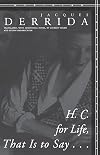
Ever since I have known her, I have read her and I keep forgetting that she writes, and I forget what she writes. This forgetting is not a forgetting like any other; it is elemental, I probably live on it.
This book is collected and edited from a lecture Derrida gave at a Cixous Conference in 1998. H.C. For Life crackles even as it retreats, asserting and then reframing. The questions it poses are almost benign taunts. Derrida is cautious and still playful, ever mindful of the brackets he show more employs. I now read Derrida under the advice of Richard Rorty. Mine is a reading of bemused wonder, especially under these heightened circumstances. I have lavished praise on the bond between Cixous and Derrida elsewhere. Their links are knotted and braided with an astonishing poetry. The situation is no different here. Derrida examines Cixous writing about her father. He explores the sense of speed and velocity in her prose. The language is sumptuous to the degree of indulgence. I admit to having no regrets. Homonyms reign here, a situation not well suited for translation. An exploration of the words for "side" and "rib" make for fascinating footnotes.
There was a subsequent reading of Cixous's whimsy about her "Uncle Freud" and in the process Derrida lost me. It has happened in most of my reading of him: I am fine and then suddenly lost. Thankfully my bearings were recovered and I finished the book in awe. show less
This book is collected and edited from a lecture Derrida gave at a Cixous Conference in 1998. H.C. For Life crackles even as it retreats, asserting and then reframing. The questions it poses are almost benign taunts. Derrida is cautious and still playful, ever mindful of the brackets he show more employs. I now read Derrida under the advice of Richard Rorty. Mine is a reading of bemused wonder, especially under these heightened circumstances. I have lavished praise on the bond between Cixous and Derrida elsewhere. Their links are knotted and braided with an astonishing poetry. The situation is no different here. Derrida examines Cixous writing about her father. He explores the sense of speed and velocity in her prose. The language is sumptuous to the degree of indulgence. I admit to having no regrets. Homonyms reign here, a situation not well suited for translation. An exploration of the words for "side" and "rib" make for fascinating footnotes.
There was a subsequent reading of Cixous's whimsy about her "Uncle Freud" and in the process Derrida lost me. It has happened in most of my reading of him: I am fine and then suddenly lost. Thankfully my bearings were recovered and I finished the book in awe. show less

Spurs (Eperons in the original French) is Derrida's treatment of Nietzsche's styles, which is to say his stylus, which is rather his phallus, approached through its apparent complement, Nietzsche's representation of "woman." Nietzsche is justifiably famous for both the seeming lucidity of his prose and the archness of his wordplay; Derrida is justly notorious for the opacity of his prose and the profundity of his wordplay. (The hieratically arcane Pierre Klossowski also deserves some show more mention, in consequence of Derrida's reliance on his translations of Nietzsche.) This combination cannot but awesomely challenge the stoutest of translators, and my hat is off to Barbara Harlow for even attempting the English contents of this volume. Still, as if in admission of the practical impossibility of a translator doing full justice to the text, the original French is reproduced here in parallel.
An introduction is furnished by Stefano Agosti, who insists that "If one is going to speak of Derrida's 'text', one can, finally, but re-state it, only prolong it" (25). Accordingly, Agosti tries to extend and outdo Derrida's verbal convolutions, to the point where the English translation (I cannot vouch for the French) becomes a nearly unreadable blow to the head. (The lexical touchstone of Agosti's introduction is the coup.)
Despite the elegance of the design, with its tallish page dimensions and enigmatic drawings by Francois Loubrieu, I fault this edition severely for its typography. In the English text (the French seems better managed) there are routine substitutions of em dashes for hyphens, hyphens for en dashes, and so forth. Especially in the context of Derrida's inventive vocabulary and his sometimes halting, digressive presentation, these confusions of punctuation are unkindnesses to the reader. Likewise, the use in both the French and the English translation of French double-angle quote marks, and only French double-angle quote marks, creates serious hazards of reading. Spurs often finds Derrida quoting Nietzsche quoting another -- even if this last is merely scare quotes -- and these nested quotes quickly become entangled, so that the compounded intertext sometimes requires a diligent reader to go back to the start of the paragraph and count the marks inward to the verbiage at stake. This last process is hardly assisted by the short lines, the lack of either indentations or line spacing at the paragraph breaks, and the absence of full justification. (The text is merely left-justified.) And parentheses are an instrument of abuse similar to the quotation marks.
But intellectual frustration is in many ways the goal of the book. Ultimately, Spurs is concerned with the undecidability of signification and the ways in which texts undergo their loss of contexts. These themes are implicitly demonstrated throughout, becoming gradually more overt, and fully explicit only in the penultimate section on "Abysses of truth" and a sort of coda: " 'I have forgotten my umbrella'." At the last, Derrida insists that his own writing (like Nietzsche's) is "indecipherable ... cryptic and parodying" (137). The disingenuous denial of the anamnesis of the umbrella is a failure to forget the phallus, an exposure of the simultaneous ubiquity and absence of sexual difference. Read it if you must. show less
An introduction is furnished by Stefano Agosti, who insists that "If one is going to speak of Derrida's 'text', one can, finally, but re-state it, only prolong it" (25). Accordingly, Agosti tries to extend and outdo Derrida's verbal convolutions, to the point where the English translation (I cannot vouch for the French) becomes a nearly unreadable blow to the head. (The lexical touchstone of Agosti's introduction is the coup.)
Despite the elegance of the design, with its tallish page dimensions and enigmatic drawings by Francois Loubrieu, I fault this edition severely for its typography. In the English text (the French seems better managed) there are routine substitutions of em dashes for hyphens, hyphens for en dashes, and so forth. Especially in the context of Derrida's inventive vocabulary and his sometimes halting, digressive presentation, these confusions of punctuation are unkindnesses to the reader. Likewise, the use in both the French and the English translation of French double-angle quote marks, and only French double-angle quote marks, creates serious hazards of reading. Spurs often finds Derrida quoting Nietzsche quoting another -- even if this last is merely scare quotes -- and these nested quotes quickly become entangled, so that the compounded intertext sometimes requires a diligent reader to go back to the start of the paragraph and count the marks inward to the verbiage at stake. This last process is hardly assisted by the short lines, the lack of either indentations or line spacing at the paragraph breaks, and the absence of full justification. (The text is merely left-justified.) And parentheses are an instrument of abuse similar to the quotation marks.
But intellectual frustration is in many ways the goal of the book. Ultimately, Spurs is concerned with the undecidability of signification and the ways in which texts undergo their loss of contexts. These themes are implicitly demonstrated throughout, becoming gradually more overt, and fully explicit only in the penultimate section on "Abysses of truth" and a sort of coda: " 'I have forgotten my umbrella'." At the last, Derrida insists that his own writing (like Nietzsche's) is "indecipherable ... cryptic and parodying" (137). The disingenuous denial of the anamnesis of the umbrella is a failure to forget the phallus, an exposure of the simultaneous ubiquity and absence of sexual difference. Read it if you must. show less
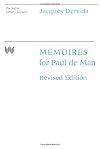
The reader is bound to history, but not the exclusive history of the time of reading. Slipping perspectives can result in backshading, a coloring of a text by subsequent developments. Paul de Man wrote some pieces during WWII, taken together they appear to contradict one another. Some of the pieces are morally horrific but not exclusively such by what he knew at that time. They are grossly horrific by what the reader knows now, after the fact. Derrida wrote about his friend almost 40 years show more ago just after de Man's death. Derrida is now dead. There are factions which continue to debate the legacy of both men. The suggestion of that may foster a smile. Yet what if questions of collaboration across Europe were soon debated, considered an opinion? Would we still be smiling?
There is a plea at the core of these pieces. I found the plea sincere. show less
There is a plea at the core of these pieces. I found the plea sincere. show less

Well, Derrida, I have realized many things about you over the years but I never realized until now that you are Thomas Kuhn! The unique event at the centre is the thing that defines the eventless ontological steady state of the structure, makes the world comprehensible. The centre in this sense is also the beginning and the end—this is more Derridean. And but in addition to that which it excludes, there is that which it can be made to encompass—there is play in it, and when we recognize show more the centre as not transcendental but instead constructed, discursive, then the play in the structure becomes the place where everything interesting happens.
D calls out Nietzsche and Freud as the classic precursors of this classic idea; it is traditional (cf. e.g. Foucault) to also include Marx, but he was no radical decenterer, merely (and I love the man) a determinist and positivist who thought things had to change. (There’s a lot there—the Marxist Revolution is the classic Event as beginning and end, destroying and founding, and yet there is no kind of relativism in the way he treats it, contrary to the perspective that would find such a relativism inevitable—and this is what I find so troubling about latter-day Marxists in the being-and-event- mould like Badiou and Žižek, this dictatorial streak—and I used to value Marxism as myth and execrate it as economics but now I wonder if the reverse might help reclaim Karl himself and remove some contradictions. Why am I writing about Marx?).
(There is also Einstein, the decenterer of the physical universe, though I think he was horrified to have himself grouped with this crew; and of course many others.)
Anyway, Derrida also includes Heidegger, and makes the evergreen observation that as he regarded Nietzsche as “the last Platonist,” we could also do the same for him, and so on, and discourse in a sense is a destroying-each-other-mutually. But the point isn’t metaphysics here but instead the human sciences specifically. Derrida’s project is moving “beyond philosophy,” though of course he just ended up reinscribing the structure and forcing philosophers to choose between a rigid “logical positivism” and a “continentalism” that is more sophisticated—more “heuristic” and less “algorithmic” about its pieties, by which I mean to convey a difference between the same situation of guided but not determined variation with the focus placed on the variation, in the case of heuristic continentals, and the guidedness or patternization, in that of the Anglo-Americans. At some point we are always reducing something in order to understand and describe it, and the point is just—at what point. We don’t criticize the linguist for describing the grammar of a language based on only an infinitesimal fraction of the utterances in that language, as Derrida notes, but it is best to remain open to question of what is nevertheless lost, what play in the “floating signifier” occluded.
And so to the names above let me also add the linguist Whorf, who took the Boas–Sapir structure of Weltansichten and pushed it into conflicted relativistic territory (but who I think like Marx was ultimately a positivist icon-breaker, a truthseeker and no relativist). Ethnography, Derrida notes with great truth, is the beginning of a relativism that matters; Being is really always just Being, no matter how we may conceive of it, until it is infiltrated by (ways of) Seeing (words, cultures, &c., but always irreducibly, interpretation—and this is why determinism is always a little gross-feeling; it takes away the agency which is our birthright).
The first time I encountered this piece, thirteen years ago now(!), it seemed like a work of metaphysics itself, but—and this is heartening—it has subsided to what seems like a more proper state: a work of idiosyncratic, oblique, scholarlily lax but intellectually dazzling intellectual history with epistemological overtones and a gentle polemic against structuralism (that still gives all credit to the structuralists for identifying the same issues, for example Lévi-Strauss on the natural/cultural dual nature of the incest prohibition, contrary to Derrida’s reputation as a big self-promoter—this leads us on to the binary blah blah, which is fine and all but not the most interesting part of this essay as I revisit it). And really cogent, which is weird to write: have I learned so much that I can handle this stuff with ease, or just spent so long in a world where difference-deferral and the gradient nature of the ontological and the linguistic and the mythopoeic and the historic (my version of a definition of bricolage, which I think this essay bears out—by adding “scientific” at the end are we completing a circle back to “ontological”?) are basic assumptions that the emperor now seems clothed? Depends on your discourse, I guess, but this essay still seems magnificent to me. As Derrida observes regarding the ethics of Nietzsche, the embrace of the noncentre is not the loss of the centre: it is freedom to take the centre or leave it, every minute of every day. Freed from the requirement of decipherment, our contradictions “reconcile[d] in an obscure economy,” let us play. show less
D calls out Nietzsche and Freud as the classic precursors of this classic idea; it is traditional (cf. e.g. Foucault) to also include Marx, but he was no radical decenterer, merely (and I love the man) a determinist and positivist who thought things had to change. (There’s a lot there—the Marxist Revolution is the classic Event as beginning and end, destroying and founding, and yet there is no kind of relativism in the way he treats it, contrary to the perspective that would find such a relativism inevitable—and this is what I find so troubling about latter-day Marxists in the being-and-event- mould like Badiou and Žižek, this dictatorial streak—and I used to value Marxism as myth and execrate it as economics but now I wonder if the reverse might help reclaim Karl himself and remove some contradictions. Why am I writing about Marx?).
(There is also Einstein, the decenterer of the physical universe, though I think he was horrified to have himself grouped with this crew; and of course many others.)
Anyway, Derrida also includes Heidegger, and makes the evergreen observation that as he regarded Nietzsche as “the last Platonist,” we could also do the same for him, and so on, and discourse in a sense is a destroying-each-other-mutually. But the point isn’t metaphysics here but instead the human sciences specifically. Derrida’s project is moving “beyond philosophy,” though of course he just ended up reinscribing the structure and forcing philosophers to choose between a rigid “logical positivism” and a “continentalism” that is more sophisticated—more “heuristic” and less “algorithmic” about its pieties, by which I mean to convey a difference between the same situation of guided but not determined variation with the focus placed on the variation, in the case of heuristic continentals, and the guidedness or patternization, in that of the Anglo-Americans. At some point we are always reducing something in order to understand and describe it, and the point is just—at what point. We don’t criticize the linguist for describing the grammar of a language based on only an infinitesimal fraction of the utterances in that language, as Derrida notes, but it is best to remain open to question of what is nevertheless lost, what play in the “floating signifier” occluded.
And so to the names above let me also add the linguist Whorf, who took the Boas–Sapir structure of Weltansichten and pushed it into conflicted relativistic territory (but who I think like Marx was ultimately a positivist icon-breaker, a truthseeker and no relativist). Ethnography, Derrida notes with great truth, is the beginning of a relativism that matters; Being is really always just Being, no matter how we may conceive of it, until it is infiltrated by (ways of) Seeing (words, cultures, &c., but always irreducibly, interpretation—and this is why determinism is always a little gross-feeling; it takes away the agency which is our birthright).
The first time I encountered this piece, thirteen years ago now(!), it seemed like a work of metaphysics itself, but—and this is heartening—it has subsided to what seems like a more proper state: a work of idiosyncratic, oblique, scholarlily lax but intellectually dazzling intellectual history with epistemological overtones and a gentle polemic against structuralism (that still gives all credit to the structuralists for identifying the same issues, for example Lévi-Strauss on the natural/cultural dual nature of the incest prohibition, contrary to Derrida’s reputation as a big self-promoter—this leads us on to the binary blah blah, which is fine and all but not the most interesting part of this essay as I revisit it). And really cogent, which is weird to write: have I learned so much that I can handle this stuff with ease, or just spent so long in a world where difference-deferral and the gradient nature of the ontological and the linguistic and the mythopoeic and the historic (my version of a definition of bricolage, which I think this essay bears out—by adding “scientific” at the end are we completing a circle back to “ontological”?) are basic assumptions that the emperor now seems clothed? Depends on your discourse, I guess, but this essay still seems magnificent to me. As Derrida observes regarding the ethics of Nietzsche, the embrace of the noncentre is not the loss of the centre: it is freedom to take the centre or leave it, every minute of every day. Freed from the requirement of decipherment, our contradictions “reconcile[d] in an obscure economy,” let us play. show less
Lists
Awards

You May Also Like


Associated Authors
Statistics
- Works
- 400
- Also by
- 33
- Members
- 19,738
- Popularity
- #1,102
- Rating
- 3.8
- Reviews
- 106
- ISBNs
- 1,004
- Languages
- 25
- Favorited
- 45


