

Jean-François Lyotard (1924–1998)
Author of The Postmodern Condition: A Report on Knowledge
About the Author
The late Jean-Francois Lyotard was Emeritus Professor of Philosophy at the University of Paris-VIII and Professor of Humanities at Emory University
Works by Jean-François Lyotard
The Hyphen : Between Judaism and Christianity (Philosophy and Literary Theory) (1999) 14 copies, 1 review
L'assassinat de l'experience par la peinture, Monory (Collection "Le Mot et la forme") (French Edition) (1984) 4 copies
"Aesthetics and Theory of Art". "Contemporary Artists". Writings on Contemporary Art and Artists (2012) 3 copies
Gestus 1 copy
¿POR QUÉ FILOSOFAR? 1 copy
La fenomenología 1 copy
KUSHTI POSTMODERN 1 copy
ポストモダン通信 こどもたちへの10の手紙 1 copy
Conditia postmoderna 1 copy
Flora danica: La secession du geste dans la peinture de Stig Brøgger (Incises) (French Edition) (1997) 1 copy
Inumanul 1 copy
Karel Appel, A Gesture of Colour (Jean-Francois Lyotard: Writings on Contemporary Art and Artists) (2009) 1 copy
Lyotard og striden 1 copy
La fenomenología 1 copy
Anamnesis: Of the Visible 1 copy
Le travail et l'écrit chez Daniel Buren : une introduction à la philosophie des arts contemporains 1 copy
Condiția postmodernă 1 copy
Der Widerstreit 1 copy
Le Travail et l'Ecrit chez Daniel Buren: Une introductionà la philosophie des arts contemporains 1 copy
Discours, figure 1 copy
Adorno as the Devil 1 copy
Associated Works
Storming the Reality Studio: A Casebook of Cyberpunk and Postmodern Science Fiction (1991) — Contributor — 263 copies
Révolution et contre-révolution en Chine: des origines à 1949 (1982) — Preface, some editions — 2 copies
エピステーメーII 3号 特集 エマニュエル・レヴィナス — Contributor — 1 copy
ユリイカ 詩と批評 1985年 06月号 — Contributor — 1 copy
Tagged
Common Knowledge
- Canonical name
- Lyotard, Jean-François
- Other names
- Laborde, François (Pseudonyme)
- Birthdate
- 1924-08-10
- Date of death
- 1998-04-21
- Gender
- male
- Education
- Sorbonne, Université de Paris (M.A.|1947)
Université Paris X (Ph.D|1971) - Occupations
- philosopher
university professor - Organizations
- Université de Paris VIII Vincennes (Professeur, 1972l1987)
Université Paris 1 Sorbonne (Maître de conférences, 1970l1972)
Université Paris X (1967l1970)
Faculté de la Sorbonne (1959l1967)
Prytanée national militaire de La Flèche (Professeur, 1952l1956)
Lycée de Constantine, Algérie (Professeur, 1950l1952) - Relationships
- Dufrenne, Mikel (Directeur de thèse)
Enaudeau, Corinne (Fille)
Gandillac, Maurice de (Professeur) - Cause of death
- leukemia
- Nationality
- France
- Birthplace
- Versailles, Yvelines, Île-de-France, France
- Place of death
- Paris, Île-de-France, France
- Burial location
- Pere Lachaise Cemetery, Division 6, Paris, France
- Associated Place (for map)
- Île-de-France, France
Members
Reviews

Postmoderne expliqué aux enfants could potentially be read as "The New Aeon Explained for Babes of the Abyss." Lyotard suggests that modernity is characterized by a critical position common to Augustine and Kant, contrasting with the "empiricocritical or pragmatic" posture of the postmodern (63). Technoscience and capital together have effected an "escape of reality from the metaphysical" (9).
The author has sometimes been misunderstood as an advocate for the postmodern, rather than a show more diagnostician of it, and in several pieces of the correspondence collected here the reader can see his frustration that the public misses his opposition to "capitalism's regime of pseudorationality and performativity" (73). He is not at all smug about the demise of the elements of modernity that give way to the postmodern, but he is also convinced and convincing that retreat to the modern is not a viable option.
In discussing the failure of modern strategies of legitimation, he glosses Hegel to the effect that "the sole normative instance, the sole source of law, the sole y, is pure will -- which is never this or that, never determined, but simply the potential to be all things. So it judges any particular act, even when it is prescribed by law and executed according to the rules, as failing to live up to the ideal. Terror acts on the suspicion that nothing is emancipated enough -- and makes it into a politics" (54). While the ideology of capitalism does not itself give rise to such terror (because it deals in evanescent needs rather than final norms), it is still vulnerable to it, in ways that have become ever more evident in the decades since Lyotard wrote the "Memorandum on Legitimation" that is the longest of the missives and essays collected here.
The afterword by Wlad Godzich constitutes an insightful summary of Lyotard's efforts prior to the publication of Postmoderne expliqué, and it might be profitable to read it first for those who have no previous familiarity with either The Postmodern Condition or The Differend. Reading it myself, I conclude that it will indeed be the child who will master the aeon, but I also register how difficult the achievement of childhood is becoming. show less
The author has sometimes been misunderstood as an advocate for the postmodern, rather than a show more diagnostician of it, and in several pieces of the correspondence collected here the reader can see his frustration that the public misses his opposition to "capitalism's regime of pseudorationality and performativity" (73). He is not at all smug about the demise of the elements of modernity that give way to the postmodern, but he is also convinced and convincing that retreat to the modern is not a viable option.
In discussing the failure of modern strategies of legitimation, he glosses Hegel to the effect that "the sole normative instance, the sole source of law, the sole y, is pure will -- which is never this or that, never determined, but simply the potential to be all things. So it judges any particular act, even when it is prescribed by law and executed according to the rules, as failing to live up to the ideal. Terror acts on the suspicion that nothing is emancipated enough -- and makes it into a politics" (54). While the ideology of capitalism does not itself give rise to such terror (because it deals in evanescent needs rather than final norms), it is still vulnerable to it, in ways that have become ever more evident in the decades since Lyotard wrote the "Memorandum on Legitimation" that is the longest of the missives and essays collected here.
The afterword by Wlad Godzich constitutes an insightful summary of Lyotard's efforts prior to the publication of Postmoderne expliqué, and it might be profitable to read it first for those who have no previous familiarity with either The Postmodern Condition or The Differend. Reading it myself, I conclude that it will indeed be the child who will master the aeon, but I also register how difficult the achievement of childhood is becoming. show less
The Postmodern Condition: A Report on Knowledge (Theory and History of Literature, Volume 10) by Jean-Francois Lyotard
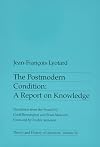
Well before Big Data there were ominous whispers. That is how I recall this book's bark at my door: fear tinged with the excitement of change Sometime between the collapse of the Wall and the Towers, I was forever fearful of a mis-step. The world was tumultuous and I lacked all grace. I was late to the Theory party. I was blind drunk on my Nietzsche, sort of mumbled through the grotesque parts of Foucault (though it was his biographies that have resonated) with Derrida and the Rhizome Twins show more (D and G) just too cool for school. Out of that rave this text resonated. It simply asked, theoretically what can we adhere towards, lacking a legitimate metanarrative, we are orphans, without a heritage or metaphysical hope. Of course it was stagecraft, we -- readers of Lyotard -- weren't being hunted in streets nor blasted by unmanned weapon platforms. The Postmodern Condition is a placeholder. It works best temporarily. Planned ignoring is suitable strategy after the fact. show less
A short, oddly readable work in which Lyotard argues that the twentieth century has seen an upswing in cynicism that rejects societal ideologies or metanarratives. Postmodernism is a rejection of the notion of universal truths, as there is no "view from nowhere" and every speaker has a bias imprinted upon his or her speech and viewpoints. With this realization comes the breakdown of the "grand narrative" of Western thought.
Oddly, writing this in the 1970s, Lyotard champions the computer as show more an answer against the potential for nihilism that arises out of postmodernism. It allows for knowledge that is both accessible and decentralized, to allow for local dialogues and a broader range of ideas without imposing the same universal Truth upon discussions by affirming only a single, indisputable Knowledge. It's too bad he died in 1998, before the real Internet boom. Maybe he'd have recanted his position after witnessing the localized internet metanarratives like LOLcats and FML :-p show less
Oddly, writing this in the 1970s, Lyotard champions the computer as show more an answer against the potential for nihilism that arises out of postmodernism. It allows for knowledge that is both accessible and decentralized, to allow for local dialogues and a broader range of ideas without imposing the same universal Truth upon discussions by affirming only a single, indisputable Knowledge. It's too bad he died in 1998, before the real Internet boom. Maybe he'd have recanted his position after witnessing the localized internet metanarratives like LOLcats and FML :-p show less
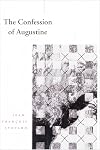
I'm pretty sure going through Lyotard is one of the only ways I can stomach Augustine: "... the divine solicitor, the judge wonders.... What game is he playing with me, pleading one hundred percent guilty? Trying to snatch some sympathy from me."
Lists
Awards


You May Also Like


Associated Authors
Statistics
- Works
- 102
- Also by
- 9
- Members
- 3,987
- Popularity
- #6,331
- Rating
- 3.7
- Reviews
- 19
- ISBNs
- 277
- Languages
- 21
- Favorited
- 3

