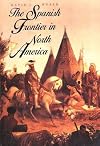
The Spanish Frontier in North America
by David J. Weber
On This Page
Description
From the Publisher: In 1513, when Ponce de Leon stepped ashore on a beach of what is now Florida, Spain gained its first foothold in North America. For the next three hundred years, Spaniards ranged through the continent building forts to defend strategic places, missions to proselytize Indians, and farms, ranches, and towns to reconstruct a familiar Iberian world. This engagingly written and well-illustrated book presents an up-to-date overview of the Spanish colonial period in North show more America. It provides a sweeping account not only of the Spaniards' impact on the lives, institutions, and environments of the native peoples but also of the effect of native North Americans on the societies and cultures of the Spanish settlers. With apt quotations and colorful detail, David J. Weber evokes the dramatic era of the first Spanish-Indian contact in North America, describes the establishment, expansion, and retraction of the Spanish frontier, and recounts the forging of a Hispanic empire that ranged from Florida to California. Weber refutes the common assumption that while the English and French came to the New World to settle or engage in honest trade, the Spaniards came simply to plunder. The Spanish missionaries, soldiers, and traders who lived in America were influenced by diverse motives, and Weber shows that their behavior must be viewed in the context of their own time and within their own frame of reference. Throughout his book Weber deals with many other interesting issues, including the difference between English, French, and Spanish treatment of Indians, the social and economic integration of Indian women into Hispanic society, and the reasons why Spanish communities in North America failed to develop at the rate that the English settlements did. His magisterial work broadens our understanding of the American past by illuminating a neglected but integral part of the nation's heritage. show lessTags
Recommendations















































Member Reviews
When people ask if I picked up any Spanish from my nine years in Los Angeles, I like to say, “Sure: ¡yo quiero Taco Bell!” This may not be technically true, but since the first Taco Bell opened in an L.A. suburb, it’s truthy enough for casual conversation.
Taco Bell is a good avatar for many histories of Spain’s imperial frontier in North America: an expression of American flair refracted through a Hispanic prism that may or may not reflect historical realities. One of this book's strengths is its running dialogue with competing historiographies, from the “Black Legend” of Spanish degeneracy and cruelty to the Boltonian school of whitewashed noble civilizers.
I enjoyed learning more about the northern fringes of colonial New show more Spain, which for three centuries sprawled in fits and starts from Florida to California. David J. Weber’s history is colorful and highly readable. If you’re not sure an Anglo-American academic could do the subject justice, it might help to know that both Spain and Mexico awarded him the highest civil honors available to foreigners.
This book helped me understand why Spain failed to establish its North American colonies on a more permanent footing. For one thing, these regions simply lacked the mineral wealth that made fortunes. Florida, New Mexico, Texas, and California had value as defensive buffers, but other provinces were too profitable for these northern outposts to attract serious settlement.
For another thing, the Spanish economy was a basket case. Aztec and Incan gold inflated Spanish manufacturers out of their own markets. Mercantilist policies sucked resources toward the monarchical center and forbade external trade, stagnating the frontiers. Dominant military priorities stifled and warped local economies. In short, the Spanish fringe was never set up for success against the commercial and military weight of expansive Anglo-American colonists.
I also appreciated Weber’s focus on Spanish influence on indigenous tribes and vice versa, though Hispanic culture predominately overwhelmed tribal societies. The mission system is an example of good intentions gone disastrously wrong as Franciscan determination to Christianize and civilize American tribes fostered epidemics and broke millenia-old lifeways.
The introduction of the horse is another great example. While the mobility provided by horses converted Southeastern hunter-gatherers into commercial fur hunters addicted to European trade goods, it transformed Plains tribes into highly effective and organized war machines. Colonial history is nothing if not a morality play about the law of unintended consequences.
If you have an interest in the history of these regions, this is a great starting point. I’ll also point out that one of Spain’s great defeats at the hands of indigenous warriors happened in Nebraska. Never again would the Spaniards seriously entertain designs on the Great Plains. I guess I can thank the Pawnee and Oto that I live in Lincoln instead of El Pueblo de Hernándo Cortéz de Santa María or whatever. show less
Taco Bell is a good avatar for many histories of Spain’s imperial frontier in North America: an expression of American flair refracted through a Hispanic prism that may or may not reflect historical realities. One of this book's strengths is its running dialogue with competing historiographies, from the “Black Legend” of Spanish degeneracy and cruelty to the Boltonian school of whitewashed noble civilizers.
I enjoyed learning more about the northern fringes of colonial New show more Spain, which for three centuries sprawled in fits and starts from Florida to California. David J. Weber’s history is colorful and highly readable. If you’re not sure an Anglo-American academic could do the subject justice, it might help to know that both Spain and Mexico awarded him the highest civil honors available to foreigners.
This book helped me understand why Spain failed to establish its North American colonies on a more permanent footing. For one thing, these regions simply lacked the mineral wealth that made fortunes. Florida, New Mexico, Texas, and California had value as defensive buffers, but other provinces were too profitable for these northern outposts to attract serious settlement.
For another thing, the Spanish economy was a basket case. Aztec and Incan gold inflated Spanish manufacturers out of their own markets. Mercantilist policies sucked resources toward the monarchical center and forbade external trade, stagnating the frontiers. Dominant military priorities stifled and warped local economies. In short, the Spanish fringe was never set up for success against the commercial and military weight of expansive Anglo-American colonists.
I also appreciated Weber’s focus on Spanish influence on indigenous tribes and vice versa, though Hispanic culture predominately overwhelmed tribal societies. The mission system is an example of good intentions gone disastrously wrong as Franciscan determination to Christianize and civilize American tribes fostered epidemics and broke millenia-old lifeways.
The introduction of the horse is another great example. While the mobility provided by horses converted Southeastern hunter-gatherers into commercial fur hunters addicted to European trade goods, it transformed Plains tribes into highly effective and organized war machines. Colonial history is nothing if not a morality play about the law of unintended consequences.
If you have an interest in the history of these regions, this is a great starting point. I’ll also point out that one of Spain’s great defeats at the hands of indigenous warriors happened in Nebraska. Never again would the Spaniards seriously entertain designs on the Great Plains. I guess I can thank the Pawnee and Oto that I live in Lincoln instead of El Pueblo de Hernándo Cortéz de Santa María or whatever. show less
I got the brief edition of this book by accident, and in a way I regret it, though in terms of available reading time it may be just as well. It gives a good overview of the entire period of Spanish rule in North America north of Mexico, from early explorers (I knew of Coronado and Cabrillo, but not, for instance, Estevao Gomes who found the site of Bangor, Maine) through the early attempts at colonies to the establishment of New Mexico and Florida as more or less solid foundations, despite the Pueblo Revolt (which, at least in this version, gets limited coverage) . He makes clear that the devastating English raids by Governor Moore and his Native allies around 1700 effectively reduced what had been a fairly stable network of show more mission/Native settlements in Florida to a handful of garrisons, which it remained thereafter. On the other hand, the adoption of a more intelligent policy that "bad peace is better than good war" by the Galvez and other late 18th century leaders restablized the Texas/New Mexico frontier after the impact of the Comanche and Apache adoption of horses and guns had given them serious tactical advantages. He also describes the mixed impact of the Spanish on the Natives of California. His version of the Adams/Onis Treaty says less about Andrew Jackson's military pressure on Florida than some accounts. He has a brief chapter on the rival hostile and romantic accounts of Spanish influence in later American culture, seeing the romantic image (adopted largely for tourist purposes) largely absorbing the hostile version. He treats the survival of genuine Spanish culture as virtually non-existent outside New Mexico, and says very little of the revival of Hispanic culture with the 20th century Mexican immigration, though he briefly mentions of Chicano Aztlan movement. show less
I remember reading this during my teaching days, but apparently lacked the time to make notes about it, since I only found in my journal a mention I read it. Overall, it is a thick history book. While the subject was interesting, the prose was very slow.
Ratings
Members
- Recently Added By
Lists

Books in the Bibliography of Contested Continent by Peter Mancall
495 works; 1 member
Author Information

40+ Works 962 Members
David J. Weber is Dedman Professor of History and director of the William P. Clements Center for Southwestern Studies at Southern Methodist University.
Awards and Honors
Awards
Notable Lists
Series
Belongs to Publisher Series
Common Knowledge
- Canonical title
- The Spanish Frontier in North America
- Original publication date
- 1992
- Important places
- American Southwest; Southern States, USA; Spanish America; American West; Viceroyalty of New Spain
- Original language
- English
Classifications
Statistics
- Members
- 339
- Popularity
- 93,869
- Reviews
- 3
- Rating
- (4.11)
- Languages
- English, Spanish
- Media
- Paper, Ebook
- ISBNs
- 8
- ASINs
- 4