On This Page
Description
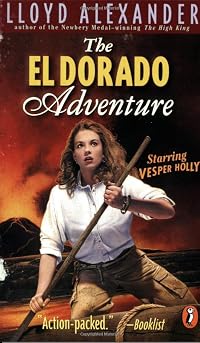
Traveling to Central America to inspect her real estate holdings, seventeen-year-old Vesper tries to stop a villain from building a canal which would destroy an Indian tribe's homeland.Tags
Recommendations


















Member Reviews
It's very difficult not to read these in one sitting. We're off again with Vesper Holly, a female amalgam of Sherlock Holmes and Indiana Jones. They books are narrated by her guardian, Brinnie, very much in the style of Sherlock Holmes, and set in the 1870s.
This one gets extra points for throwing in quite a bit of Spanish (and these were originally published before you had all the internet translators, and mostly before the vast majority of Americans had internet access), and for making a number of allusions to authors and real people that would not be part of the usual 9-13 year old's knowledge set (Rousseau, Simon Bolivar, and Adam Smith among others).
Alexander throws around 'civilized' and 'savage' a bit too much for me. While he show more also sometimes points out that these are false terms, often he doesn't. They may be set in the 1870s, but it's not like they're realistic books, exactly. There's also a bit of the white savior air to some of the books, though typically the rescuing goes back and forth a number of times between Vesper and her allies, and Vesper's role is often as a sort of intermediary.
This one was great in that Vesper and Acharro (and the chief of an indigenous tribe) don't cut each other any slack, and they call each other on their mistakes. This also deals with land rights, and while not a mirror of the building of the Panama canal, there are sort of parallels. show less
This one gets extra points for throwing in quite a bit of Spanish (and these were originally published before you had all the internet translators, and mostly before the vast majority of Americans had internet access), and for making a number of allusions to authors and real people that would not be part of the usual 9-13 year old's knowledge set (Rousseau, Simon Bolivar, and Adam Smith among others).
Alexander throws around 'civilized' and 'savage' a bit too much for me. While he show more also sometimes points out that these are false terms, often he doesn't. They may be set in the 1870s, but it's not like they're realistic books, exactly. There's also a bit of the white savior air to some of the books, though typically the rescuing goes back and forth a number of times between Vesper and her allies, and Vesper's role is often as a sort of intermediary.
This one was great in that Vesper and Acharro (and the chief of an indigenous tribe) don't cut each other any slack, and they call each other on their mistakes. This also deals with land rights, and while not a mirror of the building of the Panama canal, there are sort of parallels. show less
I read this right after Hopkinson's The Chaos, and it'd be hard to find two more dissimilar young adult books. Where Hopkinson slams straight into the modern world of a young black teen world, Alexander heads back to 1870 Philadelphia -- and then Central America -- to tell a story that would have been at home in the days of Tom Swift and Nancy Drew. Vesper Holly is the plucky, brilliant, main character, who discovers she has inherited a volcano. The story is told by her Watson-ish narrating uncle, who is steadfast and brave, but annoyingly credulous and traditional. I don't think Alexander knew how to write anything less than enjoyable, but this is definitely one of his lesser efforts.
Recommended for Alexander completists, or to pass a show more few hours. show less
Recommended for Alexander completists, or to pass a show more few hours. show less
No one can resist Vesper Holly’s charms, even though she really doesn’t seem to have any.
In this installment, Vesper receives a summons from an unknown Frenchman, Alain de Rochefort, to visit the country of El Dorado for some unspecified, important business. De Rochefort even pays for their first-class passage—one-way, of course. Vesper convinces her incredibly ineffectual guardian Brinton Garrett to undertake this highly questionable venture, and off they go.
When they arrive, they discover that de Rochefort wishes to build an ambitious canal; this project would entail crossing large swaths of property owned by Vesper and displacing a local Indian tribe called the Chiricas. Vesper refuses to acquiesce to the project, befriends show more the Chiricas & their chief Acharro, and comes up with a plan to defeat the nefarious enterprise.
What follows is the standard formula for a Vesper Holly adventure: Vesper falls for some lame ploy, she and Brinnie are kidnapped, they manage to escape, only to fall for another lame ploy, and the cycle begins all over again.
At some point, it is revealed that Vesper’s archenemy Dr. Helvitius is behind all of the disreputable shenanigans.
In the end, Dr. Helvitius fails to prevent Vesper from ruining his schemes and escapes into the wilderness. As always, Vesper gets her way and she single-handedly transforms the Chiricas village into what she thinks a tribal village should be.
I still can’t believe that my ten year old self actually enjoyed these books…the characters are so exasperating! Vesper is such a gullible and reckless know-it-all, it is positively galling; yet everyone is enthralled with her. Brinton has got to be the worst, most irresponsible guardian ever appointed. And Dr. Helvitius is just an incompetent villain; he has numerous chances to permanently do away with his nemesis, but steadfastly refuses to do so—for no good reason other than the author needs his heroine for the next book in the series.
Two stars because they were enjoyable at one point in time, but they have not aged well. show less
In this installment, Vesper receives a summons from an unknown Frenchman, Alain de Rochefort, to visit the country of El Dorado for some unspecified, important business. De Rochefort even pays for their first-class passage—one-way, of course. Vesper convinces her incredibly ineffectual guardian Brinton Garrett to undertake this highly questionable venture, and off they go.
When they arrive, they discover that de Rochefort wishes to build an ambitious canal; this project would entail crossing large swaths of property owned by Vesper and displacing a local Indian tribe called the Chiricas. Vesper refuses to acquiesce to the project, befriends show more the Chiricas & their chief Acharro, and comes up with a plan to defeat the nefarious enterprise.
What follows is the standard formula for a Vesper Holly adventure: Vesper falls for some lame ploy, she and Brinnie are kidnapped, they manage to escape, only to fall for another lame ploy, and the cycle begins all over again.
At some point, it is revealed that Vesper’s archenemy Dr. Helvitius is behind all of the disreputable shenanigans.
In the end, Dr. Helvitius fails to prevent Vesper from ruining his schemes and escapes into the wilderness. As always, Vesper gets her way and she single-handedly transforms the Chiricas village into what she thinks a tribal village should be.
I still can’t believe that my ten year old self actually enjoyed these books…the characters are so exasperating! Vesper is such a gullible and reckless know-it-all, it is positively galling; yet everyone is enthralled with her. Brinton has got to be the worst, most irresponsible guardian ever appointed. And Dr. Helvitius is just an incompetent villain; he has numerous chances to permanently do away with his nemesis, but steadfastly refuses to do so—for no good reason other than the author needs his heroine for the next book in the series.
Two stars because they were enjoyable at one point in time, but they have not aged well. show less
Lloyd Alexander is an author I have always enjoyed. This is one of his lesser known books and while it is not my favorite of his it is still quite good. His writing style is such that it definitely stands up to the test of time.
Vesper Holly drags her only-somewhat reluctant guardian Brinnie to a fictional Central American country in the late 1800s. They empower the native people, get captured and toyed with by their arch-nemesis and scope out Holly's inherited volcano.
This series is still fun, but not nearly as cool as it seemed when I was a kid.
This series is still fun, but not nearly as cool as it seemed when I was a kid.
Vesper and her guardian Brinnie head to the Central American country of El Dorado in response to a mysterious telegram. In El Dorado, they encounter earthquakes, volcanoes, Gatling guns, and their old nemesis Desmond Helvitius. Will Vesper and Brinnie be able to escape with their lives? Will they ever see Philadelphia again?
Traveling to Central America to inspect her real estate holdings, seventeen-year-old Vesper tries to stop a villain from building a canal which would destroy an Indian tribe's homeland.
Members
- Recently Added By
Lists

Books Read in 2023
5,638 works; 147 members
Author Information

100+ Works 55,898 Members
Lloyd Alexander, January 30, 1924 - May 17, 2007 Born Lloyd Chudley Alexander on January 30, 1924, in Philadelphia, Pennsylvania to Allan Audley and Edna Chudley Alexander, Lloyd knew from a young age that he wanted to write. He was reading by the time he was 3, and though he did poorly in school, at the age of fifteen, he announced that he wanted show more to become a writer. At the age of 19 in 1942, Alexander dropped out of the West Chester State Teachers College in Pennsylvania after only one term. In 1943, he attended Lafayette College in Easton, PA, before dropping out again and joining the United States Army during World War II. Alexander served in the Intelligence Department, stationed in Wales, and then went on to Counter-Intelligence in Paris, where he was promoted to Staff Sergeant. When the war ended in '45, Alexander applied to the Sorbonne, but returned to the States in '46, now married. Alexander worked as an unpublished writer for seven years, accepting positions such as cartoonist, advertising copywriter, layout artist, and associate editor for a small magazine. Directly after the war, he had translated works for such artists as Jean Paul Sartre. In 1955, "And Let the Credit Go" was published, Alexander's first book which led to 10 years of writing for an adult audience. He wrote his first children's book in 1963, entitled "Time Cat," which led to a long career of writing for children and young adults. Alexander is best known for his "Prydain Chronicles" which consist of "The Book of Three" in 1964, "The Black Cauldron" in 1965 which was a Newbery Honor Book, as well as an animated motion picture by Disney which appeared in 1985, "The Castle of Llyr" in 1966, "Taran Wanderer" in 1967, a School Library Journal's Best Book of the Year and "The High King" which won the Newberry Award. Many of his other books have also received awards, such as "The Fortune Tellers," which was a Boston Globe Horn Book Award winner. In 1986, Alexander won the Regina Medal for Lifetime Achievement from the Catholic Library Association. His titles have been translated into many languages including, Dutch, Spanish, French, German, Hebrew, Italian, Japanese, Norwegian, Serbo-Croation and Swedish. He died on May 17, 2007. (Bowker Author Biography) show less

Lloyd Alexander has a Legacy Library. Legacy libraries are the personal libraries of famous readers, entered by LibraryThing members from the Legacy Libraries group.
Series

Work Relationships
Common Knowledge
- Canonical title
- The El Dorado Adventure
- Original publication date
- 1987
- People/Characters
- Vesper Holly; Brinnie
- Important places
- El Dorado, Central America; Brazil
- Dedication
- for other Vespers
- First words
- Miss Vesper Holly is the only Philadelphian of my acquaintance to own a volcano.
Classifications
Statistics
- Members
- 426
- Popularity
- 72,744
- Reviews
- 8
- Rating
- (3.64)
- Languages
- Dutch, English, German, Swedish
- Media
- Paper
- ISBNs
- 13