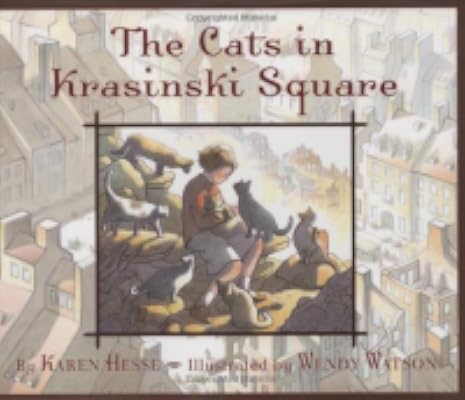
The Cats in Krasinski Square
by Karen Hesse
On This Page
Description
Two Jewish sisters, escapees of the infamous Warsaw ghetto, devise a plan to thwart an attempt by the Gestapo to intercept food bound for starving people behind the dark Wall.Tags
Recommendations



Member Recommendations
by conuly
Member Reviews
When Newbery Medalist Karen Hesse came upon a short article about cats out-foxing the Gestapo at the train station in Warsaw during WWII, she couldn't get the story out of her mind. The result is this stirring account of a Jewish girl's involvement in the Resistance. At once terrifying and soulful, this fictional account, born of meticulous research, is a testament to history and to our passionate will to survive, as only Karen Hesse can write it. A young Jewish girl and her sister face the challenges of growing up in Poland during World War II. Having escaped the ghetto, they devise a plan to smuggle food to those still there with the help of the abandoned cats of Krasinski Square. Determined to help the handful of Jewish Resistance show more fighters feed others still inside the Ghetto, she comes up with a plan to distract the Gestapo and their dogs. Will their plan work, or will they be caught in the act? show less
It can be very hard to write about the Holocaust for children. Either you water down the subject so much that you trivialize it, or you give them nightmares for a year and a day. This goes doubly or triply for picture books, where the young age of your readers has to be taken into account. And of course you want a story with a hero, not just victims, if at all possible. (The truth is that there isn't much to say about the Holocaust that you can say to kids. It boils down to "It was a terrible time, and a lot of people died".)
This book manages to convey the appropriate emotions of hiding and fear ("I wear my Polish look and my Polish walk, Polish words float from my lips") without showing too strongly any actual brutality. The author show more doesn't shy away from the hard, and pertinent, issue of hunger; and we can see the soldiers on nearly every page, but we don't explicitly see any violence either. And the book ends on a relatively high note - they outsmart the Germans and their dogs, and get food into the Ghetto, including a special bundle for her friend who is inside, despite the danger of the location. Younger children will pick up on the accomplishment, older ones will understand (or begin to ask) about why this happened.
The afterword is particularly informative. show less
This book manages to convey the appropriate emotions of hiding and fear ("I wear my Polish look and my Polish walk, Polish words float from my lips") without showing too strongly any actual brutality. The author show more doesn't shy away from the hard, and pertinent, issue of hunger; and we can see the soldiers on nearly every page, but we don't explicitly see any violence either. And the book ends on a relatively high note - they outsmart the Germans and their dogs, and get food into the Ghetto, including a special bundle for her friend who is inside, despite the danger of the location. Younger children will pick up on the accomplishment, older ones will understand (or begin to ask) about why this happened.
The afterword is particularly informative. show less
A young girl feeds the stray cats in the local square while wondering about her friend on the other side of the Ghetto wall. She, her older sister, and some others hatch a plan to safely bring food to the others.
Set during World War II in Poland, this book has the potential to be incredibly sad but it mainly stays on the hopeful side by focusing on the incredible and daring people who fought back against the Nazis using whatever means they could. In this case, it was by helping to feed Jewish people who were suffering as a result of Nazi occupation.
Of course, any story about this time period is ultimately sad, especially as an author's note explains how thousands of Polish Jews died as a result of Nazi actions. Still, it's an important show more story to know and this one is appropriate for relatively young children (probably elementary school-age would be fine). show less
Set during World War II in Poland, this book has the potential to be incredibly sad but it mainly stays on the hopeful side by focusing on the incredible and daring people who fought back against the Nazis using whatever means they could. In this case, it was by helping to feed Jewish people who were suffering as a result of Nazi occupation.
Of course, any story about this time period is ultimately sad, especially as an author's note explains how thousands of Polish Jews died as a result of Nazi actions. Still, it's an important show more story to know and this one is appropriate for relatively young children (probably elementary school-age would be fine). show less
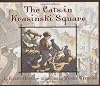
The Cats in Krasinski Square is based on a true story. It tells of how cats were used to outsmart the Gestapo during WWII so that food could be smuggled to the Jews in Warsaw, Poland. Given the subject matter, the story has a more serious tone than many picture books and the neutral tones used in the illustrations seem to echo that. Still, the climax of the story is somewhat humorous and the writing is beautiful, almost lyrical. It also has the benefit of being educational. The author includes some historical background at the end of the book which may actually be more beneficial if read first, especially for those who are not familiar with the situation in Poland at that time period. In my opinion, part of what makes this story great show more is that it can be read on several different levels depending on a child’s level of understanding. Highly recommended! show less
Out of the Dust is one of my favorite Newbery Medal books. Thus, I'm not surprised at the emotional impact this book rendered.
Based on true stories of strong, brave individuals who lived on the outside of the Warsaw Ghetto and, at the risk of life, attempted to save and provide food for those walled behind the barriers.
This is a story of a young child who plays with the cats and kittens of Krasinski Square. They have no food, no home and no one to kiss them.
This is a story of the young child's sister Mira who is brave and part of the resistance movement. When the Nazi soldiers learn of a a shipment of food destined to arrive and to be hidden in the cracks and crannies of the wall in order for the prisoners to gain nourishment, it is the show more cats hidden in baskets who rescue those on the train in danger.
Jumping out of the baskets, creating a flurry of mayhem for the nasty guard dogs and soliders, the food and helpers are saved.
Without too much heavy handedness, and without too much softness, Hesse creates a very valid and real depiction of the difficulties faced by all who were not deemed worthy to live.
Highly recommended. show less
Based on true stories of strong, brave individuals who lived on the outside of the Warsaw Ghetto and, at the risk of life, attempted to save and provide food for those walled behind the barriers.
This is a story of a young child who plays with the cats and kittens of Krasinski Square. They have no food, no home and no one to kiss them.
This is a story of the young child's sister Mira who is brave and part of the resistance movement. When the Nazi soldiers learn of a a shipment of food destined to arrive and to be hidden in the cracks and crannies of the wall in order for the prisoners to gain nourishment, it is the show more cats hidden in baskets who rescue those on the train in danger.
Jumping out of the baskets, creating a flurry of mayhem for the nasty guard dogs and soliders, the food and helpers are saved.
Without too much heavy handedness, and without too much softness, Hesse creates a very valid and real depiction of the difficulties faced by all who were not deemed worthy to live.
Highly recommended. show less
I loved this book! The first reason I loved this book was for the fact that it was written in non-rhyming prose. For example, the book began with “The cats…come…from the cracks in the wall,…the dark corners,…the openings in the rubble” each line containing a different emotion and thought adding to one another. I loved this aspect of the book because it gave the text an eloquent cadence that paired well with the light-hearted seriousness that came with the story that told of how this large group of Polish people outsmarted the Gestapo by using dozens of stray cats that roamed the streets of the city and ghetto during World War II. Reading this story with the rhythm created from the prose made the story rapidly intense at show more times, and decrepitly somber at others, making the book thrilling to read. I also loved this book for its creative character development. Even though the story spends little to no time drawing a picture of what the characters feel, understand and think, the way in which the author describes physical features and situations tells a lot about the characters in a short amount of time. For example, on the page that told of Arik telling the main character’s sister, Mira, that the Gestapo was onto their plan said “the look that passe[d] between Arik and Mira…frightens me more…than the knock on the door in the night” which showed me that Mira was in on the plan and afraid of what was going to happen now that the Gestapo knew of their plan. I thought that this was a subtly creative way of dealing aspects about Mira’s character without spending time explicitly explaining that she was involved with the life-threatening plan to secure food for the ghetto. Overall, the big idea of the book was to enlighten the reader on the dangerous times of World War II and to show what the people of that time had to do to obtain basic needs such as food and water. show less
The Cats In Krasinski Square by Karen Hesse is a picture book based on a real event that happened at the train station in Warsaw during WWII. Cats were used to distract the Gestapo's dogs.
Hesse's picture book, though, sets the stage for an otherwise short anecdote. Her protagonist is a girl living with her sister just outside the ghetto as they are blonde and can pass as Aryan Germans. They help smuggle food, when they can, in through the cracks of the hastily built wall defining the ghetto. They have also taken to caring for the cats left behind in the forced relocations of the Jews.
It is in caring for the cats and smuggling the food that they come up with an idea to thwart a plan by the gestapo to arrest the smugglers meeting a train show more at the station. show less
Hesse's picture book, though, sets the stage for an otherwise short anecdote. Her protagonist is a girl living with her sister just outside the ghetto as they are blonde and can pass as Aryan Germans. They help smuggle food, when they can, in through the cracks of the hastily built wall defining the ghetto. They have also taken to caring for the cats left behind in the forced relocations of the Jews.
It is in caring for the cats and smuggling the food that they come up with an idea to thwart a plan by the gestapo to arrest the smugglers meeting a train show more at the station. show less
Members
- Recently Added By
Lists

Children's Books about World War II (1939-1945)
143 works; 12 members
A Child's Book Tour of Poland
35 works; 4 members
Author Information

39+ Works 29,000 Members
Karen Hesse (born on August 29, 1952 Baltimore, Maryland) is an American author of children's literature and literature for young adults. She studied theatre at Towson State College, and finished her undergraduate degree at the University of Maryland in English, Psychology, and Anthropology. In 1998 she won the Newbery Medal for her young adult show more novel, Out of the Dust. Hesse lives in Vermont with her husband and two teen-aged daughters. (Bowker Author Biography) show less
All Editions
Awards and Honors
Awards
Distinctions
Notable Lists
Common Knowledge
- Canonical title
- The Cats in Krasinski Square
- Original publication date
- 2004 (copyright) (copyright)
- Important places
- Warsaw, Poland; Warsaw Ghetto; Poland
- Important events
- World War II; Holocaust
- Dedication
- In memory of my mother, Fran Levin - K.H.
For my father, Aldren Auld Watson - my teacher, mentor, colleague, and collaborator - W.W.
LJCRS Book Fair Selection 5765 - First words
- The cats come from the cracks in the Wall, the dark corners, the openings in the rubble.
Classifications
Statistics
- Members
- 909
- Popularity
- 29,711
- Reviews
- 40
- Rating
- (4.25)
- Languages
- English
- Media
- Paper
- ISBNs
- 6
- ASINs
- 4