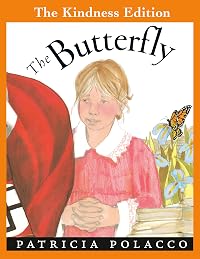
The Butterfly
by Patricia Polacco
On This Page
Description
During the Nazi occupation of France, Monique's mother hides a Jewish family in her basement and tries to help them escape to freedom.Tags
Recommendations









Member Recommendations
Member Reviews
Late one night, Monique awakens to find a ghost sitting at the foot of her bed, petting her cat, Pinouff. Believing herself to be incapable of surprise, since the occupation of her country and village by the Nazis, the young French girl is nevertheless much struck by the sad visage of her mysterious visitor. The discovery that Sevrine is no ghost, but a Jewish girl being hidden, together with her parents, in Monique's own basement, leads to the formation of a secret nighttime friendship between them. But when they are seen by a neighbor, and Sevrine and her family must be moved on to a new safe-house, both girls know that that they may never meet again...
Like so many of Patricia Polacco's books, The Butterfly is based upon the real-life show more experiences of the author's family, in this case, her Aunt Monique Boisseau Gaw, and Monique's mother, Marcel Sollilage, a member of the French Resistance during World War II. With so many fascinating branches on the family tree, I'm more interested than ever in the author's biographical background, and came away from this picture-book with a desire to know more, particularly about Marcel. The narrative hints that she hid a number of Jews from the Nazis. Who were the others, and was her work ever recognized? What about Sevrine? The afterword mentions that she survives (her parents do not), finding her way to England, and eventually to Israel. I would have loved to learn more about her journey, and about her lifelong friendship with Monique.
Leaving that aside, I thought that The Butterfly was a moving portrait of the horrors of war, as seen by a young girl, and found myself choking up - as I so frequently do, with Polacco's books - while reading it. Monique's innocence, in thinking that she is inured to shock, struck me as a very realistic (and poignant) example of the coping tactics a young child would use, when confronted with terrible realities. This is definitely a title I would recommend, to parents and teachers looking for books to introduce the difficult topics of WWII and the Holocaust to young readers. show less
Like so many of Patricia Polacco's books, The Butterfly is based upon the real-life show more experiences of the author's family, in this case, her Aunt Monique Boisseau Gaw, and Monique's mother, Marcel Sollilage, a member of the French Resistance during World War II. With so many fascinating branches on the family tree, I'm more interested than ever in the author's biographical background, and came away from this picture-book with a desire to know more, particularly about Marcel. The narrative hints that she hid a number of Jews from the Nazis. Who were the others, and was her work ever recognized? What about Sevrine? The afterword mentions that she survives (her parents do not), finding her way to England, and eventually to Israel. I would have loved to learn more about her journey, and about her lifelong friendship with Monique.
Leaving that aside, I thought that The Butterfly was a moving portrait of the horrors of war, as seen by a young girl, and found myself choking up - as I so frequently do, with Polacco's books - while reading it. Monique's innocence, in thinking that she is inured to shock, struck me as a very realistic (and poignant) example of the coping tactics a young child would use, when confronted with terrible realities. This is definitely a title I would recommend, to parents and teachers looking for books to introduce the difficult topics of WWII and the Holocaust to young readers. show less
This book begins with the Nazi's invading Monique's village in France. One night Monique sees a figure, of what she thought was a ghost of a little girl, and then she vanishes. Come to find out that the little girl, Sevrine, was real and is hiding in Monique's basement. Monique's mother has been taking in families and hiding them during the war. Monique and Sevrine become really great friends and would play every night. It wasn't until they were seen playing by a neighbor that things changed because Sevrine and her family were no longer safe. Monique and her mother take Sevrine and her family to a new home to escape. Whenever Monique sees a butterfly she thinks it is a reminder that Sevrine is safe and ok. I thought this book was very show more touching and it just shows how there were brave people, like Monique's mom, who wanted to help those in danger during WWII. Definitely a great book to introduce young readers to the topic of WWII. It also has the message that friendship is a powerful thing and sometimes you have to face tough decisions in order to make sure that other person is safe. show less
I really love this book, because it creates an accurate portrayal of the Holocaust without getting too gruesome. The story dives into the emotional side of the Holocaust by showing a friendship that is torn apart, but it doesn’t talk about the brutality of the war. The emotional side of the war in my opinion was just as destructive to families as the brutality, so this book is a good way to ease into the horrific topic. Something else that strikes me about this book is the symbolism used with the butterflies. My interpretation of the author’s use of butterflies is to represent the hope for victims of the Holocaust. I say this because, Sevrine is releasing the butterfly when the neighbor sees her and threatens her existence, so when show more the butterflies returns it is a symbol that Sevrine’s safety has returned. At the end of the book Monique tells her mother, "Sevrine sent them, I know it! She and her parents are safe." This creates a sense of closure for Sevrine and her family. The true representation of the butterflies is really left up to the reader, because all the butterflies at the end of the story could be more severe then I interpreted the text. The butterflies could have been representing all the lives lost to the war that are now in a better place. I like how the author leaves the interpretation up to the reader, because either ending could have been equally as possible, and a lot of times families that helped the Jews never knew their fate after they left their care. The author does a great job of creating this informational story, while maintain a plot that is heartwarming. The big idea of this story is that sometimes we have to accept a peace in the unknown. show less
I'm learning that children's illustrated books are written for all ages. Some books, like those written by Polacco are filled with stories of real-life experiences.
The Butterfly was written when the author learned that her Aunt was part of the French resistance during the Holocaust. When her cousin found a young girl in her bedroom, she was startled and then learned that she and her family lived in the basement of her house.
They were not the first family that her Aunt assisted in risking her life to try to save those who were helpless. The title represents the hope and beauty of life to be set free.
This is a tale of courage and hope. Wonderfully written and illustrated, it is compelling and worth the time and energy spent in reading.
The Butterfly was written when the author learned that her Aunt was part of the French resistance during the Holocaust. When her cousin found a young girl in her bedroom, she was startled and then learned that she and her family lived in the basement of her house.
They were not the first family that her Aunt assisted in risking her life to try to save those who were helpless. The title represents the hope and beauty of life to be set free.
This is a tale of courage and hope. Wonderfully written and illustrated, it is compelling and worth the time and energy spent in reading.
A tale of friendship and bravery in the midst of unthinkable horror, this classic Holocaust story from master storyteller Patricia Polacco is a vital lesson in the power of hope.In this Holocaust story based on real events and passed from the narrator to her niece, the author-illustrator herself, Patricia Polacco once again celebrates the shared humanity of the peoples of this world. Ever since the Nazis marched into Monique's small French village, terrorizing it, nothing surprises her. That is, until the night Monique encounters a little ghost sitting at the end of her bed. She turns out to be a Jewish girl named Sevrine who has been hiding from the Nazis in Monique's basement. Playing after dark, the two become friends. But when they show more are discovered, both of their families must embark on a nighttime flight. And Monique can only hope that the freedom of the butterflies in her garden will reach Sevrine as well. show less
Living in a Nazi occupied town in France during WWII, Monique soon realizes that the "ghost" she has been seeing in her room some nights is actually a little Jewish girl named Sevrine. Monique learns that Sevrine and her family have been secretly living under the floorboards in her house for awhile now. One night while releasing a butterfly out of Monique's bedroom window, Sevrine is seen by a neighbor. Understanding the danger of what has just happened the girls rush to Monique's mother's room to wake her. It is far to dangerous for Sevrine's family now and they must leave immediately. Monique and her mother help Sevrine escape the town and are forced to say goodbye. Back at home in their garden, Monique is distraught wondering about show more her new friend's safety. Just then, thirty to forty butterflies fly out the garden and Monique's mama tells her that it is a sign that Sevrine and her family are safe from harm.
No matter how the subject of the Holocaust is introduced to children, it is going to be an intense topic. I think this book does a beautiful job of not "glossing over" the horrific nature of the Holocaust, but still keeping it appropriate for an elementary audience. show less
No matter how the subject of the Holocaust is introduced to children, it is going to be an intense topic. I think this book does a beautiful job of not "glossing over" the horrific nature of the Holocaust, but still keeping it appropriate for an elementary audience. show less
This book is the story of a young girl named Monique who lived in a small French village during WWII. She woke up one night to what she thought was a ghost girl petting her cat at the end of her bed. When Monique asked who she was, she quickly disappeared. Monique told her mother about the ghost the next morning, but her mother told her it was only a dream and she went off to school. On the way home from school Monique and her friend, Denise Monsieur Mark waved the girls into the candy shop where he gave them each a piece of candy for their trip home. Shortly after the girls left, Monsieur Mark was tackled to the ground and thrown into a car by the Nazis. The girls were sobbing by the time they made it to Monique's house, so they told show more her mother what happened. Many nights passed where Monique didn't see the ghost girl again, until the night that she did. The ghost girl turned out not to be a ghost after all. She was a Jewish girl named Sevrine hiding from the Nazis in Monique's basement! The next morning Monique saw a butterfly in the garden and kept it for Sevrine along with a flower. She said the flower was Sevrine's sunshine and the butterfly flying away symbolized the day that Sevrine and her family will be able to fly away. Sadly, the neighbor spotted the two girls out the window that night so they quickly told Monique's mother. Monique's mother helped the family bury anything in the basement that made it obvious that people were living there and helped them leave the country. Before Sevrine left, Sevrine gave Monique her Star of David to remember her by and Monique gave Severine her cat since she missed her own cat so much. A few weeks passed and Monique wished for a sign that Sevrine and her family were safe. That's when nearly thirty butterflies fluttered around the garden, a sign that Sevrine and her family were safe.
This story was set in a small French village during WWII where Nazi soldiers have practically taken over. Because of this, the setting not only clarifies conflict between the Jews and Nazis but also heightens the suspense. I practically zoomed through this book because I was so worried that the Nazi soldiers were going to mistake Monique for a Jew when Sevrine gave Monique her necklace and I was worried that the Nazi soldiers would come and take Sevrine and her family away.
I adore this book. I love the symbolism in the book and how informative it is to young children! This book accurately describes the fear and struggle of Jews during the Holocaust in a kid-friendly way. This book is such a heartfelt and sweet book that must be read! show less
This story was set in a small French village during WWII where Nazi soldiers have practically taken over. Because of this, the setting not only clarifies conflict between the Jews and Nazis but also heightens the suspense. I practically zoomed through this book because I was so worried that the Nazi soldiers were going to mistake Monique for a Jew when Sevrine gave Monique her necklace and I was worried that the Nazi soldiers would come and take Sevrine and her family away.
I adore this book. I love the symbolism in the book and how informative it is to young children! This book accurately describes the fear and struggle of Jews during the Holocaust in a kid-friendly way. This book is such a heartfelt and sweet book that must be read! show less
Members
- Recently Added By
Published Reviews
Polacco continues to mine her family history, this time telling the story of an aunt's childhood in wartime France. Young Monique doesn't comprehend the brutality of the Nazis' mission--until the day three German soldiers find her admiring a butterfly. "Joli, n'est-ce pas?" says one to Monique, then grabs the butterfly and crushes it in his fist. The butterfly, or papillon as it is frequently show more called here, becomes for Monique a symbol of the Nazis' victims. Her sympathies are quickly focused: one night Monique wakes up to discover a girl in her bedroom and learns that she and her parents, Jews, have been hiding for months in Monique's house, protected by Monique's mother. The girl, Sevrine, has been forbidden to leave the hiding place, so she and Monique meet secretly. Then a neighbor sees the two girls at the window one night, and Sevrine's family must flee. As an afterword reveals, only Sevrine survives, contacting Monique by letter--with a drawing of a butterfly. In comparison with the seeming spontaneity of the author's Pink and Say, this tale's use of the butterfly symbolism gives it a slightly constructed or manipulated feel. Even so, the imagery and the dramatic plot distill for young readers the terrors and tragic consequences of the Nazi regime and the courageousness of resisters. Ages 4-8. (May)
Copyright 2000 Cahners Business Information, Inc. show less
Copyright 2000 Cahners Business Information, Inc. show less
added by sriches
Gr 1-5-Polacco relates the tale of her Aunt Monique to show, in picture-book terms, the suffering of the Jews during Nazi occupation and the courage of those who took part in the French Resistance. The setting is a small village; unbeknownst to the child, Monique's mother is hiding Jews in their basement. It is at night, when Sevrine emerges from the depths to peer out the window, that Monique show more awakens and the secret friendship begins. Polacco's use of color has never been more effective. The blackness, which starts on the endpapers, surrounds the girls' conversations, Sevrine's basement existence, the ditch hiding the two families as they flee to the next refuge, and the train car on Monique's return trip (she has become separated from her mother). In contrast are the light-filled scenes of Monique and her mother at breakfast, their sweet reunion at home, and, on the last page, mother and child surrounded by butterflies. Earlier, Monique had watched a soldier crush a papillon; later, she had taken a fluttering "kiss of an angel" inside for her friend. The bold pattern and heightened color of the insect provides a counterpoint to the equally dynamic black-on-red swastikas. Convincing in its portrayal of both the disturbing and humanitarian forces of the time, the title is not as dark or graphic as Robert Innocenti's Rose Blanche (Harcourt, 1996). An author's note relates the rest of the story: Sevrine survived and the friendship still flourishes. A perfect blend of art and story.-Wendy Lukehart, Dauphin County Library, Harrisburg, PA Copyright 2000 Cahners Business Information.| show less
added by sriches
added by sriches
Lists

Book Review Roundup
254 works; 2 members
Author Information

81+ Works 57,082 Members
Patricia Polacco was born in Lansing, Michigan on July 11, 1944. She attended Oakland Tech High School in Oakland, California before heading off to the California College of Arts and Crafts in Oakland, then Laney Community College in Oakland. She then set off for Monash University, Mulgrave, Australia and the Royal Melbourne Institute of show more Technology, Melbourne, Australia where she received a Ph.D in Art History, Emphasis on Iconography. After college, she restored ancient pieces of art for museums. She didn't start writing children's books until she was 41 years old. She began writing down the stories that were in her head, and was then encouraged to join the Society of Children's Book Writers and Illustrators. There she learned how to put together a dummy and get a story into the form of a children's picture book. Her mother paid for a trip to New York, where the two visited 16 publishers in one week. She submitted everything she had to more than one house. By the time she returned home the following week, she had sold just about everything. Polacco has won the 1988 Sydney Taylor Book Award for The Keeping Quilt, and the 1989 International Reading Association Award for Rechenka's Eggs. She was inducted into the Author's Hall of Fame by the Santa Clara Reading Council in 1990, and received the Commonwealth Club of California's Recognition of Excellence that same year for Babushka's Doll, and again in 1992 for Chicken Sunday. She also won the Golden Kite Award for Illustration from the Society of Children's Book Writers and Illustrators for Chicken Sunday in 1992, as well as the Boston Area Educators for Social Responsibility Children's Literature and Social Responsibility Award. In 1993, she won the Jane Adams Peace Assoc. and Women's Intl. League for Peace and Freedom Honor award for Mrs. Katz and Tush for its effective contribution to peace and social justice. She has won Parent's Choice Honors for Some Birthday in 1991, the video Dream Keeper in 1997 and Thank You Mr. Falker in 1998. In 1996, she won the Jo Osborne Award for Humor in Children's Literature. Her titles The Art of Miss. Chew and The Blessing Cup made The New York Times Best Seller List. (Bowker Author Biography) show less
Awards and Honors
Awards
Notable Lists
Common Knowledge
- Canonical title
- The Butterfly
- Original title
- The Butterfly
- Original publication date
- 2000
- People/Characters
- Monique; Sevrine
- Important places
- France
- Important events
- Holocaust; World War II (1939 | 1945); World War II, German Occupation of France (1940 | 1944)
- Dedication
- The Starr - Weg Family
Classifications
Statistics
- Members
- 1,360
- Popularity
- 17,647
- Reviews
- 86
- Rating
- (4.31)
- Languages
- English
- Media
- Paper
- ISBNs
- 7
- ASINs
- 5