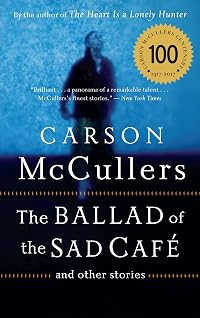
The Ballad of the Sad Café and Other Stories
by Carson McCullers 
On This Page
Description
A classic work that has charmed generations of readers, this collection assembles Carson McCullers's best stories, including her beloved novella "The Ballad of the Sad Café." A haunting tale of a human triangle that culminates in an astonishing brawl, the novella introduces readers to Miss Amelia, a formidable southern woman whose café serves as the town's gathering place. Among other fine works, the collection also includes "Wunderkind," McCullers's first published story written when she show more was only seventeen about a musical prodigy who suddenly realizes she will not go on to become a great pianist. The Ballad of the Sad Café is a brilliant study of love and longing from one of the South's finest writers. show lessTags
Recommendations












Member Reviews
The question of nurture versus nature. Every major character with The Ballad of the Sad Cafe has a tendency to instigate and agitate. Everyone stirs up trouble in one way or another. Did the impulse to do this come from something nefarious in childhood or were they born to rattle cages from the very beginning? Miss Amelia Evans is a person who, if she didn't completely understand a situation well enough to have an opinion about it, ignored it completely. Cousin Lymon is a southern Iago, prone to stirring things up with cruel intentions. When Marvin Macy comes to town it is like two criminals recognizing themselves in total strangers; they are kindred spirits, born to raise hell as a team.
Confessional: Everything about the story was sad. show more I think that was because you didn't really know why everyone was so uncaring and cruel. show less
Confessional: Everything about the story was sad. show more I think that was because you didn't really know why everyone was so uncaring and cruel. show less
The novella that gives this collection its name is short, sad, and remarkably good. It won't come as a surprise to readers that Miss Amelia's intense and wholly unforeseen relationship with Cousin Lyman ends in tragedy: she announces it several times before the plot plays out. What surprised me, though, is how clearly she articulated the pain that often comes with love and the tangled relationship between what she imagines to be the active and passive parties in a love affair. In the paragraph where she forthrightly states, " There are the lover and the beloved, but these two come from different countries," she packs more wisdom about human relationships into two paragraphs than many authors can squeeze into an entire book. This is the show more definition of impressive writing.
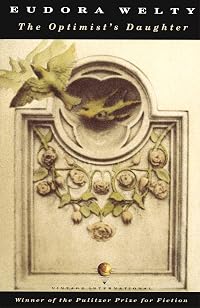
"The Ballad of the Sad Café" is in many ways an old kind of novel: there's less dialect here than there is in Faulkner or O'Connor, and McCullers's prose is admirably precise: its tone is often somewhat formal. But it's also an old novel because it's set in the real Old South. The story starts when a stranger comes to town, yes, but we don't hear anything about the changes that modernity has visited upon the book's setting. It comes off as the most isolated place on earth. This surprised me somewhat, as the only other McCullers I've read "The Optimist's Daughter," was an impressively insightful take on the collision between modern twentieth century America and older, more traditional ways of doing things south of the Mason-Dixon line. Also, the short stories in this collection are only tangentially connected to the American South, or, in a couple cases, aren't connected to the South at all. The range that McCullers demonstrates in a hundred and sixty pages is really impressive.
Of course, it's hard to ignore that queerness fairly radiates from a number of this novel's characters, but it's presented and evaluated in a context that's wholly specific to the town that the book's set in. The facts of Miss Amelia's habits, clothing choices, and relationships are described without additional comment, and the townspeople's opinions of them are reported matter-of-factly. This last attribute is important: "The Ballad of the Sad Café" is written in a fairly formal third-person, but its local character makes it seem as if a sort of second-person plural is also contributing to the telling. "The Ballad of the Sad Café" is, in some ways, a story told by an entire town. This has been done before -- think of the unnamed peasant narrator in "The Brothers Karamazov" -- but McCullers pulls is off with uncommon subtlety here. I was really quite impressed by the time I finished this one. I'll need to read more McCullers in the future. show less
"The Ballad of the Sad Café" is in many ways an old kind of novel: there's less dialect here than there is in Faulkner or O'Connor, and McCullers's prose is admirably precise: its tone is often somewhat formal. But it's also an old novel because it's set in the real Old South. The story starts when a stranger comes to town, yes, but we don't hear anything about the changes that modernity has visited upon the book's setting. It comes off as the most isolated place on earth. This surprised me somewhat, as the only other McCullers I've read "The Optimist's Daughter," was an impressively insightful take on the collision between modern twentieth century America and older, more traditional ways of doing things south of the Mason-Dixon line. Also, the short stories in this collection are only tangentially connected to the American South, or, in a couple cases, aren't connected to the South at all. The range that McCullers demonstrates in a hundred and sixty pages is really impressive.
Of course, it's hard to ignore that queerness fairly radiates from a number of this novel's characters, but it's presented and evaluated in a context that's wholly specific to the town that the book's set in. The facts of Miss Amelia's habits, clothing choices, and relationships are described without additional comment, and the townspeople's opinions of them are reported matter-of-factly. This last attribute is important: "The Ballad of the Sad Café" is written in a fairly formal third-person, but its local character makes it seem as if a sort of second-person plural is also contributing to the telling. "The Ballad of the Sad Café" is, in some ways, a story told by an entire town. This has been done before -- think of the unnamed peasant narrator in "The Brothers Karamazov" -- but McCullers pulls is off with uncommon subtlety here. I was really quite impressed by the time I finished this one. I'll need to read more McCullers in the future. show less
The grotesquely human and melancholic undertones coupled with sharp, gleefully-needling imagery, like a high-definition sepia photo of an old-fashioned circus freak show in a dusty town reminiscent of Carnivale, these hallmarks - and more - of McCullers' craft are on full display here. They make you writhe, either from the discomfort of merely witnessing these seemingly gnarly and distorted versions of humanity or from the discomfort of feeling confronted by a mirror. Best read in small doses.
Favourite story: Madame Zilensky and the King of Finland.
Favourite story: Madame Zilensky and the King of Finland.
I just finished listening to this collection that contains the novella The Ballad of the Sad Cafe and several other short stories by Carson McCullers, and while I was not disappointed with the stories, I was disappointed with the narration of this particular audiobook. The stories themselves are quirky and poignant and filled with heartbreak and humor. I like how McCuller's characters get under your skin. They are flawed and fully fleshed and often disturbing. Where I went wrong was in choosing the audiobook over the print version. McCuller's writing is all about language and her incredible grasp of using just the right phrasing to capture the action of the story and to describe the characters - it's language you want to immerse show more yourself in by rereading passages and sentences and letting the perfection of her similes and metaphors roll over you. One of my favorite examples is when she describes Mr. Brooks (from the Madam Zilensky story) as "pastel". Hard if not impossible to do that with an audiobook. And then there were the multiple narrators - the reader for the title novella was very good, but some of the others were inadequate to the task. I know that I will eventually revisit this, and when I do it will be with the physical book. show less
4.5/5
McCullers is one I come to for a reckoning, much as I do with Faulkner and O'Connor. One may bundle them up and slot them neatly under the label of Southern Gothic, but that is not a guaranteed invocation of cathedrals crazed by fecundity of both soil and symptom, an American way of the crooked cross where faith is a matter of lust and amputation. While Faulkner plunges in chiaroscuro and O'Connor sears in holy fire, McCullers sings in the twilight of a human soul, casting back on its years in search and always, always, coming up short. She is calmer than her two compatriots, but peace does not entail redemption.
These stories are short, and I am not surprised that my favorite, Wunderkind, was composed at the age of seventeen. It's show more a common thing, the vicarious living of the parent through the child, the sapling broken before it even began along lines of another's making, for intelligence and art and college and any number of reasons but the one encompassing what it is the child actually wants, or dreams, or needs. When the body ripens and the mind begins to wander beyond the closed circuit court of parental promises of wealth and fame and glory, it's no wonder that the machine begins to break. But the child does not know that. What a child does know is their failure is made purely out internal system of self, and one way or another, breaking out or breaking down, they will escape. This is a tale that the median of youth and maturity knows, especially when one is Carson McCullers at seventeen.
While that was my favorite, the rest are well worth it. All are a matter of living with those insanities we humans willingly inflict, for living is a must what with self-killing labeled as one of the more wicked sins. In the midst of souls and the relationships they wield as pitchforks, the damnation they deal is matched only by the bounty they reap, much as the sick sloth of Southern swamp and all its dead can only be graced by golden sunsets, etched into art by sprawling trees and more precious to the earth than all of humanity. The world bears us much as we bear our woes, a day by day of nearing and furthering reconciliation with too long a past to hope that sudden extinction would lead to instantaneous peace. Some moments are of utmost beauty, some are fit to kill, and one adapts accordingly.
The world may grant us sanctuary, but it does not understand us, and will not miss us when we are gone. McCullers has no concrete structure for us to dwell in forevermore; what she does for us is feel. show less
McCullers is one I come to for a reckoning, much as I do with Faulkner and O'Connor. One may bundle them up and slot them neatly under the label of Southern Gothic, but that is not a guaranteed invocation of cathedrals crazed by fecundity of both soil and symptom, an American way of the crooked cross where faith is a matter of lust and amputation. While Faulkner plunges in chiaroscuro and O'Connor sears in holy fire, McCullers sings in the twilight of a human soul, casting back on its years in search and always, always, coming up short. She is calmer than her two compatriots, but peace does not entail redemption.
These stories are short, and I am not surprised that my favorite, Wunderkind, was composed at the age of seventeen. It's show more a common thing, the vicarious living of the parent through the child, the sapling broken before it even began along lines of another's making, for intelligence and art and college and any number of reasons but the one encompassing what it is the child actually wants, or dreams, or needs. When the body ripens and the mind begins to wander beyond the closed circuit court of parental promises of wealth and fame and glory, it's no wonder that the machine begins to break. But the child does not know that. What a child does know is their failure is made purely out internal system of self, and one way or another, breaking out or breaking down, they will escape. This is a tale that the median of youth and maturity knows, especially when one is Carson McCullers at seventeen.
While that was my favorite, the rest are well worth it. All are a matter of living with those insanities we humans willingly inflict, for living is a must what with self-killing labeled as one of the more wicked sins. In the midst of souls and the relationships they wield as pitchforks, the damnation they deal is matched only by the bounty they reap, much as the sick sloth of Southern swamp and all its dead can only be graced by golden sunsets, etched into art by sprawling trees and more precious to the earth than all of humanity. The world bears us much as we bear our woes, a day by day of nearing and furthering reconciliation with too long a past to hope that sudden extinction would lead to instantaneous peace. Some moments are of utmost beauty, some are fit to kill, and one adapts accordingly.
The world may grant us sanctuary, but it does not understand us, and will not miss us when we are gone. McCullers has no concrete structure for us to dwell in forevermore; what she does for us is feel. show less
The Ballad of the Sad Cafe is another of the stories I first encountered while listening to A Day's Read (and I cannot recommend that course enough.) It was my intention to read the other stories in the volume, but time got away from me and I had to return the book to the library. No matter, it's Ballad that I'm concerned with here, not McCullers' work in general, and it's the primary, and longest work in this volume.
It's a strange story about Miss Amelia, who seems to be the town spinster. She's 6' 2", has crossed eyes, makes moonshine, and spends her free time suing people. Everyone seems a bit afraid of her, and probably for good reason. And then one day a hunchback arrives in town claiming to be Amelia's cousin.
Almost overnight, show more Amelia becomes a different woman. She's softer, kinder, more sociable. She dotes on Cousin Lymon and it's clear she loves him. And it's then that we learn that Amelia had been married years earlier to the town ne'er-do-well, a man named Marvin Macy, who fell so deeply in love with Amelia that he reformed himself and became an upstanding man. He proposed, she accepted, and then came the wedding night.
They were married for ten days, and after the separation, Marvin went back to his old ways and ended up in prison. But one day, after Cousin Lymon has been living with Amelia for about six years, Marvin reappears. Amelia is horrified and Lymon falls in love with Marvin.
It's this crazy triangle that propels this story of unrequited love and longing. We understand, through the actions of the three members of this triangle, that we are all prisoners of something we can never wholly understand, something that drives everything we do. There's no escape for any of them.
The story is beautiful, and cruel, hilarious and sad. If you read no other McCullers, read this. show less
It's a strange story about Miss Amelia, who seems to be the town spinster. She's 6' 2", has crossed eyes, makes moonshine, and spends her free time suing people. Everyone seems a bit afraid of her, and probably for good reason. And then one day a hunchback arrives in town claiming to be Amelia's cousin.
Almost overnight, show more Amelia becomes a different woman. She's softer, kinder, more sociable. She dotes on Cousin Lymon and it's clear she loves him. And it's then that we learn that Amelia had been married years earlier to the town ne'er-do-well, a man named Marvin Macy, who fell so deeply in love with Amelia that he reformed himself and became an upstanding man. He proposed, she accepted, and then came the wedding night.
They were married for ten days, and after the separation, Marvin went back to his old ways and ended up in prison. But one day, after Cousin Lymon has been living with Amelia for about six years, Marvin reappears. Amelia is horrified and Lymon falls in love with Marvin.
It's this crazy triangle that propels this story of unrequited love and longing. We understand, through the actions of the three members of this triangle, that we are all prisoners of something we can never wholly understand, something that drives everything we do. There's no escape for any of them.
The story is beautiful, and cruel, hilarious and sad. If you read no other McCullers, read this. show less
I love southern stories and nobody tells them better than Carson McCullers. I have read THE HEART IS A LONELY HUNTER several times with great joy. I now reread THE BALLAD OF THE SAD CAFE and continue to be touched by it. A southern woman caught in a triangle. One of the men was a dwarf or at least sadly deformed and was her cousin. She became his protector until he betrayed her. The cafe is where the action takes place. While it started as a cafe it attracted many locals such that she turned it into a nightclub of sorts. Against this background the drama takes place and drama it is. I highly recommend this novella to all.
Members
- Recently Added By
Lists

Southern Fiction
212 works; 51 members

20th Century Literature
1,161 works; 54 members

1950s
340 works; 22 members
TML 200 Best Books 1950-1999
202 works; 10 members

SHOULD Read Books!
354 works; 9 members
Books Set in Small Towns and Villages
278 works; 16 members

Nifty Fifties
129 works; 14 members

American Lit for Eng 11 Research Project
368 works; 6 members

Books Read in 2010
631 works; 10 members

Books You Read For University
184 works; 3 members

Recommended Reading : 600 Classics Reviewed, Editors of Salem Press, 2015
634 works; 6 members

Books Read in 2025
4,091 works; 97 members
Shannon's Read-Alikes List
71 works; 8 members
Author Information

97+ Works 22,681 Members
Carson McCullers was born in Columbus, Georgia, on February 19, 1917. She died at age fifty in Nyack, New York, on September 29, 1967. A promising pianist, she had hoped to enroll at the Juilliard School of Music when she was seventeen, but when she arrived in New York, she attended writing classes at Columbia University instead. In December 1936 show more her first story, "Wunderkind," was published in "Story" magazine. That winter she began work on "The Mute," which would become her enduring masterpiece, "The Heart Is a Lonely Hunter." (Publisher Provided) Carson McCullers was born Lula Carson Smith on February 19, 1917 in Columbus, Georgia. At the age of seventeen, desiring to become a famous concert pianist, she went to New York City to attend the Julliard School of Music. Her family sacrificed and raised money for her tuition to go to Julliard, but she lost all of her money when she left her pocketbook on the subway. Unable to tell her family what had happened, she took writing classes at Columbia University and New York University from 1935-1936. Her first novel, The Heart Is a Lonely Hunter, was published in 1940. Her other novels included Reflections in a Golden Eye, The Ballad of the Sad Café, The Member of the Wedding, and Clock Without Hands. With the help of Tennessee Williams, The Member of the Wedding was adapted into a play, which won the New York Drama Critics Circle Award in 1950. She died from a stroke and subsequent brain hemorrhage on September 29, 1967at the age of 50. (Bowker Author Biography) show less
Carson McCullers has a Legacy Library. Legacy libraries are the personal libraries of famous readers, entered by LibraryThing members from the Legacy Libraries group.
Some Editions
Awards and Honors
Awards
Series
Belongs to Publisher Series
Work Relationships
Is contained in
Common Knowledge
- Canonical title
- The Ballad of the Sad Café and Other Stories
- Original title
- The Ballad of the Sad Café and other stories
- Alternate titles
- The Ballad of the Sad Café
- Original publication date
- 1951
- People/Characters
- Miss Amelia
- Important places
- Georgia, USA
- Related movies
- The Ballad of the Sad Cafe (1991 | IMDb)
- First words
- The ballad of the Sad Café: The town itself is dreary; not much is there except the cotton-mill, the two-room houses where the workers live, a few peach trees, a church with two coloured windows, and a miserable main street ... (show all)only a hundred yards long.
Wunderkind: She came into the living-room, her music satchel plopping against her winter-stockinged legs and her other arm weighted down with school books, and stood for a moment listening to the sounds from the studio.
The jockey: The jockey came to the doorway of the dining-room, then after a moment stepped to one side and stood motionless, with his back to the wall.
Madame Zilensky and the King of Finland: To Mr Brook, the head of the music department at Ryder College, was due all the dredit for getting Madame Zilensky on the faculty.
The sojourner: The twilight border between sleep and waking was a Roman one this morning: splashing fountains and arched, narrow streets, the golden lavish city of blossoms and age-soft stone.
A domestic dilemma: On Thursday Martin Meadows left the office early enough to make the first express bus home.
A tree, a rock, a cloud: It was raining that morning, and still very dark. - Last words
- (Click to show. Warning: May contain spoilers.)The ballad of the Sad Café: Just twelve mortal men who are together.
(Click to show. Warning: May contain spoilers.)Wunderkind: Dragging her books and satchel she stumbled down the stone steps, turned in the wrong direction, and hurried down the street that had become confused with noise and bicycles and the games of other children.
(Click to show. Warning: May contain spoilers.)The jockey: The rich man sopped up some water that had been spilled on the tablecoth, and they didn't speak until the waiter came to clear away.
(Click to show. Warning: May contain spoilers.)Madame Zilensky and the King of Finland: Mr Brook watched the Airedale until he was out of sight, then resumed his work on the canons which had been turned in by the class in counterpoint.
(Click to show. Warning: May contain spoilers.)The sojourner: With inner desperation he pressed the child close - as though an emotion as protean as his love could dominate the pulse of time.
(Click to show. Warning: May contain spoilers.)A domestic dilemma: His hand sought the adjacent flesh and sorrow paralleled desire in the immense complexity of love.
(Click to show. Warning: May contain spoilers.)A tree, a rock, a cloud: 'He sure has done a lot of travelling.' - Blurbers
- Connolly, Cyril
- Original language*
- Amerikanisch
- Disambiguation notice
- This selection contains: The ballad of the sad café --
Wunderkind --
The jockey --
Madame Zilensky and the King of Finland --
The sojourner --
A domestic dilemma --
A tree, a rock, a cloud --
Please d... (show all)o not combine with volumes containing only the short story.
Please do not combine with other selections of (nearly) the same name, but with different content.
This is the selection published as a Penguin and now as a Penguin Classic, though under the title of the short story
*Some information comes from Common Knowledge in other languages. Click "Edit" for more information.
Classifications
Statistics
- Members
- 2,778
- Popularity
- 6,591
- Reviews
- 63
- Rating
- (3.90)
- Languages
- 15 — Catalan, Danish, Dutch, English, Estonian, Finnish, French, German, Hungarian, Italian, Norwegian (Bokmål), Spanish, Swedish, Turkish, Portuguese (Portugal)
- Media
- Paper, Audiobook, Ebook
- ISBNs
- 70
- UPCs
- 1
- ASINs
- 41