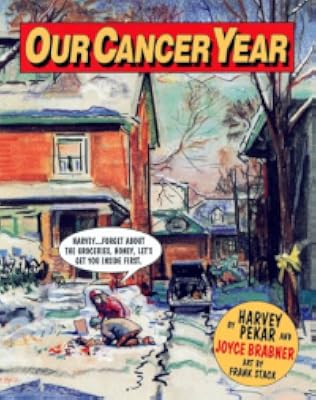
Our Cancer Year
by Harvey Pekar, Joyce Brabner, Frank Stack (Illustrator)
On This Page
Description
It was they year of Desert Storm that Harvey Pekar and his wife, Joyce Brabner, discovered Harvey had cancer. Pekar, a man who has made a profession of chronicling the Kafkaesque absurdities of an ordinary life (if any life is ordinary) suddenly found himself incapacitated. But he had a better-than-average chance to beat cancer and he took it -- kicking, screaming, and complaining all the way. Pekar and Brabner draw on this and other trials to paint a portrait of a man beset with fears real show more and imagined -- who survives. show lessTags
Recommendations

Member Recommendations

Member Reviews
Joyce Brabner and Harvey Pekar (with artist Tom Stack's surrealistically wonderful art) have made one of the most touching and affecting works I've read in years, maybe ever. And this is something as Pekar's work is naturally that anyway, but here it goes beyond that. Going through this story I felt I was a member of their household and witness to their moment in history. Told in sparse unadorned dialogue the story cuts through all the unnecessaries of alternative comics and creates something with the deepest pathos but at once is also a testament to the every day joys of the insanity of day to day life, ups and downs, profound and meaningless.
Our Cancer Year chronicles Harvey's battle with Lymphoma. Not only is it an unflinching look at chemotherapy, illness, radiation and the relationship between he and his wife, but it's an amazing documentation of what happens when life suddenly has to accommodate cancer. Because that's what life does - accommodate. It does not slow down, people do not pause and it most certainly does not come to some slow-mo inspiring stop where the unpleasant parts are mere blips on the way to beating the disease in spectacular fashion.
Much of this is just Harvey fitting Cancer into his life while he buys a new house. It's dealing with the everyday problems of life and trying to work while taking chemo. It's seeing cancer up close and far too show more personally, because it's not just the few nice shots of hair running down the drain - cancer is shingles and drug-induced paranoia. It's seeing a husband and wife pushing themselves too far before deciding to get help and finding out that even help has an unpleasant life outside of cancer.
In this complete and utter depth of detail, there is comfort in seeing that someone's willing to put out their cancer year warts and all. show less
Much of this is just Harvey fitting Cancer into his life while he buys a new house. It's dealing with the everyday problems of life and trying to work while taking chemo. It's seeing cancer up close and far too show more personally, because it's not just the few nice shots of hair running down the drain - cancer is shingles and drug-induced paranoia. It's seeing a husband and wife pushing themselves too far before deciding to get help and finding out that even help has an unpleasant life outside of cancer.
In this complete and utter depth of detail, there is comfort in seeing that someone's willing to put out their cancer year warts and all. show less
I have read many books about how families and patients deal with a cancer diagnosis and treatment, including many on graphic form. I found this one remarkable because it was told in both Joyce and Harvey's voices in a very integrated way. I was very moved by Joyce's struggle with maintaining her own career, health and identity while still wanting to be there to support her husband and his quirks. Harvey's own struggles with his OCD and his inability to maintain the control he wanted,his desire not to burden Joyce unnecessarily and his struggle with the side effects of his chemo regimen.
This book captured the pain (both physical and emotional) and love that both a cancer diagnosis and treatment create in a true, warts and all way. I show more think that anyone who is facing a diagnosis for themselves or a person that they love should read this as a primer for the difficulties ahead. It may be frightening, but I think will help people prepare themselves for the challenges ahead. show less
This book captured the pain (both physical and emotional) and love that both a cancer diagnosis and treatment create in a true, warts and all way. I show more think that anyone who is facing a diagnosis for themselves or a person that they love should read this as a primer for the difficulties ahead. It may be frightening, but I think will help people prepare themselves for the challenges ahead. show less
My previous experience with Harvey Pekar is just the first two American Splendor compilations and the film, which actually covered some of this narrative in much abbreviated form. This book tells of Harvey's bout with cancer-- or more accurately, his bout with chemotherapy to make sure that cancer doesn't come back.
The most immediately notable thing about Our Cancer Year is that, since it is written by both Harvey and his wife Joyce, it is not told from a first-person perspective but rather the third. Given that so much of American Splendor's effect depends on Harvey's distinctive voice, this creates an immediate distance. This is exacerbated by the fact it seems like Joyce did more of the writing than Harvey; we get into her head show more more than his, and though what goes on in her head is okay, the book's standout sequences are those where we really get into Harvey's experiences.
We also hear a lot about a group of refugee kids that Joyce is working with and the outbreak of the Gulf War, which is not as interesting as the amount of narrative it takes up would indicate. It might make an interesting independent book, but crammed into here, the kids don't get enough coverage to pop as characters, and so they feel intrusive.
Stack's sketchy artwork is the first time where I feel like one of Pekar's artistic collaborators have let him down. It's okay, but it's sometimes hard to tell what's actually happening-- or even who someone actually is.
These are all complaints, and Our Cancer Year's not as bad as all this might imply. But American Splendor had done better before and would do better again; given the immensity of its subject, it's an unfortunate blip. show less
The most immediately notable thing about Our Cancer Year is that, since it is written by both Harvey and his wife Joyce, it is not told from a first-person perspective but rather the third. Given that so much of American Splendor's effect depends on Harvey's distinctive voice, this creates an immediate distance. This is exacerbated by the fact it seems like Joyce did more of the writing than Harvey; we get into her head show more more than his, and though what goes on in her head is okay, the book's standout sequences are those where we really get into Harvey's experiences.
We also hear a lot about a group of refugee kids that Joyce is working with and the outbreak of the Gulf War, which is not as interesting as the amount of narrative it takes up would indicate. It might make an interesting independent book, but crammed into here, the kids don't get enough coverage to pop as characters, and so they feel intrusive.
Stack's sketchy artwork is the first time where I feel like one of Pekar's artistic collaborators have let him down. It's okay, but it's sometimes hard to tell what's actually happening-- or even who someone actually is.
These are all complaints, and Our Cancer Year's not as bad as all this might imply. But American Splendor had done better before and would do better again; given the immensity of its subject, it's an unfortunate blip. show less
I know some will think I’m committing heresy when I say I did not like this nonfiction graphic novel. I imagine some of my dislike is due to the fact that I’m also reading So Much For That by Lionel Shriver, which also details a character’s battle with cancer and how it affects here care-giver. So Much For That (fiction) is just a phenomenal book on all levels. I know the supposed beauty of Harvey Pekar’s writing is the simplicity, but when I read it in conjunction with Shriver’s book, it just made Our Cancer Year seem flat, amateurish, and poorly written.
Pekar and Brabner’s account of Harvey’s battle with lymphoma is poignant enough, but it takes some time to get to Harvey even going to the doctor. The first quarter of show more the book is all about Joyce’s friends and dealings with the international peace movement, which seems completely disjointed and… well, self-centered. Characters just appear and the reader is supposed to care about them because Joyce tells us in a few panels that they have had tough lives and are good people. We get brief updates on these characters through the book, but again it’s like someone telling you about a friend of a friend who you don’t know… while the main character (and her husband) is writhing on the floor from chemo treatments. And essentially, it all comes across as part of Joyce’s political agenda, which really should have been a completely unrelated book. SPOILER ALERT: These people, who we really don’t know, come to visit at the end and it helps “heal” Harvey’s depression. I imagine learning that he beat the cancer has something to do with it.
The dialogue and inner-dialogue throughout seems very, very simplistic and unrealistic. There are parts where I felt like I was watching that scene in all CSI episodes where they over-explain everything they’re doing so everyone with a fifth grade education can understand it. It just doesn’t work well in literature, which is disappointing because Pekar is a literature lover.
I wanted to like the book because I have heard so many times that it is a classic, but I just couldn’t get past what seemed like poor writing to me. I have not read any of the American Splendor series, so I have no way of telling how much of this book is Pekar’s writing and how much is Brabner’s, whose character I didn’t care for. I saw the movie adaptation when it came out years ago, but honestly the only thing I remember is that Robert Crumb was Pekar’s friend. Maybe watching it again would give me a better appreciation for the graphic novel. show less
Pekar and Brabner’s account of Harvey’s battle with lymphoma is poignant enough, but it takes some time to get to Harvey even going to the doctor. The first quarter of show more the book is all about Joyce’s friends and dealings with the international peace movement, which seems completely disjointed and… well, self-centered. Characters just appear and the reader is supposed to care about them because Joyce tells us in a few panels that they have had tough lives and are good people. We get brief updates on these characters through the book, but again it’s like someone telling you about a friend of a friend who you don’t know… while the main character (and her husband) is writhing on the floor from chemo treatments. And essentially, it all comes across as part of Joyce’s political agenda, which really should have been a completely unrelated book. SPOILER ALERT: These people, who we really don’t know, come to visit at the end and it helps “heal” Harvey’s depression. I imagine learning that he beat the cancer has something to do with it.
The dialogue and inner-dialogue throughout seems very, very simplistic and unrealistic. There are parts where I felt like I was watching that scene in all CSI episodes where they over-explain everything they’re doing so everyone with a fifth grade education can understand it. It just doesn’t work well in literature, which is disappointing because Pekar is a literature lover.
I wanted to like the book because I have heard so many times that it is a classic, but I just couldn’t get past what seemed like poor writing to me. I have not read any of the American Splendor series, so I have no way of telling how much of this book is Pekar’s writing and how much is Brabner’s, whose character I didn’t care for. I saw the movie adaptation when it came out years ago, but honestly the only thing I remember is that Robert Crumb was Pekar’s friend. Maybe watching it again would give me a better appreciation for the graphic novel. show less
A dark but real representation of how people in a relationship deal with the trials of disease, also juxtaposed with the uncertainty of life told with a backdrop of teenagers from war-torn countries and the idea that we all must help each other in everything.
This book was done by Harvey Pekar and Joyce Blabner when Harvey was diagnosed with cancer. You see it all the way through from diagnosis through treatment and it is amazing stuff. Years of experience at exposing both his good and bad side to everyone without any self contiousness makes this a great read. As always, Harvey does none of his own artwork and the artist who did this particular volume is not a favorite of mine but it still works very very well. The next time someone sneers at "comic books" make them read this. It perfectly illustrates that comic books are a medium, NOT a genre.
Members
- Recently Added By
Lists

Graphic Memoirs by Women
175 works; 6 members

Read These Too
458 works; 9 members

Drawn Out: The 50 Best Non-Superhero Graphic Novels
175 works; 8 members

Books That Changed Our Perspective
423 works; 168 members
Author Information

80+ Works 4,274 Members
10+ Works 536 Members
Awards and Honors
Awards
Work Relationships
Has the adaptation
Common Knowledge
- Canonical title
- Our Cancer Year
- Original publication date
- 1994-10-12
- People/Characters
- Harvey Pekar; Joyce Brabner
- Important places
- Cleveland, Ohio, USA
- Related movies
- American Splendor (2003 | IMDb)
- First words
- This is a story about a year when someone was sick.
- Last words
- (Click to show. Warning: May contain spoilers.)I think you'll like it.
Classifications
- Genre
- Graphic Novels & Comics
- DDC/MDS
- 362.1969940092 — Society, government, & culture Social problems and social services Social Welfare People with physical illnesses Services to people with specific conditions Diseases Other diseases
- LCC
- RC265.6 .P45 .B73 — Medicine Internal medicine Internal medicine Neoplasms. Tumors. Oncology
- BISAC
Statistics
- Members
- 322
- Popularity
- 99,129
- Reviews
- 13
- Rating
- (3.83)
- Languages
- English
- Media
- Paper
- ISBNs
- 3
- ASINs
- 1