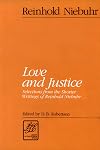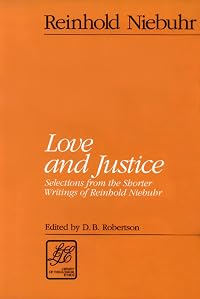
Love and Justice: Selections from the Shorter Writings of Reinhold Niebuhr (LTE) (Library of Theological Ethics)
by Reinhold Niebuhr
122 Members (3.25)
On This Page
Description
Reinhold Niebuhr is renowned for his unflinching honesty concerning issues of social ethics, specifically, love and justice. Humans, Niebuhr says, are incapable of perfect love. Therefore, their struggle against evil and injustice is doomed to only relative victory, although they strive to live in the ideal world. Niebuhr's concern with this paradox gave rise to numerous writings over the years in which he explored the many angles, subtleties, heights, and depths of the problems of humanity show more and society. Now sixty-four of these important pieces are compiled in a single volume, providing evidence of Niebuhr's belief that positive decisions and actions are possible for Christians. The Library of Theological Ethics series focuses on what it means to think theologically and ethically. It presents a selection of important and otherwise unavailable texts in easily accessible form. Volumes in this series will enable sustained dialogue with predecessors though reflection on classic works in the field. show lessTags
Recommendations


























Member Reviews
Members
- Recently Added By
Lists

Books read 2017
29 works; 1 member
Author Information

60+ Works 6,125 Members
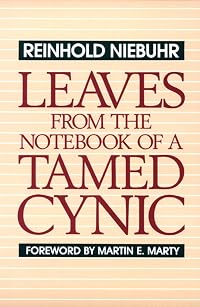
Walter Lippmann once called Reinhold Niebuhr the greatest mind America had produced since Jonathan Edwards. It was fitting, then, that Niebuhr died at home in Stockbridge, Massachusetts, in the town where Edwards had preached. He was born in Wright City, Missouri, and his father was a German immigrant who served those German-speaking churches that show more preserved both the Lutheran and Reformed (Calvinist) traditions and piety. After seminary in St. Louis, he studied for two years at Yale University, and the M.A. he received there was the highest degree he earned. Rather than work for a doctorate, he became a pastor in Detroit, where in his 13 years of service a tiny congregation grew to one of 800 members. Part of his diary from those years was published in 1929 as Leaves from the Notebook of a Tamed Cynic. During that time he began to attract attention through articles on social issues; as he said, he "cut [his] eyeteeth fighting [Henry] Ford." But the socialism to which he was attracted soon seemed naive to him: human problems could not be solved just by appealing to the good in people or by promulgating programs for change. Power, economic clout, was needed to change the systems set up by sinful groups, a position expressed in his 1932 book, Moral Man and Immoral Society. By this time Niebuhr was teaching at Union Theological Seminary in New York, where he spent the rest of his career. Niebuhr's theology always took second place to ethics. He ran for office as a socialist, rescued Paul Tillich from Germany, became a strong supporter of Israel, gave up pacifism, and was often too orthodox for the liberals, too liberal for the orthodox. His The Nature and Destiny of Man is one of the few seminal theological books written by an American. In it he reiterates a theme that led some to place him in the Barthian camp of Neo-orthodoxy: the radical sinfulness of the human creature. The human condition as illumined by the Christian tradition was always the arena in which he worked. (Bowker Author Biography) show less
All Editions
Classifications
- Genres
- Nonfiction, Religion & Spirituality, Politics and Government, General Nonfiction
- DDC/MDS
- 241.622 — Religion Christian practice & observance Christian ethics Christian ethics not otherwise covered
- LCC
- BR115 .J8 .N54 — Philosophy, Psychology and Religion Christianity Christianity Christianity in relation to special subjects
- BISAC
Statistics
- Members
- 122
- Popularity
- 268,360
- Rating
- (3.25)
- Languages
- English
- Media
- Paper, Ebook
- ISBNs
- 4
- ASINs
- 3