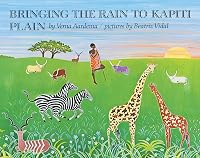
Bringing the Rain to Kapiti Plain: A Nandi Tale
by Verna Aardema
On This Page
Description
A cumulative rhyme relating how Ki-pat brought rain to the drought-stricken Kapiti Plain.Tags
Recommendations






Member Reviews
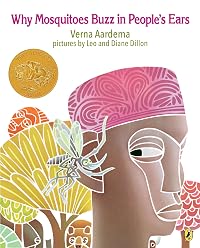
In this lovely rhyming picture book, based upon the folk traditions of the Nandi people of Kenya, a herdsman named Ki-pat finds a way to end the drought, and bring some much-needed rain to Kapiti Plain. Originally collected by British anthropologist Sir Claud Hollis, and included in his 1909 book The Nandi: Their Language and Folklore, the tale has been modernized by Verna Aardema, whose many excellent adaptations of African folklore include the Caldecott Medal-winner, Why Mosquitoes Buzz in People's Ears.
I enjoyed Bringing the Rain to Kapiti Plain immensely, and had such fun with the rhyming narrative, that I began to read it aloud to myself. I can see why it was selected to be a Reading Rainbow book! Beatriz Vidal's beautiful show more illustrations provide a charming accompaniment to the story, which would make an ideal story-hour selection. show less
I enjoyed Bringing the Rain to Kapiti Plain immensely, and had such fun with the rhyming narrative, that I began to read it aloud to myself. I can see why it was selected to be a Reading Rainbow book! Beatriz Vidal's beautiful show more illustrations provide a charming accompaniment to the story, which would make an ideal story-hour selection. show less
I ended up enjoying this book more than I predicted. When it started repeating the phrases and establishing a pattern, I became drawn into it. I liked that each phrase added expanded the picture so that the reader could understand the wide variety of things all related and unified by the Plain. It was really interesting to hear the unique words from this culture, and I loved how the pictures enhanced them. The pattern, rhyme, and rhythm made it super soothing to listen to and hear read aloud. I really liked reading this book about something that I usually don't see children's books based off of-it was nice to see a different culture and perspective of children's books from the ones I grew up reading. On the other hand, when I was show more looking at the summaries of this book, I never picked up on the myth that it tells about where Ki-pat shoots the cloud to bring the rain. I don't know if this just went over my head as I got caught up in the rhythm, or if it was too confusing for me to comprehend.
The rain brings a sense of rejuvenation and hope to the overall message of the book. It's really interesting how the overall theme of the book is enhanced by the growing picture and descriptions within the scenery, which contributes to the culture and togetherness the book portrays. show less
The rain brings a sense of rejuvenation and hope to the overall message of the book. It's really interesting how the overall theme of the book is enhanced by the growing picture and descriptions within the scenery, which contributes to the culture and togetherness the book portrays. show less
Reading Rainbow
A beautifully illustrated book, fine for its time, but I'm afraid that I cannot condone the revision or the fact that neither author nor illustrator is African or even of African descent, apparently. Also the story just doesn't make sense, tbh. If shooting an eagle feather broke open a cloud, believe me, it would have been done in the SW US and myriad other places.
A beautifully illustrated book, fine for its time, but I'm afraid that I cannot condone the revision or the fact that neither author nor illustrator is African or even of African descent, apparently. Also the story just doesn't make sense, tbh. If shooting an eagle feather broke open a cloud, believe me, it would have been done in the SW US and myriad other places.
A lovely book in rhyming fashion which addresses the issue of parched dry earth wherein there is no water for animals to drink, then as the words progress, the rain falls and the wild animals on the plains of Kapiti have plenty to drink.
It is a lovely tale of need addresses by nature. Quoting from the author -- "This is Ki-Pat who watched his herd as he stood on one leg like the big stork bird. Ki-Pat whose cos were so hungry and dry, they mooed for the rain to fall from the sky."
The story progresses when Ki-Pat finds an eagle feather from the sky. Putting together a string, a leather thong which became his bow to use the feather to shot the bow that pierced the rain cloud and the thunder LOUD!
Ki-Pat has a wife, and as the grass grew show more green, they was a little baby Ki-Pat. show less
It is a lovely tale of need addresses by nature. Quoting from the author -- "This is Ki-Pat who watched his herd as he stood on one leg like the big stork bird. Ki-Pat whose cos were so hungry and dry, they mooed for the rain to fall from the sky."
The story progresses when Ki-Pat finds an eagle feather from the sky. Putting together a string, a leather thong which became his bow to use the feather to shot the bow that pierced the rain cloud and the thunder LOUD!
Ki-Pat has a wife, and as the grass grew show more green, they was a little baby Ki-Pat. show less
An African herder works his magic to end a devastating drought on Kapiti Plain. Told as a story-poem, great fun to read aloud with kids, and to try to memorize.
This is such a beautiful book in every aspect.. It is easy to follow/read through with a nice rhythm to the words and poem format making this an easy yet fulfilling read. I especially adore the art style and the colors used for this book.
This book is very beautiful in its word choice, style and illustrations. It has a flow that is easy for young children to follow, and is perfect for a classroom read aloud. The ending is unexpected, but it makes you excited and thirsty for more.
Members
- Recently Added By
Lists

A Child's Book Tour of East Africa ::: Ethiopia, Kenya, Sudan, Uganda
68 works; 4 members

Reading Rainbow
193 works; 10 members

Most Popular Books Tagged Africa
35 works; 3 members

al.vick-wishlist-Children's
462 works; 3 members

Precious People
119 works; 1 member
Author Information

36+ Works 14,477 Members
Verna Aardema was born on June 6, 1911 in New Era Michigan. She received her B.A. degree from Michigan State College of Agriculture and Applied Sciences in 1934. She was a grade school teacher from 1934 to 1973 and staff correspondent for the Muskegon Chronicle from 1951 to 1972. Aardema started writing children's stories in the 1950's, and in show more 1960 she published her first books, Tales from the Story Hat and The Sky God Stories. She specializes in the modernization and adaptation of traditional African folktales. In the 1970s, Aardema joined illustrators Leo and Diane Dillon and produced three picture books. Why Mosquitoes Buzz in People's Ears received the Caldecott Medal in 1976 and the Brooklyn Art Books for Children Award in 1977. Who's in Rabbit's House? was the 1977 School Library Journal Best Book of the Year and a Lewis Carroll Shelf Award winner in 1978. Aardema received the Children's Reading Round Table Award in 1981, and several of her books have been selected as Notable Books by the American Library Association. Oh Kojo! How Could You! won the 1984 Parents' Choice Award for Literature. Verna Aardema died in 2000. show less
All Editions
Some Editions
Awards and Honors
Awards
Distinctions
Series
Belongs to Publisher Series
Common Knowledge
- Canonical title
- Bringing the Rain to Kapiti Plain: A Nandi Tale
- Original publication date
- 1981
- People/Characters
- Ki-pat
- Dedication
- For my librarian, Bernice Houseward
- First words
- This is the great Kapiti Plain, All fresh and green from African rains - A sea of grass for the ground birds to nest in, And patches of shade for wild creatures to rest in; With acacia trees for giraffes to browse on, And gra... (show all)ss for the herdsmen to pasture cows on.
- Last words
- (Click to show. Warning: May contain spoilers.)And Ki-pat got a wife and a little Ki-pat -
Who ends the cows now,
and shoots down the rain,
When black clouds shadow
Kapiti Plain. - Canonical DDC/MDS
- 398.22
Classifications
- Genres
- Children's Books, Poetry, Picture Books
- DDC/MDS
- 398.22 — Society, government, & culture Customs, etiquette & folklore Folklore & Folktales Folk literature Legends
- LCC
- PZ8.3 .A123 .B — Language and Literature Fiction and juvenile belles lettres Fiction and juvenile belles lettres Juvenile belles lettres
- BISAC
Statistics
- Members
- 4,217
- Popularity
- 3,609
- Reviews
- 58
- Rating
- (4.08)
- Languages
- English
- Media
- Paper, Audiobook
- ISBNs
- 30
- UPCs
- 2
- ASINs
- 15