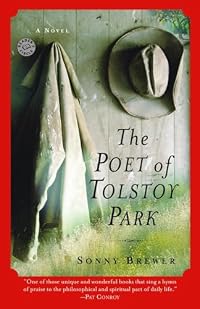
The Poet of Tolstoy Park
by Sonny Brewer
On This Page
Description
This book is based on the true life of Henry Stuart. When the 67-year-old former professor finds out he is dying of tuberculosis, he vows to "learn in solitude how to save myself." He sets off for Fairhope, Alabama, with only the writings of his beloved Tolstoy for company. There, the barefoot poet builds himself a small hut and slowly becomes an inspiration for the rest of the utopian town. When his last few months become his last few years, Henry's attempt to understand death becomes a show more lesson on life. show lessTags
Recommendations

Member Reviews
In the words of Dylan Thomas, “Do not go gentle to that good night,/ Old age should burn and rage at close of day;/ Rage, rage against the dying of the light.”
Henry James Stuart was such a one. He did not go gently, he went on his own terms. Some would say he beat death at its own game, although he would have been the first to tell you that death is always the winner, eventually.
What we can learn from Henry Stuart is more about life than it ever could be about death. He was an amazingly complex, but unbelievably simple, man. He made difficult decisions, some of which others could barely understand, but he was true to his belief that all men are a part of God and His plan, and cannot be divorced for Him. He took joy in being a cog show more in a great machine, but recognized that the machine would not run as smoothly without the cog serving its function.
There is a temptation to compare Stuart to Thoreau. If you have read Walton, you cannot avoid the connection. He went into the woods, built his own distinct home, and separated himself from others for a period of time to commune with nature and his own psyche. In doing so, he honed his soul into something that sparkled and twinkled from his head to his very bare feet. But, unlike, Thoreau, his experiment was done only for himself, with no intent to share its outcome with others, for he had been given a terminal diagnosis by a doctor in Idaho. And, unlike Thoreau, he did not set the limits of his exile, he had them set for him by the awakening of his soul and with that the discovery of the meaning of his life.
I found this to be an amazing story. It was no doubt as much fiction as fact, for while Henry did live and build and thrive at Tolstoy Park in Alabama, the fact that he deliberately kept no journal during this time precludes anyone knowing exactly what his thoughts and feelings were. That matters little. His life alone tells us something of him, and Sonny Brewer can be extremely proud of the way he has filled in the missing parts and given this story a depth of both feeling and intellect that is superbly done.
I have seldom wanted to preserve so many quotations from a text. Besides his own astute observances, Mr. Brewer has quoted some of the greatest minds of literature and fit them seamlessly into the tale he has woven. It is as beautiful and as intricate as the handwoven rugs of Henry Stuart, or as the myriad creations of a God of infinite possibilities.
For an example of beauty of language:
Sleep rolled over Henry like a fog over the marshes at the headwaters of Mobile Bay, and his mind was still and quiet as the silver mist under a windless sickle of moon and the arcing of the stars in Leo.
Or of thought:
But now he felt better the intimate connection between all people, and most important, a common mortality. If there was any way at all to feel deep inside some kinship with the strangers who constitute humanity, it would have to be accomplished in the single knowledge that we will all die.
A truth that takes on new meaning the closer and closer we get to the inevitable. And, yes, I speak from experience.
What a wonderful way to finish my year of reading. I hope it bodes well for all the great books I might find in 2018. show less
Henry James Stuart was such a one. He did not go gently, he went on his own terms. Some would say he beat death at its own game, although he would have been the first to tell you that death is always the winner, eventually.
What we can learn from Henry Stuart is more about life than it ever could be about death. He was an amazingly complex, but unbelievably simple, man. He made difficult decisions, some of which others could barely understand, but he was true to his belief that all men are a part of God and His plan, and cannot be divorced for Him. He took joy in being a cog show more in a great machine, but recognized that the machine would not run as smoothly without the cog serving its function.
There is a temptation to compare Stuart to Thoreau. If you have read Walton, you cannot avoid the connection. He went into the woods, built his own distinct home, and separated himself from others for a period of time to commune with nature and his own psyche. In doing so, he honed his soul into something that sparkled and twinkled from his head to his very bare feet. But, unlike, Thoreau, his experiment was done only for himself, with no intent to share its outcome with others, for he had been given a terminal diagnosis by a doctor in Idaho. And, unlike Thoreau, he did not set the limits of his exile, he had them set for him by the awakening of his soul and with that the discovery of the meaning of his life.
I found this to be an amazing story. It was no doubt as much fiction as fact, for while Henry did live and build and thrive at Tolstoy Park in Alabama, the fact that he deliberately kept no journal during this time precludes anyone knowing exactly what his thoughts and feelings were. That matters little. His life alone tells us something of him, and Sonny Brewer can be extremely proud of the way he has filled in the missing parts and given this story a depth of both feeling and intellect that is superbly done.
I have seldom wanted to preserve so many quotations from a text. Besides his own astute observances, Mr. Brewer has quoted some of the greatest minds of literature and fit them seamlessly into the tale he has woven. It is as beautiful and as intricate as the handwoven rugs of Henry Stuart, or as the myriad creations of a God of infinite possibilities.
For an example of beauty of language:
Sleep rolled over Henry like a fog over the marshes at the headwaters of Mobile Bay, and his mind was still and quiet as the silver mist under a windless sickle of moon and the arcing of the stars in Leo.
Or of thought:
But now he felt better the intimate connection between all people, and most important, a common mortality. If there was any way at all to feel deep inside some kinship with the strangers who constitute humanity, it would have to be accomplished in the single knowledge that we will all die.
A truth that takes on new meaning the closer and closer we get to the inevitable. And, yes, I speak from experience.
What a wonderful way to finish my year of reading. I hope it bodes well for all the great books I might find in 2018. show less
An older "Thoreau" faces mortality. Sonny Brewer's book is a puzzle to me. It's a book which moves slowly and inexorably, yet most pleasurably towards its inevitable end. I was initially put off by all the minute detail, which seemed unnecessary, given the everyday nature of what was being described. Here's an example:
"Henry was washing his breakfast bowl in a white porcelain-coated metal bucket ... Henry lifted the bowl from the water in the bucket and slung droplets from it onto the ground. He reached a small white cotton towel down from where it hung on a holly branch near the well, dried the bowl, and returned the towel. He took the clean spoon from his pants pocket and placed it inside the bowl and was taking steps toward the barn show more to put the dish away ..."
There's a lot of this kind of picture-making detail in the book, but you kind of get used to it after a bit and fall willingly into the slow cadences and rhythms of a timeless tale about life, death, relationships. Henry Stuart knows he's dying. He just doesn't know when. And of course no one does, and therein lies the unifying theme, I think. It's not about how long we live or when we die, it's about how we spend our time while we're still here. At first Henry thinks he needs to be alone - and perhaps he does - but then he realizes that other people are important too, and ends up becoming an important and integral part of the Fairhope and Montrose community. I thought of Thoreau and Walden while reading this book, of course, but I also thought of the southern novelist, Reynolds Price, whose dignified and stately style Brewer's gentle story brings to mind. So yeah, I enjoyed the story. On a more irreverent note, I was kinda wishing, waaay in the back of my mind, that maybe ol' Henry and Kate (some thirty years younger)would get together a la "Murphy's Romance." (Remember James Garner and Sally Field?) But I suppose that woulda spoiled the dignified and artistic tone of the book. But who knows? Maybe Hollywood will add that twist by the time it gets to the screen. Great story, Sonny. You have a voice that deserves to find an audience. show less
"Henry was washing his breakfast bowl in a white porcelain-coated metal bucket ... Henry lifted the bowl from the water in the bucket and slung droplets from it onto the ground. He reached a small white cotton towel down from where it hung on a holly branch near the well, dried the bowl, and returned the towel. He took the clean spoon from his pants pocket and placed it inside the bowl and was taking steps toward the barn show more to put the dish away ..."
There's a lot of this kind of picture-making detail in the book, but you kind of get used to it after a bit and fall willingly into the slow cadences and rhythms of a timeless tale about life, death, relationships. Henry Stuart knows he's dying. He just doesn't know when. And of course no one does, and therein lies the unifying theme, I think. It's not about how long we live or when we die, it's about how we spend our time while we're still here. At first Henry thinks he needs to be alone - and perhaps he does - but then he realizes that other people are important too, and ends up becoming an important and integral part of the Fairhope and Montrose community. I thought of Thoreau and Walden while reading this book, of course, but I also thought of the southern novelist, Reynolds Price, whose dignified and stately style Brewer's gentle story brings to mind. So yeah, I enjoyed the story. On a more irreverent note, I was kinda wishing, waaay in the back of my mind, that maybe ol' Henry and Kate (some thirty years younger)would get together a la "Murphy's Romance." (Remember James Garner and Sally Field?) But I suppose that woulda spoiled the dignified and artistic tone of the book. But who knows? Maybe Hollywood will add that twist by the time it gets to the screen. Great story, Sonny. You have a voice that deserves to find an audience. show less
When retired philosophy professor Henry Stuart learns he is dying, he decides to leave his home of Idaho - and his boots - behind, traveling barefoot to Fairhope, Alabama to live out the remaining year of his life in a small colony. Inspired by the writings of Tolstoy, Henry espouses his beliefs on organized religion, the value of hard work, and how we treat one another. He also weaves in lessons from Buddhist monks and Black Elk of the Lakota people.
Known as "the hermit of Fairhope", he's more the poet of Tolstoy Park, a tract of land he named and built a round hut upon, with a bed high in the air requiring a ladder to access. Henry is eccentric, yes, but his diagnosis - and the recent death of his wife - have brought him to reassess show more what matters and he is determined to make the best of the time he has left. That means giving away his boots so he can feel his bare feet on the earth, working with his hands, and balancing a life of solitude with kindness to others.
The result, from a literary perspective, is more a character study than a plot-driven narrative. At times, the story moves slowly, describing Henry's building of his hut with the same detail Thoreau dedicated to describing his natural experiences in Walden (definitely an inspiration for Brewer). Still, Henry is such a fascinating - and fascinated - man, it's an easy journey to take. show less
Known as "the hermit of Fairhope", he's more the poet of Tolstoy Park, a tract of land he named and built a round hut upon, with a bed high in the air requiring a ladder to access. Henry is eccentric, yes, but his diagnosis - and the recent death of his wife - have brought him to reassess show more what matters and he is determined to make the best of the time he has left. That means giving away his boots so he can feel his bare feet on the earth, working with his hands, and balancing a life of solitude with kindness to others.
The result, from a literary perspective, is more a character study than a plot-driven narrative. At times, the story moves slowly, describing Henry's building of his hut with the same detail Thoreau dedicated to describing his natural experiences in Walden (definitely an inspiration for Brewer). Still, Henry is such a fascinating - and fascinated - man, it's an easy journey to take. show less
Sometimes it is great to slow down and read a book that is gentle and philosophical. Sonny Brewer's novel based on the life of Henry Stuart is just such a book. When diagnosed with tuberculosis in 1925, Stuart made the unusual decision to leave his home and go to a place where he could face his impending death on his own terms. To that end, he bought ten acres of undeveloped land in Fairhope, Alabama, gave away most of his worldly goods, and climbed aboard the train that would, he assumed, take him to the place of his passing. Fortunately for Henry, and for us, that passing took much longer than expected. For almost twenty years, the hermit of Tolstoy Park, the name he called his new home, became Fairhope's own version of Henry David show more Thoreau, complete with his own outlook on life, and more importantly, death. I highly recommend this book. show less
“The more you transform your life from the material to the spiritual domain, the less you become afraid of death.” Leo Tolstoy (Chapter 10)
The main character of the novel, Henry James Stuart, his move south to Alabama, and his building of a round stone house are historical. I imagine the fictional part of the book is in the details - the minute circumstances of his life and thoughts that make the story interesting and readable.
The hero's quest Henry embarked on in the face of his terminal diagnosis was to live a spare, essential, and meaningful life. I loved the story partly because I can relate to his stage of life and his response to it. I have a sneaking suspicion some modern elements like mindfulness, zen, and Black Elk crept show more into the period, but it's a good tale regardless. I was captivated. show less
The main character of the novel, Henry James Stuart, his move south to Alabama, and his building of a round stone house are historical. I imagine the fictional part of the book is in the details - the minute circumstances of his life and thoughts that make the story interesting and readable.
The hero's quest Henry embarked on in the face of his terminal diagnosis was to live a spare, essential, and meaningful life. I loved the story partly because I can relate to his stage of life and his response to it. I have a sneaking suspicion some modern elements like mindfulness, zen, and Black Elk crept show more into the period, but it's a good tale regardless. I was captivated. show less
I didn't expect to like this book, but then he stopped wearing shoes! A most interesting man about whom I'd like to know more.
Can't say I'd live as he did, but it certainly seemed to work for him for quite a few years.
Highly recommended.
Can't say I'd live as he did, but it certainly seemed to work for him for quite a few years.
Highly recommended.
I loved this book. It makes me want to visit Fairhope, Alabama.
Members
- Recently Added By
Lists

Books Read in 2021
5,361 works; 114 members
Author Information

13+ Works 615 Members
Sonny Brewer is the founder of Over the Transom Bookshop in Fairhope, Alabama, and is board chairman of the nonprofit Fairhope Center for the Writing Arts.
Common Knowledge
- Canonical title
- The Poet of Tolstoy Park
Classifications
Statistics
- Members
- 214
- Popularity
- 151,343
- Reviews
- 7
- Rating
- (4.00)
- Languages
- English
- Media
- Paper, Audiobook, Ebook
- ISBNs
- 9
- ASINs
- 2