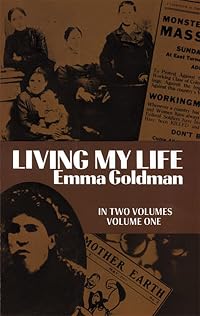
Living My Life, Vol. 1
by Emma Goldman
On This Page
Description
Volume 1 of the candid, no-holds-barred account by American anarchist Goldman relates her philosophical and political journey through life, beginning with her emigration from Russia to the U.S. in 1886. "You damn bitch of an anarchist, I wish I could get at you. I would tear your heart out and feed it to my dog." This was one of the less obscene messages received by Emma Goldman (1869-1940), while in jail on suspicion of complicity in the assassination of McKinley. The most notorious woman show more of her day, she was bitterly hated by millions and equally revered by millions. The strong feelings she aroused are understandable. She was an alien, a practicing anarchist, a labor agitator, a pacifist in World War 1, an advocate of political violence, a feminist, a proponent of free love and birth control, a communist, a street-fighter for justice - all of which she did with strong intellect and boundless passion. Today, of course, many of the issues that she fought over are just as vital as they were then. Emma Goldman came from Russia at the age of 17. After an encounter with the sweatshop and an unfortunate marriage, she plunged into the bewildering intellectual and activist chaos that attended American social evolution around the turn of the twentieth century. She knew practically everyone of importance in radical circles. She dominated many areas of the radical movement, lecturing, writing, haranguing, and publishing to awaken the world to her ideas. After World War I she was deported to Russia, where she soon discovered that anarchists were no better liked than in America, despite Lenin's first gesture of welcome. She escaped with her life but never was allowed to return to the United States. Emma Goldman was a devastatingly honest woman, who spared herself as little as she spared anyone else. From her account the reader can gain insight into a curious personality type of recurrent interest: a woman who devoted her life to eliminating suffering, yet could make a bomb or assist in staging an assassination. Equally interesting are her comments on other radicals of the period, such as Kropotkin, Berkman, Mooney, Lenin, Trotsky, Haywood, Most, the Haymarket martyrs, and many others. Her autobiography, written with vigor, ranks among the finest in the English language. show lessTags
Recommendations























Member Reviews
The past couple of years, I've been leaning into my innate anarchism. Reading this book is part of my effort to understand how some early anarchists made their way in this country, fought for their values, and resisted political and social oppression. I picked up both volumes of Emma Goldman's Living My Life. This review is for volume one.
Let me start by saying: Emma Goldman was one bad bitch. Honestly, how did she go under my radar for so long? Oh, I know. Because she was (and is most likely still) considered a threat to the auspices of 'law and order' that keep powerful systems rife with disparity and exploitation in place. Once considered the most dangerous woman in America, Goldman lived her life fully in every moment, refusing to show more compromise her autonomy and devotion to the ideal that no human belongs 'over' another.
I wish every single person would read this book. Not because I think everyone will be converted to anarchism. Instead, I want people to understand in great detail what anarchism actually is.
Personally, I spent most of my life slightly afraid of anarchy. The first time I saw the symbol, it was scrawled on the notebook of one of the 'bad' kids in school. You know the type, always in trouble. The term was always defined for me as "lawlessness" and "chaos" by the media and the adults in my life.
On the contrary, anarchism is the idea that people can and should live freely without top-down hierarchical power brokers deciding their fate.
To be fair, the idea of anarchism can be scary if you're the kind of person who feels insecure without having any authority telling you what to do, think, or believe. I know many people who genuinely believe that if it weren't for their religion or the rule of law, they wouldn't be able to govern themselves and be a 'good person'.
However, the more I read this book, the more I found that anarchism resonates with the person I've always been. As I read the words of this extraordinary woman, I found myself feeling not so alone in the world. It was like a massive part of me had finally been seen. A part of me that has always made me feel like an outsider. My heart swelled as I devoured this book.
Goldman came to the U.S. in 1886 at the age of seventeen after being raised in Russia in a home with an abusive father. She married early, then divorced, and spent the rest of her life in and out of relationships with men that she loved but with whom she did not 'make it official.' Her political positions on issues like racism, sexism, labor, and religion are ahead of her time.
Shit, they're ahead of our time:
On marriage: "'If ever I love a man again, I will give myself to him without being bound by the rabbi or the law,' I declared, "'and when that love dies, I will leave without permission.'"
On sex work: "I rebelled against the Christian hypocrisy which allowed the men to go free and sent the poor women to prison for having ministered to the sexual demands of those men."
On what a woman wants: "No amount of wardrobe could have given me so much joy as my precious little library."
On God: "I was opposed to the Catholic as to the other Churches. I considered them all alike, enemies of the people. They preached submission, and their God was the God of the rich and the mighty. I hated their God and would never make peace with him."
On family planning: "Still more impressed was I by the fierce, blind struggle of the women of the poor against frequent pregnancies. Most of them lived in continual dread of conception...Having a large brood of children, often many more than the weekly wage of the father could provide for, each additional child was a curse, 'a curse of God,' as orthodox Jewish and Irish Catholics repeatedly told me."
After becoming part of the Yiddish-speaking anarchist community, Goldman discovered her skill as an orator. She began to command crowds of people, and subsequently, the attention of the rich and powerful, who spent decades trying to bring her down. Regardless, she stayed focused on her work and looked for any opportunity - even her own public trial - to spread anarchist messages.
One of the most essential takeaways from this book is that it provides a glimpse into just how dire the situation was for the average worker, woman, and child during the turn of the century. It illustrates in great detail just how depraved power can be, how heartless and cruel unchecked capitalism is. At a time when many of our rights are being stripped away - after a century of work by leftists of all stripes - it would behoove us to take note and act now to prevent their further erosion.
Goldman was very clear that politics is not the way to solve most of the problems facing society. Leaving the solutions to our problems in the hands of those with the most money and power - and yes, folks, that is who holds political office in America - is a recipe for exploitation. Her narrative pulls no punches. She is unapologetic throughout the telling of her life story and is frank about her own missteps. Her words reflect both a fiery, passionate rebel and the tender heart of a woman without artifice who loved as intensely as she fought.
My request to you is this: read this book. Read it. You don't have to agree with everything in it, but if you don't see parallels to the conversations happening around the power imbalances we are facing today; and the infinite, sinister ways that those who hold the greatest amount of power protect their own interests and ruthlessly penalize the people who stand up to them, then I dunno. Maybe democracy isn't for you. show less
Let me start by saying: Emma Goldman was one bad bitch. Honestly, how did she go under my radar for so long? Oh, I know. Because she was (and is most likely still) considered a threat to the auspices of 'law and order' that keep powerful systems rife with disparity and exploitation in place. Once considered the most dangerous woman in America, Goldman lived her life fully in every moment, refusing to show more compromise her autonomy and devotion to the ideal that no human belongs 'over' another.
I wish every single person would read this book. Not because I think everyone will be converted to anarchism. Instead, I want people to understand in great detail what anarchism actually is.
Personally, I spent most of my life slightly afraid of anarchy. The first time I saw the symbol, it was scrawled on the notebook of one of the 'bad' kids in school. You know the type, always in trouble. The term was always defined for me as "lawlessness" and "chaos" by the media and the adults in my life.
On the contrary, anarchism is the idea that people can and should live freely without top-down hierarchical power brokers deciding their fate.
To be fair, the idea of anarchism can be scary if you're the kind of person who feels insecure without having any authority telling you what to do, think, or believe. I know many people who genuinely believe that if it weren't for their religion or the rule of law, they wouldn't be able to govern themselves and be a 'good person'.
However, the more I read this book, the more I found that anarchism resonates with the person I've always been. As I read the words of this extraordinary woman, I found myself feeling not so alone in the world. It was like a massive part of me had finally been seen. A part of me that has always made me feel like an outsider. My heart swelled as I devoured this book.
Goldman came to the U.S. in 1886 at the age of seventeen after being raised in Russia in a home with an abusive father. She married early, then divorced, and spent the rest of her life in and out of relationships with men that she loved but with whom she did not 'make it official.' Her political positions on issues like racism, sexism, labor, and religion are ahead of her time.
Shit, they're ahead of our time:
On marriage: "'If ever I love a man again, I will give myself to him without being bound by the rabbi or the law,' I declared, "'and when that love dies, I will leave without permission.'"
On sex work: "I rebelled against the Christian hypocrisy which allowed the men to go free and sent the poor women to prison for having ministered to the sexual demands of those men."
On what a woman wants: "No amount of wardrobe could have given me so much joy as my precious little library."
On God: "I was opposed to the Catholic as to the other Churches. I considered them all alike, enemies of the people. They preached submission, and their God was the God of the rich and the mighty. I hated their God and would never make peace with him."
On family planning: "Still more impressed was I by the fierce, blind struggle of the women of the poor against frequent pregnancies. Most of them lived in continual dread of conception...Having a large brood of children, often many more than the weekly wage of the father could provide for, each additional child was a curse, 'a curse of God,' as orthodox Jewish and Irish Catholics repeatedly told me."
After becoming part of the Yiddish-speaking anarchist community, Goldman discovered her skill as an orator. She began to command crowds of people, and subsequently, the attention of the rich and powerful, who spent decades trying to bring her down. Regardless, she stayed focused on her work and looked for any opportunity - even her own public trial - to spread anarchist messages.
One of the most essential takeaways from this book is that it provides a glimpse into just how dire the situation was for the average worker, woman, and child during the turn of the century. It illustrates in great detail just how depraved power can be, how heartless and cruel unchecked capitalism is. At a time when many of our rights are being stripped away - after a century of work by leftists of all stripes - it would behoove us to take note and act now to prevent their further erosion.
Goldman was very clear that politics is not the way to solve most of the problems facing society. Leaving the solutions to our problems in the hands of those with the most money and power - and yes, folks, that is who holds political office in America - is a recipe for exploitation. Her narrative pulls no punches. She is unapologetic throughout the telling of her life story and is frank about her own missteps. Her words reflect both a fiery, passionate rebel and the tender heart of a woman without artifice who loved as intensely as she fought.
My request to you is this: read this book. Read it. You don't have to agree with everything in it, but if you don't see parallels to the conversations happening around the power imbalances we are facing today; and the infinite, sinister ways that those who hold the greatest amount of power protect their own interests and ruthlessly penalize the people who stand up to them, then I dunno. Maybe democracy isn't for you. show less
This is volume 1 of the Dover edition, which is complete and unabridged. Why bother with the Penguin edition, which is almost as long, scarcely cheaper, and has who knows what material "abridged"? Go for volumes 1 and 2 of the Dover edition.
As for the content -- Emma Goldman's biography is a must for all lovers of radical history and people seeking to understand the genesis and development of anarchist thought. But I would also recommend it to people who like historical fiction, particularly the picaresque. The lives of our radical activist forebears are filled with the sort of action that seems wholly fictional to modern eyes.
As for the content -- Emma Goldman's biography is a must for all lovers of radical history and people seeking to understand the genesis and development of anarchist thought. But I would also recommend it to people who like historical fiction, particularly the picaresque. The lives of our radical activist forebears are filled with the sort of action that seems wholly fictional to modern eyes.
Ratings
Members
- Recently Added By
Author Information

182+ Works 4,005 Members
Series
Belongs to Publisher Series
Work Relationships
Is contained in
Common Knowledge
- People/Characters
- Emma Goldman
- First words
- It was the 15th of August 1889, the day of my arrival in New York City. I was twenty years old. All that had happened in my life until that time was now left behind me, cast off like a worn-out garment.
- Disambiguation notice
- Volume 1 of 2, do not combine with volume 1 of 3-volume editions.
Classifications
- Genres
- Biography & Memoir, Nonfiction, General Nonfiction, History, Sexuality and Gender Studies
- DDC/MDS
- 335.830924 — Society, government, & culture Economics Socialism and related systems Other systems Anarchism Biography And History Biography
- LCC
- HX843 .G6 — Social sciences Socialism. Communism. Anarchism Anarchism
- BISAC
Statistics
- Members
- 395
- Popularity
- 79,126
- Reviews
- 2
- Rating
- (4.24)
- Languages
- Dutch, English, Spanish, Turkish
- Media
- Paper, Ebook
- ISBNs
- 11
- UPCs
- 1
- ASINs
- 3