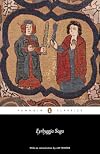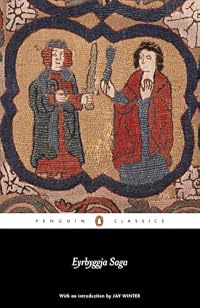
Eyrbyggja Saga
by Anonymous, Snorri Sturluson
On This Page
Description
An Icelandic saga which mixes realism with wild gothic imagination and history with eerie tales of hauntings. It dramatizes a 13th century view of the past, from the pagan anarchy of the Viking age to the settlement of Iceland, the coming of Christianity and the beginnings of organized society. For more than seventy years, Penguin has been the leading publisher of classic literature in the English-speaking world. With more than 1,700 titles, Penguin Classics represents a global bookshelf of show more the best works throughout history and across genres and disciplines. Readers trust the series to provide authoritative texts enhanced by introductions and notes by distinguished scholars and contemporary authors, as well as up-to-date translations by award-winning translators. show lessTags
Recommendations








Member Reviews
My dear husband, sensitively attuned to my growing interest in Iceland, bought me my first Icelandic saga—was it Christmas? Valentines’ Day? It was probably the only saga at the bookstore, but it was still a most excellent choice. Eyrbyggja Saga has all those elements that so endear the sagas to us. Yes, I’m talking love, hate, jealousy and revenge. Bloody fights, heroism and sacrifice; petty cruelty and betrayal. But enough of the blathering--let’s have some fine examples to tempt the saga-hungry reader!
Bjorn takes leave of his love, probably forever:
"From fair golden daybreak
to deep blue darkness,
long should the day have lasted,
my delight, my despair!
As the day is dying
a drink I’ll pledge
to the pain-filled memory
of passing show more pleasures."
The droll, laconic conversation so typical of sagas is found throughout this one as well. Snorri the Priest is talking to Thorstein at the Assembly about Thorstein’s lawsuits. “’I daresay you’d like us to be as helpful to you with your cases as you and the men of Borgarfjord were to me last summer?’ asked Snorri. ‘No, I don’t think I would,’ said Thorstein.”
Or, this exchange between Ospak and Alf: “Then Alf the Short stepped forward and asked Ospak not to take the whale. ‘You’d better keep out of this, Alf,’ said Ospak, ‘you have a thick skull, and I’ve a heavy axe’…It was good advice, and Alf took it.”
How to banish too many ghosts at Frodriver?
"It seems that Thorodd and other ghosts were sitting by the fire, every night. They were making it very difficult for the people who lived there. The solution: take the ghosts to court. Each of the ghosts was summonsed for '…trespassing on the home and robbing people of life and health.'
As sentence was being passed on Thorir Wood-Leg, he rose to his feet, ‘I sat here as long as people would let me,’ he said, then went out through the other door where the court was not being held.
After that, sentence was passed on the shepherd, and he stood up. ‘I’ll go now,’ he said, ‘and it seems I should have gone sooner.’
When Thorgrima Witch-Face heard her sentence, she stood up, too. ‘I stayed as long as you let me,’ she said.
…Thorodd was the last to be sentenced. When he heard the judgment, he stood up. ‘There’s no peace here,’ he said, ‘we’d best all be on our way.’ And with that he walked out."
Epic battles are immortalized in poetry, such as the Lay of the Raven:
"Two were slain
by the stout-hearted soldier,
south of the stream
rang the swords:
seven more spirits
slept, robbed of life,
at Thors Ness, slaughtered
for all to see."
And these are just a few highlights! Read Eyrbyggja Saga and see for yourself. show less
Bjorn takes leave of his love, probably forever:
"From fair golden daybreak
to deep blue darkness,
long should the day have lasted,
my delight, my despair!
As the day is dying
a drink I’ll pledge
to the pain-filled memory
of passing show more pleasures."
The droll, laconic conversation so typical of sagas is found throughout this one as well. Snorri the Priest is talking to Thorstein at the Assembly about Thorstein’s lawsuits. “’I daresay you’d like us to be as helpful to you with your cases as you and the men of Borgarfjord were to me last summer?’ asked Snorri. ‘No, I don’t think I would,’ said Thorstein.”
Or, this exchange between Ospak and Alf: “Then Alf the Short stepped forward and asked Ospak not to take the whale. ‘You’d better keep out of this, Alf,’ said Ospak, ‘you have a thick skull, and I’ve a heavy axe’…It was good advice, and Alf took it.”
How to banish too many ghosts at Frodriver?
"It seems that Thorodd and other ghosts were sitting by the fire, every night. They were making it very difficult for the people who lived there. The solution: take the ghosts to court. Each of the ghosts was summonsed for '…trespassing on the home and robbing people of life and health.'
As sentence was being passed on Thorir Wood-Leg, he rose to his feet, ‘I sat here as long as people would let me,’ he said, then went out through the other door where the court was not being held.
After that, sentence was passed on the shepherd, and he stood up. ‘I’ll go now,’ he said, ‘and it seems I should have gone sooner.’
When Thorgrima Witch-Face heard her sentence, she stood up, too. ‘I stayed as long as you let me,’ she said.
…Thorodd was the last to be sentenced. When he heard the judgment, he stood up. ‘There’s no peace here,’ he said, ‘we’d best all be on our way.’ And with that he walked out."
Epic battles are immortalized in poetry, such as the Lay of the Raven:
"Two were slain
by the stout-hearted soldier,
south of the stream
rang the swords:
seven more spirits
slept, robbed of life,
at Thors Ness, slaughtered
for all to see."
And these are just a few highlights! Read Eyrbyggja Saga and see for yourself. show less
After Thorolf died, a good many people found it more and more unpleasant to stay out of doors once the sun had begun to go down. As the summer wore on, it became clear that Thorolf wasn't lying quiet, for after sunset no one out of doors was left in peace. There was another thing, too: the oxen which had been used to haul Thorolf's body were ridden to death by demons, and every beast that came near his grave went out of its mind, and howled itself to death. The shepherd a Hvamm often came running with Thorolf after him. One day that autumn neither sheep nor shepherd came back to the farm, and next morning, when a search was made for him the shepherd was found dead, not far from Thorolf's grave, his corpse coal-black, and every bone in show more his body broken.
As well as lots feuds and pitched battles, Eyrbyggja Saga includes gothic elements such as witchcraft, omens of ill-fortune, and hauntings by the unquiet dead. It was Sir Walter Scot's favourite Icelandic saga.
As Snorri and his men were coming up the scree, Steinthor cast a spear over them for good luck, according to ancient custom. The spear sought out its victim and struck Mar Hallvardsson, Snorri's uncle, putting him out of the fight.
The practice of throwing a spear over men who are about to fight, to dedicate the dead to Odin, also occurs in "American Gods"by Neil Gaiman. show less
As well as lots feuds and pitched battles, Eyrbyggja Saga includes gothic elements such as witchcraft, omens of ill-fortune, and hauntings by the unquiet dead. It was Sir Walter Scot's favourite Icelandic saga.
As Snorri and his men were coming up the scree, Steinthor cast a spear over them for good luck, according to ancient custom. The spear sought out its victim and struck Mar Hallvardsson, Snorri's uncle, putting him out of the fight.
The practice of throwing a spear over men who are about to fight, to dedicate the dead to Odin, also occurs in "American Gods"by Neil Gaiman. show less
A saga concentrating on the Odinic religion of the Icelanders. It relates a good deal of the career of Snorri the Priest who also appears in the Njal Saga. It reads well, and has a story about an Icelandic zombie, or Draugr. Reread in 2025.
Fascinating account of life in early Iceland, including religious life.
Ratings
Members
- Recently Added By
Lists

Readable Classics
110 works; 15 members
Author Information
51 Works 14,489 Members

168+ Works 8,002 Members
Snorri Sturluson's fame as a historian---his main work is the 16 sagas included in Heimskringla (c.1230), a monumental history of Norway from its beginning until 1177---lies both in his critical approach to sources and in his fine, realistic exposition of event and motivation. A similar combination of scholarly and imaginative talent is seen in show more The Prose Edda (c.1220). Intended to be a handbook in skaldic poetry, it preserves invaluable mythological tales that were on the verge of being forgotten even in Sturluson's time. A large part of what we know about Nordic mythology stems from his Edda. The bibliography that follows also lists the anonymous Egil's Saga (1200--30), which many expert Scandinavian medievalists (e.g., Sigurdur Nordal and Bjorn M. Olsen) attribute to Sturluson. It is a fascinating account of life in Norway, England, and Iceland and of the poet-warrior Egil, whose skaldic verse is renowned for its unusual emotional and personal qualities. Snorri Sturluson's own life was as eventful as those about whom he wrote. Returning to Iceland from exile in 1239, he again became deeply involved in serious power struggles and was murdered in 1241. (Bowker Author Biography) show less
Some Editions
Series
Belongs to Publisher Series
Work Relationships
Is contained in
Islänningasagorna : samtliga släktsagor och fyrtionio tåtar: Rikedom och makt, Tro och kamp by Kristinn Jóhannesson
Common Knowledge
- Canonical title
- Eyrbyggja Saga
- Original title
- Eyrbyggja Saga
- Alternate titles
- The Saga of the People of Eyri
- People/Characters
- Snorri the Priest; Arnkel Hrolfsson
- First words
- There was a great chieftain in Norway called Ketil Flat-Nose, the son of Bjorn Buna, son of Grim, one of the leading men in Sogn.
(translated by Hermann Palsson and Paul Edwards, 1972) - Last words
- (Click to show. Warning: May contain spoilers.)AND SO WE END THIS STORY ABOUT
THE PEOPLE OF THOR'S NESS,
EYR, AND ALFTAFJORD.
(translated by Hermann Palsson and Paul Edwards, 1972) - Original language
- Old Norse
Classifications
- Genre
- Fiction and Literature
- DDC/MDS
- 839.61 — Literature & rhetoric German & related literatures Other Germanic literatures Old Norse, Old Icelandic, Icelandic, Faroese literatures Old Norse poetry
- LCC
- PT7269 .E6 .E5 — Language and Literature German, Dutch and Scandinavian literatures Old Norse literature: Old Icelandic and Old Norwegian Individual sagas and historical works
- BISAC
Statistics
- Members
- 392
- Popularity
- 79,151
- Reviews
- 4
- Rating
- (3.74)
- Languages
- 6 — English, Germanic (Other), German, Icelandic, Norwegian (Nynorsk), Spanish
- Media
- Paper, Ebook
- ISBNs
- 10
- ASINs
- 2