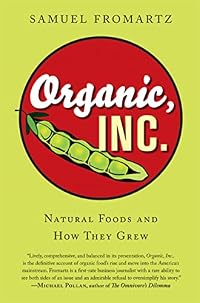
Organic, Inc.: Natural Foods and How They Grew
by Samuel Fromartz
On This Page
Description
Organic food has become a juggernaut in an otherwise sluggish food industry, growing at 20 percent a year as products like organic ketchup and corn chips vie for shelf space with conventional comestibles. But what is organic food? Is it really better for you? Where did it come from, and why are so many of us buying it? Business writer Samuel Fromartz set out to get the story behind this surprising success after he noticed that his own food choces were changing with the times. In Organic, show more Inc., Fromartz traces organic food back to its anti-industrial origins more than a century ago. Then he follows it forward again, casting a spotlight on the innovators who created an alternative way of producing food that took root and grew beyond their wildest expectations. In the process he captures how the industry came to risk betraying the very ideals that drove its success in a classically complex case of free-market triumph. [from publisher description]. show lessTags
Recommendations




Member Reviews
Just think about that title. What really gets me is the phrase, "natural foods." What a strange concept, "natural foods." Who would have thought 100 years ago that there would come a day when we differentiate "natural" foods from...from what, "unnatural" foods? What could be more natural than eating and what could we eat more naturally than food? Really, I think this phrase encapsulates what food has come down to under our very noses and often with subconscious consumer complicity. And really that is what this book all boils down to.
Fromartz is a business writer who decided to delve ever deeper into one of his hobbies-turned-lifestyles, natural food eating. What began as escapades down the aisles of Whole Foods turned into seeking out show more local farmers markets and organic farms. And with that, a book was born that provides not only a history of organic food itself, but also the history and present condition of the business of organic - an element of organic that I would argue is more important than the actual production and strict adherence to standards that make "organic" organic because in the end it has to sell.
Those that began the organic movement did so to change the world and how people eat. The catch-22 of it was that in order to appeal to the masses and actually change their eating habits, portions of organic had to become big business. While it would be more ecologically/emotionally/psychologically appealing if local organic farmers were able to deliver their products to every niche market in the country, the reality is that organic can only reach the masses if it becomes available to them, and the local farmers just could not do this. They had to sell out.
Regardless of business models and strict adherence to organic mores, the facts of the state of U.S. agriculture and the allowance of use of strange and possibly disease-inducing products would make anyone think twice about not choosing organic instead. While this book is not as nitty-gritty detailed in the meat industry like Fast Food Nation or as fight for the worker as The Jungle, it certainly does have elements of both. I recommend this read to any true foodie, and I highly recommend it to those in the food industry. It is succinct, informative, and on target - balanced and digestible like a home-cooked meal on an organic family farm. show less
Fromartz is a business writer who decided to delve ever deeper into one of his hobbies-turned-lifestyles, natural food eating. What began as escapades down the aisles of Whole Foods turned into seeking out show more local farmers markets and organic farms. And with that, a book was born that provides not only a history of organic food itself, but also the history and present condition of the business of organic - an element of organic that I would argue is more important than the actual production and strict adherence to standards that make "organic" organic because in the end it has to sell.
Those that began the organic movement did so to change the world and how people eat. The catch-22 of it was that in order to appeal to the masses and actually change their eating habits, portions of organic had to become big business. While it would be more ecologically/emotionally/psychologically appealing if local organic farmers were able to deliver their products to every niche market in the country, the reality is that organic can only reach the masses if it becomes available to them, and the local farmers just could not do this. They had to sell out.
Regardless of business models and strict adherence to organic mores, the facts of the state of U.S. agriculture and the allowance of use of strange and possibly disease-inducing products would make anyone think twice about not choosing organic instead. While this book is not as nitty-gritty detailed in the meat industry like Fast Food Nation or as fight for the worker as The Jungle, it certainly does have elements of both. I recommend this read to any true foodie, and I highly recommend it to those in the food industry. It is succinct, informative, and on target - balanced and digestible like a home-cooked meal on an organic family farm. show less
This book focused primarily on the culture and personalities of the people that made organic food trendy in the 1970s, but was light on the science separating organic food from non-organic. I was less interested in the characters and specific company names than in the broad trends in what we eat. Is our diet getting better or are there misteps in the food supply that are contributing to the massive shift to an unhealthy populace that is currently proceeding? I didn't expect this book to answer that question in it's totality, but I was hoping for a bit more insight specifically into the organic vs. conventional aspect. Instead, I got an exhaustive coverage of the tension between the ideological but inefficient small farmer and the show more efficient but agnostic large-scale organic farm. show less
This book gave me a better understanding of the history, growth, and passion of the organic food movement. It took a while for me to finish this book, but I'm glad I stuck with it.
While this book did hold some information on the health issues of organic foods, the main story was the growth of the industry. With the introduction of organic products being produced at a large scale there is a fight to define what is organic. For someone like myself that has little knowledge about organic foods this is a good introduction to the industry that has become so popular.
lively story of the development of the organic food industry in the USA
Ratings
Members
- Recently Added By
Author Information

2 Works 327 Members
Classifications
- Genres
- Nonfiction, General Nonfiction, Business, Science & Nature, Food & Cooking
- DDC/MDS
- 338.1 — Society, government, & culture Economics Production Agricultural products
- LCC
- HD9000.5 .F765 — Social sciences Industries. Land use. Labor Industries. Land use. Labor Special industries and trades Agricultural industries
- BISAC
Statistics
- Members
- 179
- Popularity
- 182,360
- Reviews
- 5
- Rating
- (3.36)
- Languages
- English
- Media
- Paper, Ebook
- ISBNs
- 3
- ASINs
- 2