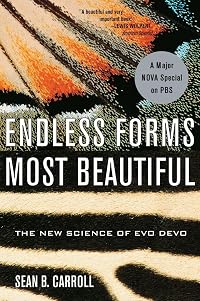
Endless Forms Most Beautiful: The New Science of Evo Devo
by Sean B. Carroll
On This Page
Description
An introduction to evolutionary developmental biology demonstrates how the many forms of animals evolved and came into being, documenting how the Evo Devo branch of science proved that all animal organs and appendages, from arms and legs to wings and fins, were created from a small number of primitive genes.Tags
Recommendations








Member Recommendations
Member Reviews
"Evo devo" might sound like an 80's rock band, but this book is one of those few that really does open the door to a new world of wonder -- evolutionary developmental biology, or the new and rapidly growing understanding of how a single cell is able to unfold itself, step by step, into enormously complex trillion-celled systems like us. And it's a story told here first hand, by a leading investigator of this new world, with warmth, passion, and humor.
Sean Carroll does a masterful job in putting together some of the recent advances on molecular biology (about the control of expression of different genes) and linking them to the evolution and phylogeny of animals.
A very lucid discussion on how changes in animal morphology can come around just by changes in timing, spatial distribution and "dose" of genes, switches and modifiers helps in really unifying the understanding of DNA activity, macroscopic morphology and evolution. I really think if you don't understand evolution of form after reading this book, there are some basic problems with accepting reasoned arguments. Brilliant!
A very lucid discussion on how changes in animal morphology can come around just by changes in timing, spatial distribution and "dose" of genes, switches and modifiers helps in really unifying the understanding of DNA activity, macroscopic morphology and evolution. I really think if you don't understand evolution of form after reading this book, there are some basic problems with accepting reasoned arguments. Brilliant!
I received a BS in Biology in 1984 and had an affinity toward genetics. This book was written and published in 2005 and referred to advances and discoveries in biology over the preceding 20 years that more firmly supported the idea that forms of insect, fish, mammals, and other animals changed over the hundreds of millions of years of its' existence of this planet.
A PERIOD DURING WHICH I MISSED OUT ON SOME OF THOSE ADVANCES!!
Over the past decade or so I have made an attempt to remedy that shortcoming. (Your Inner Fish by Neil Shubin, and The Third Chimpanzee by Jared Diamond are notable)
Dr. Carroll's book reads on a level that makes it accessible to more than those who have studied within the biological sciences, and has a show more straight-forward approach to the delivery of concepts that have been ascertained over the decades of study by many, may researchers.
The text lays out references to strong evidence for the biological changes in development and form of animals, past and present, include our own genus and species.
I was pleased that Dr. Carroll ended with a slight critique and condemnation (although gentle) of Creationism and its bastard offspring Intelligent Design. (other good reads: The Devil in Dover by Lauri Lebo, and The Battle Over the Meaning of Everything by Gordy Slack)
The section for Further Readings has offered prospectives for me for follow-ups and leads to increase my knowledge and understanding of EvoDevo (Evolutionary Development). show less
A PERIOD DURING WHICH I MISSED OUT ON SOME OF THOSE ADVANCES!!
Over the past decade or so I have made an attempt to remedy that shortcoming. (Your Inner Fish by Neil Shubin, and The Third Chimpanzee by Jared Diamond are notable)
Dr. Carroll's book reads on a level that makes it accessible to more than those who have studied within the biological sciences, and has a show more straight-forward approach to the delivery of concepts that have been ascertained over the decades of study by many, may researchers.
The text lays out references to strong evidence for the biological changes in development and form of animals, past and present, include our own genus and species.
I was pleased that Dr. Carroll ended with a slight critique and condemnation (although gentle) of Creationism and its bastard offspring Intelligent Design. (other good reads: The Devil in Dover by Lauri Lebo, and The Battle Over the Meaning of Everything by Gordy Slack)
The section for Further Readings has offered prospectives for me for follow-ups and leads to increase my knowledge and understanding of EvoDevo (Evolutionary Development). show less
A very good primer on what Evo Devo ('evolutionary developmental biology' shortened) is and how it greatly adds to our understanding of how parts and pieces develop, relatedness, etc. Especially interesting after reading [b:Genome: the Autobiography of a Species in 23 Chapters|4591|Genome the Autobiography of a Species in 23 Chapters|Matt Ridley|https://d202m5krfqbpi5.cloudfront.net/books/1362958533s/4591.jpg|1987129], seeing how science has progressed to looking at the changes in switches/expression rather than hunting for specific genes and assuming species developed them independently.
It is a very well written book, on an immensely interesting topic in current biology. Written to the mythical average intelligent layperson without biological science studies. It doesn't require even bio101 to understand and it does get into topics which could be difficult if presented badly. The author is to be commended for not just his depth of biological studies but even more for his ability to popularize and write good science at a level that people can understand. I expect to see much more from this author over the years, this book is making the rounds of the discussion boards and i have yet to see a reviewer bad mouth the book.
Start with one of two chapters, 5:The Dark matter of the Genome if you want to see an excellent show more discussion of hox genes or 6:The Big Bang of Animal Evolution if you'd rather see the effect of hox genes on the development of different creatures. Either one ought to tell you enough about how you will react to the book in order to decide to read it all. It is not so difficult that you have to own a copy and mark it up, library usage is possible with this book, an unusual thing for even popular science.
The main point of the book is that evo devo=evolutionary development is adding so much information and substantiating so much theory that evolutionary biology ought to consider a new paradigm, the modern synthesis + evo devo(and embryology), as the new core of the biological sciences. Like the commonality of the genetic code mapping DNA codons to tRNA, hox genes have unified biology like nothing else since the incorporation of genetics into darwinianism in the 1930's(forming the modern synthesis). Not only their extraordinary widespreadness from round worms to fruit flies to human beings, something that was not predicted even 30 years ago, but the pervasiveness of mutations in those critical genes, their switches and other regulatory sequences and how it so greatly effects body plans.
Get together a few pullquotes and summary aphorisms from the book:
Preface: Revolution #3
"the key to any scientific advance is to be able "to explain the complex visible by some simple invisible""
"development is intimately connected to evolution because it is through changes in embryos that changes in form arise."
Introduction: Butterflies, Zebras, and Embryos
"The great variety in the size, shape, organizatin, and color of animal bodies raises deep questions about the origins of animal forms. How are individual forms generated? And how have such diverse forms evolved?"
"The key to answering such questions is to realize that every animal form is the product of two processes-development from an egg and evolution from its ancestors."
"all complex animals...share a common tool kit of master genes that govern the formation and patterning of their bodies and body parts."
"The first idea is that diversity is not so much a matter of the complement of genes in an animal's tool kit, but, in the words of Eric Clapton, 'it's in the way that you use it'".
"The second idea concerns where in the genome the smoking guns for the evolution in form are found."
about 3% of our DNA is regulatory, about 100 million individual bits.
"as splendid examples of how nature invents by teaching very old genes new tricks"
"here in act III, there is also a special grandeur in the view embryology and evolutionary developmental biology provide into the making of animal form and diversity."
in regards to what is beautiful in science, "There's a fog of events and suddenly you see a connection. It expresses a complex of human concerns that goes deeply to you, that connects things that were always in you that were never put together before."
Part 1: The Making of Animals
1: Animal Architecture: Modern Forms, Ancient Designs
"individual animals are made up of numbers of the same kinds of parts, like building blocks."
"The theme of modular design is by no neans limited to vertebrates."
"Is there a connection between modularity of design and the success in evolutionary diversifications?" pg 26
homologs, "This means they are the same structure modified in different ways in each species.="forelimbs of mice and men
serial homologs, "structures that arose as a repeated series and have become differentiatied to varying degrees in different animals."=forelimbs and hindlimbs
axis of symmetry, axis of polarity=head to tail, top to bottom, on things that project, near to the body and further away from it 34
"four main questions"
"1. What are some of the major rules for generating animal form?
2.how is the species specific information for building a particular animal encoded?
3. How does diversity evolve?
4.What explains large-scale trends in evolution, such as the chage in number and function of repeated parts?"
2: Monsters, Mutants, and Naster Genes
the importance of the study of monster=with the wrong number of parts or parts in the wrong places. 38
"the cells of organizers produce substances that can influence the development of other cells." eyespot organizer, Spemann's organizer and the zone of polarizing activity. the dorsal lip of the blastopore.
concentration gradients of morphogens
3: From E. Coli to Elephants
"So the long-standing assumption has been the greater the disparity in form, the less, if anything any two species would have in cmmon at the level of their genes." 54
evo devo destroys this assumption. very unlike creatures are very alike in their form generating ways.
"The selective production of proteins in some places and not others, or at some times and not others, if fundamental to the making of complex organisms."
"not even the most ardent advocate of fruit fly research predicted the universal distribution and importance of Hox genes. The implications were stunning, Disparate animals were built using not just the same kinds of tools, but indeed, the very same genes!" 65
"a large portion of the tool kit is composed of transcription factors" 74
signaling pathways:=modest number of them, fruit fly about 10, consist of signals, receptiors, and various intermediates which traffic the signal through the components fo the cell, into the nucleus.
4: Making Babies: 25K Genes, Some Assembly Required
"Mapmaking is one of the first stages of scientific exploration."
"The images of tool kit genes in embryos create a vivid, dynamic map of the geography of the growing embry-a map that reveals to us the order and logic of how complex animals are progressively construction from simple egg through the work of tool kit genes." 84
"At what point in embryonic development is a cell's fate sealed?" terminal differentiation
fate maps and the geography of the embryo
longitudes, the east-west axis and stripes
latitudes, the north-south axis
"The axes and tissue layers of vertebrate embryos are organized by a chain of inductive events, where the production of one molecule induces others and so on." 99
the making of limbs, proximal and distal axis, growing a limb bud outward and giving it a front back, top bottom orientation.
"Stripes that foreshadowed segments, patches that revealed powerful zones of organizing activity and other patterns that marked positions of bones, joints, muscles, organs, limbs, etc.-allof these connected invisible genes to the making of visible forms."
"The complexity arises from the parallel and sequential action of tool kit genes-dozen of genes acting at the same time and plcae, may more genes acting in different places at the same time, and hundreds of tool kit genes acting in sequence as development progresses. The chain of parallel and successive operations is what builds complexity." 106
5: The Dark Matter of the Genome: Operating Instructions for the Tool Kit
genetic switches: "one gene may be regulated by many separate switches such that the gene is used many times and in different places-" 113
"The general function of a switch is to transform existing patterns of gene activity into a new pattern of gene activity."
switches can have multiple inputs: activators and repressors
"An average-size switch is usually several hundred base pairs of DNA long. Within this span there may be anywhere from a half dozen to twenty or more signature sequence for several different proteins." 118
"The whole tool kit of an anaimal contains several hundred or so different DNA-binding proteins, most with different signature preferences."
"A gene not only may have multiple switches for different subpatterns of expression at a given time, but will frequently have different switches that control entirely different patterns in different tissues and at different stages in development."
two levels of switches: those that activate the HOX genes themselves and those that contain signature sequences that are recognized by the Hox proteins and control how other genes are expressed.
Part II: Fossils, Genes, and the Making of Animal Diversity
animal forms evolve by changes in embryo geography
"the impact of Evo Devo come sfrom both its noveltry and the unprecedented quality of evidence it provides."
6: The Big Bang of Animal Evolution
"The simplest and, for a long time, the most commonly held idea relating genes to the evolution of complex form is that new genes must evolve in order for new kinds of body designs and structure to arise." 150
"The increase in the number of different appendage and sgment types in arthropod evoltuin is the product of generating a greater number of unique zones in the embryo in which specific indivdiual or combinations of Hox genes are expressed. This relative shifting of Hox zones is therefore one of the mechanisms underpinnning Williston's Law-the specialization of repetitive parts requires at the different parts fall into different Hox zones."
"Evolutionary shifts in Hox zones arise through changes in the DNA sequences of Hox gene switches." 163
"Changing the sequence fo switches allows for changes to embryo geography without disrupting the functionalintegrity of a tool kit protein."
7: Little Bangs: Wings and Other Revolutionary Inventions
"Namely, structures that evolve a dedicated function are often drvied from a preexisting structure that served more than one role. The duplication of the original structure enbabled the subdivison of labor among two distinct structures. Furthermore, selected for a new purpose, the structure can then evolve further modifications and specializations." 168
"The importance of serially repetitive body design is the ability to shift the burden of some task from two of more pairs of structures onto fewer structures, then to specialize the free-up structures for new purposes."
"The whole story of arthropod limb evolution revolves around the orgin and modification of an ancestral biramous (orked)limb.
the four secrets of evolutionary innovation:
1-to work with what is already present
2-multifunctionality
3-redundancy
4-modularity
"switches are the secret to modularity and modularity the secret to arthropod and vertebrate success." 195
innovation allows for invasion of new niches, and invasion leads to the expansion of diversity"
8: How the Butterfly Got Its Spots
9: Paint It Black
10: A Beautiful Mind: The Making of Homo sapiens
"brain evolution exhibits a mosaic pattern, with certain parts of the brain chagning in concert with another, but independently of other parts." 263
"weight of genetic evidence is telling us that the evolution of primates, great apes, and humans is due to changes more in the control of genes than in the proteins the genes encode." 270
FOXP2 gene, language, selective sweep=pattern of reduced variation at a gene relative to its neighbors due to natural selection on that sequence variation.
11: Endless Forms Most Beautiful
the ancient origin of the genes for building all sorts of animals, very similar sets of tool kit proteins was entirely unexpected. 255
reveals deep connections between animal groups that were not al all appreciated form their dramatically different morphologies
the discovery that organs and structures which were viewed as independent analogous inventions have common genetic ingredients in their development.
Sources and Further Reading
an excellent set of endnotes aimed at the layman and annotated nicely.
As you can see from these few quotations, the book proceeds in a very orderly manner, building from the details to the big picture.
The big picture is that evo devo adds greatly to biology, it integrates and explains things that were until recently hidden.
It's a good book, essential reading for those laypeople interested in the debate over origins, which the author talks about with reference to biology teaching in the last chapter. It is one of those books i wish i could make required reading...grin. show less
Start with one of two chapters, 5:The Dark matter of the Genome if you want to see an excellent show more discussion of hox genes or 6:The Big Bang of Animal Evolution if you'd rather see the effect of hox genes on the development of different creatures. Either one ought to tell you enough about how you will react to the book in order to decide to read it all. It is not so difficult that you have to own a copy and mark it up, library usage is possible with this book, an unusual thing for even popular science.
The main point of the book is that evo devo=evolutionary development is adding so much information and substantiating so much theory that evolutionary biology ought to consider a new paradigm, the modern synthesis + evo devo(and embryology), as the new core of the biological sciences. Like the commonality of the genetic code mapping DNA codons to tRNA, hox genes have unified biology like nothing else since the incorporation of genetics into darwinianism in the 1930's(forming the modern synthesis). Not only their extraordinary widespreadness from round worms to fruit flies to human beings, something that was not predicted even 30 years ago, but the pervasiveness of mutations in those critical genes, their switches and other regulatory sequences and how it so greatly effects body plans.
Get together a few pullquotes and summary aphorisms from the book:
Preface: Revolution #3
"the key to any scientific advance is to be able "to explain the complex visible by some simple invisible""
"development is intimately connected to evolution because it is through changes in embryos that changes in form arise."
Introduction: Butterflies, Zebras, and Embryos
"The great variety in the size, shape, organizatin, and color of animal bodies raises deep questions about the origins of animal forms. How are individual forms generated? And how have such diverse forms evolved?"
"The key to answering such questions is to realize that every animal form is the product of two processes-development from an egg and evolution from its ancestors."
"all complex animals...share a common tool kit of master genes that govern the formation and patterning of their bodies and body parts."
"The first idea is that diversity is not so much a matter of the complement of genes in an animal's tool kit, but, in the words of Eric Clapton, 'it's in the way that you use it'".
"The second idea concerns where in the genome the smoking guns for the evolution in form are found."
about 3% of our DNA is regulatory, about 100 million individual bits.
"as splendid examples of how nature invents by teaching very old genes new tricks"
"here in act III, there is also a special grandeur in the view embryology and evolutionary developmental biology provide into the making of animal form and diversity."
in regards to what is beautiful in science, "There's a fog of events and suddenly you see a connection. It expresses a complex of human concerns that goes deeply to you, that connects things that were always in you that were never put together before."
Part 1: The Making of Animals
1: Animal Architecture: Modern Forms, Ancient Designs
"individual animals are made up of numbers of the same kinds of parts, like building blocks."
"The theme of modular design is by no neans limited to vertebrates."
"Is there a connection between modularity of design and the success in evolutionary diversifications?" pg 26
homologs, "This means they are the same structure modified in different ways in each species.="forelimbs of mice and men
serial homologs, "structures that arose as a repeated series and have become differentiatied to varying degrees in different animals."=forelimbs and hindlimbs
axis of symmetry, axis of polarity=head to tail, top to bottom, on things that project, near to the body and further away from it 34
"four main questions"
"1. What are some of the major rules for generating animal form?
2.how is the species specific information for building a particular animal encoded?
3. How does diversity evolve?
4.What explains large-scale trends in evolution, such as the chage in number and function of repeated parts?"
2: Monsters, Mutants, and Naster Genes
the importance of the study of monster=with the wrong number of parts or parts in the wrong places. 38
"the cells of organizers produce substances that can influence the development of other cells." eyespot organizer, Spemann's organizer and the zone of polarizing activity. the dorsal lip of the blastopore.
concentration gradients of morphogens
3: From E. Coli to Elephants
"So the long-standing assumption has been the greater the disparity in form, the less, if anything any two species would have in cmmon at the level of their genes." 54
evo devo destroys this assumption. very unlike creatures are very alike in their form generating ways.
"The selective production of proteins in some places and not others, or at some times and not others, if fundamental to the making of complex organisms."
"not even the most ardent advocate of fruit fly research predicted the universal distribution and importance of Hox genes. The implications were stunning, Disparate animals were built using not just the same kinds of tools, but indeed, the very same genes!" 65
"a large portion of the tool kit is composed of transcription factors" 74
signaling pathways:=modest number of them, fruit fly about 10, consist of signals, receptiors, and various intermediates which traffic the signal through the components fo the cell, into the nucleus.
4: Making Babies: 25K Genes, Some Assembly Required
"Mapmaking is one of the first stages of scientific exploration."
"The images of tool kit genes in embryos create a vivid, dynamic map of the geography of the growing embry-a map that reveals to us the order and logic of how complex animals are progressively construction from simple egg through the work of tool kit genes." 84
"At what point in embryonic development is a cell's fate sealed?" terminal differentiation
fate maps and the geography of the embryo
longitudes, the east-west axis and stripes
latitudes, the north-south axis
"The axes and tissue layers of vertebrate embryos are organized by a chain of inductive events, where the production of one molecule induces others and so on." 99
the making of limbs, proximal and distal axis, growing a limb bud outward and giving it a front back, top bottom orientation.
"Stripes that foreshadowed segments, patches that revealed powerful zones of organizing activity and other patterns that marked positions of bones, joints, muscles, organs, limbs, etc.-allof these connected invisible genes to the making of visible forms."
"The complexity arises from the parallel and sequential action of tool kit genes-dozen of genes acting at the same time and plcae, may more genes acting in different places at the same time, and hundreds of tool kit genes acting in sequence as development progresses. The chain of parallel and successive operations is what builds complexity." 106
5: The Dark Matter of the Genome: Operating Instructions for the Tool Kit
genetic switches: "one gene may be regulated by many separate switches such that the gene is used many times and in different places-" 113
"The general function of a switch is to transform existing patterns of gene activity into a new pattern of gene activity."
switches can have multiple inputs: activators and repressors
"An average-size switch is usually several hundred base pairs of DNA long. Within this span there may be anywhere from a half dozen to twenty or more signature sequence for several different proteins." 118
"The whole tool kit of an anaimal contains several hundred or so different DNA-binding proteins, most with different signature preferences."
"A gene not only may have multiple switches for different subpatterns of expression at a given time, but will frequently have different switches that control entirely different patterns in different tissues and at different stages in development."
two levels of switches: those that activate the HOX genes themselves and those that contain signature sequences that are recognized by the Hox proteins and control how other genes are expressed.
Part II: Fossils, Genes, and the Making of Animal Diversity
animal forms evolve by changes in embryo geography
"the impact of Evo Devo come sfrom both its noveltry and the unprecedented quality of evidence it provides."
6: The Big Bang of Animal Evolution
"The simplest and, for a long time, the most commonly held idea relating genes to the evolution of complex form is that new genes must evolve in order for new kinds of body designs and structure to arise." 150
"The increase in the number of different appendage and sgment types in arthropod evoltuin is the product of generating a greater number of unique zones in the embryo in which specific indivdiual or combinations of Hox genes are expressed. This relative shifting of Hox zones is therefore one of the mechanisms underpinnning Williston's Law-the specialization of repetitive parts requires at the different parts fall into different Hox zones."
"Evolutionary shifts in Hox zones arise through changes in the DNA sequences of Hox gene switches." 163
"Changing the sequence fo switches allows for changes to embryo geography without disrupting the functionalintegrity of a tool kit protein."
7: Little Bangs: Wings and Other Revolutionary Inventions
"Namely, structures that evolve a dedicated function are often drvied from a preexisting structure that served more than one role. The duplication of the original structure enbabled the subdivison of labor among two distinct structures. Furthermore, selected for a new purpose, the structure can then evolve further modifications and specializations." 168
"The importance of serially repetitive body design is the ability to shift the burden of some task from two of more pairs of structures onto fewer structures, then to specialize the free-up structures for new purposes."
"The whole story of arthropod limb evolution revolves around the orgin and modification of an ancestral biramous (orked)limb.
the four secrets of evolutionary innovation:
1-to work with what is already present
2-multifunctionality
3-redundancy
4-modularity
"switches are the secret to modularity and modularity the secret to arthropod and vertebrate success." 195
innovation allows for invasion of new niches, and invasion leads to the expansion of diversity"
8: How the Butterfly Got Its Spots
9: Paint It Black
10: A Beautiful Mind: The Making of Homo sapiens
"brain evolution exhibits a mosaic pattern, with certain parts of the brain chagning in concert with another, but independently of other parts." 263
"weight of genetic evidence is telling us that the evolution of primates, great apes, and humans is due to changes more in the control of genes than in the proteins the genes encode." 270
FOXP2 gene, language, selective sweep=pattern of reduced variation at a gene relative to its neighbors due to natural selection on that sequence variation.
11: Endless Forms Most Beautiful
the ancient origin of the genes for building all sorts of animals, very similar sets of tool kit proteins was entirely unexpected. 255
reveals deep connections between animal groups that were not al all appreciated form their dramatically different morphologies
the discovery that organs and structures which were viewed as independent analogous inventions have common genetic ingredients in their development.
Sources and Further Reading
an excellent set of endnotes aimed at the layman and annotated nicely.
As you can see from these few quotations, the book proceeds in a very orderly manner, building from the details to the big picture.
The big picture is that evo devo adds greatly to biology, it integrates and explains things that were until recently hidden.
It's a good book, essential reading for those laypeople interested in the debate over origins, which the author talks about with reference to biology teaching in the last chapter. It is one of those books i wish i could make required reading...grin. show less
An excellent and clear introduction to the science of evo-devo.
Caroll lays out beautifully what he and colleagues are learning through combining embryology with evolution, and shows how the union solves a number of mysteries that have been puzzling scientists for decades.
Although this is very definitely a layman's introduction, it does get quite deep into the science, to the point that I found myself a bit confused by all the different concepts - switches, toolkits, etc.
I also couldn't help feeling that he allows his enthusiasm - and his bias as one of the leaders in the field - to get the better of him, leaving the impression that not only is evo-devo the best thing since sliced bread, but that no-one had ever made any progress in show more studying evolution until it came along.
Pity, because the science clearly has had a major impact, but there's still plenty of interesting things going on outside of the field and Carroll doesn't do himself any favours by implying otherwise. show less
Caroll lays out beautifully what he and colleagues are learning through combining embryology with evolution, and shows how the union solves a number of mysteries that have been puzzling scientists for decades.
Although this is very definitely a layman's introduction, it does get quite deep into the science, to the point that I found myself a bit confused by all the different concepts - switches, toolkits, etc.
I also couldn't help feeling that he allows his enthusiasm - and his bias as one of the leaders in the field - to get the better of him, leaving the impression that not only is evo-devo the best thing since sliced bread, but that no-one had ever made any progress in show more studying evolution until it came along.
Pity, because the science clearly has had a major impact, but there's still plenty of interesting things going on outside of the field and Carroll doesn't do himself any favours by implying otherwise. show less
(posted on my blog: davenichols.net)
Sean Carroll, researcher and professor at the Howard Hughes Institute, is a genetics expert who offers a wonderful exploration of the cutting-edge science of evolutionary development (evo devo). This book, drawing from decades of genetics research as well as experiments performed in Carroll's own lab, reveals the subtle and exquisite results of millions of years of evolution as it relates to (specifically) embryology.
The first hundred pages or so are a primer on evolution as it is theorized in the Modern Synthesis of evolution. We find that the evidence for evolution is not just substantial, but largely consistent with this theory and overwhelmingly evidence of its predictions.
The second part of the show more book serve to isolate a few choice types of evidence, including fossil records and genes, and presents the findings of evolutionary development researchers as they apply to the making and diversity of animal species. Carroll focuses on numerous examples in nature of evolutionary processes, including the diversity and differences of butterfly patterns, three different wing development processes, and the coloration changes which lead to black pigmentation.
Carroll wraps up the latter half of the book by challenging the notion that creationism can explain any of this, and instead, offers that the proof of evolution was undeniable decades ago, and only strengthened with more recent research. Humans share a staggering portion of our genes, including the nearly-universal tool kit genes which dictate timing and location of other genes. Human beings are shown to be part of this earth-wide process, not a seperate entity with unusual properties.
At times, Endless Forms is a bit clinical, with several dozen pages running together filled with technical terms and often difficult-to-understand processes. I did have to reread sections to fully understand what was being stated. While this made it slow going at times, the result for me (and I hope for other readers) was a detailed understanding of why evo devo research can answer difficult questions about evolutionary processes which are unanswered in other disciplines.
For anyone interested in the clinical side of evolutionary research, this book is an excellent intermediate-level study of evo devo. Carroll is a fascinating researcher with years of first-hand experience in the field. While the text is dry at times, the information provided is worth the time spent to understand it. Four stars. show less
Sean Carroll, researcher and professor at the Howard Hughes Institute, is a genetics expert who offers a wonderful exploration of the cutting-edge science of evolutionary development (evo devo). This book, drawing from decades of genetics research as well as experiments performed in Carroll's own lab, reveals the subtle and exquisite results of millions of years of evolution as it relates to (specifically) embryology.
The first hundred pages or so are a primer on evolution as it is theorized in the Modern Synthesis of evolution. We find that the evidence for evolution is not just substantial, but largely consistent with this theory and overwhelmingly evidence of its predictions.
The second part of the show more book serve to isolate a few choice types of evidence, including fossil records and genes, and presents the findings of evolutionary development researchers as they apply to the making and diversity of animal species. Carroll focuses on numerous examples in nature of evolutionary processes, including the diversity and differences of butterfly patterns, three different wing development processes, and the coloration changes which lead to black pigmentation.
Carroll wraps up the latter half of the book by challenging the notion that creationism can explain any of this, and instead, offers that the proof of evolution was undeniable decades ago, and only strengthened with more recent research. Humans share a staggering portion of our genes, including the nearly-universal tool kit genes which dictate timing and location of other genes. Human beings are shown to be part of this earth-wide process, not a seperate entity with unusual properties.
At times, Endless Forms is a bit clinical, with several dozen pages running together filled with technical terms and often difficult-to-understand processes. I did have to reread sections to fully understand what was being stated. While this made it slow going at times, the result for me (and I hope for other readers) was a detailed understanding of why evo devo research can answer difficult questions about evolutionary processes which are unanswered in other disciplines.
For anyone interested in the clinical side of evolutionary research, this book is an excellent intermediate-level study of evo devo. Carroll is a fascinating researcher with years of first-hand experience in the field. While the text is dry at times, the information provided is worth the time spent to understand it. Four stars. show less
Members
- Recently Added By
Published Reviews
Although Endless Forms Most Beautiful is a lucid and valuable summary of evo–devo, it does proclaim a clever but still unproved hypothesis as central to the evolutionary process. As Carroll himself notes: "Simplification may indeed be necessary for news articles, but it can distort the more complex and subtle realities of evolutionary patterns and mechanisms."
added by jlelliott
Lists

Recommended Nature Writing
346 works; 180 members

Books Read in 2017
4,249 works; 129 members
Author Information

14 Works 3,013 Members
Sean B. Carroll is an award-winning scientist, writer, educator, and film producer. His books include The Serengeti Rules (Princeton), Brave Genius, and Remarkable Creatures, which was a finalist for the National Book Award.
Some Editions
Awards and Honors
Common Knowledge
- Canonical title*
- Infinite forme bellissime. La nuova scienza dell'Evo-Devo
- Original title
- Endless Forms Most Beautiful: The New Science of Evo Devo
- Original publication date
- 2005
- First words
- The amazing variety of animal forms does not end with those on land and or in the sea.
- Last words
- (Click to show. Warning: May contain spoilers.)What will be the legacy of this new century - to cherish and protect Nature, or to see butterflies and zebras and much more vanish into legend like the thylacine, moa, and dodo?
- Publisher's editor
- Repcheck, Jack
- Blurbers
- Zimmer, Carl; Knoll, Andrew H.
*Some information comes from Common Knowledge in other languages. Click "Edit" for more information.
Classifications
Statistics
- Members
- 1,039
- Popularity
- 24,775
- Reviews
- 26
- Rating
- (3.98)
- Languages
- 6 — Czech, English, Finnish, German, Italian, Portuguese
- Media
- Paper, Audiobook, Ebook
- ISBNs
- 22
- ASINs
- 8