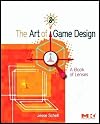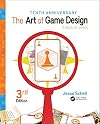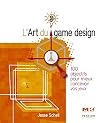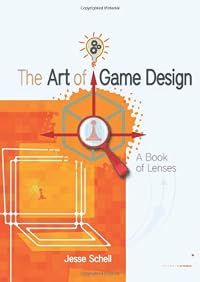
The Art of Game Design: A Book of Lenses
by Jesse Schell
On This Page
Description
Presents over 100 sets of questions, or different lenses, for viewing a game’s design. Written by one of the world's top game designers, this book describes the deepest and most fundamental principles of game design, demonstrating how tactics used in board, card, and athletic games also work in video games. It provides practical instruction on creating world-class games that will be played again and again. New to this edition: many great examples from new VR and AR platforms as well as show more examples from modern games such as Uncharted 4 and The Last of Us, Free to Play games, hybrid games, transformational games, and more. show lessTags
Recommendations







Member Reviews
On one level, this is a textbook about how to design a game. On another level, this a work of love by someone who clearly understands why games are fun, and how to manage the tricky business of coordinating all the people required to build one. Jesse Schell breaks games down into their individual components, and explains how those can work together to reinforce an experience of fun. The book is full of practical, folksy wisdom on managing artists, programmers, playtesters, and clients. A charming, conversational book full of hard advice and useful ideas. A good read for anybody who loves games, and essential for somebody who plans to design one.
I'm trying to learn about game design. But I also like to read books that are about creating things that are not screenplays; often they give me fresher insight than screenwriting books do. (As Ram Dass said, "When you know how to listen, everybody is the guru.")
Jesse Schell's ART OF GAME DESIGN: A BOOK OF LENSES presents a hundred ways to look at game design. It's about your process designing a game, seen from a multiplicity of angles. It's incidentally also about making movies, although it pretends not to be. It is also probably about fashion design, although I know nothing about fashion design.
For example, in dealing with dumb feedback, don't agree to the client's changes, or reject them. Instead, try to figure out what problem the show more client is trying to solve. Schell had a client ask for more chrome on the racing cars in a game. When Schell asked what problem the client was trying to solve, it turned out that the client thought the cars should go faster, but assumed they were going as fast as the game's computer processor could handle. He thought that more chrome would feel faster. Adding chrome probably wouldn't have fixed the problem. Lowering the virtual camera so it was closer to the ground did fix the problem.
Or, the "three layers of desire." What does the client say she wants? What does she think she wants? What does she really want? Your client may say she wants an educational game. But what she really wants is a space game; but she has money from an educational game publisher, so she has to deliver an educational game. That's why she's so hot on the spaceships in your educational game. What she really wants, though, is to become a game designer herself, a desire you must consider as you work with her.
It is really an extraordinarily smart book. show less
Jesse Schell's ART OF GAME DESIGN: A BOOK OF LENSES presents a hundred ways to look at game design. It's about your process designing a game, seen from a multiplicity of angles. It's incidentally also about making movies, although it pretends not to be. It is also probably about fashion design, although I know nothing about fashion design.
For example, in dealing with dumb feedback, don't agree to the client's changes, or reject them. Instead, try to figure out what problem the show more client is trying to solve. Schell had a client ask for more chrome on the racing cars in a game. When Schell asked what problem the client was trying to solve, it turned out that the client thought the cars should go faster, but assumed they were going as fast as the game's computer processor could handle. He thought that more chrome would feel faster. Adding chrome probably wouldn't have fixed the problem. Lowering the virtual camera so it was closer to the ground did fix the problem.
Or, the "three layers of desire." What does the client say she wants? What does she think she wants? What does she really want? Your client may say she wants an educational game. But what she really wants is a space game; but she has money from an educational game publisher, so she has to deliver an educational game. That's why she's so hot on the spaceships in your educational game. What she really wants, though, is to become a game designer herself, a desire you must consider as you work with her.
It is really an extraordinarily smart book. show less
A well-written and engaging book that, while focused on game design, provides insights far beyond the world of game design and is full of useful advice for anyone designing anything.
The book guides the reader through the entire design process, starting with discussing the designer's ultimate objective (to create an experience); continuing through understanding the elements that comprise games, addressing the needs of players, exploring the fundamental types of game mechanics, developing game worlds; and concluding with how to deal with clients, how to pitch a game, and how games transform their audiences.
Along the way, the author present a series of 100 "lenses" through which designers can focus on specific aspects of their design. Each show more lens provides a series of questions that help designers stay on track during the course of their design. The author also sells a card set called "A Deck of Lenses" which present these lenses with illustrations (http://artofgamedesign.com/cards/). The deck of lenses is also available as an smart phone/tablet app (https://itunes.apple.com/us/app/agd-lenses/id385531319?mt=8).
As I noted above, many of the concepts in this book can be applied to not only game design, but also provide insights that can be applied to other fields as well. I'm a big fan of Walt Disney Imagineering, and found that many of the design principles in this book are the same principles used by the Imagineers in the design of Disney theme parks. Based on the author's background (Jesse Schell is a former Imagineer), this wasn't too big a surprise, but I still find the parallels worth noting.
I highly recommend this book to anyone working in the game industry, as well as anyone interested in design in general. You'll be glad you added this book to your library. show less
The book guides the reader through the entire design process, starting with discussing the designer's ultimate objective (to create an experience); continuing through understanding the elements that comprise games, addressing the needs of players, exploring the fundamental types of game mechanics, developing game worlds; and concluding with how to deal with clients, how to pitch a game, and how games transform their audiences.
Along the way, the author present a series of 100 "lenses" through which designers can focus on specific aspects of their design. Each show more lens provides a series of questions that help designers stay on track during the course of their design. The author also sells a card set called "A Deck of Lenses" which present these lenses with illustrations (http://artofgamedesign.com/cards/). The deck of lenses is also available as an smart phone/tablet app (https://itunes.apple.com/us/app/agd-lenses/id385531319?mt=8).
As I noted above, many of the concepts in this book can be applied to not only game design, but also provide insights that can be applied to other fields as well. I'm a big fan of Walt Disney Imagineering, and found that many of the design principles in this book are the same principles used by the Imagineers in the design of Disney theme parks. Based on the author's background (Jesse Schell is a former Imagineer), this wasn't too big a surprise, but I still find the parallels worth noting.
I highly recommend this book to anyone working in the game industry, as well as anyone interested in design in general. You'll be glad you added this book to your library. show less
Last month, I ran across the YouTube channel Extra Credits, and I have become a creature obsessed. Extra Credits is a shining example of quality game discourse: Every episode is well-written, thoughtful, and informed. They've put together a playlist of all their episodes in chronological order, which you can find right here. Sorry in advance for sucking up all your spare time.
In one of their "mailbag" episodes, in which they answer questions sent in by viewers, they recommended a number of books on game design. Now, I'm not interested in becoming a game designer myself, but I am very interested in the game design process, so I decided to write down their suggestions and add them to my TBR list.
First up was Jesse Schell's guide, The Art show more of Game Design: A Book of Lenses. My library had a digital copy and I forgot to bring a book for my lunch break, so I started reading it almost immediately.
I'm glad that I read The Art of Game Design right after watching so many episodes of Extra Credits, when my enthusiasm was way up. As interesting as I think game design is, this is definitely a book written directly to game designers. Coming at it from a player perspective made the whole thing feel a bit off.
Even so, it was a good read. The whole book is organized well, so the sections that are super back-end, hidden-from-view, gritty details that I didn't care about were easy to skip, and honestly, the "lenses" that Schell highlights throughout the book do a nice job of summarizing each section, making this a book that's easy to come back to for refreshers, or an easy skim if you just want a basic primer on the subject of game design.
If you're interested in game design, The Art of Game Design is well worth your time, even if you only want to flip through and read the summaries of each section. As a player, I learned a lot, and if you're an aspiring or current designer, I'm sure you'll learn even more.
(This review has been cross-posted to my blog.) show less
In one of their "mailbag" episodes, in which they answer questions sent in by viewers, they recommended a number of books on game design. Now, I'm not interested in becoming a game designer myself, but I am very interested in the game design process, so I decided to write down their suggestions and add them to my TBR list.
First up was Jesse Schell's guide, The Art show more of Game Design: A Book of Lenses. My library had a digital copy and I forgot to bring a book for my lunch break, so I started reading it almost immediately.
I'm glad that I read The Art of Game Design right after watching so many episodes of Extra Credits, when my enthusiasm was way up. As interesting as I think game design is, this is definitely a book written directly to game designers. Coming at it from a player perspective made the whole thing feel a bit off.
Even so, it was a good read. The whole book is organized well, so the sections that are super back-end, hidden-from-view, gritty details that I didn't care about were easy to skip, and honestly, the "lenses" that Schell highlights throughout the book do a nice job of summarizing each section, making this a book that's easy to come back to for refreshers, or an easy skim if you just want a basic primer on the subject of game design.
If you're interested in game design, The Art of Game Design is well worth your time, even if you only want to flip through and read the summaries of each section. As a player, I learned a lot, and if you're an aspiring or current designer, I'm sure you'll learn even more.
(This review has been cross-posted to my blog.) show less
This is a classic text which breaks down game design into different perspectives or lenses. In one sense this is clever and useful because it allows for a flexible structure to emerge in evaluating game design. But in another it leaves open many fundamental questions at the heart of what is a game. The book offers a theoretical franework for game design that does not rest on any fundamental cohesive whole. Nevertheless the text is practically useful for many game types.
A fantastic text book on designing games. To praise this book properly I would need to sound like an ad. It covers every aspect of game design, from conception to play-testing and revisions, and then goes on to give you pointers on finding an agent, selling and marketing your game. All of it is very involved, and it shows that the author has taught a class in game design over many years. This is basically a textbook for that class, in my mind, and reading this is like going to that class.
Ratings
Members
- Recently Added By
Author Information
5+ Works 613 Members
Common Knowledge
- Canonical title
- The Art of Game Design: A Book of Lenses
- Original publication date
- 2008
- Dedication
- For Nyra; who always listens
Classifications
- Genres
- Nonfiction, Art & Design, General Nonfiction, Technology
- DDC/MDS
- 794.81536 — Arts & recreation Recreation, sports, and performing arts Chess, Computer Games / Card Games Electronic games Computer programming
- LCC
- QA76.76 .C672 .S34 — Science Mathematics Mathematics Instruments and machines Calculating machines Electronic computers. Computer science Computer software
- BISAC
Statistics
- Members
- 566
- Popularity
- 51,654
- Reviews
- 6
- Rating
- (4.34)
- Languages
- 5 — English, French, German, Korean, Spanish
- Media
- Paper, Ebook
- ISBNs
- 22
- ASINs
- 7