On This Page
Description
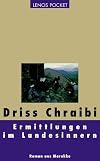
In this novel the author describes life in post-independence Morocco in which a modern regime has taken over the structures left by the French, treating them as tools for further oppression rather than using them to liberate the people.Tags
Recommendations
















Member Reviews
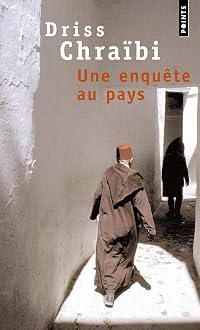
Une enquête au pays, the first of six novels featuring the Moroccan policeman Inspector Ali, ironically confronts the familiar format of the "crime-novel" with a situation where all our assumptions about the ability of law and order to give cohesive structure to the world fall apart. Chraïbi isn't the first writer to use this particular literary trope, of course, but his down-to-earth wit and postcolonial perspective seem to work extremely well with it.
The irascible Police Chief and his sidekick, Ali, arrive in a remote mountain village where it obviously hasn't rained for years, and sit bickering in their hot car about "insectuels" and "filou soufi" - for all the world like a couple of Beckett characters - for a couple of chapters. show more Just when we're starting to think that this actually is Beckett and they won't ever get around to investigating anything, Chraïbi relents and brings them together with a monosyllabic local, but the investigation doesn't seem to be advancing.
It turns out that the Chief's uniform, anger and authority as a representative of the independent postcolonial state don't count for much in a place where people have nothing and their only contact with the State is the annual visit of the tax-collectors. Ali is slightly better off - he grew up in extreme poverty himself and recognises the villagers as people like his parents, so he has some idea of how to win respect without shouting - but he is easily distracted by a romantic projection of his own ideas about the uncontaminated simplicity of their "medieval" lives. Especially when he tastes Hajja's tajine and glimpses the (inevitably) gazelle-eyed sisters Yasmina and Yasmine.
Chraïbi keeps us laughing as he piles on the levels of anger and irony and makes sure that we can't take either the civilised values the policemen represent or the purity of the villagers' harsh existence for granted any more by the end of the book. We can't help enjoying the sharp dialogue and the many barbed jokes about the confrontations between incompatible and contradictory ways of looking at the world, but of course it isn't really funny if you've got to live that life... show less
The irascible Police Chief and his sidekick, Ali, arrive in a remote mountain village where it obviously hasn't rained for years, and sit bickering in their hot car about "insectuels" and "filou soufi" - for all the world like a couple of Beckett characters - for a couple of chapters. show more Just when we're starting to think that this actually is Beckett and they won't ever get around to investigating anything, Chraïbi relents and brings them together with a monosyllabic local, but the investigation doesn't seem to be advancing.
It turns out that the Chief's uniform, anger and authority as a representative of the independent postcolonial state don't count for much in a place where people have nothing and their only contact with the State is the annual visit of the tax-collectors. Ali is slightly better off - he grew up in extreme poverty himself and recognises the villagers as people like his parents, so he has some idea of how to win respect without shouting - but he is easily distracted by a romantic projection of his own ideas about the uncontaminated simplicity of their "medieval" lives. Especially when he tastes Hajja's tajine and glimpses the (inevitably) gazelle-eyed sisters Yasmina and Yasmine.
Chraïbi keeps us laughing as he piles on the levels of anger and irony and makes sure that we can't take either the civilised values the policemen represent or the purity of the villagers' harsh existence for granted any more by the end of the book. We can't help enjoying the sharp dialogue and the many barbed jokes about the confrontations between incompatible and contradictory ways of looking at the world, but of course it isn't really funny if you've got to live that life... show less
This book is prefixed with a quote from the author, but the line I couldn’t stop thinking of while I was reading it was a Bob Dylan lyric: ‘They may call you doctor or they may call you chief, but you’re gonna have to serve somebody.’ The nature of power relations, the question of who is serving whom and why, is central to this charming novel written and set in a Morocco still coming to terms with its independence from France.
The story begins with the arrival of two policemen – a pedantic police chief and his savvy inspector subordinate – in a small village in the mountains near the Algerian border. Here, modern trappings are no longer valid – this is ‘le royaume primitif, l’éternité retrouvée: la terre et le show more soleil’. The contrast between the urban officials and the simple country-folk could be played for laughs or explored for political reflection. Chraïbi does both. The early scenes are very funny, something which for me at least came as a pleasant surprise – I suppose I’ve come to associate African post-colonial novels with adjectives like ‘bleak’ or ‘horrific’. Whereas this, at least at the start, is all about witty back-and-forth, and scenes of understated character comedy.
But the balance between town and country attitudes is just one of a whole series of contrasts between entities holding different kinds of power. The policemen themselves have a particularly engaging working relationship whose dynamic drives most of the novel’s emotions – the chief determined to do things by the book, determined to keep his subordinate in line – and Inspector Ali himself, the novel’s hero, mollifying his boss while talking the villagers round, and generally playing both sides against the middle.
The humour never seems friviolous, though, and from the beginning, there are signs of a seriousness behind the laughter. The two come together well in a bravura section telling the story of a ‘Commandant Filagare’, a legendary figure in the village. He turns out to be a simple farmer who went down to trade in a nearby town and got caught up in the Algerian war; when French soldiers challenged him at gunpoint he said in terror Nji filagare! (‘I’ve just come from the station!’) and the Europeans thought he was admitting to being a fellagha or guerrilla fighter.
The start of this tale is made charming and funny; the violent consequences are anything but – but the fact that Chraïbi uses a linguistic pun to trigger his exploration of regional politics is a good illustration of his approach. The whole book does something similar on a wider scale, as the relationships between Inspector Ali and his chief, between both of them and the villagers, and between all of them and their country, are gradually given layers of extra nuance.
The police chief is shown at first as a comical boss, tied to regulations and hopelessly unable to talk to real people. But to him, his rank is something to be fiercely proud of, a tangible manifestation of Morocco’s ability to govern itself.
L’indépendence nationale est venue et la génération nouvelle dont je fais partie a conquis sa dignité. Mon père n’était qu’un gardien, un simple flic sans pouvoir de décision, sans aucune responsabilité. Tandis que moi, son fils, j’ai l’autorité!
(‘National independence came, and the new generation, which I am a part of, won its dignity. My father was just a guard, a simple flatfoot with no power to take decisions, with no responsibility. Whereas I, his son – I have authority!’)
Meanwhile for Ali, not much has changed – he still has to salute his betters, even if they’re in a different uniform.
Les Français étaient partis, mais demeuraient les esclaves – portiers, domestiques, secrétaires, petits intermédiaires coincés à jamais entre les nouveaux maîtres du Tiers Monde et le peuple.
(The French had gone, but the slaves remained – porters, maids, secretaries, insignificant intermediaries stuck forever between their new Third-World masters and the people.)
And above the chief are more chiefs, a bewildering profusion of them, so that in this novel everyone is seen to be in thrall to someone else. Behind these human relationships looms the relationship between Morocco itself and its former colonial power France. The novel’s title has a double meaning: pays can mean ‘countryside’ or ‘nation-state’. In English, ‘A Country Inquiry’ would have had the same ambiguity, which makes you wonder why the only existing English translation seems to be called ‘The Flutes of Death’ (dear god).
One of the questions the book examines is whether tiny rural communities like this village represent an escape from this endless national power-play. Here, after all, locals know little about who is in charge of the country and care less – ‘les conquérants et les civilisateurs de toutes races et de tous mots les avaient fait revenir à leur état d’origine, comme à l’aube de la création du monde’. Inspector Ali can’t help submitting to the usual pastoral fantasies about whether life would be simpler at this more old-fashioned pace—
plus la civilisation avançait à pas de géant, plus l’existence devenait verte, acide, coriace, impropre à la consommation.
(the more civilisation leapt forward, the more existence became raw, acidic, tough, not fit for consumption.)
But something dark is lurking in this seemingly-idyllic village, and there will be no easy solutions, no ducking out of power altogether, much as Inspector Ali tries. Even religion is drawn into the equation, in a remarkable passage near the end where Islam, Christianity, Judaism and other belief systems are dismissed as yet more forms of keeping people down. It should remind us, I think, of Morocco’s often-tenuous place on the very edge of the Arab world, and its diverse Berber-Arab mix.
The message at the end is resigned but not entirely unhopeful. It’s no wonder Chraïbi saw potential in Ali and brought him back for several other books: this one is a very fresh meditation on how how colonialism can affect the psychology of human relationships all through society. And I couldn’t help thinking, when I finished, about how the author himself has ‘gotta serve somebody’ too. After all, the book’s not written in Arabic. show less
The story begins with the arrival of two policemen – a pedantic police chief and his savvy inspector subordinate – in a small village in the mountains near the Algerian border. Here, modern trappings are no longer valid – this is ‘le royaume primitif, l’éternité retrouvée: la terre et le show more soleil’. The contrast between the urban officials and the simple country-folk could be played for laughs or explored for political reflection. Chraïbi does both. The early scenes are very funny, something which for me at least came as a pleasant surprise – I suppose I’ve come to associate African post-colonial novels with adjectives like ‘bleak’ or ‘horrific’. Whereas this, at least at the start, is all about witty back-and-forth, and scenes of understated character comedy.
But the balance between town and country attitudes is just one of a whole series of contrasts between entities holding different kinds of power. The policemen themselves have a particularly engaging working relationship whose dynamic drives most of the novel’s emotions – the chief determined to do things by the book, determined to keep his subordinate in line – and Inspector Ali himself, the novel’s hero, mollifying his boss while talking the villagers round, and generally playing both sides against the middle.
The humour never seems friviolous, though, and from the beginning, there are signs of a seriousness behind the laughter. The two come together well in a bravura section telling the story of a ‘Commandant Filagare’, a legendary figure in the village. He turns out to be a simple farmer who went down to trade in a nearby town and got caught up in the Algerian war; when French soldiers challenged him at gunpoint he said in terror Nji filagare! (‘I’ve just come from the station!’) and the Europeans thought he was admitting to being a fellagha or guerrilla fighter.
The start of this tale is made charming and funny; the violent consequences are anything but – but the fact that Chraïbi uses a linguistic pun to trigger his exploration of regional politics is a good illustration of his approach. The whole book does something similar on a wider scale, as the relationships between Inspector Ali and his chief, between both of them and the villagers, and between all of them and their country, are gradually given layers of extra nuance.
The police chief is shown at first as a comical boss, tied to regulations and hopelessly unable to talk to real people. But to him, his rank is something to be fiercely proud of, a tangible manifestation of Morocco’s ability to govern itself.
L’indépendence nationale est venue et la génération nouvelle dont je fais partie a conquis sa dignité. Mon père n’était qu’un gardien, un simple flic sans pouvoir de décision, sans aucune responsabilité. Tandis que moi, son fils, j’ai l’autorité!
(‘National independence came, and the new generation, which I am a part of, won its dignity. My father was just a guard, a simple flatfoot with no power to take decisions, with no responsibility. Whereas I, his son – I have authority!’)
Meanwhile for Ali, not much has changed – he still has to salute his betters, even if they’re in a different uniform.
Les Français étaient partis, mais demeuraient les esclaves – portiers, domestiques, secrétaires, petits intermédiaires coincés à jamais entre les nouveaux maîtres du Tiers Monde et le peuple.
(The French had gone, but the slaves remained – porters, maids, secretaries, insignificant intermediaries stuck forever between their new Third-World masters and the people.)
And above the chief are more chiefs, a bewildering profusion of them, so that in this novel everyone is seen to be in thrall to someone else. Behind these human relationships looms the relationship between Morocco itself and its former colonial power France. The novel’s title has a double meaning: pays can mean ‘countryside’ or ‘nation-state’. In English, ‘A Country Inquiry’ would have had the same ambiguity, which makes you wonder why the only existing English translation seems to be called ‘The Flutes of Death’ (dear god).
One of the questions the book examines is whether tiny rural communities like this village represent an escape from this endless national power-play. Here, after all, locals know little about who is in charge of the country and care less – ‘les conquérants et les civilisateurs de toutes races et de tous mots les avaient fait revenir à leur état d’origine, comme à l’aube de la création du monde’. Inspector Ali can’t help submitting to the usual pastoral fantasies about whether life would be simpler at this more old-fashioned pace—
plus la civilisation avançait à pas de géant, plus l’existence devenait verte, acide, coriace, impropre à la consommation.
(the more civilisation leapt forward, the more existence became raw, acidic, tough, not fit for consumption.)
But something dark is lurking in this seemingly-idyllic village, and there will be no easy solutions, no ducking out of power altogether, much as Inspector Ali tries. Even religion is drawn into the equation, in a remarkable passage near the end where Islam, Christianity, Judaism and other belief systems are dismissed as yet more forms of keeping people down. It should remind us, I think, of Morocco’s often-tenuous place on the very edge of the Arab world, and its diverse Berber-Arab mix.
The message at the end is resigned but not entirely unhopeful. It’s no wonder Chraïbi saw potential in Ali and brought him back for several other books: this one is a very fresh meditation on how how colonialism can affect the psychology of human relationships all through society. And I couldn’t help thinking, when I finished, about how the author himself has ‘gotta serve somebody’ too. After all, the book’s not written in Arabic. show less
> Babelio : https://www.babelio.com/livres/Chraibi-Une-enquete-au-pays/128845
> Un bon roman policier, mais aussi cette enquête n'est en fait qu'un prétexte visant à dresser l'état des lieux du Maroc de l'époque, et notamment des relations entre ses classes sociales, entre les nouveaux dirigeants - qui ont gravi les échelons des administrations alors que le pays recouvrait son indépendance - et leurs subordonnés. Très intéressant.
—Danieljean (Babelio)
> Un bon roman policier, mais aussi cette enquête n'est en fait qu'un prétexte visant à dresser l'état des lieux du Maroc de l'époque, et notamment des relations entre ses classes sociales, entre les nouveaux dirigeants - qui ont gravi les échelons des administrations alors que le pays recouvrait son indépendance - et leurs subordonnés. Très intéressant.
—Danieljean (Babelio)
Feb 18, 2021 (Edited)French
Ratings
Members
- Recently Added By
Author Information

30 Works 601 Members
Series

Belongs to Publisher Series
Lenos Pocket (137)
Seuil, Points roman (R656)
Common Knowledge
- Canonical title
- Flutes of Death
- Original title
- Une enquête au pays
- Alternate titles
- Flutes of Death [English translation]
- Original publication date
- 1981
Classifications
Statistics
- Members
- 54
- Popularity
- 548,273
- Reviews
- 3
- Rating
- (3.72)
- Languages
- 5 — Czech, English, French, German, Italian
- Media
- Paper, Ebook
- ISBNs
- 14
- ASINs
- 2