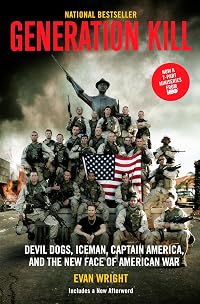
Generation Kill: Devil Dogs, Iceman, Captain America, and the New Face of American War
by Evan Wright
On This Page
Description
They were called a generation without heroes. Then they were called upon to be heroes. Within hours of 9/11, America's war on terrorism fell to those like the twenty-three Marines of the First Recon Battalion, the first generation dispatched into open-ended combat since Vietnam. They were a new breed of American warrior unrecognizable to their forebears-soldiers raised on hip-hop, Internet porn, Marilyn Manson, video games, and The Real World, a band of born-again Christians, dopers, show more Buddhists, and New Agers who gleaned their precepts from kung fu movies and Oprah Winfrey. Cocky, brave, headstrong, wary, and mostly unprepared for the physical, emotional, and moral horrors ahead, the "First Suicide Battalion" would spearhead the blitzkrieg on Iraq and fight against the hardest resistance Saddam had to offer.Generation Kill is the funny, frightening, and profane firsthand account of these remarkable men, of the personal toll of victory, and of the randomness, brutality, and camaraderie of a new American war. show lessTags
Recommendations

Member Recommendations
Member Reviews
Generation Kill is the definitive cultural history of the invasion of Iraq, an honest account of war and the men who fight in it, and a damn good read.
Wright spent the invasion embedded with Bravo Company, First Marine Recon, and he mostly lets the men speak for themselves, liberally quoting their personal philosophies, reflections on battle, and back-and-forth bullshit. These vignettes are balanced by Wright's personal reflections on being shot at, mortared, and taking part in what I can only describe as History's Worst Roadtrip.
A little criticism and comparison. Wright occasionally flubs some technical military stuff (how mortars work, FLIR) which some people might find annoying. He gives more 'screen-time' to outspoken Marines who show more match his attitudes, like Espera and Reyes, than the quieter and more conservative southerners. This is a just a month-long slice of the American military at the peak of its power and confidence, before the worst effects of the Long War took hold. Compared to the HBO miniseries, the book is better paced--war truly is long periods of boredom interspersed with absolute terror--and that makes for problematic TV. Generation Kill is generally easier to read and grasp than Fick's One Bullet Away because Wright, like most of us, is an outsider to the Marines (not that Fick is a bad writer: he's quite skilled, but Wright makes a living with the pen and there's a clear difference), while at the same time being more sensationalized. Really though, there's no reason not to check out all of these versions of the story.
The Marines of First Recon are depicted as supremely skilled killers eager to test themselves against the Ultimate. They're ironic patriots, mocking the Marines indoctrination and moto BS while enthusiastically basing their identified around warrior machismo. The best of them balance cold-blooded sharpshooting with moral sensitivity. They keep going, despite nonsensical orders, no sleep, no supplies, and a mission that they didn't train for.
Generation Kill is a great book, one that can only be described with the two most important words in the whole Marine Corps: Get some! show less
Wright spent the invasion embedded with Bravo Company, First Marine Recon, and he mostly lets the men speak for themselves, liberally quoting their personal philosophies, reflections on battle, and back-and-forth bullshit. These vignettes are balanced by Wright's personal reflections on being shot at, mortared, and taking part in what I can only describe as History's Worst Roadtrip.
A little criticism and comparison. Wright occasionally flubs some technical military stuff (how mortars work, FLIR) which some people might find annoying. He gives more 'screen-time' to outspoken Marines who show more match his attitudes, like Espera and Reyes, than the quieter and more conservative southerners. This is a just a month-long slice of the American military at the peak of its power and confidence, before the worst effects of the Long War took hold. Compared to the HBO miniseries, the book is better paced--war truly is long periods of boredom interspersed with absolute terror--and that makes for problematic TV. Generation Kill is generally easier to read and grasp than Fick's One Bullet Away because Wright, like most of us, is an outsider to the Marines (not that Fick is a bad writer: he's quite skilled, but Wright makes a living with the pen and there's a clear difference), while at the same time being more sensationalized. Really though, there's no reason not to check out all of these versions of the story.
The Marines of First Recon are depicted as supremely skilled killers eager to test themselves against the Ultimate. They're ironic patriots, mocking the Marines indoctrination and moto BS while enthusiastically basing their identified around warrior machismo. The best of them balance cold-blooded sharpshooting with moral sensitivity. They keep going, despite nonsensical orders, no sleep, no supplies, and a mission that they didn't train for.
Generation Kill is a great book, one that can only be described with the two most important words in the whole Marine Corps: Get some! show less
[b:Generation Kill|6357099|Generation Kill|Evan Wright|https://i.gr-assets.com/images/S/compressed.photo.goodreads.com/books/1327571775l/6357099._SY75_.jpg|908023] is a favourite book of mine that I hadn't reread for about 15 years. Then I picked it up for reference while reviewing [b:Occupational Hazards|594673|Occupational Hazards|Rory Stewart|https://i.gr-assets.com/images/S/compressed.photo.goodreads.com/books/1356125412l/594673._SY75_.jpg|29349] and accidentally reread all 450 pages in an evening. It was just as involving and brilliantly observed as when I first read it. The author, Evan Wright, was embedded with the recon marines who were at 'the tip of the spear' of the 2003 Iraq invasion. It's pretty wild that the marine corps show more thought bringing a reporter from Rolling Stone magazine onto the front line of an invasion was a solid idea. Showing a remarkable lack of self-preservation instincts, Wright rode along in an unarmoured humvee with a recon marine platoon during the first weeks of the war. First recon were sent ahead of the main American forces in an erratic series of missions that repeatedly took them through built-up areas in order to draw out Iraqi forces.
What makes Wright's book truly compelling is his portraits of the recon marines he accompanied and their reactions to the invasion. He gets way past the superficial macho hoo-rah, which is particularly potent in the elite all-male recon marines. Wright devotes a lot of time to the marines' bullshit and banter in order to establish their culture, dynamics, and relationships. The personalities he depicts are so compelling that HBO adapted the book into a miniseries. I highly recommend that as well. With the warning that, as with all war TV that tries to be authentic with uniforms, it will take several episodes to recognise anyone as they all look the same. This is only appropriate, as Wright mentions his initial struggle to distinguish between all these guys:
By experiencing the mayhem and danger of the invasion along with the marines, Wright provides a raw and visceral account of what happened. It is unflattering to overall military command and doesn't show the marine corps in a remotely good light. But the individual marines he accompanied are presented in a nuanced, sympathic manner, providing a fascinating insight into what made them join recon. (There seems to be a fair amount of masochism involved.) Yet he never loses sight of the fact that they are killers:
[b:Generation Kill|6357099|Generation Kill|Evan Wright|https://i.gr-assets.com/images/S/compressed.photo.goodreads.com/books/1327571775l/6357099._SY75_.jpg|908023] is excellent at conveying the terrible contradictions and cruelties of the Iraq invasion. It seems a matter of chance whether the marines are shooting Iraqi children or offering them humanitarian rations and medical care at any given point. The narrative is also intensely entertaining, as Wright is a brilliant journalist who was put in an extraordinary situation. His account covers two extremely intense months, concluding with his departure from Iraq on May 4th 2003. For involving accounts of the subsequent occupation, which echo Fick's observation in April 2003 that "As far as I can see, there's no American plan for Baghdad", try [b:Imperial Life in the Emerald City: Inside Baghdad's Green Zone|1151312|Imperial Life in the Emerald City Inside Baghdad's Green Zone|Rajiv Chandrasekaran|https://i.gr-assets.com/images/S/compressed.photo.goodreads.com/books/1347802069l/1151312._SY75_.jpg|1275660] and [b:Occupational Hazards|594673|Occupational Hazards|Rory Stewart|https://i.gr-assets.com/images/S/compressed.photo.goodreads.com/books/1356125412l/594673._SY75_.jpg|29349]. show less
What makes Wright's book truly compelling is his portraits of the recon marines he accompanied and their reactions to the invasion. He gets way past the superficial macho hoo-rah, which is particularly potent in the elite all-male recon marines. Wright devotes a lot of time to the marines' bullshit and banter in order to establish their culture, dynamics, and relationships. The personalities he depicts are so compelling that HBO adapted the book into a miniseries. I highly recommend that as well. With the warning that, as with all war TV that tries to be authentic with uniforms, it will take several episodes to recognise anyone as they all look the same. This is only appropriate, as Wright mentions his initial struggle to distinguish between all these guys:
In my first couple of days at the camp I'm placed in a tent with officers. I can't tell anybody apart; they all look the same in their desert camouflage fatigues. Most of the officers seem to be square-jawed, blue-eyed white guys in their mid to late twenties. The initial reason I strike up an acquaintance with Lt. Fick, commander of the platoon I end up spending the war with, is he's easily recognisable. Though he's twenty-five, he has a loping, adolescent stride you can spot from a hundred metres away. He's one of fifty men who introduce themselves to me during my first twenty-four hours at the camp, but he's the only one I'm able to call by name on my way to the mess tent and ask if I can join him for dinner.
By experiencing the mayhem and danger of the invasion along with the marines, Wright provides a raw and visceral account of what happened. It is unflattering to overall military command and doesn't show the marine corps in a remotely good light. But the individual marines he accompanied are presented in a nuanced, sympathic manner, providing a fascinating insight into what made them join recon. (There seems to be a fair amount of masochism involved.) Yet he never loses sight of the fact that they are killers:
However admirable the military's attempts are to create ROE [rules of engagement],
they basically create an illusion of moral order where there is none. The Marines operate in chaos. It doesn't matter if a Marine is following orders and ROE, or disregarding them. The fact is, as soon as a Marine pulls the trigger on his rifle, he's on his own. He's entered a game of moral chance. When it's over, he's as likely to go down as a hero or as a baby killer. The only difference between Trombley and any number of other Marines who've shot or killed people they shouldn't have is that he got caught. And this only happened because the battalion stopped moving long enough for the innocent victims to catch up with it.
[b:Generation Kill|6357099|Generation Kill|Evan Wright|https://i.gr-assets.com/images/S/compressed.photo.goodreads.com/books/1327571775l/6357099._SY75_.jpg|908023] is excellent at conveying the terrible contradictions and cruelties of the Iraq invasion. It seems a matter of chance whether the marines are shooting Iraqi children or offering them humanitarian rations and medical care at any given point. The narrative is also intensely entertaining, as Wright is a brilliant journalist who was put in an extraordinary situation. His account covers two extremely intense months, concluding with his departure from Iraq on May 4th 2003. For involving accounts of the subsequent occupation, which echo Fick's observation in April 2003 that "As far as I can see, there's no American plan for Baghdad", try [b:Imperial Life in the Emerald City: Inside Baghdad's Green Zone|1151312|Imperial Life in the Emerald City Inside Baghdad's Green Zone|Rajiv Chandrasekaran|https://i.gr-assets.com/images/S/compressed.photo.goodreads.com/books/1347802069l/1151312._SY75_.jpg|1275660] and [b:Occupational Hazards|594673|Occupational Hazards|Rory Stewart|https://i.gr-assets.com/images/S/compressed.photo.goodreads.com/books/1356125412l/594673._SY75_.jpg|29349]. show less
A depressing book about men who mainly joined the Marines because they think it’ll make them men, or don’t have anything more promising to do, and end up going to war in Iraq. The war they go to is dumb, though they don’t care about the whys; they’re both wastefully oversupplied and tragically short on a few crucial things (including batteries for the night vision goggles that can be the difference between life and death). They’re glancingly led and mostly lost in the fog of war, once the war starts. They kill, and sometimes they know they killed civilians and sometimes they just hope it was hostiles, and they tell themselves it’s us or them. It’s just layer on layer of pointless, bloody waste.
Summary: Generation Kill is the book that came out of Rolling Stone writer Evan Wright being part one of the journalists embedded with U.S. troops during the 2003 invasion of Iraq. He was embedded with the First Recon Marines, a unit of soldiers that are among the best of the best - highly trained special ops forces. But what they're not trained to do is to drive unarmored Humvees in a slow, evenly spaced line through hostile territory, where it's frequently impossible to tell civilians from enemy soldiers. On top of this, the soldiers that Wright rode with also had to deal with a lack of proper supplies (most notably insufficient batteries for their night vision goggles and a lack of lubricant to keep their guns firing despite Iraqi show more dust and sandstorms), unreliable communications, and a command structure that seemed to be more intent on maintaining the grooming standard or scoring machismo points than on keeping their troops both safe and effective.
Review: This is going to be one of those book reviews that shades into a movie review, despite my best efforts to keep them separate. In part, that's because the book and the film version are very, very similar, primarily due to the fact that the miniseries stays remarkably true to the book not only in story but also in terms of characterization, message, and general tone. In a lot of ways, they compliment each other, since the book can provide background details that can't be readily explained on film, and the film can provide visuals for those of us who don't have the military knowledge to be able to picture various types of weapons from their written description. But they're also both complete and perfectly understandable on their own.
Together or apart, they paint a really compelling picture of the current state of warfare, and of the people and personalities involved. I'm not a current-events junkie by any stretch of the imagination, but I know well enough that Generation Kill gives a (literal) on-the-ground look at some of the reality of the Iraq war that gets lost in the translation to a 30-second news clip. It's easy to sit at home and bemoan the number of civilian casualties or the cost of the war, but this book makes you take a hard look at what it's like in the moment, in situations most of us could never imagine. I do wish Wright had given us a little bit more of his first-person outsider's POV, though. There were certainly touches of it, and I found them particularly fascinating (and often quite funny, for example the story of him running in a zig-zag pattern to avoid sniper fire, to the consternation and amusement of the soldiers he was with).
What I appreciated most about Generation Kill was that it gives a very clear picture of the soldiers of the First Recon Marines as real people. They're obnoxious and crude and thoroughly un-PC, but there's a very clear sense that they are pretty much just regular guys, dealing with the situation and the constant danger and the lack of sleep and the surges of adrenaline and the randomness of war however they can. Wright doesn't do a whole lot of political analysis or authorial pontificating, for the most point preferring to let the story speak for itself, but his respect for the men he rode with (if not for their commanders) comes across loud and clear... and I think will be unavoidably contagious to his readers. 4.5 out of 5 stars.
Recommendation: Hard to say, since I don't usually care for politics/current events/war books (Emergency Sex excepted), but I quite enjoyed this. Really, I'd recommend it for just about everyone who has an opinion of any kind about the war and/or wants an inside look into what the war was like for the men who actually fought it. show less
Review: This is going to be one of those book reviews that shades into a movie review, despite my best efforts to keep them separate. In part, that's because the book and the film version are very, very similar, primarily due to the fact that the miniseries stays remarkably true to the book not only in story but also in terms of characterization, message, and general tone. In a lot of ways, they compliment each other, since the book can provide background details that can't be readily explained on film, and the film can provide visuals for those of us who don't have the military knowledge to be able to picture various types of weapons from their written description. But they're also both complete and perfectly understandable on their own.
Together or apart, they paint a really compelling picture of the current state of warfare, and of the people and personalities involved. I'm not a current-events junkie by any stretch of the imagination, but I know well enough that Generation Kill gives a (literal) on-the-ground look at some of the reality of the Iraq war that gets lost in the translation to a 30-second news clip. It's easy to sit at home and bemoan the number of civilian casualties or the cost of the war, but this book makes you take a hard look at what it's like in the moment, in situations most of us could never imagine. I do wish Wright had given us a little bit more of his first-person outsider's POV, though. There were certainly touches of it, and I found them particularly fascinating (and often quite funny, for example the story of him running in a zig-zag pattern to avoid sniper fire, to the consternation and amusement of the soldiers he was with).
What I appreciated most about Generation Kill was that it gives a very clear picture of the soldiers of the First Recon Marines as real people. They're obnoxious and crude and thoroughly un-PC, but there's a very clear sense that they are pretty much just regular guys, dealing with the situation and the constant danger and the lack of sleep and the surges of adrenaline and the randomness of war however they can. Wright doesn't do a whole lot of political analysis or authorial pontificating, for the most point preferring to let the story speak for itself, but his respect for the men he rode with (if not for their commanders) comes across loud and clear... and I think will be unavoidably contagious to his readers. 4.5 out of 5 stars.
Recommendation: Hard to say, since I don't usually care for politics/current events/war books (Emergency Sex excepted), but I quite enjoyed this. Really, I'd recommend it for just about everyone who has an opinion of any kind about the war and/or wants an inside look into what the war was like for the men who actually fought it. show less
The "The Wire" crew turned this book into a fantastic HBO mini-series. It is easy to see why they liked this hard-to-put-down account by a Rolling Stone reporter of invading Iraq with a US marine battalion. He describes the young men with a lot of sympathy and brings their idiosyncrasies to life. They live in a strange world, with strange rules. A separate micro-cosmos which is based on US society, its products, its TV shows and media, but is also vastly different. "Generation Kill" is a misnomer. Kill is accurate, but they are not representative of their generation. Only a minority (and predominantly the underclass) of Americans serves in the US military. This book shows the rest of America (and the world) how that tiny slice of show more humanity lives and how they behaved in Iraq - just as "The Wire" offered a glimpse into Baltimore's projects.
Their world (and the US military) is held together by sergeants who train, educate and integrate and micro-manage both their charges, the enlisted men and the officers. As this book drastically shows, the US military has lost the "war for talents". While the military is still an attractive career option for enlisted men from America's underprivileged areas, good officers are in short supply - and the best are pushed out of the system while the worst tend to be promoted. An organization with a lot of brawn but little brain.
The book is filled with examples where a little thought could have vastly improved the (often deadly) outcome. Due to different encryption tools, East Coast marines are unable to communicate with West Coast marines (apart from the fact of limited abilities to communicate with the Air force, US army and their allies which often leads to friendly fire among the trigger-happy US forces) - easily solvable by a relay. Their guns jam because they lack lubricants (to be expected in a desert environment), they cannot use their night-vision goggles because they are short of batteries, ...
On a grander level, the lack of planning and imagination has devastating consequences for the Iraqi people who are subjected to a wide range of US violence, from negligence to abuse to unnecessary cruelty to outright war crimes. A complicit hierarchy creates a climate for war crimes, neglects to investigate or charge offenders (who in this unit are even promoted despite showing horrible lapses of leadership and even military skill, the Peter principle on steroids). The platoon psycho is christened "Whopper BK" (baby killer for his unnecessary shooting of a child). Having his killer instincts honed in the marine corps, readers will note that this individual has joined the LAPD, another institution with a fine human rights track record. Incidents such as the Haditha killings show similar lack of leadership, integrity and responsibility. The US military in all its branches is in severe need of rebuilding.
The book also shows how the marines were good at breaking things, but lacked the tools, understanding and resources to restore order and civilization after the mayhem they inflicted. Time and time again, the reporter notes that the Iraqis welcomed the Americans (despite their violent appearance) but were turned away and left alone with their problems. A number of heroic individuals were unable to prevail against the incompetent Bush administration, the military brass and bureaucratic shortsighted meanness, In a fair world, those responsible would be punished. This book exposes the ugly side of America. The mini-series and the book deserve a wide audience, so that what happened is not pushed down the memory hole. show less
Their world (and the US military) is held together by sergeants who train, educate and integrate and micro-manage both their charges, the enlisted men and the officers. As this book drastically shows, the US military has lost the "war for talents". While the military is still an attractive career option for enlisted men from America's underprivileged areas, good officers are in short supply - and the best are pushed out of the system while the worst tend to be promoted. An organization with a lot of brawn but little brain.
The book is filled with examples where a little thought could have vastly improved the (often deadly) outcome. Due to different encryption tools, East Coast marines are unable to communicate with West Coast marines (apart from the fact of limited abilities to communicate with the Air force, US army and their allies which often leads to friendly fire among the trigger-happy US forces) - easily solvable by a relay. Their guns jam because they lack lubricants (to be expected in a desert environment), they cannot use their night-vision goggles because they are short of batteries, ...
On a grander level, the lack of planning and imagination has devastating consequences for the Iraqi people who are subjected to a wide range of US violence, from negligence to abuse to unnecessary cruelty to outright war crimes. A complicit hierarchy creates a climate for war crimes, neglects to investigate or charge offenders (who in this unit are even promoted despite showing horrible lapses of leadership and even military skill, the Peter principle on steroids). The platoon psycho is christened "Whopper BK" (baby killer for his unnecessary shooting of a child). Having his killer instincts honed in the marine corps, readers will note that this individual has joined the LAPD, another institution with a fine human rights track record. Incidents such as the Haditha killings show similar lack of leadership, integrity and responsibility. The US military in all its branches is in severe need of rebuilding.
The book also shows how the marines were good at breaking things, but lacked the tools, understanding and resources to restore order and civilization after the mayhem they inflicted. Time and time again, the reporter notes that the Iraqis welcomed the Americans (despite their violent appearance) but were turned away and left alone with their problems. A number of heroic individuals were unable to prevail against the incompetent Bush administration, the military brass and bureaucratic shortsighted meanness, In a fair world, those responsible would be punished. This book exposes the ugly side of America. The mini-series and the book deserve a wide audience, so that what happened is not pushed down the memory hole. show less
Detta är en dokumentär roman om amerikanska soldater som krigar i Irak. Reportern Evan Wright åkte dit och följde de och var med de dygnet runt för att ta reda på vilka är de, vad för slags unga män är det som vill ut och kriga. Boken är fängslande opartisk och ärlig, man får en riktig bild av hur det är, vilken kaos det kan uppstå och även lära känna soldater, deras tankar om kriget, deras värderingar. Militären är en helt annan värld föt de flesta av oss, en mycket manlig subkultur.
Boken är inte svårläst och tar upp allt det intressanta och spännande, det som jag har undrat över
Boken är inte svårläst och tar upp allt det intressanta och spännande, det som jag har undrat över
US Marines. Jarheads. Devil Dogs. Many names to call them but none could really embody the essence and the spirit. Compared with the other military branches in the US Armed Forces, I think this one is the most unique, and thus most intriguing. This memoir told a story about the marines based on direct view from a reporter (from Rolling Stones magazine) who ‘joined’ the First Recon Battalion, one of the first units deployed in and entering Iraq in 2003. Cynics or critics may say this is a typical pop-ish war stories from an outsider who wanted to produce an easy-to-read yet empty, explosive account on the things happening over there. They are wrong, obviously.
Different with my previous reviews (not that I made a lot), I’ll try to show more be as disciplined as possible (military mode = ON) by dividing my comments into several parts with quotes from the book as titles.
"Get some!"
The unofficial Marine Corps cheer used by the enlisted men to keep up their (and their fellows’) spirit. 'Get some' means kill the enemies, that simple. Do they really take this by heart? Well, yes and no. Some marines in this book loved using their mighty guns and blew things up to oblivion because it is exhilarating and makes them feel more ‘alive’. Others, the more cynical ones, said that they found no real pleasure in shooting people and they feel that it’s just to protect their comrades and do their jobs. However, there is always an oddball, in this case Pvt. Trombley, who said he’s more excited playing Grand Theft Auto (videogame) than shooting people with his SAW machine gun. The "get some" mentality doesn't always prevail. Cruelties and damages caused by war did make the Marines feel something different. Remorse, frustration, anger and finally indifference are not uncommon. Which brings us to the next subject.
"We’re going to be fighting a war for oil."
Aha! I had a question earlier before reading this book. Do the soldiers deployed in Iraq know that this war isn’t just to fight terror? That there’s more basic (and practical) reason behind it? Apparently, some realized this from the very start, before the media reported that the search for WMD had failed. Did it stop them from fighting? Nope. Why? Idealism, romance, and camaraderie. Quoting from the super hawt Sgt. Reyes (who played himself in the HBO miniseries because it’s too hard to cast someone like him), the romance comes in because the Marines are a small band of hard motherfuckers, trained to go behind enemy lines against forces twenty or forty times bigger." Another quote from the Sgt. Brad ‘Iceman’ Colbert, “We are going to the great unknown. Scary, isn’t it? I can’t wait." So apparently he didn’t care that the US wanted to topple Saddam and more inclined to think of the war as a grand personal challenge. Another marine said that he preferred to die among his friends (brave warriors) than die old in bed with only a few people by his side.
"Every time he steps out of the vehicle, I pray he gets shot."
The incompetent leading the unwilling to do the unnecessary. That pretty well sums up all the gigantic mess caused by the officers leading their units in this book. Sometimes mentioned only by nicknames bestowed by the enlisted men, such as Godfather (the Marlon Brando-voice battalion commander who was always ready to send his troops into harm’s way to lick his bosses’ arse) Encino Man (a company commander who was so astoundingly dim-witted hence the name), Captain America (a platoon leader whose combination of reckless gungho-ness and paranoid antics made his soldiers constantly fantasizing about killing him) etc. I could only admire the strong will of the soldiers not to seriously injure those bozzos who fucked up many times, endangering the Marines and civilians. Encino Man for example, ordered an artillery fire (when there’s absolutely nothing to worry about) way too close to his marines just because he did not know the safe distance required. Lucky that he couldn’t give the correct degrees thus his men were saved by his incompetence. Godfather, aside from his arsekissing, also paid (wayyyy too) much concern on his battalion’s "Grooming Standard". He basically waged a holy war against the evil, evil moustaches. Anyway, Wright wrote about them quite objectively. He did not only interview the soldiers but also the despised officers so as to acquire their views. The reasons given were silly at best but I am glad that the writer did that.
"Sir, not to get homoerotic about this, but I could kiss you."
Marines worship their competent officers and leaders. Such respect does not come easily but when one earns it, it will stay. One of the most beloved officers in First Recon is Lt. Fick (the Dick Winters in Bravo Company) who is smart, brave and reliable. Soldiers will follow their leaders to hell with no question if they trust them. Fick paid attention to his men, took initiatives and dismissed his superiors’ asinine demands. I can’t wait to receive my copy of his memoir soon. Eric Kocher (who also starred in the HBO miniseries – but not as himself) is another example. He repeatedly countermand the colossally retarded orders from Captain America even if that could (and finally did) cause him huge trouble.
"The Americans have let Ali Baba into Baghdad."
So said an Iraqi, lamenting the flourishing looting and bandits roaming the streets of Baghdad during the night while the American promised to restore order. A promise is a promise is a promise. The US didn’t have any clear idea on what to do after they beat the main Iraqi army. The Iraqis did not put up too much confrontation when the US forces came, but they did not really surrender either. Pockets of resistance are everywhere. Clueless is the best word to describe the US policy on this. A war that’s suppose to last for like 3 months, have been going on for 8 years and killing thousands of its youth. A translator opined: “You have taken this country apart and you are not putting it together.” Speaking about translator, how could a battalion, an elite one that was among the first ones entering Iraq, only had and relied on one translator and none in the command structure fluently spoke Arabic? I am indeed scratching my head because of this. That is so downright unprofessional. If every battalion that used to be and currently deployed there suffers from the same problem, then no wonder miscommunication (and lack of cooperation) with the locals occur.
"Goddamn kid playing peekaboo."
Rules of engagement is without doubt one of (if not the most) the most complicated part in a war. Civilians casualties and all those shits, they never look good in front of the cameras, or even in front the soldiers fighting to save their lives. How to differentiate a combatant and a noncombatant if they all look the same? The enemies do not wear their clothes (if they’re soldiers) to be distinct. The enemies do not hesitate to live and move among civilians and shoot their mortars from settlements. The enemies have different rules and Geneva Convention is not one of them.
"This war will need its own theme music."
If you’ve seen the HBO miniseries, there are lots of scenes when the Marines are singing. Here’s some examples: http://www.youtube.com/watch?v=j9UpK_uAP...
Apparently, they did sing a lot. To spend time, mostly. The lead driver in Bravo company, Corp. Person, a very talkative and hilarious persona during the war, often engaged the others to sing with him (Well, not country music since his team leader, Colbert, banned it, referring to one song as "Special Olympics-gay"). He’s not the only one with musical prowess in the company. All kinds of genres, 80s, hip-hops, you name it.
The soldiers in the Bravo Company, as in the other units in the Armed Forces, come from a generation that are raised in pop culture, hardly remember Vietnam and uses internet. This new breed of men are spearheading a country's languished efforts to reach its national goal (Terror? Oil? It all comes down to self-survival). Aside from the undeniable and incomparable sense of brotherhood (remember the quote from Henry V about Band of Brothers?), war brings only suffering. Policymakers should pay more attention to the troopers and do not treat them like toilet tissues.
All in all, I am satisfied with this book. Its deficiencies are covered by its stellar close-range reporting. Funny, smart, engaging, and somewhat enlightening. In conclusion, allow me to let loose a stream of Marine Corps-grade epithet: THIS *expletive* BOOK IS THE *expletive* BEST *expletive* COMBAT *expletive* MEMOIR I’VE EVER *expletive* READ!
PS: fill in the expletive blank by yourself. And don’t forget to watch the miniseries. It is superb. show less
Different with my previous reviews (not that I made a lot), I’ll try to show more be as disciplined as possible (military mode = ON) by dividing my comments into several parts with quotes from the book as titles.
"Get some!"
The unofficial Marine Corps cheer used by the enlisted men to keep up their (and their fellows’) spirit. 'Get some' means kill the enemies, that simple. Do they really take this by heart? Well, yes and no. Some marines in this book loved using their mighty guns and blew things up to oblivion because it is exhilarating and makes them feel more ‘alive’. Others, the more cynical ones, said that they found no real pleasure in shooting people and they feel that it’s just to protect their comrades and do their jobs. However, there is always an oddball, in this case Pvt. Trombley, who said he’s more excited playing Grand Theft Auto (videogame) than shooting people with his SAW machine gun. The "get some" mentality doesn't always prevail. Cruelties and damages caused by war did make the Marines feel something different. Remorse, frustration, anger and finally indifference are not uncommon. Which brings us to the next subject.
"We’re going to be fighting a war for oil."
Aha! I had a question earlier before reading this book. Do the soldiers deployed in Iraq know that this war isn’t just to fight terror? That there’s more basic (and practical) reason behind it? Apparently, some realized this from the very start, before the media reported that the search for WMD had failed. Did it stop them from fighting? Nope. Why? Idealism, romance, and camaraderie. Quoting from the super hawt Sgt. Reyes (who played himself in the HBO miniseries because it’s too hard to cast someone like him), the romance comes in because the Marines are a small band of hard motherfuckers, trained to go behind enemy lines against forces twenty or forty times bigger." Another quote from the Sgt. Brad ‘Iceman’ Colbert, “We are going to the great unknown. Scary, isn’t it? I can’t wait." So apparently he didn’t care that the US wanted to topple Saddam and more inclined to think of the war as a grand personal challenge. Another marine said that he preferred to die among his friends (brave warriors) than die old in bed with only a few people by his side.
"Every time he steps out of the vehicle, I pray he gets shot."
The incompetent leading the unwilling to do the unnecessary. That pretty well sums up all the gigantic mess caused by the officers leading their units in this book. Sometimes mentioned only by nicknames bestowed by the enlisted men, such as Godfather (the Marlon Brando-voice battalion commander who was always ready to send his troops into harm’s way to lick his bosses’ arse) Encino Man (a company commander who was so astoundingly dim-witted hence the name), Captain America (a platoon leader whose combination of reckless gungho-ness and paranoid antics made his soldiers constantly fantasizing about killing him) etc. I could only admire the strong will of the soldiers not to seriously injure those bozzos who fucked up many times, endangering the Marines and civilians. Encino Man for example, ordered an artillery fire (when there’s absolutely nothing to worry about) way too close to his marines just because he did not know the safe distance required. Lucky that he couldn’t give the correct degrees thus his men were saved by his incompetence. Godfather, aside from his arsekissing, also paid (wayyyy too) much concern on his battalion’s "Grooming Standard". He basically waged a holy war against the evil, evil moustaches. Anyway, Wright wrote about them quite objectively. He did not only interview the soldiers but also the despised officers so as to acquire their views. The reasons given were silly at best but I am glad that the writer did that.
"Sir, not to get homoerotic about this, but I could kiss you."
Marines worship their competent officers and leaders. Such respect does not come easily but when one earns it, it will stay. One of the most beloved officers in First Recon is Lt. Fick (the Dick Winters in Bravo Company) who is smart, brave and reliable. Soldiers will follow their leaders to hell with no question if they trust them. Fick paid attention to his men, took initiatives and dismissed his superiors’ asinine demands. I can’t wait to receive my copy of his memoir soon. Eric Kocher (who also starred in the HBO miniseries – but not as himself) is another example. He repeatedly countermand the colossally retarded orders from Captain America even if that could (and finally did) cause him huge trouble.
"The Americans have let Ali Baba into Baghdad."
So said an Iraqi, lamenting the flourishing looting and bandits roaming the streets of Baghdad during the night while the American promised to restore order. A promise is a promise is a promise. The US didn’t have any clear idea on what to do after they beat the main Iraqi army. The Iraqis did not put up too much confrontation when the US forces came, but they did not really surrender either. Pockets of resistance are everywhere. Clueless is the best word to describe the US policy on this. A war that’s suppose to last for like 3 months, have been going on for 8 years and killing thousands of its youth. A translator opined: “You have taken this country apart and you are not putting it together.” Speaking about translator, how could a battalion, an elite one that was among the first ones entering Iraq, only had and relied on one translator and none in the command structure fluently spoke Arabic? I am indeed scratching my head because of this. That is so downright unprofessional. If every battalion that used to be and currently deployed there suffers from the same problem, then no wonder miscommunication (and lack of cooperation) with the locals occur.
"Goddamn kid playing peekaboo."
Rules of engagement is without doubt one of (if not the most) the most complicated part in a war. Civilians casualties and all those shits, they never look good in front of the cameras, or even in front the soldiers fighting to save their lives. How to differentiate a combatant and a noncombatant if they all look the same? The enemies do not wear their clothes (if they’re soldiers) to be distinct. The enemies do not hesitate to live and move among civilians and shoot their mortars from settlements. The enemies have different rules and Geneva Convention is not one of them.
"This war will need its own theme music."
If you’ve seen the HBO miniseries, there are lots of scenes when the Marines are singing. Here’s some examples: http://www.youtube.com/watch?v=j9UpK_uAP...
Apparently, they did sing a lot. To spend time, mostly. The lead driver in Bravo company, Corp. Person, a very talkative and hilarious persona during the war, often engaged the others to sing with him (Well, not country music since his team leader, Colbert, banned it, referring to one song as "Special Olympics-gay"). He’s not the only one with musical prowess in the company. All kinds of genres, 80s, hip-hops, you name it.
The soldiers in the Bravo Company, as in the other units in the Armed Forces, come from a generation that are raised in pop culture, hardly remember Vietnam and uses internet. This new breed of men are spearheading a country's languished efforts to reach its national goal (Terror? Oil? It all comes down to self-survival). Aside from the undeniable and incomparable sense of brotherhood (remember the quote from Henry V about Band of Brothers?), war brings only suffering. Policymakers should pay more attention to the troopers and do not treat them like toilet tissues.
All in all, I am satisfied with this book. Its deficiencies are covered by its stellar close-range reporting. Funny, smart, engaging, and somewhat enlightening. In conclusion, allow me to let loose a stream of Marine Corps-grade epithet: THIS *expletive* BOOK IS THE *expletive* BEST *expletive* COMBAT *expletive* MEMOIR I’VE EVER *expletive* READ!
PS: fill in the expletive blank by yourself. And don’t forget to watch the miniseries. It is superb. show less
Members
- Recently Added By
Lists

Best Military History Books
125 works; 21 members

Reading Glasses Podcast
410 works; 3 members

Books Read in 2009
464 works; 11 members

Books Read in 2010
631 works; 10 members
Author Information

5+ Works 2,156 Members
Evan Wright is the New York Times bestselling, award-winning author of Generation Kill, recently an HBO miniseries, which he co-wrote. A contributing editor to Vanity Fair, he has also written for Rolling Stone, the New York Times, and the Los Angeles Times, among numerous other publications.
Awards and Honors
Awards
Common Knowledge
- Canonical title
- Generation Kill: Devil Dogs, Iceman, Captain America, and the New Face of American War
- Original title
- Generation Kill: Devil Dogs, Iceman, Captain America, and the New Face of American War
- Original publication date
- 2004
- People/Characters
- Nathaniel Fick; Brad Colbert; Josh Ray Person; Evan Wright; James Trombley
- Important places
- Iraq; Baghdad, Iraq
- Important events
- Iraq War (2003 | 2004)
- Related movies
- Generation Kill (2008 | IMDb)
- Dedication
- To the warriors of Hitman-2 and Hitman-3: The strength of the Pack is the Wolf.
- First words
- It's another Iraqi town, nameless to the Marines racing down the main drag in Humvees, blowing it to pieces.
- Last words
- (Click to show. Warning: May contain spoilers.)As this book goes to press, the men in Bravo Second Platoon, along with the rest of First Recon, are in Fallujah, Iraq.
- Disambiguation notice
- Full title (2004): Generation kill : Devil Dogs, Iceman, Captain America, and the new face of American war / Evan Wright
Classifications
Statistics
- Members
- 1,771
- Popularity
- 12,462
- Reviews
- 39
- Rating
- (4.16)
- Languages
- 5 — Czech, English, German, Italian, Swedish
- Media
- Paper, Audiobook, Ebook
- ISBNs
- 23
- UPCs
- 2
- ASINs
- 15