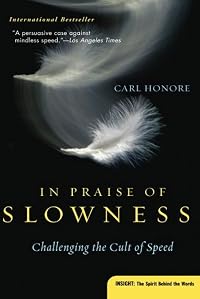
In Praise of Slowness: Challenging the Cult of Speed
by Carl Honoré
On This Page
Description
We live in the age of speed. We strain to be more efficient, to cram more into each minute, each hour, each day. Since the Industrial Revolution shifted the world into high gear, the cult of speed has pushed us to a breaking point. Consider these facts: Americans on average spend seventy-two minutes of every day behind the wheel of a car, a typical business executive now loses sixty-eight hours a year to being put on hold, and American adults currently devote on average a mere half hour per show more week to making love. Living on the edge of exhaustion, we are constantly reminded by our bodies and minds that the pace of life is spinning out of control. In Praise of Slowness traces the history of our increasingly breathless relationship with time and tackles the consequences of living in this accelerated culture of our own creation. Why are we always in such a rush? What is the cure for time sickness? Is it possible, or even desirable, to slow down? Realizing the price we pay for unrelenting speed, people all over the world are reclaiming their time and slowing down the pace -- and living happier, healthier, and more productive lives as a result. A Slow revolution is taking place. Here you will find no Luddite calls to overthrow technology and seek a preindustrial utopia. This is a modern revolution, championed by cell-phone using, e-mailing lovers of sanity. The Slow philosophy can be summed up in a single word -- balance. People are discovering energy and efficiency where they may have been least expected -- in slowing down. In this engaging and entertaining exploration, award-winning journalist and rehabilitated speedaholic Carl Honoré details our perennial love affair with efficiency and speed in a perfect blend of anecdotal reportage, history, and intellectual inquiry. In Praise of Slowness is the first comprehensive look at the worldwide Slow movements making their way into the mainstream -- in offices, factories, neighborhoods, kitchens, hospitals, concert halls, bedrooms, gyms, and schools. Defining a movement that is here to stay, this spirited manifesto will make you completely rethink your relationship with time. show lessTags
Recommendations




Member Reviews
With regards to this book it is more about the advised philosophy than the strength of the writing. I picked this up because I was interested in the Slow Movement. One of my favourite subjects was that of time, the opening subject, which started off well with the following paragraph - What is the very first thing you do in the morning? Draw the curtains? Roll over to snuggle with your partner or pillow? Spring out of bed and do ten push ups to get the blood pumping? No, the first thing you do, the first thing everyone does, is check the time. Page 17.
In my opinion it was one of the strongest subjects and made me think about my own relationship with time.
"Boredom - the word itself hardly existed 150 years ago - is a modern invention." show more This sentence really made me stop and think. 'I'm bored' is a term I have heard with increasing frequency each year. I only have to think back to when I was a child, and how the more technology developed and the less time we spent outdoors, the more bored we got, and to look at my young cousins now who are glued to their DS's which once the battery dies have absolutely no idea how to amuse themselves. It seems we have all forgotten how to slow down and simply be alive rather than constantly trying to maintain a state of hyper stimulation.
"Thanks to speed we live in the age of rage."
This rang truer for me than I would like to admit. I'm embarrassed to think of all the times I have huffed and puffed and gotten angry just by getting stuck in traffic or if I have to line up somewhere for more than a minute, not to mention if my Internet is lagging, having obviously completely forgotten what it was like when the first modem came out...When I think back on all the times I have gotten angry, most of it has been over nothing. Really. What does it matter if you have to wait a few minutes? After reading this I changed my ways. I know longer mind waiting. Instead I do some deep breathing, day dream about the newest hunk on True Blood or simply have a gander at what is going on in the world around me - birds finding twigs, children playing games, a leaf dancing on the wind etc. Slowing down has made me happier and calmer.
What I didn't like about this book was the chapter on music; it dragged on far too long and was very repetitive. Some chapters too suffered from repetition.
I also lost respect for the author on the chapter of Tantric sex. It might be a personal bias, but I could not understand how he could go back to the second class WITHOUT HIS WIFE. He went on to say, that although he performed the night's exercises with another woman (including touching her in places to see how pleasurable it was for her etc) it was all completely innocent. I mean honestly, he couldn't skip one night and wait until the next to go back with his wife to experience non-sex-induced orgasms??
After that I didn't really enjoy hearing his personal slant on everything and would have preferred he stay neutral and merely inform me of the different fields of the Slow Movement. show less
In my opinion it was one of the strongest subjects and made me think about my own relationship with time.
"Boredom - the word itself hardly existed 150 years ago - is a modern invention." show more This sentence really made me stop and think. 'I'm bored' is a term I have heard with increasing frequency each year. I only have to think back to when I was a child, and how the more technology developed and the less time we spent outdoors, the more bored we got, and to look at my young cousins now who are glued to their DS's which once the battery dies have absolutely no idea how to amuse themselves. It seems we have all forgotten how to slow down and simply be alive rather than constantly trying to maintain a state of hyper stimulation.
"Thanks to speed we live in the age of rage."
This rang truer for me than I would like to admit. I'm embarrassed to think of all the times I have huffed and puffed and gotten angry just by getting stuck in traffic or if I have to line up somewhere for more than a minute, not to mention if my Internet is lagging, having obviously completely forgotten what it was like when the first modem came out...When I think back on all the times I have gotten angry, most of it has been over nothing. Really. What does it matter if you have to wait a few minutes? After reading this I changed my ways. I know longer mind waiting. Instead I do some deep breathing, day dream about the newest hunk on True Blood or simply have a gander at what is going on in the world around me - birds finding twigs, children playing games, a leaf dancing on the wind etc. Slowing down has made me happier and calmer.
What I didn't like about this book was the chapter on music; it dragged on far too long and was very repetitive. Some chapters too suffered from repetition.
I also lost respect for the author on the chapter of Tantric sex. It might be a personal bias, but I could not understand how he could go back to the second class WITHOUT HIS WIFE. He went on to say, that although he performed the night's exercises with another woman (including touching her in places to see how pleasurable it was for her etc) it was all completely innocent. I mean honestly, he couldn't skip one night and wait until the next to go back with his wife to experience non-sex-induced orgasms??
After that I didn't really enjoy hearing his personal slant on everything and would have preferred he stay neutral and merely inform me of the different fields of the Slow Movement. show less
No one can deny that our modern world is a very fast place. People zoom around in cars or public transport, crunch through work as fast as they can (and for as long as they can, most days), start focusing on the next thing as soon as the current event has started, rush through their food and their play and their time with their kids as if reaching the end on time - or before time is up, even better! - is the true target of these activities. Not enjoyment, not fulfillment, not even necessarily doing the job well. No, speed, speed and punctuality is the key.
I first encountered this book, In Praise of Slow, a few years ago, and it's taken me a while to get around to reading it. Part of it is that, well, I feel that advocating slowing my show more life down all over isn't feasible, and so I felt that reading a book like this would only make me feel bad about myself and somewhat ashamed that I can't take control of my life the way that the author suggests, even if I may want to. Thankfully, this isn't the case. The stories that the book advances resonate with me not just because I can recognize details of my own life in them, but because the morals and suggestions stemming from a lot of them seem practical and usable.
Honore details just how speed and constantly watching the clock, feeling like we're always battling against time, came to be one of the defining characteristics of our society, starting from the Industrial Revolution and moving onwards towards the present day, and the harms it has for our society - making us sicker, making us less happy, giving less time to the activities and connections we say are important to us. He then goes through a variety of different movements (which all seem to have some version of the word "slow" in them somewhere) that are trying to ameliorate things. The Slow Food movement, I'd already heard of: it consists of people who believe we should take longer to eat, enjoying better, more local food and the atmosphere and company that should go with it. And that's certainly something I can get behind.
What I hadn't connected up before, and what's the real interesting throughline of the book, were all these other ideas: Slow Cities, encouraging changing the use of cities to get more people walking, more green space, less cars, etc.; changes in how to work, including job-sharing, more flexible hours, being able to step back, etc; different movements for slowing down in education, and letting kids explore and learn at a more natural pace for them. Trends for slower, more relaxing forms of leisure, like knitting, reading, or gardening - even slowing down classical music to the way it used to be played; trends for differing approaches to medicine, to meditation, to sex. I think I'd heard of a large number of these, but having them grouped together like this really pointed up that they all stem from similar desires for things to proceed at a more reflective pace.
That's what this comes to, in the end, and that's what makes the book practical and useful: the real take-home message, reinforced regularly through the book, is that this isn't meant to be a slow-down-in-everything philosophy. Speed has its place, too. It's an argument for taking each element of one's life at the speed it's best appreciated. Rushing through things that should be savored doesn't make us happier, and not taking time to reflect and calm ourselves before rushing on leads to consistently worse results. Honore puts this before us time and again, referencing studies, giving testimonials, drawing back to point at the ways we damage ourselves and our world with too much speed, and trying to show how people can succeed more by taking things more naturally. The style is a little bit cutesy sometimes - man, he adores alliteration ad nauseam, to take a quote from somewhere I can't recall - but it's engaging and keeps you into it. I read it slowly, so it'd sink in. And I think others would probably enjoy reading it, as well. A lot of these books, I finish, and I can't see how I'll be able to keep applying it; this one, I think I can really use. show less
I first encountered this book, In Praise of Slow, a few years ago, and it's taken me a while to get around to reading it. Part of it is that, well, I feel that advocating slowing my show more life down all over isn't feasible, and so I felt that reading a book like this would only make me feel bad about myself and somewhat ashamed that I can't take control of my life the way that the author suggests, even if I may want to. Thankfully, this isn't the case. The stories that the book advances resonate with me not just because I can recognize details of my own life in them, but because the morals and suggestions stemming from a lot of them seem practical and usable.
Honore details just how speed and constantly watching the clock, feeling like we're always battling against time, came to be one of the defining characteristics of our society, starting from the Industrial Revolution and moving onwards towards the present day, and the harms it has for our society - making us sicker, making us less happy, giving less time to the activities and connections we say are important to us. He then goes through a variety of different movements (which all seem to have some version of the word "slow" in them somewhere) that are trying to ameliorate things. The Slow Food movement, I'd already heard of: it consists of people who believe we should take longer to eat, enjoying better, more local food and the atmosphere and company that should go with it. And that's certainly something I can get behind.
What I hadn't connected up before, and what's the real interesting throughline of the book, were all these other ideas: Slow Cities, encouraging changing the use of cities to get more people walking, more green space, less cars, etc.; changes in how to work, including job-sharing, more flexible hours, being able to step back, etc; different movements for slowing down in education, and letting kids explore and learn at a more natural pace for them. Trends for slower, more relaxing forms of leisure, like knitting, reading, or gardening - even slowing down classical music to the way it used to be played; trends for differing approaches to medicine, to meditation, to sex. I think I'd heard of a large number of these, but having them grouped together like this really pointed up that they all stem from similar desires for things to proceed at a more reflective pace.
That's what this comes to, in the end, and that's what makes the book practical and useful: the real take-home message, reinforced regularly through the book, is that this isn't meant to be a slow-down-in-everything philosophy. Speed has its place, too. It's an argument for taking each element of one's life at the speed it's best appreciated. Rushing through things that should be savored doesn't make us happier, and not taking time to reflect and calm ourselves before rushing on leads to consistently worse results. Honore puts this before us time and again, referencing studies, giving testimonials, drawing back to point at the ways we damage ourselves and our world with too much speed, and trying to show how people can succeed more by taking things more naturally. The style is a little bit cutesy sometimes - man, he adores alliteration ad nauseam, to take a quote from somewhere I can't recall - but it's engaging and keeps you into it. I read it slowly, so it'd sink in. And I think others would probably enjoy reading it, as well. A lot of these books, I finish, and I can't see how I'll be able to keep applying it; this one, I think I can really use. show less
I’m always conscious of time—and I envy creative people like musicians, writers and artists who can place themselves in the flow and losethemselves. I envy them because I so rarely get there myself. But I’ve been trying. See, I have a problem with time management. Not that I’m disorganized but I’m always trying to fit more in so I can do it all. As a result I’ve read probably every time management book under the sun. In the eighties I had my Time Planner, and now I live by my todo lists, and weekly, quarterly and annual goals. I’ve learned to be efficient and I’m always looking for ways to cut corners on the things that don’t matter to me so I can spend more time on the things that do.
So I’ve really been looking show more forward to reading In Praise of Slowness because I am the target demographic. A number of years ago I read John de Graff’s book Take Back Your Time and it changed my life. It opened my eyes to how we overwork ourselves in the United States. One of my favorite posters on his organization’s site is a cartoon that says, “Medieval Peasants Worked Less Than You Do.” I even attended one of their conferences. It was right after the economy crashed and they were struggling with how we could possibly get a minimum vacation law passed now. How sad!
In Praise of Slowness is a great book. It focuses on the Slow movement started in Italy and profiles areas where people are deciding enough is enough, work isn’t all there is, and it is time to get off the treadmill and enjoy life. The author, Carl Honore profiles ways people are taking back their lives through and choosing a more leisurely route through food, urban planning, mind/body, medicine, sex, work, leisure, and the over scheduled child.
I’m not exactly about to start cooking several hours a day, but I’ll be glad to eat any meals my friends choose to make and spend an evening with them. In fact, I did that last Friday. I went to a friend’s house and I made a new salad recipe while she and her partner bbqed. We drank wine while the kids went crazy running around the backyard. I left with a full belly and my kid fell asleep in the car on the way home. I need more nights like that. And that is something I’m working on—I’m currently working on building my support network in the real world and making more time for friends and family.
If you think your life is stressful and there isn’t enough time in the day, then please read this book. Pick an area or two, and then focus on how you can slow down. (And if you choose food, please invite me over). Then read de Graaf’s book Take Back Your Time and look for how we can change the work world to make it better. And then learn how to stop being a slave to technology by reading Be Excellent at Everything. show less
So I’ve really been looking show more forward to reading In Praise of Slowness because I am the target demographic. A number of years ago I read John de Graff’s book Take Back Your Time and it changed my life. It opened my eyes to how we overwork ourselves in the United States. One of my favorite posters on his organization’s site is a cartoon that says, “Medieval Peasants Worked Less Than You Do.” I even attended one of their conferences. It was right after the economy crashed and they were struggling with how we could possibly get a minimum vacation law passed now. How sad!
In Praise of Slowness is a great book. It focuses on the Slow movement started in Italy and profiles areas where people are deciding enough is enough, work isn’t all there is, and it is time to get off the treadmill and enjoy life. The author, Carl Honore profiles ways people are taking back their lives through and choosing a more leisurely route through food, urban planning, mind/body, medicine, sex, work, leisure, and the over scheduled child.
I’m not exactly about to start cooking several hours a day, but I’ll be glad to eat any meals my friends choose to make and spend an evening with them. In fact, I did that last Friday. I went to a friend’s house and I made a new salad recipe while she and her partner bbqed. We drank wine while the kids went crazy running around the backyard. I left with a full belly and my kid fell asleep in the car on the way home. I need more nights like that. And that is something I’m working on—I’m currently working on building my support network in the real world and making more time for friends and family.
If you think your life is stressful and there isn’t enough time in the day, then please read this book. Pick an area or two, and then focus on how you can slow down. (And if you choose food, please invite me over). Then read de Graaf’s book Take Back Your Time and look for how we can change the work world to make it better. And then learn how to stop being a slave to technology by reading Be Excellent at Everything. show less
I must be getting a reputation. I don't think there are many people left who don't now know that my early report card read "You can't hurry Helen". Well, Tamette loaned me what she figured was the perfect book for me: In praise of Slow. I had no idea that there are whole movements across the world with the aim of "slowing down" in one arena of life or another, complete with theories that everything from health to productivity improves as a result. It was an informative and enjoyable read, and I was particularly fascinated by the musical concept of tempo giusto, which argues, among other things, that our current reading of early metronome markings is incorrect. There used to be two beats to every note, not one, meaning that most music is show more probably played twice as fast as it ought to be. The idea is not that everything should be played ridiculously slowly, but that each piece should find its natural rhythms, or its tempo giusto. Apparently, much music is more complex and beautiful than we are able to comprehend at the speeds normally played. An example of inappropriate speed is Mozart's Rondo alla turca which is meant to be a march, but which is usually played at something more closely resembling a flat out sprint.
But, most fascinating of all, for me, was the fact that so many people, including the author before he began his research, need to be persuaded that slowing down can be less rather than more stressful, and that it might not be boring. But then, I was always very slow - noone was ever going to convince me that hurrying up was a good idea!
One of the supposed benefits of slowing down in at least some areas of life is that when we slow down, we allow our brains to enter their more creative thinking mode. At such times our thinking becomes less linear and rational (no wonder I'm not logical!) but makes more and deeper connections, meanings and new ideas. Perhaps this could explain why I sometimes catch people whispering to each other that I'm actually pretty intelligent. I never know whether they're finding that I'm more intelligent than they had realised or expected, or whether they believe that I don't recognise the level of my own intelligence. What I do know is that I have many times caught people at finding a need to express the fact of my intelligence, as though this is a thing that needs to be mentioned.
This seems quite strange really, because while they're busy reading biography, science and literature, I'm reading children's books. While they're catching up with the news and the latest discoveries, I'm surfing the net for barbie dolls. Not much comparison really - I'm pretty much an intellectual barbarian. But then, it's a bit like Maslow's hierarchy for me. It's not that I have no interest in or capability to read and do the things that others routinely do; it's just a matter of priorities. Reading (basic, imaginative reading) is at the priority level of sleep for me. If I have read enough stories and walked enough and thought enough, then I might have some brain and spirit room available for higher orders. But, by the time I have finished with work and people, there is not enough time even for my basic priorities, so I quite firmly leave everything else alone. But perhaps because I am so stubborn, I have a bit more time for my brain to simply wander as it needs to do, so that, even though I have taken in little useful information, my brain has thoroughly processed and connected the information it has received, with the result that I appear surprisingly "intelligent". If that's the case then all the swots out there are wasting their time - they should just relax and have a good read!
This also makes me think of C S Lewis. I remember reading, with enormous envy, that for a good part of his life he managed to work according to what, to him, was the perfect schedule. He worked in the morning for 4 hours. After lunch he spent the whole afternoon walking, and then in the evenings he read and conversed with friends. That always sounded absolutely divine to me but very "unproductive" by current standards. However, according to Slow, we are actually more productive if we spend more time in unstructured ways and less time "working". And, given the nature of Lewis' work, imagine the meanings, connections and ideas that could be developed with so much time spent in solitude, with the mind wandering freely, and then in reading and dialogue. He would have been much healthier than most people today and probably capable of much greater levels of intellectual prowess. What a wonderful template for living!
I think I have a new (corny) slogan: "Born to be Slow"! show less
But, most fascinating of all, for me, was the fact that so many people, including the author before he began his research, need to be persuaded that slowing down can be less rather than more stressful, and that it might not be boring. But then, I was always very slow - noone was ever going to convince me that hurrying up was a good idea!
One of the supposed benefits of slowing down in at least some areas of life is that when we slow down, we allow our brains to enter their more creative thinking mode. At such times our thinking becomes less linear and rational (no wonder I'm not logical!) but makes more and deeper connections, meanings and new ideas. Perhaps this could explain why I sometimes catch people whispering to each other that I'm actually pretty intelligent. I never know whether they're finding that I'm more intelligent than they had realised or expected, or whether they believe that I don't recognise the level of my own intelligence. What I do know is that I have many times caught people at finding a need to express the fact of my intelligence, as though this is a thing that needs to be mentioned.
This seems quite strange really, because while they're busy reading biography, science and literature, I'm reading children's books. While they're catching up with the news and the latest discoveries, I'm surfing the net for barbie dolls. Not much comparison really - I'm pretty much an intellectual barbarian. But then, it's a bit like Maslow's hierarchy for me. It's not that I have no interest in or capability to read and do the things that others routinely do; it's just a matter of priorities. Reading (basic, imaginative reading) is at the priority level of sleep for me. If I have read enough stories and walked enough and thought enough, then I might have some brain and spirit room available for higher orders. But, by the time I have finished with work and people, there is not enough time even for my basic priorities, so I quite firmly leave everything else alone. But perhaps because I am so stubborn, I have a bit more time for my brain to simply wander as it needs to do, so that, even though I have taken in little useful information, my brain has thoroughly processed and connected the information it has received, with the result that I appear surprisingly "intelligent". If that's the case then all the swots out there are wasting their time - they should just relax and have a good read!
This also makes me think of C S Lewis. I remember reading, with enormous envy, that for a good part of his life he managed to work according to what, to him, was the perfect schedule. He worked in the morning for 4 hours. After lunch he spent the whole afternoon walking, and then in the evenings he read and conversed with friends. That always sounded absolutely divine to me but very "unproductive" by current standards. However, according to Slow, we are actually more productive if we spend more time in unstructured ways and less time "working". And, given the nature of Lewis' work, imagine the meanings, connections and ideas that could be developed with so much time spent in solitude, with the mind wandering freely, and then in reading and dialogue. He would have been much healthier than most people today and probably capable of much greater levels of intellectual prowess. What a wonderful template for living!
I think I have a new (corny) slogan: "Born to be Slow"! show less
In Praise of Slowness is a plea for deceleration. Author Carl Honore would like us to remember that even though our machines have become very fast indeed, human beings need not emulate them.
Naturally he starts with the Italians, who invented the Slow Food movement and inspired various other movements: Slow Sex, Slow Cities, Slow Parenting, et cetera. This book (and the many people quoted in it) make a good case for chilling out. Do we really want to live in a world where books of One-Minute Bedtime Stories are bestsellers? How many people really enjoy a caffeinated lifestyle, fueled by nuked food?
In Praise of Slowness would be a better book if it proceeded at a leisurely pace, rather than darting from point to point in a brisk, show more glossy-magazine manner. Then again, if Honore didn't keep the pace brisk, how many modern readers would set aside the time to read it? show less
Naturally he starts with the Italians, who invented the Slow Food movement and inspired various other movements: Slow Sex, Slow Cities, Slow Parenting, et cetera. This book (and the many people quoted in it) make a good case for chilling out. Do we really want to live in a world where books of One-Minute Bedtime Stories are bestsellers? How many people really enjoy a caffeinated lifestyle, fueled by nuked food?
In Praise of Slowness would be a better book if it proceeded at a leisurely pace, rather than darting from point to point in a brisk, show more glossy-magazine manner. Then again, if Honore didn't keep the pace brisk, how many modern readers would set aside the time to read it? show less
With regards to this book it is more about the advised philosophy than the strength of the writing. I picked this up because I was interested in the Slow Movement. One of my favourite subjects was that of time, the opening subject, which started off well with the following paragraph - What is the very first thing you do in the morning? Draw the curtains? Roll over to snuggle with your partner or pillow? Spring out of bed and do ten push ups to get the blood pumping? No, the first thing you do, the first thing everyone does, is check the time. Page 17.
In my opinion it was one of the strongest subjects and made me think about my own relationship with time.
"Boredom - the word itself hardly existed 150 years ago - is a modern invention." show more This sentence really made me stop and think. 'I'm bored' is a term I have heard with increasing frequency each year. I only have to think back to when I was a child, and how the more technology developed and the less time we spent outdoors, the more bored we got, and to look at my young cousins now who are glued to their DS's which once the battery dies have absolutely no idea how to amuse themselves. It seems we have all forgotten how to slow down and simply be alive rather than constantly trying to maintain a state of hyper stimulation.
"Thanks to speed we live in the age of rage."
This rang truer for me than I would like to admit. I'm embarrassed to think of all the times I have huffed and puffed and gotten angry just by getting stuck in traffic or if I have to line up somewhere for more than a minute, not to mention if my Internet is lagging, having obviously completely forgotten what it was like when the first modem came out...When I think back on all the times I have gotten angry, most of it has been over nothing. Really. What does it matter if you have to wait a few minutes? After reading this I changed my ways. I know longer mind waiting. Instead I do some deep breathing, day dream about the newest hunk on True Blood or simply have a gander at what is going on in the world around me - birds finding twigs, children playing games, a leaf dancing on the wind etc. Slowing down has made me happier and calmer.
What I didn't like about this book was the chapter on music; it dragged on far too long and was very repetitive. Some chapters too suffered from repetition.
I also lost respect for the author on the chapter of Tantric sex. It might be a personal bias, but I could not understand how he could go back to the second class WITHOUT HIS WIFE. He went on to say, that although he performed the night's exercises with another woman (including touching her in places to see how pleasurable it was for her etc) it was all completely innocent. I mean honestly, he couldn't skip one night and wait until the next to go back with his wife to experience non-sex-induced orgasms??
After that I didn't really enjoy hearing his personal slant on everything and would have preferred he stay neutral and merely inform me of the different fields of the Slow Movement. show less
In my opinion it was one of the strongest subjects and made me think about my own relationship with time.
"Boredom - the word itself hardly existed 150 years ago - is a modern invention." show more This sentence really made me stop and think. 'I'm bored' is a term I have heard with increasing frequency each year. I only have to think back to when I was a child, and how the more technology developed and the less time we spent outdoors, the more bored we got, and to look at my young cousins now who are glued to their DS's which once the battery dies have absolutely no idea how to amuse themselves. It seems we have all forgotten how to slow down and simply be alive rather than constantly trying to maintain a state of hyper stimulation.
"Thanks to speed we live in the age of rage."
This rang truer for me than I would like to admit. I'm embarrassed to think of all the times I have huffed and puffed and gotten angry just by getting stuck in traffic or if I have to line up somewhere for more than a minute, not to mention if my Internet is lagging, having obviously completely forgotten what it was like when the first modem came out...When I think back on all the times I have gotten angry, most of it has been over nothing. Really. What does it matter if you have to wait a few minutes? After reading this I changed my ways. I know longer mind waiting. Instead I do some deep breathing, day dream about the newest hunk on True Blood or simply have a gander at what is going on in the world around me - birds finding twigs, children playing games, a leaf dancing on the wind etc. Slowing down has made me happier and calmer.
What I didn't like about this book was the chapter on music; it dragged on far too long and was very repetitive. Some chapters too suffered from repetition.
I also lost respect for the author on the chapter of Tantric sex. It might be a personal bias, but I could not understand how he could go back to the second class WITHOUT HIS WIFE. He went on to say, that although he performed the night's exercises with another woman (including touching her in places to see how pleasurable it was for her etc) it was all completely innocent. I mean honestly, he couldn't skip one night and wait until the next to go back with his wife to experience non-sex-induced orgasms??
After that I didn't really enjoy hearing his personal slant on everything and would have preferred he stay neutral and merely inform me of the different fields of the Slow Movement. show less
With regards to this book it is more about the advised philosophy than the strength of the writing. I picked this up because I was interested in the Slow Movement. One of my favourite subjects was that of time, the opening subject, which started off well with the following paragraph - What is the very first thing you do in the morning? Draw the curtains? Roll over to snuggle with your partner or pillow? Spring out of bed and do ten push ups to get the blood pumping? No, the first thing you do, the first thing everyone does, is check the time. Page 17.
In my opinion it was one of the strongest subjects and made me think about my own relationship with time.
"Boredom - the word itself hardly existed 150 years ago - is a modern invention." show more This sentence really made me stop and think. 'I'm bored' is a term I have heard with increasing frequency each year. I only have to think back to when I was a child, and how the more technology developed and the less time we spent outdoors, the more bored we got, and to look at my young cousins now who are glued to their DS's which once the battery dies have absolutely no idea how to amuse themselves. It seems we have all forgotten how to slow down and simply be alive rather than constantly trying to maintain a state of hyper stimulation.
"Thanks to speed we live in the age of rage."
This rang truer for me than I would like to admit. I'm embarrassed to think of all the times I have huffed and puffed and gotten angry just by getting stuck in traffic or if I have to line up somewhere for more than a minute, not to mention if my Internet is lagging, having obviously completely forgotten what it was like when the first modem came out...When I think back on all the times I have gotten angry, most of it has been over nothing. Really. What does it matter if you have to wait a few minutes? After reading this I changed my ways. I know longer mind waiting. Instead I do some deep breathing, day dream about the newest hunk on True Blood or simply have a gander at what is going on in the world around me - birds finding twigs, children playing games, a leaf dancing on the wind etc. Slowing down has made me happier and calmer.
What I didn't like about this book was the chapter on music; it dragged on far too long and was very repetitive. Some chapters too suffered from repetition.
I also lost respect for the author on the chapter of Tantric sex. It might be a personal bias, but I could not understand how he could go back to the second class WITHOUT HIS WIFE. He went on to say, that although he performed the night's exercises with another woman (including touching her in places to see how pleasurable it was for her etc) it was all completely innocent. I mean honestly, he couldn't skip one night and wait until the next to go back with his wife to experience non-sex-induced orgasms??
After that I didn't really enjoy hearing his personal slant on everything and would have preferred he stay neutral and merely inform me of the different fields of the Slow Movement. show less
In my opinion it was one of the strongest subjects and made me think about my own relationship with time.
"Boredom - the word itself hardly existed 150 years ago - is a modern invention." show more This sentence really made me stop and think. 'I'm bored' is a term I have heard with increasing frequency each year. I only have to think back to when I was a child, and how the more technology developed and the less time we spent outdoors, the more bored we got, and to look at my young cousins now who are glued to their DS's which once the battery dies have absolutely no idea how to amuse themselves. It seems we have all forgotten how to slow down and simply be alive rather than constantly trying to maintain a state of hyper stimulation.
"Thanks to speed we live in the age of rage."
This rang truer for me than I would like to admit. I'm embarrassed to think of all the times I have huffed and puffed and gotten angry just by getting stuck in traffic or if I have to line up somewhere for more than a minute, not to mention if my Internet is lagging, having obviously completely forgotten what it was like when the first modem came out...When I think back on all the times I have gotten angry, most of it has been over nothing. Really. What does it matter if you have to wait a few minutes? After reading this I changed my ways. I know longer mind waiting. Instead I do some deep breathing, day dream about the newest hunk on True Blood or simply have a gander at what is going on in the world around me - birds finding twigs, children playing games, a leaf dancing on the wind etc. Slowing down has made me happier and calmer.
What I didn't like about this book was the chapter on music; it dragged on far too long and was very repetitive. Some chapters too suffered from repetition.
I also lost respect for the author on the chapter of Tantric sex. It might be a personal bias, but I could not understand how he could go back to the second class WITHOUT HIS WIFE. He went on to say, that although he performed the night's exercises with another woman (including touching her in places to see how pleasurable it was for her etc) it was all completely innocent. I mean honestly, he couldn't skip one night and wait until the next to go back with his wife to experience non-sex-induced orgasms??
After that I didn't really enjoy hearing his personal slant on everything and would have preferred he stay neutral and merely inform me of the different fields of the Slow Movement. show less
Members
- Recently Added By
Author Information

19+ Works 1,951 Members
Awards and Honors
Distinctions
Common Knowledge
- Canonical title
- In Praise of Slowness: Challenging the Cult of Speed
Classifications
Statistics
- Members
- 1,632
- Popularity
- 13,898
- Reviews
- 36
- Rating
- (3.46)
- Languages
- 14 — Czech, Danish, Dutch, English, Finnish, French, Icelandic, Italian, Norwegian (Bokmål), Norwegian, Polish, Portuguese, Spanish, Swedish
- Media
- Paper, Audiobook, Ebook
- ISBNs
- 55
- ASINs
- 14