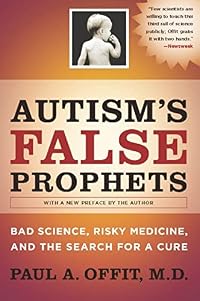
Autism's False Prophets: Bad Science, Risky Medicine, and the Search for a Cure
by Paul A. Offit
On This Page
Description
A London researcher was the first to assert that the combination measles-mumps-rubella vaccine known as MMR caused autism in children. Following this "discovery," a handful of parents declared that a mercury-containing preservative in several vaccines was responsible for the disease. If mercury caused autism, they reasoned, eliminating it from a child's system should treat the disorder. Consequently, a number of untested alternative therapies arose, and, most tragically, in one such show more treatment, a doctor injected a five-year-old autistic boy with a chemical in an effort to cleanse him of mercury, which stopped his heart instead. Children with autism have been placed on stringent diets, subjected to high-temperature saunas, bathed in magnetic clay, asked to swallow digestive enzymes and activated charcoal, and injected with various combinations of vitamins, minerals, and acids. Instead of helping, these therapies can hurt those who are most vulnerable, and particularly in the case of autism, they undermine childhood vaccination programs that have saved millions of lives. An overwhelming body of scientific evidence clearly shows that childhood vaccines are safe and does not cause autism. Yet widespread fear of vaccines on the part of parents persists. In this book, Paul A. Offit, a national expert on vaccines, challenges the modern-day false prophets who have so egregiously misled the public and exposes the opportunism of the lawyers, journalists, celebrities, and politicians who support them. Offit recounts the history of autism research and the exploitation of this tragic condition by advocates and zealots. He considers the manipulation of science in the popular media and the courtroom, and he explores why society is susceptible to the bad science and risky therapies put forward by many antivaccination activists. show lessTags
Recommendations



Member Reviews
‘Autism‘s False Prophets’ makes for a compelling read. Of course, the main topic here is to debunk the junk idea that the MMR vaccine cause autism. The flabbergasting saga which saw a self-interested physician in cahoots with injury lawyers and having gone as far as to falsify data, collected and handled in an unethical way in the first place, after relying on a study which was everything but conclusive to end up with a study itself inconclusive is, in itself, quite disturbing. That the results of such fraud contributed to a tsunami of scaremongering within the mass media (never shy when it comes to spread sensationalism over facts) and, as a result, the public at large, is also telling of what a sad era we are living in -an era show more shaped by science, yet when people have no understanding of what the scientific method is to start with.
Had it been just that, the retelling of a medical and scientific fraud still believed by the gullible and the price of which we are still paying to this day (measles, mumps and rubella made a come-back, while autism hasn’t been ‘cured’ -should we be surprised?), such book would have been necessary enough. But, fascinatingly, and with high relevance, it goes way beyond that.
First, it's about scientific research itself. Science indeed cannot be objective when the research is financed by vested lobbies, a state of affair which is common in the USA, where lawyers can fund their own research to serve their own legal cases (and where Andrew Wakefield, incidentally, is now ‘in exile’ and free to carry on sprouting his nonsense...) but wasn’t the case in Europe back then. As the author states:
‘The case against MMR was the first in England’s history in which the Legal Services Commission financed scientific research. And it will probably be the last. The commission concluded: “In retrospect, it was not effective or appropriate for us to fund research. The courts are not the place to prove medical truths”. The commission reasoned that science directed by a team of personal injury lawyers wasn’t likely to be the best kind of science.’
Well, duh! It seems common sense, and in the case of the MMR vaccine saga we saw the terrible consequences of such colluding (the author, in fact, also recounts what had happened with the tobacco industry to nail the point). Still, we ought to bear that in mind when faced with a dangerous trend these days, that the author doesn’t mention but which nevertheless is taking hold, whereas corporates and entrepreneurs are hijacking whole scientific fields (e.g. genetics) while public funding are drained.
Then, it’s also about the scientific method, and, beyond, about critical thinking. Dealing with a vaccine, the author outlines what the precautionary principle really entails -a nice reminder at a time of mass hysteria on all side around COVID-19 (both pro and anti vax alike ought to read this, although this book, obviously, doesn’t address the COVID pandemic since it was published in 2008…). Nothing is simple, but he reminds of the key difference between biological studies and epidemiological studies as well, in explanations which are straightforward but crucial. He also points at the absurdity prevalent among the anti MMR vaccines, purporting to be enlightened but being, in the end, nothing but useful idiots preyed upon by quacks:
‘Although some parents have been skeptical of the scientists and public health officials who failed to find that vaccines caused autism, questioning their motives and occasionally threatening them, they haven’t been similarly skeptical of the vast array of autism therapies, all of which are claimed to work and all of which are based on theories that are ill-founded, poorly conceived, contradictory, or disproved.’
Now, it’s easy to point at such absurd cherry-picking and failure in critical thinking (and feeling sad for the vulnerable yet gullible parents being targeted) yet the impact matters and it matters a great deal.
Finally indeed, and above all, what this book brilliantly exposes is what such bogus research and the alternative treatments coming in their trails really embody: a twisted and prejudicial perception of what is autism, and, by extension, of autistic people. We may live a time when autism as a spectrum is gaining better recognition and understanding, and when neurodiversity is gaining ground. However, there are still people out there, especially ‘doctors’ and businesses, entertaining the false view than autism is nothing but a burden, an horrible illness, a tragedy to be cured at all cost and autistic children nothing but damaged goods. It might be a prejudicial view and a whole self-serving industry and market, but it has consequences. Chelation, cranial manipulation, secretin, Lupron… The author does more than debunking the supposed causation between the MMR vaccine and a learning disability, and he does more than outlining how science works and is about. He, also, details the harrowing treatments such children are being put through by the ‘false prophets’, who are the only ones, in the end, profiting from such scaremongering.
Here’s a must read for anyone interested not only in autism, but, also, in science and the importance of critical thinking at a time of triumphing quackeries. When greed, sloppiness and fraud ally themselves with ignorance and harmful prejudice, the impact can be catastrophic indeed. Clear, accessible, well-argued and dispassionate, here’s debunking at its best. Highly recommended! show less
Had it been just that, the retelling of a medical and scientific fraud still believed by the gullible and the price of which we are still paying to this day (measles, mumps and rubella made a come-back, while autism hasn’t been ‘cured’ -should we be surprised?), such book would have been necessary enough. But, fascinatingly, and with high relevance, it goes way beyond that.
First, it's about scientific research itself. Science indeed cannot be objective when the research is financed by vested lobbies, a state of affair which is common in the USA, where lawyers can fund their own research to serve their own legal cases (and where Andrew Wakefield, incidentally, is now ‘in exile’ and free to carry on sprouting his nonsense...) but wasn’t the case in Europe back then. As the author states:
‘The case against MMR was the first in England’s history in which the Legal Services Commission financed scientific research. And it will probably be the last. The commission concluded: “In retrospect, it was not effective or appropriate for us to fund research. The courts are not the place to prove medical truths”. The commission reasoned that science directed by a team of personal injury lawyers wasn’t likely to be the best kind of science.’
Well, duh! It seems common sense, and in the case of the MMR vaccine saga we saw the terrible consequences of such colluding (the author, in fact, also recounts what had happened with the tobacco industry to nail the point). Still, we ought to bear that in mind when faced with a dangerous trend these days, that the author doesn’t mention but which nevertheless is taking hold, whereas corporates and entrepreneurs are hijacking whole scientific fields (e.g. genetics) while public funding are drained.
Then, it’s also about the scientific method, and, beyond, about critical thinking. Dealing with a vaccine, the author outlines what the precautionary principle really entails -a nice reminder at a time of mass hysteria on all side around COVID-19 (both pro and anti vax alike ought to read this, although this book, obviously, doesn’t address the COVID pandemic since it was published in 2008…). Nothing is simple, but he reminds of the key difference between biological studies and epidemiological studies as well, in explanations which are straightforward but crucial. He also points at the absurdity prevalent among the anti MMR vaccines, purporting to be enlightened but being, in the end, nothing but useful idiots preyed upon by quacks:
‘Although some parents have been skeptical of the scientists and public health officials who failed to find that vaccines caused autism, questioning their motives and occasionally threatening them, they haven’t been similarly skeptical of the vast array of autism therapies, all of which are claimed to work and all of which are based on theories that are ill-founded, poorly conceived, contradictory, or disproved.’
Now, it’s easy to point at such absurd cherry-picking and failure in critical thinking (and feeling sad for the vulnerable yet gullible parents being targeted) yet the impact matters and it matters a great deal.
Finally indeed, and above all, what this book brilliantly exposes is what such bogus research and the alternative treatments coming in their trails really embody: a twisted and prejudicial perception of what is autism, and, by extension, of autistic people. We may live a time when autism as a spectrum is gaining better recognition and understanding, and when neurodiversity is gaining ground. However, there are still people out there, especially ‘doctors’ and businesses, entertaining the false view than autism is nothing but a burden, an horrible illness, a tragedy to be cured at all cost and autistic children nothing but damaged goods. It might be a prejudicial view and a whole self-serving industry and market, but it has consequences. Chelation, cranial manipulation, secretin, Lupron… The author does more than debunking the supposed causation between the MMR vaccine and a learning disability, and he does more than outlining how science works and is about. He, also, details the harrowing treatments such children are being put through by the ‘false prophets’, who are the only ones, in the end, profiting from such scaremongering.
Here’s a must read for anyone interested not only in autism, but, also, in science and the importance of critical thinking at a time of triumphing quackeries. When greed, sloppiness and fraud ally themselves with ignorance and harmful prejudice, the impact can be catastrophic indeed. Clear, accessible, well-argued and dispassionate, here’s debunking at its best. Highly recommended! show less
This is not going to be a fair and balanced review.
That's because there is nothing to be fair or balanced about. Vaccines don't cause autism -- if anything, they prevent it (there are some hints that prenatal inflammation causes autism, and vaccines will prevent the mother from passing pathogens to her fetus). This is not controversial in the scientific community, and I haven't noticed much controversy about it in the autism community either (that is, among those of us who have autism, as opposed to those parents who want to cure their children of a condition that some of us are perfectly content to have, thank you very much!). The study by Andrew Wakefield that claimed vaccines as a cause of autism was too small, improperly conducted, show more unethical -- and has never been replicated. Junk science.
This book makes that clear enough. But, in a way, it misses the point. It points most of the blame at the media. But -- like too many books about scientific controversies -- it misunderstands the media's problem.
It's true that the mainstream media like to create controversies. And, of course, they don't like telling the truth when it might cost them readers.
But this isn't the media's real problem. It's "balance." Truth doesn't matter to them; if a sufficient sector of the population believes something, they give it equal time. Doesn't matter if it's false ("vaccines cause autism"), deliberately misleading ("evolution is only a theory"), or information that makes no difference to anyone ("so-and-so was the secret murderer of so-and-so"). I can speak to this from experience; I had an ongoing row with a newspaper editor saying that his coverage of science was false (which it was) and he arguing that it was his duty to present both sides. He told me that he knew I was right about the science, but his job was "balance"!
As a scientist and a person with autism, believe me, I could not have made that up if I tried!
And this book just doesn't get into the mass media's obsession with balance. But, as long as balance is treated as more important than truth, then we have a problem.
So: This book tells important truths. If you don't know the facts about the matter of autism and vaccines, you will learn a lot (although the fact that the book was written in 2008 means that it is now rather dated; we've learned a lot about autism since then). But it won't teach you how we can fix the problem of these anti-scientific myths. I don't know the answer myself, but just arguing against the media doesn't help. Yes, they're wrong -- but they're wrong for a different reason than is described in this book. Which makes it all sort of irrelevant. show less
That's because there is nothing to be fair or balanced about. Vaccines don't cause autism -- if anything, they prevent it (there are some hints that prenatal inflammation causes autism, and vaccines will prevent the mother from passing pathogens to her fetus). This is not controversial in the scientific community, and I haven't noticed much controversy about it in the autism community either (that is, among those of us who have autism, as opposed to those parents who want to cure their children of a condition that some of us are perfectly content to have, thank you very much!). The study by Andrew Wakefield that claimed vaccines as a cause of autism was too small, improperly conducted, show more unethical -- and has never been replicated. Junk science.
This book makes that clear enough. But, in a way, it misses the point. It points most of the blame at the media. But -- like too many books about scientific controversies -- it misunderstands the media's problem.
It's true that the mainstream media like to create controversies. And, of course, they don't like telling the truth when it might cost them readers.
But this isn't the media's real problem. It's "balance." Truth doesn't matter to them; if a sufficient sector of the population believes something, they give it equal time. Doesn't matter if it's false ("vaccines cause autism"), deliberately misleading ("evolution is only a theory"), or information that makes no difference to anyone ("so-and-so was the secret murderer of so-and-so"). I can speak to this from experience; I had an ongoing row with a newspaper editor saying that his coverage of science was false (which it was) and he arguing that it was his duty to present both sides. He told me that he knew I was right about the science, but his job was "balance"!
As a scientist and a person with autism, believe me, I could not have made that up if I tried!
And this book just doesn't get into the mass media's obsession with balance. But, as long as balance is treated as more important than truth, then we have a problem.
So: This book tells important truths. If you don't know the facts about the matter of autism and vaccines, you will learn a lot (although the fact that the book was written in 2008 means that it is now rather dated; we've learned a lot about autism since then). But it won't teach you how we can fix the problem of these anti-scientific myths. I don't know the answer myself, but just arguing against the media doesn't help. Yes, they're wrong -- but they're wrong for a different reason than is described in this book. Which makes it all sort of irrelevant. show less
This is the first book since my first encounter with Carl Sagan's work that stirred such a powerful, visceral emotion in me.
Autism's False Prophets is a thorough and detailed look at the vaccine debacle regarding autism, with an explanation of the research and history that caused the argument in the first place as well as how and why it is incorrect. It also looks at some related and equally ineffective other fad treatments for autism.
Overall, I can't say that I 'enjoyed' the book. It is like reading about any other great American tragedy. The sheer number of children harmed by people misrepresenting science is boggling and infuriating. However, I did appreciate the book for its message and intent.
The evidence in the book is show more well-referenced and clearly cited. Despite the author's clear passion for helping those with autism and clearing the dangerous and incorrect belief that vaccines are harmful, there is no embellishment or fabrication here, just clear hard facts. The back of the book is replete with the references, all well-documented events and studies from peer-reviewed, respected hard science journals.
Not only does the author prove beyond a doubt that vaccines do not cause autism, he also goes over the rationale behind the use of vitamin megadosing, difficult fad diets, expensive barometric chambers, and wildly dangerous chelation therapy. The heart-wrenching failure of facilitated communication is also debunked.
Let it be known: VACCINES DO NOT CAUSE AUTISM. AUTISM IS PRIMARILY GENETIC.
I have three criticisms for this book:
1.) The book is fantastic for pointing out what not to do, but glosses over the effective treatments, such as applied behavior analysis, that do work and should be pursued.
2.) The writing of the book is still a bit advanced for its target audience. The people that the author seeks to persuade---needs to persuade---are most likely not going to be completely familiar or comfortable with scientific methods, rationale, or terminology. 'Translations' would have been helpful to include to keep this book from sounding like technobabble.
3.) The deplorable treatment of Dr. Israel's treatment. In the book, the author decries Israel's use of shock as part of his therapy. To support this, the book uses a completely out of context quote on how the shocks must hurt. However, the author does not go over, or indeed, seem to even know, the rationale behind the shocks.
I am familiar with Israel's school and find his mis-representation to be a knee-jerk reaction and totally out of place. For those unfamiliar, Israel runs a facility for children with severe behavior disorders, including those with autism. More often than not, these children have been kicked out of any other program. Israel focuses on the use of reinforcement---Positive rewards---to improve behavior. If this does not work and the behavior is severe enough, he uses electric shock to punish the behavior. Yes, the shock hurts. No, it does not cause permanent damage. A judge, lawyer, and physician oversee the use of shock---which is fully monitored at all times---and represent the interests of the child against the school. The shock is effective and it saves lives. Examples of its use include extremely violent behavior towards caregivers, starvation, and self-injury severe enough that the child was going to lose their eyesight or even their life. I've heard a 'victim' of this shock treatment speak about his experiences, and he admitted that while it hurt, it allowed him to learn appropriate behavior. It saved lives. Many, many lives. It is a last resort. And to have the author smear Israel's methods without looking into them is deplorable.
TL;DR: While perhaps a smidgeon over-technical, this book is a must-read and contains crucial information for parents and professionals alike. show less
Autism's False Prophets is a thorough and detailed look at the vaccine debacle regarding autism, with an explanation of the research and history that caused the argument in the first place as well as how and why it is incorrect. It also looks at some related and equally ineffective other fad treatments for autism.
Overall, I can't say that I 'enjoyed' the book. It is like reading about any other great American tragedy. The sheer number of children harmed by people misrepresenting science is boggling and infuriating. However, I did appreciate the book for its message and intent.
The evidence in the book is show more well-referenced and clearly cited. Despite the author's clear passion for helping those with autism and clearing the dangerous and incorrect belief that vaccines are harmful, there is no embellishment or fabrication here, just clear hard facts. The back of the book is replete with the references, all well-documented events and studies from peer-reviewed, respected hard science journals.
Not only does the author prove beyond a doubt that vaccines do not cause autism, he also goes over the rationale behind the use of vitamin megadosing, difficult fad diets, expensive barometric chambers, and wildly dangerous chelation therapy. The heart-wrenching failure of facilitated communication is also debunked.
Let it be known: VACCINES DO NOT CAUSE AUTISM. AUTISM IS PRIMARILY GENETIC.
I have three criticisms for this book:
1.) The book is fantastic for pointing out what not to do, but glosses over the effective treatments, such as applied behavior analysis, that do work and should be pursued.
2.) The writing of the book is still a bit advanced for its target audience. The people that the author seeks to persuade---needs to persuade---are most likely not going to be completely familiar or comfortable with scientific methods, rationale, or terminology. 'Translations' would have been helpful to include to keep this book from sounding like technobabble.
3.) The deplorable treatment of Dr. Israel's treatment. In the book, the author decries Israel's use of shock as part of his therapy. To support this, the book uses a completely out of context quote on how the shocks must hurt. However, the author does not go over, or indeed, seem to even know, the rationale behind the shocks.
I am familiar with Israel's school and find his mis-representation to be a knee-jerk reaction and totally out of place. For those unfamiliar, Israel runs a facility for children with severe behavior disorders, including those with autism. More often than not, these children have been kicked out of any other program. Israel focuses on the use of reinforcement---Positive rewards---to improve behavior. If this does not work and the behavior is severe enough, he uses electric shock to punish the behavior. Yes, the shock hurts. No, it does not cause permanent damage. A judge, lawyer, and physician oversee the use of shock---which is fully monitored at all times---and represent the interests of the child against the school. The shock is effective and it saves lives. Examples of its use include extremely violent behavior towards caregivers, starvation, and self-injury severe enough that the child was going to lose their eyesight or even their life. I've heard a 'victim' of this shock treatment speak about his experiences, and he admitted that while it hurt, it allowed him to learn appropriate behavior. It saved lives. Many, many lives. It is a last resort. And to have the author smear Israel's methods without looking into them is deplorable.
TL;DR: While perhaps a smidgeon over-technical, this book is a must-read and contains crucial information for parents and professionals alike. show less
I am a somewhat crunchy mother of an autistic 6 year old. When I joined autism support groups to better help my son, I was confronted with a dizzying array of treatment options, many of which sounded offbeat or just plain dangerous. Many of the other parents of autistic children were strongly encouraging me to stopping vaccinations for all of my children. I took two months to read everything I could about both sides of the debate regarding vaccines and any possible link to autism, and I could have saved all that time by starting with this book.
Offit outlines the history of the vaccine issue in a way that is easy to read and understand. He gives detailed and pertinent examples of similar issues in recent history. I found it facinating to show more see how the anti-vaccine movement soon had a life of its own involving not only vaccines, but also chelation and the gluten-free/casein-free diets. While the focus is on the vaccine debate, Offit does explore these other very risky and dubious treatments.
This book has been extremely valuable to sort through what I have been hearing and where these ideas may have come from. Having read Autism's False Prophets, I now feel like I have made an informed decision about vaccines and I can give a solid and educated answer regarding other fringe autism treatments. Every parent with an autistic child should read this book before engaging in time consuming, difficult, and expensive treatments. show less
Offit outlines the history of the vaccine issue in a way that is easy to read and understand. He gives detailed and pertinent examples of similar issues in recent history. I found it facinating to show more see how the anti-vaccine movement soon had a life of its own involving not only vaccines, but also chelation and the gluten-free/casein-free diets. While the focus is on the vaccine debate, Offit does explore these other very risky and dubious treatments.
This book has been extremely valuable to sort through what I have been hearing and where these ideas may have come from. Having read Autism's False Prophets, I now feel like I have made an informed decision about vaccines and I can give a solid and educated answer regarding other fringe autism treatments. Every parent with an autistic child should read this book before engaging in time consuming, difficult, and expensive treatments. show less
(I received a copy of this book via the Scienceblogs Book Club)
A brief look at the reviews of "Autism's False Prophets" on Amazon will show the hallmarks of a contentious issue; at the time of this writing the 18 reviews are either 5-stars or one (9 of each), and a number of reviews show no indication of actually having read the book. Which raises the rather important question of whether the book - Paul Offit's coverage of the vaccine/autism issue - can avoid being caught up in the stridency.
It mostly does; while Offit does develop to his position - the evidence says neither Thermisol nor MMR causes cancer, and the vaccine/autism link is false - he narrates the other side effectively, and at first lets his opponents hang themselves. show more The dishonesty of Andrew Wakefield is particularly galling. The man falsified his research assistant's data, and failed to disclose he was paid by trial lawyers suing vaccine manufacturers - and then claimed it was only $50,000 until the real amount was revealed as $800,000. Offit does get more emphatic but it never descends into raw viciousness; which is nice when the publisher is so spooked a book tour is considered too dangerous for the author.
I have a few bones to pick with his presentation, though. He chooses a sort of rise and fall format for the early parts - first MMR/autism and then thermisol/autism. So he builds up the anti-vaxers and then breaks them down; the problem is the narrative strikes me as slightly false. The evidence against thermisol, for example, started hitting well before the "high" of Hollywood calling in 2006, and comments like "But the next few years would reveal that it was all a mirage" don't fit the accumulation of evidence already there. None of this undermines the science, but a more general chronological narrative not only would have fit better, but would have reinforced the point of how evidence and public consciousness become disjointed.
The later passages are smoother, though Offit doesn't seem quite sure how to integrate the pro-vaccine autism bloggers into the book. Much of the coverage of how the science is abused by the media and legal system is nothing new, but it is solid and gains some strength by resting on the case made earlier in the book. More on the issue of how casting the debate as over "damaged" kids reverberates among the actual autistic - both its insulting nature to the kids themselves, and the harm it does in getting resources to allow society to integrate them - would have been nice, but the former of the two does get handled somewhat.
The anti-vaccine contingent tied the goalposts to their truck and hit the gas some time ago, as David Kirby's bizarre November 2006 blameshifting - plumes of smoke from China, forest fires, and cremated dental filings as the new source of mercury for autism - show. But for its history and capable discussion of science's imperfect integration into the public domain, "Autism's False Prophets" is a good choice for people who haven't already made up their mind. show less
A brief look at the reviews of "Autism's False Prophets" on Amazon will show the hallmarks of a contentious issue; at the time of this writing the 18 reviews are either 5-stars or one (9 of each), and a number of reviews show no indication of actually having read the book. Which raises the rather important question of whether the book - Paul Offit's coverage of the vaccine/autism issue - can avoid being caught up in the stridency.
It mostly does; while Offit does develop to his position - the evidence says neither Thermisol nor MMR causes cancer, and the vaccine/autism link is false - he narrates the other side effectively, and at first lets his opponents hang themselves. show more The dishonesty of Andrew Wakefield is particularly galling. The man falsified his research assistant's data, and failed to disclose he was paid by trial lawyers suing vaccine manufacturers - and then claimed it was only $50,000 until the real amount was revealed as $800,000. Offit does get more emphatic but it never descends into raw viciousness; which is nice when the publisher is so spooked a book tour is considered too dangerous for the author.
I have a few bones to pick with his presentation, though. He chooses a sort of rise and fall format for the early parts - first MMR/autism and then thermisol/autism. So he builds up the anti-vaxers and then breaks them down; the problem is the narrative strikes me as slightly false. The evidence against thermisol, for example, started hitting well before the "high" of Hollywood calling in 2006, and comments like "But the next few years would reveal that it was all a mirage" don't fit the accumulation of evidence already there. None of this undermines the science, but a more general chronological narrative not only would have fit better, but would have reinforced the point of how evidence and public consciousness become disjointed.
The later passages are smoother, though Offit doesn't seem quite sure how to integrate the pro-vaccine autism bloggers into the book. Much of the coverage of how the science is abused by the media and legal system is nothing new, but it is solid and gains some strength by resting on the case made earlier in the book. More on the issue of how casting the debate as over "damaged" kids reverberates among the actual autistic - both its insulting nature to the kids themselves, and the harm it does in getting resources to allow society to integrate them - would have been nice, but the former of the two does get handled somewhat.
The anti-vaccine contingent tied the goalposts to their truck and hit the gas some time ago, as David Kirby's bizarre November 2006 blameshifting - plumes of smoke from China, forest fires, and cremated dental filings as the new source of mercury for autism - show. But for its history and capable discussion of science's imperfect integration into the public domain, "Autism's False Prophets" is a good choice for people who haven't already made up their mind. show less
Excellent reporting on the charlatans who are preying on the parents of autistic children with false cures and hopes, as well as the slimy lawyers and politicians who cash in on the issue.
In general I found Autism's False Prophets: Bad Science, Risky Medicine, and The Search for a Cure interesting and educational (all I knew going in was that the "vaccines cause autism" nonsense was both quackery and dangerous), and I recommend it to anyone interested in the so-called controversy—there is no controversy as far as the science is concerned—as well as for the book's interesting discussion on the interaction between science and the public via the media. People distrust science and its authority figures all the time; usually this just leads to ignorance, but in the case of "let's not vaccinate our kids" it can lead to death. Which isn't cool.
Summary: Autism's False Prophets begins by offering a pre-vaccine history of show more autism and attempts to cure it. A pattern is established: people come up with some desperate theory, put a lot of time and effort and money in trying to "cure" their children, some of the "cures" wind up doing severe damage, parents move to next theory. Then enters the vaccine theory, which is actually two-fold. It begins in England with Andrew Wakefield announcing that the Measles, Mumps, and Rubella (MMR) vaccine increases rates of autism; he's even got an (unsupported) idea as to why this should be the case. (People seemed to not mind that he's had it out against MMR since the 1980s.) Meanwhile, as the MMR-autism link isn't able to be reproduced in independent studies and Wakefield is exposed as a fraud, a panel in the US realizes that the amount of ethylmercury in vaccines (used as a preservative, which makes the vaccine both cheaper and safer to use) is higher than the amount of recommend safe-levels of methylmercury. Spurred on by parents who have decided that their kids got autism after getting their vaccines (most austism symptoms become the most apparent about a year or so of age, right around when kids get many of their vaccines, so the emotional causal link isn't unsurprising), the panel figures that there isn't any harm in being cautious. So they announce that while there isn't any reason to be afraid, they will be looking into the situation. And all hell breaks loose.
Offit traces this aftermath right up to the Omnibus Autism Proceedings, a huge court case of thousands of parents claiming that vaccines caused autism in their children; the court's decision is due out early 2009. [Edited to add: the court found that there is no evidence for a link between vaccines and autism.] Offit then discusses how this controversy is a classic example of fear, scandal, and headlines driving the media narrative more than responsibly informing the public of the facts: the scientific case showing no linkage between vaccines and autism has actually been established for some years now. But, Offit argues, the public equates going online and reading what shows up on a Google search with scientific literacy, and our culture likes to buck authority, and so the result is kids dying of measles. The book closes with a short look into what actually does cause autism (it's genetic), and how a few parents of autistic children who know vaccines weren't the cause—and who don't like having their children referred to as "mad," "damaged," or "soulless"—have been responding to this whole fiasco.
Review: In general, I liked this book and found it easy to read. However, there were several stylistic points which were downright annoying. (I get the impression that while the author did his job, the editor did not.) First, there are several simultaneous storylines weaved throughout the text, yet as the story is not always told chronologically, it's difficult to keep any of the dates and the relative orderings of different "plots" straight. In this same vein, the book is written with the understanding that vaccines do not cause autism, but often the story is told like it is a story, a thriller: the case against vaccines-cause-autism isn't made strongly and irrevocably until well into the book, so someone could easily read halfway and think "zomg! conspiracy!!!" Also, as this is a book talking about how important believing the scientific consensus is, I would have appreciated it if the end notes listed at the back of the book were actually marked in the text itself. The organization of the book is also somewhat shaky, causing some interesting points get a bit buried in the text. For example: if vaccines-cause-autism really is this big conspiracy, then how come the scientists, etc. supposedly perpetuating this conspiracy vaccinate their own kids? Or that kids absorb more methylmercury from breast milk and baby formula than from vaccines in their first few months of life anyhow, a fact which is just mentioned in an off-hand kind of way in the middle of some chapter.
The two chapters towards the end of the book on science and the media and how the general public portrays science were both interesting and elucidating. I can't come up with solutions to these problems, but Offit at least lays out the issues well.
(I received Autism's False Prophets: Bad Science, Risky Medicine, and The Search for a Cure by Paul Offit through the ScienceBlogs Book Club. Cross-posted at a geocentric view.) show less
Summary: Autism's False Prophets begins by offering a pre-vaccine history of show more autism and attempts to cure it. A pattern is established: people come up with some desperate theory, put a lot of time and effort and money in trying to "cure" their children, some of the "cures" wind up doing severe damage, parents move to next theory. Then enters the vaccine theory, which is actually two-fold. It begins in England with Andrew Wakefield announcing that the Measles, Mumps, and Rubella (MMR) vaccine increases rates of autism; he's even got an (unsupported) idea as to why this should be the case. (People seemed to not mind that he's had it out against MMR since the 1980s.) Meanwhile, as the MMR-autism link isn't able to be reproduced in independent studies and Wakefield is exposed as a fraud, a panel in the US realizes that the amount of ethylmercury in vaccines (used as a preservative, which makes the vaccine both cheaper and safer to use) is higher than the amount of recommend safe-levels of methylmercury. Spurred on by parents who have decided that their kids got autism after getting their vaccines (most austism symptoms become the most apparent about a year or so of age, right around when kids get many of their vaccines, so the emotional causal link isn't unsurprising), the panel figures that there isn't any harm in being cautious. So they announce that while there isn't any reason to be afraid, they will be looking into the situation. And all hell breaks loose.
Offit traces this aftermath right up to the Omnibus Autism Proceedings, a huge court case of thousands of parents claiming that vaccines caused autism in their children; the court's decision is due out early 2009. [Edited to add: the court found that there is no evidence for a link between vaccines and autism.] Offit then discusses how this controversy is a classic example of fear, scandal, and headlines driving the media narrative more than responsibly informing the public of the facts: the scientific case showing no linkage between vaccines and autism has actually been established for some years now. But, Offit argues, the public equates going online and reading what shows up on a Google search with scientific literacy, and our culture likes to buck authority, and so the result is kids dying of measles. The book closes with a short look into what actually does cause autism (it's genetic), and how a few parents of autistic children who know vaccines weren't the cause—and who don't like having their children referred to as "mad," "damaged," or "soulless"—have been responding to this whole fiasco.
Review: In general, I liked this book and found it easy to read. However, there were several stylistic points which were downright annoying. (I get the impression that while the author did his job, the editor did not.) First, there are several simultaneous storylines weaved throughout the text, yet as the story is not always told chronologically, it's difficult to keep any of the dates and the relative orderings of different "plots" straight. In this same vein, the book is written with the understanding that vaccines do not cause autism, but often the story is told like it is a story, a thriller: the case against vaccines-cause-autism isn't made strongly and irrevocably until well into the book, so someone could easily read halfway and think "zomg! conspiracy!!!" Also, as this is a book talking about how important believing the scientific consensus is, I would have appreciated it if the end notes listed at the back of the book were actually marked in the text itself. The organization of the book is also somewhat shaky, causing some interesting points get a bit buried in the text. For example: if vaccines-cause-autism really is this big conspiracy, then how come the scientists, etc. supposedly perpetuating this conspiracy vaccinate their own kids? Or that kids absorb more methylmercury from breast milk and baby formula than from vaccines in their first few months of life anyhow, a fact which is just mentioned in an off-hand kind of way in the middle of some chapter.
The two chapters towards the end of the book on science and the media and how the general public portrays science were both interesting and elucidating. I can't come up with solutions to these problems, but Offit at least lays out the issues well.
(I received Autism's False Prophets: Bad Science, Risky Medicine, and The Search for a Cure by Paul Offit through the ScienceBlogs Book Club. Cross-posted at a geocentric view.) show less
Members
- Recently Added By
Author Information

15 Works 1,942 Members
Paul A. Offit, MD, is the director of the Vaccine Education Center at the Children's Hospital of Philadelphia, as well as the Maurice R. Hilleman Professor of Vaccinology and Professor of Pediatrics at the University of Pennsylvania School of Medicine. A national expert on vaccines and coinventor of the rotavirus vaccine, Dr. Offit is a recipient show more of many awards, including a Research Career Development Award from the National Institutes of Health. Dr. Offit was elected to the Institute of Medicine of the National Academies and is a member of the FDA's Vaccine Advisory Committee. show less
Awards and Honors
Awards
Common Knowledge
- Original publication date
- 2008
- People/Characters
- Richard Barr (sponsor of inaccurate autism research); Dan Burton (congressman); Sylvia Chin-Caplin; David Geier; Mark Geier; Neal Halsey (show all 10); David Kirby; Lyn Redwood; Kathleen Siedel; Andrew Wakefield
- Epigraph
- When religion was strong and science weak,
men mistook magic for medicine.
Now, when science is strong and religion weak,
men mistake medicine for magic.
-- Thomas Szasz - Dedication
- To Kathleen Seidel, Camille Clark, Michael Fitzpatrick
Peter Hotez, and Roy Richard Grinker:
some of the real heroes -- and true prophets -- of this story - First words
- PROLOGUE
I get a lot of hate mail. - Blurbers
- Oshinsky, David; Carter, Rosalynn; Jacoby, Susan; Doherty, Peter C.
Classifications
- Genres
- Nonfiction, Science & Nature, General Nonfiction
- DDC/MDS
- 618.9285882 — Technology Medicine & health Gynecology, obstetrics, pediatrics, geriatrics Pediatrics & Geriatrics Pediatric Care Diseases of nervous system and mental disorders
- LCC
- RJ506 .A9 .O34 — Medicine Pediatrics Pediatrics Diseases of children and adolescents Mental disorders. Child psychiatry
- BISAC
Statistics
- Members
- 223
- Popularity
- 145,446
- Reviews
- 10
- Rating
- (4.59)
- Languages
- English
- Media
- Paper, Ebook
- ISBNs
- 5
- ASINs
- 3