On This Page
Description
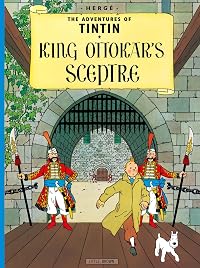
Tintin travels to the kingdom of Syldavia to stop a villainous gang from stealing the royal scepter and overthrowing the government.Tags
Recommendations


















Member Reviews
http://nwhyte.livejournal.com/2354109.html
I remembered this fondly from my childhood - it may even have been the first Tintin book I ever read - and very much hoped that it would live up to my memories. I'm glad to say that it did, and if anything it works even better for me now that I have spent several years in the meantime being closely involved with Balkan politics, and also because I now know Brussels rather better than I did when I was 9. (Apparently it was the first Tintin story to be translated into English, though that was some time before I was taking much interest in these matters.)
The story is pretty straightforward - Tintin gets recruited by a Balkan culture expert to travel to the mysterious land of Syldavia, where he show more crucially averts a plot to deprive the young king of his throne, engineered by an internal revolutionary movement which is a proxy for the neighbouring dictatorship of Borduria. There are lots of lovely Balkan/Slavic touches - although Syldavian spelling is closer to Polish than to the Balkans, the towns clearly have minarets and Cyrillic is used; the landscape and army/police uniforms are clearly drawn from the Balkan kingdoms between the wars. The small countries of south-eastern Europe are an easy target, but sometimes this can be done well.
But in fact the Balkans are mere protective coloration for what Hergé was really writing about. The unusually realistic depictions of the Warandepark and Avenue Louise in the early pages give it away. King Ottokar, running a small democracy in fear of annexation by its authoritarian neighbour through a front organisation, is not (as I have heard some speculate) Michael of Romania, but a slightly romanticised Leopold III of Belgium. The Bordurian plot to invade Syldavia could have been based on the Gleiwitz incident, were it not for the fact that it was published in Le Petit Vingtième in the summer of 1939, shortly before the Gleiwitz incident actually happened. Less than a year after Tintin En Syldavie had finished its original run, Belgium was occupied not by the sinister Bordurian activist Müsstler but by a bloke with a similar name.
And considering the general perception that Hergé was not exactly vigorous in resistance to Nazi occupation, it's a bit redemptive to see this story putting down a marker before it actually happened.
Also, given Tom McCarthy's speculation about Hergé's ancestry, it's amusing that he draws himself into two of the court scenes...
This was a good jumping-off point for my lifelong affection for Tintin, and I think I would still recommend it as a starting point today for people who for whatever reason have never yet tried it. The best of the pre-war albums is The Blue Lotus, but to really enjoy it you have to have read the inferior Cigars of the Pharaoh first. King Ottokar's Sceptre works well as a standalone adventure. (Even without Captain Haddock.) show less
I remembered this fondly from my childhood - it may even have been the first Tintin book I ever read - and very much hoped that it would live up to my memories. I'm glad to say that it did, and if anything it works even better for me now that I have spent several years in the meantime being closely involved with Balkan politics, and also because I now know Brussels rather better than I did when I was 9. (Apparently it was the first Tintin story to be translated into English, though that was some time before I was taking much interest in these matters.)
The story is pretty straightforward - Tintin gets recruited by a Balkan culture expert to travel to the mysterious land of Syldavia, where he show more crucially averts a plot to deprive the young king of his throne, engineered by an internal revolutionary movement which is a proxy for the neighbouring dictatorship of Borduria. There are lots of lovely Balkan/Slavic touches - although Syldavian spelling is closer to Polish than to the Balkans, the towns clearly have minarets and Cyrillic is used; the landscape and army/police uniforms are clearly drawn from the Balkan kingdoms between the wars. The small countries of south-eastern Europe are an easy target, but sometimes this can be done well.
But in fact the Balkans are mere protective coloration for what Hergé was really writing about. The unusually realistic depictions of the Warandepark and Avenue Louise in the early pages give it away. King Ottokar, running a small democracy in fear of annexation by its authoritarian neighbour through a front organisation, is not (as I have heard some speculate) Michael of Romania, but a slightly romanticised Leopold III of Belgium. The Bordurian plot to invade Syldavia could have been based on the Gleiwitz incident, were it not for the fact that it was published in Le Petit Vingtième in the summer of 1939, shortly before the Gleiwitz incident actually happened. Less than a year after Tintin En Syldavie had finished its original run, Belgium was occupied not by the sinister Bordurian activist Müsstler but by a bloke with a similar name.
And considering the general perception that Hergé was not exactly vigorous in resistance to Nazi occupation, it's a bit redemptive to see this story putting down a marker before it actually happened.
Also, given Tom McCarthy's speculation about Hergé's ancestry, it's amusing that he draws himself into two of the court scenes...
This was a good jumping-off point for my lifelong affection for Tintin, and I think I would still recommend it as a starting point today for people who for whatever reason have never yet tried it. The best of the pre-war albums is The Blue Lotus, but to really enjoy it you have to have read the inferior Cigars of the Pharaoh first. King Ottokar's Sceptre works well as a standalone adventure. (Even without Captain Haddock.) show less
My review, as posted in Tintin Books
I very much enjoyed rereading this album. Herge got the balance right here between real-world politics and the 'lighter' espionage and chase elements of the adventure. The chase sequences don't feel as gratuitous as they did in The Black Island, because they're tied in to the sceptre as the album's overarching plot device. And the realisation of Syldavia is marvelous: as a child, I'm sure I was mistaken into believing these were real countries. The crisply drawn avenues, the rich crowd scenes, the national traditions: all combine to create a truly worrying political situation, which of course was Herge's intention coming as it did in 1938. (The serial's final strip was published less than a month show more before Hitler invaded Poland)
I'm glad we'll meet Captain Haddock soon, but this album feels perfect as is - it's good to have Tintin and Snowy on the run, being both aided and abetted by those around them. This is probably for me the first 'pinnacle' of the series, as the first five were very much experiments with finding the formula, and numbers six and seven were very well-done but had their fair share of faults. show less
I very much enjoyed rereading this album. Herge got the balance right here between real-world politics and the 'lighter' espionage and chase elements of the adventure. The chase sequences don't feel as gratuitous as they did in The Black Island, because they're tied in to the sceptre as the album's overarching plot device. And the realisation of Syldavia is marvelous: as a child, I'm sure I was mistaken into believing these were real countries. The crisply drawn avenues, the rich crowd scenes, the national traditions: all combine to create a truly worrying political situation, which of course was Herge's intention coming as it did in 1938. (The serial's final strip was published less than a month show more before Hitler invaded Poland)
I'm glad we'll meet Captain Haddock soon, but this album feels perfect as is - it's good to have Tintin and Snowy on the run, being both aided and abetted by those around them. This is probably for me the first 'pinnacle' of the series, as the first five were very much experiments with finding the formula, and numbers six and seven were very well-done but had their fair share of faults. show less
King Ottokar's Sceptre is the last Tintin adventure originally written and published before World War II and Belgium becoming an occupied country. It is also the last Tintin adventure before the appearance of Tintin's friend Captain Haddock. In some sense, it is the last of the "pure" Tintin books and one of the most political and serious ones as well. Without Haddock and Calculus to provide goofy humor, the only comedic relief in an otherwise fairly tense sorry of royal intrigue is the bumbling duo of Thompson and Thomson, and they are clearly a sideshow in this volume. Because of this, King Ottokar's Sceptre is one of the most adventure oriented and one of the best stand alone volumes in the series.
The book begins blandly enough when show more Tintin finds an unattended briefcase sitting on a park bench. After checking inside to find the owners' identity, he heads off on a good Samaritan mission to return the valise to its proper owner. This leads him to Professor Hector Alembeck, an expert in the somewhat obscure field of Sigillography, the study of seals, a subject Alembeck finds endlessly fascinating, and which seems to interest Tintin as well. Of particular note, and setting the story into motion, is the seal of King Ottokar IV of Syldavia, a tiny country with an obscure sigillographic history. Alembeck tells Tintin of his intention to travel to Syldavia and study the seals of that country in the near future, but complains that he need a private secretary to assist him when he travels.
The story would have ended there, but the villains continue in the proud tradition of Tintin villains and wildly overreact to Tintin's presence and draw attention to themselves. First by acting suspiciously they lead Tintin to a Syldavian restaurant, leading him to follow even more suspicious activity, and then by trying to warn him off, arousing his interest even further. Eventually this leads Tintin to accepting the position as Alembeck's personal secretary and sends him off to Syldavia. Once again, had the villains simply laid low and hadn't engaged in heavy-handed and clumsy attempts to dissuade Tintin's investigations, their actual plans would have remained hidden and they would have accomplished their ultimate goal. Instead, by trying to warn Tintin off (and eventually kill him), all they did was put our hero on their trail. This leads to a number of cat and mouse situations - a man arranges to meet Tintin to pass information to him, but then shows up knocked out on Tintin's doorstep having lost his memory. A package is delivered to Tintin's house that turns out to be a bomb, leading to a car chase. And so on.
Tintin's suspicions are aroused even further when he is speaking with Alembeck on the phone and hears sounds of a struggle. Rushing to Alembeck's apartment, Tintin finds an undisturbed professor packing his clothes. In any event, Tintin and the putative Alembeck head off on their trip to Syldavia, and this is where Hergé really begins to flex his story telling muscles. To this point the story has been a fairly run-of-the-mill spy story. But now, Hergé shows off his now well-developed world-building abilities, creating an entire fictional Balkan nation with an interesting history and a plausible long-standing rivalry with its neighbor. And he does so in just three pages, including one beautifully drawn full page illustration representing a medieval miniature depicting the fictitious Battle of Zileheroum in which the Syldavians defeated the Turkish troops occupying their country. In these three pages Hergé establishes the background needed for his story and does it in a manner that avoids making the reader think he has just had nothing but the critical elements dumped on his head. There is enough "extra" exposition over and above that strictly necessary to the plot to give the impression that Syldavia is a real place, but not so much more that the book bogs down in a swamp of detailed world-building background.
Having established his setting, Hergé wastes no time getting back to the plot, as Tintin becomes more and more suspicious that the individual he is traveling with is not actually Professor Alembeck. Soon enough, the tables turn and Tintin and Snowy are dumped out of an airborne plane. The sequence that follows established Tintin as (a) incredibly lucky, and (b) incredibly durable, adding to his list of superpowers the ability to survive a fall from an aircraft by landing in a pile of hay. Oddly, despite trying to get Tintin out of the way, the villains waited until they were over Syldavia to dump him out of the plane, which positions Tintin to try to foil their plan. On the other hand, Tintin is hampered by two things that make his task more difficult. First, he has no real direct information about the villains' plans, having come up with a guess based on nothing more than the fact that they were trying to get rid of him and the contents of a travel brochure he read while traveling on a plane. One has to wonder if Tintin is able to tie these ephemeral threads together and deduce the nature of the conspiracy against the Syldavian monarchy why no one in Syldavia has been able to figure this out. Second, it seems like almost everyone Tintin comes across in Syldavia is in on the conspiracy. Local police chiefs, members of the King's personal guard, the official Court photographer, and random people on the street all seem to be conspirators bent on overthrowing the Syldavian monarchy and assisting in a foreign takeover of the country.
So, Tintin manages to overcome the vast pervasive conspiracy that seems to permeate all of Syldavia and make his way to the king (along the way, he meets Bianca Castafiore for the first time in the series, and she regales him with an impromptu performance as they travel together, leading Tintin to note that it is a good thing the car they are riding in has safety glass). Although his path to get to King Muskar XII is difficult, once he does get a chance to talk to him, Tintin has a fairly easy time convincing him that his most trusted adviser is conspiring against him. Because Tintin is the protagonist, he is quickly given access to the heavily guarded Kropow Castle where the royal regalia is located, although not until it is just too late to prevent the theft of the royal sceptre, which happens to be the indispensable symbol of Syldavian royal legitimacy. Oddly, Tintin never mentions his connection to Professor Alembeck (who had been given the run of Kropow Castle already), nor does he mention his suspicions about Alembeck being replaced by a double. It seems like, having served his purpose in getting Tintin started along the path to uncovering the conspiracy, the relationship between the two men is forgotten and each follows an entirely separate path for the rest of the book.
Once Tintin reveals the plot, he and King Muskar are confronted with a locked door mystery in which the sceptre has seemingly disappeared from a heavily guarded room while everyone inside was knocked unconscious. Thompson and Thomson arrive for a little bit of comic relief, but even though they remain clumsy and full of malapropisms, they are no longer stupidly incompetent. Although the bumbling detectives are not able to solve the mystery, they are on the right track until Tintin trumps them with a flash of insight. This leads to a chase after the sceptre that leads through the Syldavian mountains to the Bodurian border. As one would expect, Tintin prevails, and uncovers some rather shocking documents from the thief. Of course, what is rather shocking is that the man Tintin takes them from had the documents at all given that he seems to be little more than a flunky, making the fact that he has detailed plans outlining the entire conspiracy signed by its leader seem somewhat odd. Having recovered the sceptre and the remarkably incriminating documents, Tintin must make his way back to the Syldavian capital Klow, and we learn that in addition to his many other super powers, Tintin is able to pilot a military aircraft that he has presumably never seen before.
In the end, Tintin finds his way back to Klow, and so does the sceptre. Some people have argued that the plot of King Ottokar's Sceptre is a criticism of the Nazi Anschluss that annexed Austria to Germany, and it might be. But if it is, it is a fairly cautious and oblique criticism, as the conspiracy in this story seems to be aimed at imposing a mostly unwelcome invader upon Syldavia, although whether the Nazi's were welcomed into Austria is a debatable point. No matter whether this story was intended as an allegory or not, what it is is an exciting and well-written adventure with strong world-building and interesting characters. As an aside, I'll note that the edition I own is a post-World War II revised edition, and this is one of the books that went through the most substantial revisions, although not to the story, but rather to the artwork. In the original edition, although Syldavia was supposed to be located in the Balkans, many Syldavian characters wore outfits that would be much more British in style, including the guards at Kropow Castle who were dressed as Beefeaters. Following the war, Hergé went back and redrew many panels to give Syldavia the much more Slavic flavor that it has today, a change that definitely improved the book. This excellent artwork combined with the strong story makes this one of the best Tintin stand-alone books. If you have a reader unfamiliar with The Adventures of Tintin who is interested in giving the series a try, and they aren't a stickler for reading things in their "proper" order, this would be the book I would hand them first.
This review has also been posted to my blog Dreaming About Other Worlds. show less
The book begins blandly enough when show more Tintin finds an unattended briefcase sitting on a park bench. After checking inside to find the owners' identity, he heads off on a good Samaritan mission to return the valise to its proper owner. This leads him to Professor Hector Alembeck, an expert in the somewhat obscure field of Sigillography, the study of seals, a subject Alembeck finds endlessly fascinating, and which seems to interest Tintin as well. Of particular note, and setting the story into motion, is the seal of King Ottokar IV of Syldavia, a tiny country with an obscure sigillographic history. Alembeck tells Tintin of his intention to travel to Syldavia and study the seals of that country in the near future, but complains that he need a private secretary to assist him when he travels.
The story would have ended there, but the villains continue in the proud tradition of Tintin villains and wildly overreact to Tintin's presence and draw attention to themselves. First by acting suspiciously they lead Tintin to a Syldavian restaurant, leading him to follow even more suspicious activity, and then by trying to warn him off, arousing his interest even further. Eventually this leads Tintin to accepting the position as Alembeck's personal secretary and sends him off to Syldavia. Once again, had the villains simply laid low and hadn't engaged in heavy-handed and clumsy attempts to dissuade Tintin's investigations, their actual plans would have remained hidden and they would have accomplished their ultimate goal. Instead, by trying to warn Tintin off (and eventually kill him), all they did was put our hero on their trail. This leads to a number of cat and mouse situations - a man arranges to meet Tintin to pass information to him, but then shows up knocked out on Tintin's doorstep having lost his memory. A package is delivered to Tintin's house that turns out to be a bomb, leading to a car chase. And so on.
Tintin's suspicions are aroused even further when he is speaking with Alembeck on the phone and hears sounds of a struggle. Rushing to Alembeck's apartment, Tintin finds an undisturbed professor packing his clothes. In any event, Tintin and the putative Alembeck head off on their trip to Syldavia, and this is where Hergé really begins to flex his story telling muscles. To this point the story has been a fairly run-of-the-mill spy story. But now, Hergé shows off his now well-developed world-building abilities, creating an entire fictional Balkan nation with an interesting history and a plausible long-standing rivalry with its neighbor. And he does so in just three pages, including one beautifully drawn full page illustration representing a medieval miniature depicting the fictitious Battle of Zileheroum in which the Syldavians defeated the Turkish troops occupying their country. In these three pages Hergé establishes the background needed for his story and does it in a manner that avoids making the reader think he has just had nothing but the critical elements dumped on his head. There is enough "extra" exposition over and above that strictly necessary to the plot to give the impression that Syldavia is a real place, but not so much more that the book bogs down in a swamp of detailed world-building background.
Having established his setting, Hergé wastes no time getting back to the plot, as Tintin becomes more and more suspicious that the individual he is traveling with is not actually Professor Alembeck. Soon enough, the tables turn and Tintin and Snowy are dumped out of an airborne plane. The sequence that follows established Tintin as (a) incredibly lucky, and (b) incredibly durable, adding to his list of superpowers the ability to survive a fall from an aircraft by landing in a pile of hay. Oddly, despite trying to get Tintin out of the way, the villains waited until they were over Syldavia to dump him out of the plane, which positions Tintin to try to foil their plan. On the other hand, Tintin is hampered by two things that make his task more difficult. First, he has no real direct information about the villains' plans, having come up with a guess based on nothing more than the fact that they were trying to get rid of him and the contents of a travel brochure he read while traveling on a plane. One has to wonder if Tintin is able to tie these ephemeral threads together and deduce the nature of the conspiracy against the Syldavian monarchy why no one in Syldavia has been able to figure this out. Second, it seems like almost everyone Tintin comes across in Syldavia is in on the conspiracy. Local police chiefs, members of the King's personal guard, the official Court photographer, and random people on the street all seem to be conspirators bent on overthrowing the Syldavian monarchy and assisting in a foreign takeover of the country.
So, Tintin manages to overcome the vast pervasive conspiracy that seems to permeate all of Syldavia and make his way to the king (along the way, he meets Bianca Castafiore for the first time in the series, and she regales him with an impromptu performance as they travel together, leading Tintin to note that it is a good thing the car they are riding in has safety glass). Although his path to get to King Muskar XII is difficult, once he does get a chance to talk to him, Tintin has a fairly easy time convincing him that his most trusted adviser is conspiring against him. Because Tintin is the protagonist, he is quickly given access to the heavily guarded Kropow Castle where the royal regalia is located, although not until it is just too late to prevent the theft of the royal sceptre, which happens to be the indispensable symbol of Syldavian royal legitimacy. Oddly, Tintin never mentions his connection to Professor Alembeck (who had been given the run of Kropow Castle already), nor does he mention his suspicions about Alembeck being replaced by a double. It seems like, having served his purpose in getting Tintin started along the path to uncovering the conspiracy, the relationship between the two men is forgotten and each follows an entirely separate path for the rest of the book.
Once Tintin reveals the plot, he and King Muskar are confronted with a locked door mystery in which the sceptre has seemingly disappeared from a heavily guarded room while everyone inside was knocked unconscious. Thompson and Thomson arrive for a little bit of comic relief, but even though they remain clumsy and full of malapropisms, they are no longer stupidly incompetent. Although the bumbling detectives are not able to solve the mystery, they are on the right track until Tintin trumps them with a flash of insight. This leads to a chase after the sceptre that leads through the Syldavian mountains to the Bodurian border. As one would expect, Tintin prevails, and uncovers some rather shocking documents from the thief. Of course, what is rather shocking is that the man Tintin takes them from had the documents at all given that he seems to be little more than a flunky, making the fact that he has detailed plans outlining the entire conspiracy signed by its leader seem somewhat odd. Having recovered the sceptre and the remarkably incriminating documents, Tintin must make his way back to the Syldavian capital Klow, and we learn that in addition to his many other super powers, Tintin is able to pilot a military aircraft that he has presumably never seen before.
In the end, Tintin finds his way back to Klow, and so does the sceptre. Some people have argued that the plot of King Ottokar's Sceptre is a criticism of the Nazi Anschluss that annexed Austria to Germany, and it might be. But if it is, it is a fairly cautious and oblique criticism, as the conspiracy in this story seems to be aimed at imposing a mostly unwelcome invader upon Syldavia, although whether the Nazi's were welcomed into Austria is a debatable point. No matter whether this story was intended as an allegory or not, what it is is an exciting and well-written adventure with strong world-building and interesting characters. As an aside, I'll note that the edition I own is a post-World War II revised edition, and this is one of the books that went through the most substantial revisions, although not to the story, but rather to the artwork. In the original edition, although Syldavia was supposed to be located in the Balkans, many Syldavian characters wore outfits that would be much more British in style, including the guards at Kropow Castle who were dressed as Beefeaters. Following the war, Hergé went back and redrew many panels to give Syldavia the much more Slavic flavor that it has today, a change that definitely improved the book. This excellent artwork combined with the strong story makes this one of the best Tintin stand-alone books. If you have a reader unfamiliar with The Adventures of Tintin who is interested in giving the series a try, and they aren't a stickler for reading things in their "proper" order, this would be the book I would hand them first.
This review has also been posted to my blog Dreaming About Other Worlds. show less
A Ruritanian Romance in the style of The Prisoner of Zenda by Anthony Hope, this one sees Tintin and Snowy enmeshed in the political machinations of a small Balkan country which is riven by internal strife and coveted by a militaristic neighbouring country.
According to the Tintin website, Hergé partly based this story on the Nazi annexation of Austria,though it's not giving too much away to reveal that our young hero foils the plot! .
Hergé's well into his stride now and the adventures rattle along. The usual car and plane chases take Tintin across Europe at an incredible pace, but Hergé does remember to make his hero feel hunger pangs after being out in the mountains all night: nice touches of realism like this help to balance out show more the amazing, but necessary and expected, coincidences that crop up. And how come Thomson and Thompson are the only detectives anybody calls in to investigate anything, anywhere, despite their obvious ineptitude? Wacky Belgian humour!!
We get our first introduction to opera diva, Bianca Castafiore, and I'm looking forward to Captain Haddock's first appearance in the next story, The Crab with the Golden Claws. show less
According to the Tintin website, Hergé partly based this story on the Nazi annexation of Austria,
Hergé's well into his stride now and the adventures rattle along. The usual car and plane chases take Tintin across Europe at an incredible pace, but Hergé does remember to make his hero feel hunger pangs after being out in the mountains all night: nice touches of realism like this help to balance out show more the amazing, but necessary and expected, coincidences that crop up. And how come Thomson and Thompson are the only detectives anybody calls in to investigate anything, anywhere, despite their obvious ineptitude? Wacky Belgian humour!!
We get our first introduction to opera diva, Bianca Castafiore, and I'm looking forward to Captain Haddock's first appearance in the next story, The Crab with the Golden Claws. show less
Fun story. Major plot holes, of course - what gave Tintin the idea that this whole complicated plot had anything to do with the sceptre? And he got suspicious and too easily lulled again. Tintin's acrobatics and Thomson and Thompson's pratfalls are rather spectacular in this one. Just about everyone is in on the plot - who the heck did they find to make the arrests, since every police chief seems to be on the wrong side? Oh, and I think this is Tintin's first meeting with Bianca Castafiore - an amusing one, of course. Very standard Tintin - enjoyable in itself, don't try for logic.
Really, Milou alone should be more than enough reason to read this book. And if you're not already inclined to read it, I'm not going to convince you. I'm just going to talk about the few issues I have with it, and with Tintin in general.
The most noticeable issue with most of Hergé's earlier work is the extreme racism and close-mindedness, which is obviously strongly linked to the time during which his works was written. Taking historical context into account, the caricatures and stereotypes are more understandable. The other little issue I have with this book is the same issue I have with most bande-dessinée, comic, or graphic novel books; I have a hard time not reading ahead. Sometimes the text is cumbersome and seems to hinder the show more flow of the book.
Aside from those issues, this book was quite enjoyable.
And, you know. Milou. show less
The most noticeable issue with most of Hergé's earlier work is the extreme racism and close-mindedness, which is obviously strongly linked to the time during which his works was written. Taking historical context into account, the caricatures and stereotypes are more understandable. The other little issue I have with this book is the same issue I have with most bande-dessinée, comic, or graphic novel books; I have a hard time not reading ahead. Sometimes the text is cumbersome and seems to hinder the show more flow of the book.
Aside from those issues, this book was quite enjoyable.
And, you know. Milou. show less
This is an enjoyable installment in the Tintin series, set in the fictional kingdom of Syldavia and featuring a number of Tintin's friends. It's a good adventure story, with lots of political intrigue and some exciting escapes.
Members
- Recently Added By
Lists

Recommended Comics / Graphic Novels
595 works; 122 members

Favorite Childhood Books
1,651 works; 519 members

Fictional European countries
58 works; 2 members

ClubLeabhar: Leabhar na Míosa
121 works; 1 member
Author Information

'Hergé' was born Georges Remi on 22 May, 1907 in Etterbeek, a suburb of Brussels, in Belgium. After leaving school, he worked for the daily newspaper, Le XXe Siècle (The 20th Century). He was responsibe the for the section of the newspaper designed for children. Tintin, the main character in his works, was introduced on January 10, 1929 in a show more story entitled 'Tintin in the Land of the Soviets.' Each story ran as a comic strip in the newspaper and then was published as a book. Some of these books were adapted for the small screen including The Crab With The Golden Claws, Star of Mystery, Red Rakham's Treasure, Black Island, Objective Moon and The Calculus Affair. French TV produced longer versions of twenty of the books in 1992, which have been broadcast in over fifty countries. On 3 March, 1983, he died in Brussels. At the time of his death, he was working on Tintin and the Alpha-Art, which was published in an unfinished form. (Bowker Author Biography) show less
Some Editions
Awards and Honors
Notable Lists
Series

Work Relationships
Is contained in
Is a retelling of
Has the adaptation
Common Knowledge
- Canonical title
- King Ottokar's Sceptre
- Original title
- Le Sceptre d'Ottokar
- Alternate titles*
- Tintin : Le sceptre d'Ottokar
- Original publication date
- 1939 (book) (book); 1938-08-04 to 1939-08-10 (serial) (serial)
- People/Characters
- Muskar XII; Colonel Boris; Tintin; Milou; Snowy; Hector Alembick (show all 15); Mrs Piggott; The Thompson Twins; Schzlozitch; Trovik; Wizskitortz; Bianca Castafiore; Lieutenant Kromir; Herr Czarlitz; Mustler
- Important places
- Klow, Syldavia; Borduria; Prague, Czech Republic; Zlip; Kropow Castle
- First words
- Let's sit down on this bench for a minute.
- Last words
- (Click to show. Warning: May contain spoilers.)Ha Ha!
ha Ha!
ha Ha! - Original language
- French
- Disambiguation notice
- This is the 1947 redrawn and colourised version of King Ottokar's Sceptre (Le Sceptre d'Ottokar). Please, do not combine it with the 1939 original black and white version.
*Some information comes from Common Knowledge in other languages. Click "Edit" for more information.
Classifications
- Genre
- Graphic Novels & Comics
- DDC/MDS
- 741.59493 — Arts & recreation Drawing & decorative arts Drawing Comic books, graphic novels, fotonovelas, cartoons, caricatures, comic strips History, geographic treatment, biography European Other European Belgium & Luxembourg
- LCC
- PN6790 .B44 .T56613 — Language and Literature Literature (General) Literature (General) Collections of general literature Comic books, strips, etc.
- BISAC
Statistics
- Members
- 2,060
- Popularity
- 10,160
- Reviews
- 17
- Rating
- (4.08)
- Languages
- 30 — Afrikaans, Arabic, Bengali, Catalan, Chinese, Czech, Danish, Dutch, English, Finnish, French, German, Greek, Hindi, Hungarian, Italian, Japanese, Korean, Norwegian (Bokmål), Norwegian, Portuguese, Romanian, Serbian, Scots, Croatian, Slovak, Spanish, Swedish, Turkish, Welsh
- Media
- Paper, Ebook
- ISBNs
- 90
- ASINs
- 19