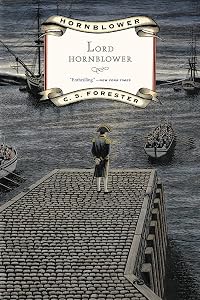
Lord Hornblower
by C. S. Forester
Horatio Hornblower (10), Horatio Hornblower: Chronological Order (10)
On This Page
Description
As his naval battles with Napoleon conclude, Horatio Hornblower must rescue a man he knows to be a tyrant from the mutiny of his crew.Tags
Recommendations













Member Reviews
While a book in a longer series, I read this without much prior knowledge of the character and enjoyed it fine even so. We here follow naval hero Horatio Hornblower's outer and inner struggles in the final years of the Napoleonic wars. The novel begins very strongly, in my opinion, with Hornblower sent to deal with a mutinous crew with whom he secretly sympathizes. The pages flew by here, dove-tailing into a rather different tale as the resulting mission creep ends up being quite extreme. However, by the time a new status quo is set, the book starts dragging its feet, more and more so, and the middle third of the novel gradually loses all the steam of the first third. There is a rallying sequence of exciting action towards the very end, show more albeit comparatively brief, but this still ended up weakening my impression of the novel as a whole by rather a lot.
Forester's ability to show the positives and negatives of Hornblower's (for a literary war hero perhaps slightly unusual) constant introspection, prickly pride and chiding self-deprecation, strikes me as very impressive. It never slows down the narrative -- even during the slow bits mentioned above, this is if anything one of the redeeming qualities -- and only very rarely gets heavy-handed with spelling out for the reader how his thoughts and reality don't necessarily match up like he thinks they do.
All in all, despite the weaker second half of the book, I enjoyed this novel, and if I stumble over another Hornblower story in a bargain bin somewhere, I might well pick it up. show less
Forester's ability to show the positives and negatives of Hornblower's (for a literary war hero perhaps slightly unusual) constant introspection, prickly pride and chiding self-deprecation, strikes me as very impressive. It never slows down the narrative -- even during the slow bits mentioned above, this is if anything one of the redeeming qualities -- and only very rarely gets heavy-handed with spelling out for the reader how his thoughts and reality don't necessarily match up like he thinks they do.
All in all, despite the weaker second half of the book, I enjoyed this novel, and if I stumble over another Hornblower story in a bargain bin somewhere, I might well pick it up. show less
The tenth in C.S. Forester's wonderful series of novels about a British naval officer during the Napoleonic Wars, this entry illustrates Forester's growth as a writer of adventurous fiction depicting a deeply human protagonist. Forester has a way with his hero, a way of conveying Hornblower's own unheroic thoughts so as to amplify the man's true heroism. Horatio Hornblower is ten times the man he thinks himself to be, and that is much of the series' charm. But Forester has a way, also, with nautical language, language he rarely if ever explains, but which rolls off his pen so eloquently that it defines itself through osmosis. After a few of these books, one *feels* like a sailor. And finally, the adventures themselves are deeply show more involving, none more so than this one chronicling the end of the wars Hornblower has fought since he was youth. This is a magnificently entertaining series of novels. show less
It was the best of books, it was the worst of books... Okay, that's a bit of hyperbole. Lord Hornblower, the penultimate novel of the Hornblower series, is a very good adventure. Once again Horatio Hornblower finds obstacles in his mission--this time his task is to recover a ship captured by mutineers. Once again he wrestles with self doubt. And once again he proves himself to be the resourceful, creative, and heroic commander that everyone else in the story knows him to be. But then Mr. Forester has to peg on another adventure, where Hornblower is less than exemplary and which ends... well, let's just say I was completely underwhelmed. I think I liked the ending of the unfinished novel better. In Mr. Forester's defense, he did need to show more follow history in this historical novel. Letting Hornblower enjoy a "happily ever after" at the end of the first adventure really wasn't an option. Anyway, don't let my grumblings dissuade you from checking it out. It really is a book worth reading. show less
I kind of think that Forester noted about Commodore Hornblower the same thing that I did in my review: that it all seemed too easy. Lord Hornblower starts with a big challenge for Horatio, to bring back a group of mutineers without compromising discipline or just slaughtering them all. It's a sticky problem; Hornblower thinks they have a point, but can't give them clemency. But if he fights them, they'll just flee into the arms of the French. What's a captain to do? As always, it's enjoyable to see Hornblower's mind work over the problem and come up with one of his typically clever solutions.
After that (about the first third or so), though, the book flounders, as Hornblower convinces a French town to come over to the side of the French show more Royalists. Like Commodore, it doesn't feel like it matters. How will the war or Hornblower suffer if this plan fails? And land-bound politics just aren't what one reads a Hornblower novel for. Bush is killed. It's a typically understated moment, but I understand it; it doesn't seem right that all these military men could live through a war, and so someone's gotta die, even if it's just before the close. Feels unfair that a born sailor should die on land, though.
The final third picks up, chronicling what Hornblower gets up to when Napoleon escapes while he's vacationing in France, and thus suddenly becomes a wanted man. It's harsh and bleak and well-written but I just don't think it's where I would go with this series. Again, it just doesn't feel like what one reads Hornblower for. A well-executed version of an ill-conceived plan, I guess. The climax to the whole thing is pretty great, though.
Anyway, the next Hornblower book is our first jump backward, and I can see why; the two post-trilogy books have largely lost what made the first book work so well, and maybe by going back to the roots of the character, Forester can also get back to the roots of the series's appeal. show less
After that (about the first third or so), though, the book flounders, as Hornblower convinces a French town to come over to the side of the French show more Royalists. Like Commodore, it doesn't feel like it matters. How will the war or Hornblower suffer if this plan fails? And land-bound politics just aren't what one reads a Hornblower novel for. Bush is killed. It's a typically understated moment, but I understand it; it doesn't seem right that all these military men could live through a war, and so someone's gotta die, even if it's just before the close. Feels unfair that a born sailor should die on land, though.
The final third picks up, chronicling what Hornblower gets up to when Napoleon escapes while he's vacationing in France, and thus suddenly becomes a wanted man. It's harsh and bleak and well-written but I just don't think it's where I would go with this series. Again, it just doesn't feel like what one reads Hornblower for. A well-executed version of an ill-conceived plan, I guess. The climax to the whole thing is pretty great, though.
Anyway, the next Hornblower book is our first jump backward, and I can see why; the two post-trilogy books have largely lost what made the first book work so well, and maybe by going back to the roots of the character, Forester can also get back to the roots of the series's appeal. show less
Hornblower was the inspiration for Star Trek's Captain James Kirk, as well as Cornwell's Sharpe. Hornblower is more cerebral and socially awkward than Kirk, more educated and refined than Sharpe. In his own right, Hornblower is certainly an engaging and complex character and the series is an interesting study in leadership, and a fascinating portrait of life at sea in the age of sail.
I do think the series lost something after Hornblower gained so much in rank and position. I think the best books run from Hornblower and the Hotspur to Flying Colours when he captained ships of his own. But I do think one of the strengths of the series is we see Hornblower at all stages of his naval career--from raw teenage midshipman to admiral. And it's show more not as if this book doesn't have its share of daring do and loss. Hornblower has his faults, his moments of self doubts, and his dealings with women... well. But especially in the course of reading several books he begins to feel real in a way few fictional characters do. I'd say he's easily as indelible and remarkable a literary creation as Sherlock Holmes. And if this isn't in my opinion as good as those books with him as captain, it's stronger than others in the series, and certainly very readable. show less
I do think the series lost something after Hornblower gained so much in rank and position. I think the best books run from Hornblower and the Hotspur to Flying Colours when he captained ships of his own. But I do think one of the strengths of the series is we see Hornblower at all stages of his naval career--from raw teenage midshipman to admiral. And it's show more not as if this book doesn't have its share of daring do and loss. Hornblower has his faults, his moments of self doubts, and his dealings with women... well. But especially in the course of reading several books he begins to feel real in a way few fictional characters do. I'd say he's easily as indelible and remarkable a literary creation as Sherlock Holmes. And if this isn't in my opinion as good as those books with him as captain, it's stronger than others in the series, and certainly very readable. show less
Hornblower is a complex character that comes close to portraying the actual life of a real person. He has these wonderful analytical abilities, but is plagued with self doubt and a desire for love that steers him into troubling spots in his personal relationships.
I am struggling on whether to give 3.5 or 4 stars. I would definitely give four if there had been more action. The real disappointment was Bush. Here is a character that has been a great foil for Hornblower throughout most of his career, and he barely appears in the book before being dismissed. Bummer.
I am struggling on whether to give 3.5 or 4 stars. I would definitely give four if there had been more action. The real disappointment was Bush. Here is a character that has been a great foil for Hornblower throughout most of his career, and he barely appears in the book before being dismissed. Bummer.
Hornblower is sent out to sea to deal with a band of mutineers against one of his old acquaintances. With his typical daring, Hornblower turns the tables on the mutineers and the French simultaneously; he brings about the turning of Le Havre to the Bourbon cause and becomes governor of the city and must protect it from the wrath of Napoleon. Later, caught in France during the Hundred Days, Hornblower leads a guerilla band in a last desperate attempt to defeat Bonaparte.
This was undoubtedly my least favorite of the Hornblower novels. Only the very beginning of the story takes place on the sea - where Hornblower invariably shines. Most of it is consumed with the politicking necessary to deal with dignitaries and his own wife and her kin. show more Unfortunately a great deal of Hornblower's time is taken up with being mad at his wife because she enjoys different things than he does, because he spoils her evenings through tactlessness, generally because he has to be courteous and think of someone other than himself and he resents it. And as usual, this makes him turn to yet another woman. I hate Hornblower's dealings with women - one of the reasons I like it best when he is at sea and far away from them.
I don't want to paint too bleak a picture of this novel. It still had high points (especially the beginning). But Hornblower is either feeling guilty or in mourning for most of the novel and there is not much action to take his mind off of these things. show less
This was undoubtedly my least favorite of the Hornblower novels. Only the very beginning of the story takes place on the sea - where Hornblower invariably shines. Most of it is consumed with the politicking necessary to deal with dignitaries and his own wife and her kin. show more Unfortunately a great deal of Hornblower's time is taken up with being mad at his wife because she enjoys different things than he does, because he spoils her evenings through tactlessness, generally because he has to be courteous and think of someone other than himself and he resents it. And as usual, this makes him turn to yet another woman. I hate Hornblower's dealings with women - one of the reasons I like it best when he is at sea and far away from them.
I don't want to paint too bleak a picture of this novel. It still had high points (especially the beginning). But Hornblower is either feeling guilty or in mourning for most of the novel and there is not much action to take his mind off of these things. show less
Members
- Recently Added By
Lists

Best Historical Fiction
620 works; 261 members

Books Read in 2014
2,344 works; 89 members

Huxley's Reading Log 2020
24 works; 1 member
Author Information

182+ Works 34,749 Members
Born Cecil Louis Troughton Smith on August 27, 1899, in Cairo, Egypt, where his father was a government official, C. S. Forester grew up mainly in England. He was educated at Dulwich College, studying medicine briefly before decidint to become a writer. Forester moved to the United States before the start of World War II, and lived in Berkeley, show more California, until his death in 1966. Although Forester was a journalist, a novelist and a Hollywood scriptwriter, he is probably best known for his historical fiction, particularly the series of novels that feature Horatio Hornblower. The eleven-book series begins with Mr. Midshipmen Hornblower, in which the seventeen-year old Hornblower joins the British navy in 1793, just as the Napoleonic Wars are about to begin. Hornblower's continuing adventures, as well as his advancement to the highest ranks of the navy, are chronicled in further books, including Beat to Quarters, Flying Colours, Commodore Hornblower, Lord Hornblower, The Happy Return, and A Ship of the Line, for which Forester recived the James Tait Black Memorial Prize in 1939. Several of Forester's novels were made into films, most notably Payment Deferred (his first novel published in 1926), Eagle Squadron, The Commandos (the movie title was The Commandos Strike at Dawn), Captain Horatio Hornblower, Sink the Bismarck!, and The African Queen, starring Katharine Hepburn and Humphrey Bogart. Forester's nonfiction includes The Age of Fighting Sail: The Story of the Naval War of 1812, as well as biographies of Lord Nelson, Napoleon, Josephine, and King Louis XIV. He also wrote an autobiography, Long Before Forty. (Bowker Author Biography) show less
Some Editions
Awards and Honors
Distinctions
Notable Lists
Series


Belongs to Publisher Series
Work Relationships
Common Knowledge
- Canonical title
- Lord Hornblower
- Original title
- Lord Hornblower
- Original publication date
- 1946
- People/Characters
- Horatio Hornblower (Commodore); Barbara Wellesley (Barbara Hornblower); John Jervis, Earl of St Vincent; Freeman; Brown; Richard Hornblower (show all 11); Nathaniel Sweet; Hercule Lebrun; William Bush (Captain); Lucien Antoine de Ladon, Comte de Graçay; Marie de Ladon, Vicomtesse de Graçay
- Important places
- Normandy, France; English Channel; Westminster Abbey, London, England, UK; London, England, UK; Le Havre, Normandy, France; Caudebec, Normandy, France (show all 8); Rouen, Seine-Maritime, Normandy, France; Paris, France
- Important events
- Napoleonic Wars; Bourbon Restoration; Napoleon's One Hundred Days
- Epigraph
- [None]
- Dedication
- [None]
- First words
- The chapel stall of carved oak on which Sir Horatio Hornblower was sitting was most uncomfortable, and the sermon which the Dean of Westminster was preaching was deadly dull.
- Last words
- (Click to show. Warning: May contain spoilers.)And Barbara.
- Blurbers
- Churchill, Winston
- Original language
- English
Classifications
Statistics
- Members
- 2,161
- Popularity
- 9,470
- Reviews
- 22
- Rating
- (3.90)
- Languages
- 11 — Danish, Dutch, English, Finnish, French, German, Norwegian (Bokmål), Portuguese, Russian, Spanish, Swedish
- Media
- Paper, Audiobook, Ebook
- ISBNs
- 53
- ASINs
- 60