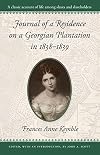
Journal of a Residence on a Georgian Plantation in 1838-1839
by Fanny Kemble, John Anthony Scott (Editor)
On This Page
Description
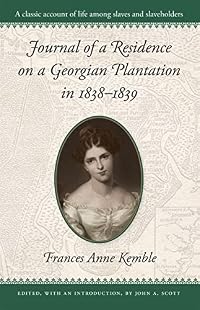
A few years after her marriage to a wealthy American, the English stage-actress Frances Anne Kemble (1809-1893) moved with her husband to his residence in Georgia, where he had inherited two plantations. There she kept a journal of her shocking observations of the practice of slavery. Written over a period of less than four months, Kemble's journal records her day-to-day encounters with her husband's slaves, and attempts to expose the moral injustice of slavery. The journal circulated show more privately among her friends, but was not published until 1863, long after Kemble's divorce in 1849. Her book is credited with influencing Britain's position of neutrality during the American Civil War despite the cotton industry's lobbying in favour of the South. Kemble's journal remains a lasting and important critique of slavery, and a valuable document about the nineteenth-century American south. show lessTags
Recommendations








Member Reviews
http://nhw.livejournal.com/588685.html
Published in 1863, this is a series of letters from Kemble to her friend E[lizabeth Sedgwick] describing her four months as the wife of a Georgian plantation owner, and going into considerable detail about the living conditions of the slaves. It is horrific stuff, an eloquent argument against slavery, published twenty-five years after the event in a deliberate attempt to undermine British sympathy for the Confederacy in the middle of the Civil War. I haven't read any of the editorials in the Times that she is reacting to, but I do remember the right-wing British press on apartheid, Northern Ireland, and (more dimly) Rhodesia. Sadly, I have little difficulty in imagining pompous British journalists show more of the day trying to reassure their readers that slavery was actually a very good deal for the slaves. (It is also a shameful fact, remembered by few, that Irish nationalists of the 1860s sympathised with the Confederacy too, as they sympathised with the Boers at the end of the century.)
Bearing in mind that the author was an actress, I was alert for clues that the letters might have been somewhat revised for publication to put her case in the best possible light. But I ended up doubting that this was the case - there are enough internal repetitions that a good editor would have taken out to ensure a better flow of the narrative. I am sure that she did delete certain more personal details about her husband and daughters, but I feel that otherwise this is pretty much the horrified account of a thirty-year-old woman trying (and ultimately failing) to come to terms with the society she had married into, rather then her fifty-five-year-old self retrospectively justifying it; a famous and glamorous English actress, who had married a rich and charming young American and only gradually come to a realisation of exactly how his family's fortunes were sustained.
Thank heavens there were people like her prepared to bear witness to what slavery actually meant. show less
Published in 1863, this is a series of letters from Kemble to her friend E[lizabeth Sedgwick] describing her four months as the wife of a Georgian plantation owner, and going into considerable detail about the living conditions of the slaves. It is horrific stuff, an eloquent argument against slavery, published twenty-five years after the event in a deliberate attempt to undermine British sympathy for the Confederacy in the middle of the Civil War. I haven't read any of the editorials in the Times that she is reacting to, but I do remember the right-wing British press on apartheid, Northern Ireland, and (more dimly) Rhodesia. Sadly, I have little difficulty in imagining pompous British journalists show more of the day trying to reassure their readers that slavery was actually a very good deal for the slaves. (It is also a shameful fact, remembered by few, that Irish nationalists of the 1860s sympathised with the Confederacy too, as they sympathised with the Boers at the end of the century.)
Bearing in mind that the author was an actress, I was alert for clues that the letters might have been somewhat revised for publication to put her case in the best possible light. But I ended up doubting that this was the case - there are enough internal repetitions that a good editor would have taken out to ensure a better flow of the narrative. I am sure that she did delete certain more personal details about her husband and daughters, but I feel that otherwise this is pretty much the horrified account of a thirty-year-old woman trying (and ultimately failing) to come to terms with the society she had married into, rather then her fifty-five-year-old self retrospectively justifying it; a famous and glamorous English actress, who had married a rich and charming young American and only gradually come to a realisation of exactly how his family's fortunes were sustained.
Thank heavens there were people like her prepared to bear witness to what slavery actually meant. show less
Important reading.
How on earth could the slave owners and overseers not realize that in listening to the complaints of the slaves, this woman was actually doing the owners themselves a favor -rather than increasing discontent, listening gave an outlet to those slaves who confided in her, thus actually decreasing their discontent by making them feel heard, and actually adding years to the lives of the masters and overseers. Had the slaves not felt listened to, they might have slit the throats of all the white men on the plantation, despite (or because of) the repressive conditions. How on earth could they not realize that their very deafness and blindness to their cruelty increased the risk of revolt? Discontent penned up boils over, show more as the Great Depression showed (which was why we got Social Security, Medica* and Welfare -that, and the fact that FDR did not want the Japanese using segregation and Bread Lines as bad P.R. against US...).
Courage, and hope against hope.
In Service to Community,
MEOW Date: 27 August 12,014 H.E. (Holocene/Human Era) show less
How on earth could the slave owners and overseers not realize that in listening to the complaints of the slaves, this woman was actually doing the owners themselves a favor -rather than increasing discontent, listening gave an outlet to those slaves who confided in her, thus actually decreasing their discontent by making them feel heard, and actually adding years to the lives of the masters and overseers. Had the slaves not felt listened to, they might have slit the throats of all the white men on the plantation, despite (or because of) the repressive conditions. How on earth could they not realize that their very deafness and blindness to their cruelty increased the risk of revolt? Discontent penned up boils over, show more as the Great Depression showed (which was why we got Social Security, Medica* and Welfare -that, and the fact that FDR did not want the Japanese using segregation and Bread Lines as bad P.R. against US...).
Courage, and hope against hope.
In Service to Community,
MEOW Date: 27 August 12,014 H.E. (Holocene/Human Era) show less
Ratings
Members
- Recently Added By
Lists

Book Titles Mentioned In Newberry Medal And Honor Books
884 works; 3 members
Author Information

28+ Works 402 Members
Series
Belongs to Publisher Series
Work Relationships
Has the (non-series) sequel
Is replied to in
Has as a commentary on the text
Common Knowledge
- Canonical title
- Journal of a Residence on a Georgian Plantation in 1838-1839
- Original publication date
- 1863
- People/Characters
- Fanny Kemble
- Important places
- Georgia, USA
- Dedication
- (Editor's)
For Elizabeth and Wendy
(Diarist's)
To Elizabeth Dwight Sedgwick,
This Journal,
Originally Kept for Her,
is
Most Affectionately
Dedicated. - First words
- (Editor's Intro)
Frances Anne Kemble recorded her stay in the Georgia Sea Islands twenty-two years before the outbreak of the Civil War; her book was the product of the fierce debate over slavery that exercised the min... (show all)ds of men and women on both sides of the Atlantic in the years following the end of the American Revolution. - Last words
- (Click to show. Warning: May contain spoilers.)Mr. K[ing[ was an extremely wise man.
Classifications
- Genres
- Nonfiction, History, General Nonfiction, Biography & Memoir
- DDC/MDS
- 975.8 — History & geography History of North America Southeastern United States (South Atlantic states) Georgia
- LCC
- E445 .G3 .K46 — History of the United States United States Revolution to the Civil War, 1775/1783-1861 Slavery in the United States. Antislavery
- BISAC
Statistics
- Members
- 276
- Popularity
- 116,288
- Reviews
- 2
- Rating
- (3.68)
- Languages
- English
- Media
- Paper, Audiobook, Ebook
- ISBNs
- 35
- ASINs
- 14