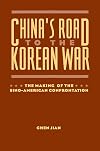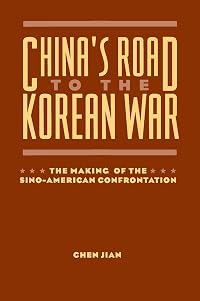
China's Road to the Korean War
by Jian Chen
On This Page
Description
Through the use of recently released Chinese documents, conversations with People's Republic of China scholars, and in-depth interviews with people who were present at key decision-making meetings, this book aims to discover China and the USSR's roles in the outbreak of the Korean conflict.Tags
Recommendations















Member Reviews
This is an excellent book, written from largely Chinese primary sources. The terms "seminal" and "groundbreaking" are used ad nauseum these days, but it is really true for this book. Chen argues that Mao bullied the PRC into the Korean War as a way to advance his revolutionary agenda both at home and abroad. Most high level Chinese Communists opposed supporting Kim Il Song, but Mao's authority forced it forward. Korea was an opportunity to advance the Communist cause because the United States was more concerned about Europe and would not intervene to save the South Koreans. Once it was clear that this assumption was mistaken, he saw an opportunity to further his domestic agenda. A direct conflict with the United States would allow Mao show more to mobilize the Chines masses and overcome opposition to his policies domestically. In this respect, the war was a success for him. Militarily and diplomatically, it was a disaster.
As with any ground-breaking work, some parts of Chen's analysis may come under challenge, particularly if more Chinese and Soviet documents become available. Even so, the support he provides for his overall thesis is impressive and very convincing. Anyone interested in the Chinese side of the Korean War must read this book. show less
As with any ground-breaking work, some parts of Chen's analysis may come under challenge, particularly if more Chinese and Soviet documents become available. Even so, the support he provides for his overall thesis is impressive and very convincing. Anyone interested in the Chinese side of the Korean War must read this book. show less
This is a scholarly history and can be read and enjoyed by a much broader public. Although published in 1994 this is still considered the go to source for subject and period. One learns that after China's government decides to militarily enter the conflict it was held back by North Koreas' leader, Kim Il-sung who did not want them there. Also, that China anticipated the American/United Nations landing at Inchon and tried to warn Kim who ignored them. This is a primary as well as revisionist history that succeeds in its purpose. No longer does one accept that the Korean War was begun because Russia was the initiator.
Quotes: (pages 112-113) “In short, Kim came to Beijing largely because Stalin wanted him to get Beijing's support for his show more attack on the South. Although Mao seemed to have some reservations, he never seriously challenged Kim's plans. When Kim left China he thus had every reason to inform Stalin and his comrades in Pyongyang (and we have every reason that he did) that he had the support of his Chinese comrades. In fact, after his visit to Moscow and Beijing Kim accelerated preparations to attack the South. With the help of Soviet militarily advisors, the North Korean military worked out the optional plans for the attack in late May and early June. Thus Kim's visit to Beijing represented another crucial step toward the coming of the Korean War, and Beijing's policy escalated further the potential confrontation between China and the United States in East China.”
(page 126) “Washington's decision to intervene in Korea and Taiwan challenged in the first place a crucial perception that CCP leaders had held since 1946-1947: that East Asia represented 'the weak point of international front of imperialism.' The CCP leadership, influenced by their own experience during the Chinese civil war, believed correctly that American strategy emphasis at the time lay in Europe. They also perceived, less correctly, that American military strength in the Asia-Pacific area was inadequate, making major American intervention in the internal conflicts or revolutionary changes in an Asian country unlikely.”
(page 214) “Mao and his fellow CCP leaders grew up in an age when China had lost its status as the 'Central Kingdom' and the very survival of the Chinese nation was at stake. Their conception of China's national interests was deeply influenced by the unequal exchanges between China and the foreign powers, and their commitment to Communist revolution in China grew out of the belief that the revolution would revitalize the Chinese nation and lead to the destruction of the 'old world,' and that China's position as a 'Central Kingdom' would be resumed in the emergence of the 'new word.; Mao's concept of revolution reflected his generation's emotional commitment to China's national liberation as well as its longing for China to take a central position in world politics. Not surprisingly, with the Communist seizure of power in China the CCP's revolutionary nationalism became a persistent driving force in changing China's weak power status and pursuing a prominent position in the world.” show less
Quotes: (pages 112-113) “In short, Kim came to Beijing largely because Stalin wanted him to get Beijing's support for his show more attack on the South. Although Mao seemed to have some reservations, he never seriously challenged Kim's plans. When Kim left China he thus had every reason to inform Stalin and his comrades in Pyongyang (and we have every reason that he did) that he had the support of his Chinese comrades. In fact, after his visit to Moscow and Beijing Kim accelerated preparations to attack the South. With the help of Soviet militarily advisors, the North Korean military worked out the optional plans for the attack in late May and early June. Thus Kim's visit to Beijing represented another crucial step toward the coming of the Korean War, and Beijing's policy escalated further the potential confrontation between China and the United States in East China.”
(page 126) “Washington's decision to intervene in Korea and Taiwan challenged in the first place a crucial perception that CCP leaders had held since 1946-1947: that East Asia represented 'the weak point of international front of imperialism.' The CCP leadership, influenced by their own experience during the Chinese civil war, believed correctly that American strategy emphasis at the time lay in Europe. They also perceived, less correctly, that American military strength in the Asia-Pacific area was inadequate, making major American intervention in the internal conflicts or revolutionary changes in an Asian country unlikely.”
(page 214) “Mao and his fellow CCP leaders grew up in an age when China had lost its status as the 'Central Kingdom' and the very survival of the Chinese nation was at stake. Their conception of China's national interests was deeply influenced by the unequal exchanges between China and the foreign powers, and their commitment to Communist revolution in China grew out of the belief that the revolution would revitalize the Chinese nation and lead to the destruction of the 'old world,' and that China's position as a 'Central Kingdom' would be resumed in the emergence of the 'new word.; Mao's concept of revolution reflected his generation's emotional commitment to China's national liberation as well as its longing for China to take a central position in world politics. Not surprisingly, with the Communist seizure of power in China the CCP's revolutionary nationalism became a persistent driving force in changing China's weak power status and pursuing a prominent position in the world.” show less
Ratings
Members
- Recently Added By
Lists

"the china pill"
96 works; 2 members

Books in the Bibliography of The Cold War by John Lewis Gaddis
192 works; 1 member
Author Information

29 Works 260 Members
Common Knowledge
- Important places
- China
- Important events
- Korean War (1950 | 1953)
Classifications
- Genres
- History, Nonfiction, General Nonfiction, Politics and Government
- DDC/MDS
- 951.904 — History & geography History of Asia East Asia: China, Taiwan, Hong Kong, Korea Korean Peninsula
- LCC
- DS919.5 .C4513 — History of Europe, Asia, Africa and Oceania Asia History of Asia Korea History War and intervention, 1950-1953
- BISAC
Statistics
- Members
- 50
- Popularity
- 604,137
- Reviews
- 2
- Rating
- (4.30)
- Languages
- English
- Media
- Paper, Ebook
- ISBNs
- 3
- ASINs
- 1