Listen to the Wind: The Story of Dr. Greg & Three Cups of Tea
by Greg Mortenson, Susan L. Roth
On This Page
Description
Tells the true story of a man who became lost and delirious after an unsuccessful trek to the top of K2, was saved by the locals of a remote Himalayan village, and kept his vow to return one day to build them a new school as a gesture of sincere appreciation and gratitude for what they did for him in his time of need.Tags
Recommendations



Member Reviews
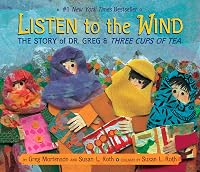
My book club will be reading Mortenson's Three Cups of Tea later this year, so this children's version of the story caught my eye. Even if the title hadn't (and the subtitle as it came up when I added this book was wrong, so I corrected it), the cover artwork would have.
Susan Roth has created stunning, colorful, three-dimensional, highly textural collages for this book's illustrations. The head scarves (made of fabric or textured papers) of the Pakistani girls and women look as though they are actually wrapped around the heads. Paper fingers are bent and look as though they are actually holding objects. Roth includes an informative artist's note at the end of the book, explaining her inspiration and how she created the collages and base show more papers.
The story, of Greg Mortensen's follow-though on a promise to build a school in a remote village after the people there helped him recover after a failed mountain climb in the area, is inspiring. A scrapbook with actual photographs of the villagers and the school at the end of the book shows children the story is true.
The artwork will encourage children to create their own collages, and the story will prompt them to consider ways in which one person's actions can make such a difference. I will definitely be purchasing this book for the curriculum collection of my university's library. show less
Susan Roth has created stunning, colorful, three-dimensional, highly textural collages for this book's illustrations. The head scarves (made of fabric or textured papers) of the Pakistani girls and women look as though they are actually wrapped around the heads. Paper fingers are bent and look as though they are actually holding objects. Roth includes an informative artist's note at the end of the book, explaining her inspiration and how she created the collages and base show more papers.
The story, of Greg Mortensen's follow-though on a promise to build a school in a remote village after the people there helped him recover after a failed mountain climb in the area, is inspiring. A scrapbook with actual photographs of the villagers and the school at the end of the book shows children the story is true.
The artwork will encourage children to create their own collages, and the story will prompt them to consider ways in which one person's actions can make such a difference. I will definitely be purchasing this book for the curriculum collection of my university's library. show less
I hated everything about this book! The illustrations, which were collages of scraps from the illustrator's studio, looked like they were just sloppily slapped together of, like she was on a deadline. The fact that the children on the cover are wearing hijabs, when it doesn't show any pictures of the actual children wearing them, shows me that she didn't look beyond stereotypes. As for the story, I think it's actually more about the author's messiah complex. Basically, he gets lost hiking in the mountains and comes across a village, where the villagers take care of him for about a year. When it's time for him to leave, he asks the old wise man of the village what he can do to give something back to them. The old man replies, "listen to show more the wind." The author somehow interprets this as the children of the village need a modern, Americanized school. Who knows what the old mountain man really meant??? They build a school for the children and apparently everything is happy ever after. And I love how he tells the story from the children's point of view, instead of his own! That way, we can definitely be sure whether the children and villagers really appreciated his "gift". To me, the book is really about a typical American who believes his way of life is so much better than other people's (more simple) way of life, so he takes it upon himself to assimilate them. The fact that it is written under the guise of a happy little children's book is even worse. would NEVER read this book to children, unless it was to teach them that just because you like your way of life, doesn't mean that is what everybody else wants and needs, too. I'm glad I have a strong intuition about fake, terrible people. Do a little googling about Greg Mortensen and you'll see what I mean. show less
Listen to the Wind: The Story of Dr. Greg & Three Cups of Tea by Greg Mortenson and Susan L. Roth is a children’s picture book, told from the perspective of the children of Korphe.
First the children tell us a bit about their life, and then they tell us that before their school was built, they had lessons outside. Then they tell how a stranger stumbled in to their village, cold, hungry, and sick. They helped him get better and, because he was trained as a nurse, he helped the sick people of Korphe get better.
For those of you who know the story of Three Cups of Tea, you’ll know that “Dr. Greg,” as he was known, asked Haji Ali how he could help the people of Korphe. Haji Ali told him to “listen to the wind,” and Greg decided show more that what he needed to do most was build a school for the children of Korphe. Of course, he then returns to Korphe a year later and the people of the village all help him build a bridge and a school.
The picture book story is perfectly put together. There are no extraneous details, as I felt the full-length book had. And in the end, I loved the story because of the children of Korphe, which is what I thought Three Cups of Tea should have been about in the beginning. The person of Greg Mortenson was not all that interesting to me: the children who went to school on the ground should always have been the theme. Listen to the Wind tells an inspiring story that children and adults can relate to.
The illustrations are collages, which I personally liked but may be an acquired taste. show less
First the children tell us a bit about their life, and then they tell us that before their school was built, they had lessons outside. Then they tell how a stranger stumbled in to their village, cold, hungry, and sick. They helped him get better and, because he was trained as a nurse, he helped the sick people of Korphe get better.
For those of you who know the story of Three Cups of Tea, you’ll know that “Dr. Greg,” as he was known, asked Haji Ali how he could help the people of Korphe. Haji Ali told him to “listen to the wind,” and Greg decided show more that what he needed to do most was build a school for the children of Korphe. Of course, he then returns to Korphe a year later and the people of the village all help him build a bridge and a school.
The picture book story is perfectly put together. There are no extraneous details, as I felt the full-length book had. And in the end, I loved the story because of the children of Korphe, which is what I thought Three Cups of Tea should have been about in the beginning. The person of Greg Mortenson was not all that interesting to me: the children who went to school on the ground should always have been the theme. Listen to the Wind tells an inspiring story that children and adults can relate to.
The illustrations are collages, which I personally liked but may be an acquired taste. show less
This is a beautiful book, both in the artwork and the story. It was amazing to see the dream the people of Korphe had for a school and how it came true for them. Dr. Mortenson was inspired by the kindness of the villagers and was able to repay them in a meaningful way. This book would be wonderful for intermediate students to inspire them to take on meaningful projects that help others. The collages could also be used to teach about reusing materials.
I like this book for three reasons. First, the illustrations in this book were very creative and different. I have never seen anything like it in a storybook before. The illustrator used different scraps and made collages for each page. For example, when Greg Mortenson reached the village in Pakistan, the illustrator used what looks like different colored construction paper to enhance the story with neutral colors to represent a man that has been lost/ill. The crafts reinforce what is being told on each page, which allow the readers to visual the story. Second, the plot was suspenseful and encouraged me to continue reading. Greg Mortenson was determined to build a school for the children of Korphe, but conflict arose when he had to get show more the materials back to the village via a line and no bridge. I continued reading to figure out if he made it back to the village, and how he made it back. Finally, I like the fact that the book encouraged the readers to think about actual issues that third world countries face. The book started off with mentioning that the children of this village had their classes held outside, and used sticks to write on the ground. With limited resources and no building, the children of Korphe were still receiving some form of education, which leads to the big idea of the story. The big idea is being grateful for free, public schooling from K-12 in America. Not all countries have the privilege of receiving an education, yet alone a free one. show less
I think part of the reason that I gave this book such a good rating is that I really enjoyed the unique illustrations which were beautifully explained in the back of the book in Susan L Roth's artist's note. The illustrations were made from bits of cloth from Baltistan and scraps of papers to form collages that the artist modeled after the traditional Balti hat, handmade talismans, and pictures and other items from Baltistan. The story itself, of a man (Greg Mortenson) who gets lost Pakistan and ends up in a small village where he returns to build schools, is one that was popularized in media and his book Three Cups of Tea. So, for most adults, it is not a new story even though it is still a moving one. The illustrations, or collages show more brought authenticity and another angle to the story with their vibrants colors, layering of detail, and simplistic (although I am very sure hard to make) figures as if they had been made by the hand of a child of Korphe.
The other detail which surprised me was that instead of the story being from Greg Mortenson's perspective it was from the perspective of the children of the town where he was rescued and then came back to, Korphe. From a child's point of view you got to hear what it might have been like to see a strange man emerge, sick and lost out of the mountains and how his promise to them to come back and then actually coming back to build a school must have felt. An entire bridge had to be built just to carry the supplies to this remote village.
Another asset of the book is the scrapbook at the end showing the real people of Korphe, Dr. Greg, and the school that was built. All in all, I think the book did a great job of enticing children with the bright pictures, telling a true story that they can actually see evidence of in the scrap book and then carrying across what could have been a very difficult message in understandable language in a very short time. That one person can change the lives of many others.
One of my elementary classes became "pen pals" with a young boy from Guatemala. We were supposed to talk about our lives and he then responded by talking about his. This book felt a lot like that. It did a good job of explaining how different another child's life is half a world away where he or she may not even have a classroom to be sitting in. This in itself could be used as a tool in geography (Where are these students from? Can you find it on a map?) to talks about what kids do every day to help others whether it be fundraising or going out and helping to build a garden. This book is a good starting off point in an elementary class to ask, "What can you do to help others?" Even if that means just being nicer to your little brother cause your mom told you to like our fourth pen pal once advised us to do. show less
The other detail which surprised me was that instead of the story being from Greg Mortenson's perspective it was from the perspective of the children of the town where he was rescued and then came back to, Korphe. From a child's point of view you got to hear what it might have been like to see a strange man emerge, sick and lost out of the mountains and how his promise to them to come back and then actually coming back to build a school must have felt. An entire bridge had to be built just to carry the supplies to this remote village.
Another asset of the book is the scrapbook at the end showing the real people of Korphe, Dr. Greg, and the school that was built. All in all, I think the book did a great job of enticing children with the bright pictures, telling a true story that they can actually see evidence of in the scrap book and then carrying across what could have been a very difficult message in understandable language in a very short time. That one person can change the lives of many others.
One of my elementary classes became "pen pals" with a young boy from Guatemala. We were supposed to talk about our lives and he then responded by talking about his. This book felt a lot like that. It did a good job of explaining how different another child's life is half a world away where he or she may not even have a classroom to be sitting in. This in itself could be used as a tool in geography (Where are these students from? Can you find it on a map?) to talks about what kids do every day to help others whether it be fundraising or going out and helping to build a garden. This book is a good starting off point in an elementary class to ask, "What can you do to help others?" Even if that means just being nicer to your little brother cause your mom told you to like our fourth pen pal once advised us to do. show less
Based on a true story, this tale of Dr Greg and the village of Korphe is truly touching. When an American man finds himself lost and sick in a foreign country, he is taken in and nursed back to health by the Korphe villagers. In order to show his appreciation he returns and builds a school for the children to learn. This story not only shows the connectedness of humanity regardless of cultural origin, but also illustrates the availability of education many of us take for granted. The illustrative collages by Susan Roth give the reader a sense of the Korphe culture while adding a whimsical element to the tale of the villager’s dream come true.
Librarians can use this book in many ways. An excellent choice for story time, the story show more invokes excitement for learning while educating children about less fortunate countries, their struggles to obtain schools and achieve a proper education. Originating from a true story, this book also can also be a starting off point for fundraisers, pen-pal groups or simply demonstrating how one person can make a difference. The collage illustrations could also be a good jumping off point for an arts and crafts class where the children can become interactive with the images and create their own. The inclusion of a librarian donating books to each establishment also serves as a representation of the importance of libraries within the community as a useful resource of knowledge. show less
Librarians can use this book in many ways. An excellent choice for story time, the story show more invokes excitement for learning while educating children about less fortunate countries, their struggles to obtain schools and achieve a proper education. Originating from a true story, this book also can also be a starting off point for fundraisers, pen-pal groups or simply demonstrating how one person can make a difference. The collage illustrations could also be a good jumping off point for an arts and crafts class where the children can become interactive with the images and create their own. The inclusion of a librarian donating books to each establishment also serves as a representation of the importance of libraries within the community as a useful resource of knowledge. show less
Members
- Recently Added By
Published Reviews
ThingScore 100
The minimal text is splendidly paired with Susan L. Roth’s textural, earth-toned collages, which evoke the roughness of the terrain and the primitive quality of life there.
added by Shortride
Lists

A Child's Book Tour of Afghanistan
13 works; 2 members
Author Information

7 Works 18,587 Members
Greg Mortenson was born in 1957 in St. Cloud, Minnesota. From 1958 - 1973, he lived on the slopes of Mt. Kilimanjaro, Tanzania where his father, Dempsey, co-founded the teaching hospital, Kilimanjaro Christian medical Center (KCMC), and where his mother, Jerene, founded the International School Moshi. After serving in the U.S. Army in Germany from show more 1977 - 1979, Mortenson graduated from the University of South Dakota in 1983 with an Associate Degree in Nursing and a Bachelor's Degree in Chemistry. He is the co-founder of the nonprofit Central Asia Institute and founder of Pennies for Peace, and is the co-author of the #1 New York Times best-seller, Three Cups of Tea, which has won several awards including Time Magazine's Asia Book of the Year. Mortenson is a humanitarian and has dedicated his life to promote education, especially for girls, in remote regions of Pakistan and Afghanistan, where he has established over 78 schools. In 2009, Pakistan's government awarded Mortenson Pakistan's highest civil award, the Sitara-e-Pakistan ("Star of Pakistan"). Mortenson has received many other awards including National Award for Citizen Diplomacy in 2008, Rotary International Paul Harris Award in 2007, and Red Cross (Montana) "Humanitarian of the Year" in 2005. As of 2009, Mortenson has also received 10 honorary doctorates. Mortenson is married to Dr. Tara Bishop, a clinical psychologist. They have two children. show less

37+ Works 4,097 Members
Awards and Honors
Awards
Distinctions
Work Relationships
Common Knowledge
- Canonical title
- Listen to the Wind: The Story of Dr. Greg & Three Cups of Tea
- Original publication date
- 2009
- People/Characters
- Greg Mortenson; Haji Ali
- Important places
- Korphe, Pakistan
- Dedication
- In Memory of Haji Ali
- First words
- We are the children of Korphe.
- Quotations
- Before our school was built, we had our lessons outside. We wrote with sticks, on the ground.
- Last words
- (Click to show. Warning: May contain spoilers.)We are the children of Korphe. Can you hear our voices?
Listen to the wind... - Disambiguation notice
- This is a children's version of Three Cups of Tea..., co-written with Susan L. Roth
Classifications
- Genre
- Picture Books
- DDC/MDS
- 371.0095491 — Society, government, & culture Education Schools and their activities; special education Biography And History Asia
- LCC
- LC5148 .P18 .M67 — Education Special aspects of education Special aspects of education Education of special classes of persons Other special classes
- BISAC
Statistics
- Members
- 1,181
- Popularity
- 21,160
- Reviews
- 83
- Rating
- (4.04)
- Languages
- English
- Media
- Paper
- ISBNs
- 5
- UPCs
- 1
- ASINs
- 4