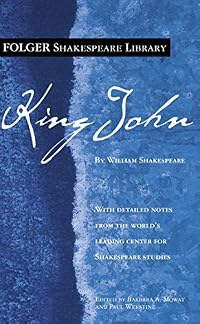
King John
by William Shakespeare
On This Page
Description
King John of England is pitted against the united powers of France, Brittany, Austria, and the Papacy. Will England be destroyed by his fatal indecision? As alliances are made, broken, and remade, the paranoid and erratic John reveals his weakness and reliance on those around him-including his powerful mother Queen Elinor and Faulconbridge, the cynical and witty bastard son of the dead King Richard I.Tags
Recommendations



















Member Reviews
One of Shakespeare's most unpopular history plays, King John deals with the life and death of King John, who reigned from 1199 to 1216. This is as early as Shakespeare goes in his treatment of English history, concentrating more successfully on the later 14th and 15th centuries in the plays which stretch from Richard II to Henry VI. As a result King John suffers from being so historically distant in time, as well as offering a rather weak and vacillating king, who lacks the charisma and authority of Richard III or Henry V. The play begins with King John struggling to retain his throne, under attack from rebellious courtiers and Philip, the king of France. As the quarrel escalates into war with France, the play begins to take on a show more contemporary Elizabethan flavour--the feared invasion from a foreign (Catholic) nation, and the extent to which such an invasion is based on the questionable paternity of King John (like Queen Elizabeth, John is accused of being a bastard and is excommunicated). The play is saved from its rather colourless political machinations by Philip the Bastard, John's favourite, a dramatic forerunner of dubious but charismatic malcontents like Edmund in King Lear. It is also Philip who is given the most powerful and patriotic lines, when he claims that "This England never did, nor never shall,/Lie at the proud foot of a conqueror". King John's mysterious and anticlimactic death through illness at the end of the play deflates expectations - something that could be said of the play as a whole. --Jerry Brotton show less
I decided to work through the least memorable or least beloved plays while I'm working through the more beloved histories, and frankly, I don't think this one was bad at all.
Sure, there's no Magna Carta, even though it would have been signed one year before the King's death, but as it has been said many times before, no one in Shakespeare's time really gave a hoot about the document.
So why did this flop of a play even get written? For it was a flop at its inception and no one really wants to see it on stage, now. Are there any redeeming virtues?
Hell yeah. Philip the Bastard. Many soliloquies, the last line in the play, and my god what a mouth he has. :) He has the righteous Plantagenet fire, the hot breast, the military and manly and show more steadfast nobility that everyone loves and honors... and yet, despite that, he's a Bastard.
Let me back up. Most bastards in any of the Shakespearian plays are real bastards. This is the only one that is truly noble, through and through. Wow! What a departure! Plus, he was pretty show-stealing every time he popped his head up on the page, with great quips, true heart, and utter loyalty to the king.
Plus we get to see a pretty spry old woman Eleanor of Aquitaine. But that's just for us history buffs. She really doesn't do much except support son the King's decisions and help raise the fortune of Philip the Bastard. :) Which is delightful enough.
The rest of the play, though, does appear to have the right kind of propagandist flavor, turning King John into a Protestant by default because he chooses to snub the Cardinal who then proceeds to excommunicate him, but in my eye, that's just the overt window dressing.
There's absolutely nothing wrong with the story in the play, either. There's wars, reconciliations, humorous dealings at Anjou, bitter sorrow over Arthur, and more war, ending with the declaration that there will never be another successful invasion of England.
Pretty rousing. I was entertained. So why the hate?
*shrug* maybe people are just idiots. :) Great characters, good story. I guess this is just one of those cases that because Shakespeare wrote it, it must be brilliant instead of just fine, and therefore we must, obviously, rate it low. :) show less
Sure, there's no Magna Carta, even though it would have been signed one year before the King's death, but as it has been said many times before, no one in Shakespeare's time really gave a hoot about the document.
So why did this flop of a play even get written? For it was a flop at its inception and no one really wants to see it on stage, now. Are there any redeeming virtues?
Hell yeah. Philip the Bastard. Many soliloquies, the last line in the play, and my god what a mouth he has. :) He has the righteous Plantagenet fire, the hot breast, the military and manly and show more steadfast nobility that everyone loves and honors... and yet, despite that, he's a Bastard.
Let me back up. Most bastards in any of the Shakespearian plays are real bastards. This is the only one that is truly noble, through and through. Wow! What a departure! Plus, he was pretty show-stealing every time he popped his head up on the page, with great quips, true heart, and utter loyalty to the king.
Plus we get to see a pretty spry old woman Eleanor of Aquitaine. But that's just for us history buffs. She really doesn't do much except support son the King's decisions and help raise the fortune of Philip the Bastard. :) Which is delightful enough.
The rest of the play, though, does appear to have the right kind of propagandist flavor, turning King John into a Protestant by default because he chooses to snub the Cardinal who then proceeds to excommunicate him, but in my eye, that's just the overt window dressing.
There's absolutely nothing wrong with the story in the play, either. There's wars, reconciliations, humorous dealings at Anjou, bitter sorrow over Arthur, and more war, ending with the declaration that there will never be another successful invasion of England.
Pretty rousing. I was entertained. So why the hate?
*shrug* maybe people are just idiots. :) Great characters, good story. I guess this is just one of those cases that because Shakespeare wrote it, it must be brilliant instead of just fine, and therefore we must, obviously, rate it low. :) show less
http://nhw.livejournal.com/1111973.html
I confess I knew nothing at all about this play before last week. It's a somewhat weird meditation on the political process. There is a sort-of viewpoint character, "The Bastard" who is the illegitimate son of John's brother Richard Cœur de Lion; yet at the same time he consistently argues for a more vigorous and vicious engagement by the English against the French and/or the Pope, including at times when this is obviously a bad idea. So although he is definitely the author's creation, it is not at all clear that he is the author's mouthpiece.
King John himself is also an ambiguous figure. His bold words against the Pope in Act 3, which sound terribly impressive in post-Henry VIII England, melt show more into historical footnotes in Act V. The cosmic karma that descends on him for killing Arthur is unfair because a) his orders weren't actually carried out, b) he changed his mind and c) Arthur dies by accident. John (and by the end of the play Henry III) may be legitimate, but that doesn't make you right. It's not at all obvious that John's agonising death is deserved.
I'm surprised that this play isn't better known. Apart from the title role, the Bastard, Constance, Arthur, Hubert and Salisbury all seem to me to be rather interesting characters who could be brought to life under the right circumstances. Arkangel have a decent cast, none particularly outstanding, but it is good material and they deliver a quality product. show less
I confess I knew nothing at all about this play before last week. It's a somewhat weird meditation on the political process. There is a sort-of viewpoint character, "The Bastard" who is the illegitimate son of John's brother Richard Cœur de Lion; yet at the same time he consistently argues for a more vigorous and vicious engagement by the English against the French and/or the Pope, including at times when this is obviously a bad idea. So although he is definitely the author's creation, it is not at all clear that he is the author's mouthpiece.
King John himself is also an ambiguous figure. His bold words against the Pope in Act 3, which sound terribly impressive in post-Henry VIII England, melt show more into historical footnotes in Act V. The cosmic karma that descends on him for killing Arthur is unfair because a) his orders weren't actually carried out, b) he changed his mind and c) Arthur dies by accident. John (and by the end of the play Henry III) may be legitimate, but that doesn't make you right. It's not at all obvious that John's agonising death is deserved.
I'm surprised that this play isn't better known. Apart from the title role, the Bastard, Constance, Arthur, Hubert and Salisbury all seem to me to be rather interesting characters who could be brought to life under the right circumstances. Arkangel have a decent cast, none particularly outstanding, but it is good material and they deliver a quality product. show less
This review is written with a GPL 4.0 license and the rights contained therein shall supersede all TOS by any and all websites in regards to copying and sharing without proper authorization and permissions. Crossposted at WordPress, Blogspot & Librarything by Bookstooge’s Exalted Permission
Title: King John
Author: William Shakespeare
Rating: 4 of 5 Stars
Genre: Play
Pages: 265
Words: 76K
Synopsis:
From Wikipedia
King John receives an ambassador from France who demands with a threat of war that he renounce his throne in favour of his nephew, Arthur, whom the French King Philip believes to be the rightful heir to the throne.
John adjudicates an inheritance dispute between Robert Faulconbridge and his older brother Philip the Bastard, during show more which it becomes apparent that Philip is the illegitimate son of King Richard I. Queen Eleanor, mother to both Richard and John, recognises the family resemblance and suggests that he renounce his claim to the Faulconbridge land in exchange for a knighthood. John knights Philip the Bastard under the name Richard.
In France, King Philip and his forces besiege the English-ruled town of Angers, threatening attack unless its citizens support Arthur. Philip is supported by Austria, who is believed to have killed King Richard. The English contingent arrives; and then Eleanor trades insults with Constance, Arthur's mother. Kings Philip and John stake their claims in front of Angers' citizens, but to no avail: their representative says that they will support the rightful king, whoever that turns out to be.
The French and English armies clash, but no clear victor emerges. Each army dispatches a herald claiming victory, but Angers' citizens continue to refuse to recognize either claimant because neither army has proven victorious.
The Bastard proposes that England and France unite to punish the rebellious citizens of Angers, at which point the citizens propose an alternative: Philip's son, Louis the Dauphin, should marry John's niece Blanche (a scheme that gives John a stronger claim to the throne) while Louis gains territory for France. Though a furious Constance accuses Philip of abandoning Arthur, Louis and Blanche are married.
Cardinal Pandolf arrives from Rome bearing a formal accusation that John has disobeyed the Pope and appointed an archbishop contrary to his desires. John refuses to recant, whereupon he is excommunicated. Pandolf pledges his support for Louis, though Philip is hesitant, having just established family ties with John. Pandolf brings him round by pointing out that his links to the church are older and firmer.
War breaks out; Austria is beheaded by the Bastard in revenge for his father's death; and both Angers and Arthur are captured by the English. Eleanor is left in charge of English possessions in France, while the Bastard is sent to collect funds from English monasteries. John orders Hubert to kill Arthur. Pandolf suggests to Louis that he now has as strong a claim to the English throne as Arthur (and indeed John), and Louis agrees to invade England.
Hubert finds himself unable to kill Arthur. John's nobles urge Arthur's release. John agrees, but is wrong-footed[clarification needed] by Hubert's announcement that Arthur is dead. The nobles, believing he was murdered, defect to Louis' side. Equally upsetting, and more heartbreaking to John, is the news of his mother's death, along with that of Lady Constance. The Bastard reports that the monasteries are unhappy about John's attempt to seize their gold. Hubert has a furious argument with John, during which he reveals that Arthur is still alive. John, delighted, sends him to report the news to the nobles.
Arthur dies jumping from a castle wall. (It is open to interpretation whether he deliberately kills himself or just makes a risky escape attempt.) The nobles believe he was murdered by John, and refuse to believe Hubert's entreaties. John attempts to make a deal with Pandolf, swearing allegiance to the Pope in exchange for Pandolf's negotiating with the French on his behalf. John orders the Bastard, one of his few remaining loyal subjects, to lead the English army against France.
While John's former noblemen swear allegiance to Louis, Pandolf explains John's scheme, but Louis refuses to be taken in by it. The Bastard arrives with the English army and threatens Louis, but to no avail. War breaks out with substantial losses on each side, including Louis' reinforcements, who are drowned during the sea crossing. Many English nobles return to John's side after a dying French nobleman, Melun, warns them that Louis plans to kill them after his victory.
John is poisoned by a disgruntled monk. His nobles gather around him as he dies. The Bastard plans the final assault on Louis' forces, until he is told that Pandolf has arrived with a peace treaty. The English nobles swear allegiance to John's son Prince Henry, and the Bastard reflects that this episode has taught that internal bickering could be as perilous to England's fortunes as foreign invasion.
My Thoughts:
FINALLY! A Shakespeare play that I fully enjoyed and didn't feel like pee'ing on after I was done reading it. I don't know if it was the actual play, the fact that we've moved into “recent” history (as opposed to ancient history of Greece, Rome, etc), or what, but I had zero quibbles while reading this.
Lots of drama and people being jerks and lying and backstabbing, but I still understood the context. I guess that was what was missing for a lot of the other plays I read? I couldn't understand why the characters would do what they did, but here I could completely understand things, even if I thought it was stupid or wrong.
My only hesitation now is that if I liked this so much, perhaps I'm setting the bar too high for the rest of the Histories? Of course, with works like Henry V coming down the pipeline, that shouldn't be a concern of mine. But I'm a worrier, so I'm going to worry about something that doesn't matter one whit.
★★★★☆ show less
Title: King John
Author: William Shakespeare
Rating: 4 of 5 Stars
Genre: Play
Pages: 265
Words: 76K
Synopsis:
From Wikipedia
King John receives an ambassador from France who demands with a threat of war that he renounce his throne in favour of his nephew, Arthur, whom the French King Philip believes to be the rightful heir to the throne.
John adjudicates an inheritance dispute between Robert Faulconbridge and his older brother Philip the Bastard, during show more which it becomes apparent that Philip is the illegitimate son of King Richard I. Queen Eleanor, mother to both Richard and John, recognises the family resemblance and suggests that he renounce his claim to the Faulconbridge land in exchange for a knighthood. John knights Philip the Bastard under the name Richard.
In France, King Philip and his forces besiege the English-ruled town of Angers, threatening attack unless its citizens support Arthur. Philip is supported by Austria, who is believed to have killed King Richard. The English contingent arrives; and then Eleanor trades insults with Constance, Arthur's mother. Kings Philip and John stake their claims in front of Angers' citizens, but to no avail: their representative says that they will support the rightful king, whoever that turns out to be.
The French and English armies clash, but no clear victor emerges. Each army dispatches a herald claiming victory, but Angers' citizens continue to refuse to recognize either claimant because neither army has proven victorious.
The Bastard proposes that England and France unite to punish the rebellious citizens of Angers, at which point the citizens propose an alternative: Philip's son, Louis the Dauphin, should marry John's niece Blanche (a scheme that gives John a stronger claim to the throne) while Louis gains territory for France. Though a furious Constance accuses Philip of abandoning Arthur, Louis and Blanche are married.
Cardinal Pandolf arrives from Rome bearing a formal accusation that John has disobeyed the Pope and appointed an archbishop contrary to his desires. John refuses to recant, whereupon he is excommunicated. Pandolf pledges his support for Louis, though Philip is hesitant, having just established family ties with John. Pandolf brings him round by pointing out that his links to the church are older and firmer.
War breaks out; Austria is beheaded by the Bastard in revenge for his father's death; and both Angers and Arthur are captured by the English. Eleanor is left in charge of English possessions in France, while the Bastard is sent to collect funds from English monasteries. John orders Hubert to kill Arthur. Pandolf suggests to Louis that he now has as strong a claim to the English throne as Arthur (and indeed John), and Louis agrees to invade England.
Hubert finds himself unable to kill Arthur. John's nobles urge Arthur's release. John agrees, but is wrong-footed[clarification needed] by Hubert's announcement that Arthur is dead. The nobles, believing he was murdered, defect to Louis' side. Equally upsetting, and more heartbreaking to John, is the news of his mother's death, along with that of Lady Constance. The Bastard reports that the monasteries are unhappy about John's attempt to seize their gold. Hubert has a furious argument with John, during which he reveals that Arthur is still alive. John, delighted, sends him to report the news to the nobles.
Arthur dies jumping from a castle wall. (It is open to interpretation whether he deliberately kills himself or just makes a risky escape attempt.) The nobles believe he was murdered by John, and refuse to believe Hubert's entreaties. John attempts to make a deal with Pandolf, swearing allegiance to the Pope in exchange for Pandolf's negotiating with the French on his behalf. John orders the Bastard, one of his few remaining loyal subjects, to lead the English army against France.
While John's former noblemen swear allegiance to Louis, Pandolf explains John's scheme, but Louis refuses to be taken in by it. The Bastard arrives with the English army and threatens Louis, but to no avail. War breaks out with substantial losses on each side, including Louis' reinforcements, who are drowned during the sea crossing. Many English nobles return to John's side after a dying French nobleman, Melun, warns them that Louis plans to kill them after his victory.
John is poisoned by a disgruntled monk. His nobles gather around him as he dies. The Bastard plans the final assault on Louis' forces, until he is told that Pandolf has arrived with a peace treaty. The English nobles swear allegiance to John's son Prince Henry, and the Bastard reflects that this episode has taught that internal bickering could be as perilous to England's fortunes as foreign invasion.
My Thoughts:
FINALLY! A Shakespeare play that I fully enjoyed and didn't feel like pee'ing on after I was done reading it. I don't know if it was the actual play, the fact that we've moved into “recent” history (as opposed to ancient history of Greece, Rome, etc), or what, but I had zero quibbles while reading this.
Lots of drama and people being jerks and lying and backstabbing, but I still understood the context. I guess that was what was missing for a lot of the other plays I read? I couldn't understand why the characters would do what they did, but here I could completely understand things, even if I thought it was stupid or wrong.
My only hesitation now is that if I liked this so much, perhaps I'm setting the bar too high for the rest of the Histories? Of course, with works like Henry V coming down the pipeline, that shouldn't be a concern of mine. But I'm a worrier, so I'm going to worry about something that doesn't matter one whit.
★★★★☆ show less
I love, love, love King John. I can see why it's hardly ever performed, though - there's several characters that only show up for a scene or two before leaving (the three women - Constance, Queen Elinore and Blanche disappear after act three), plus it would be hard to find a child actor that could memorize and speak Arthur's role. But, dear God, the characters! Constance and Philip the Bastard may be two of my favorite characters in all the histories. Constance is just so nuts - her catfight with Queen Elinor is hilarious - and the Bastard is so completely epic in every way. His constant haranguing of Austria is hilarious, and his utterly mad schemes of warfare (that always end up working!) are just...he's just awesome.
King John is the earliest chronological setting for his English history plays, taking place in the early 13th century. It's also one that doesn't get read or staged very often. This is because it is a pretty average Shakespeare work, perhaps even self-derivative. And for a play about war, there's an awful lot action taking place off stage that gets mentioned in the dialogue.
John ascended to the throne after the death of his elder brother Richard the Lionhearted. However, the young Arthur, the son of John's other older brother Geoffrey, also has a claim to kingship. Naturally, King Philip of France supports Arthur's claim and his troops meet Arthur's troops outside the city of Angers, one of the English crowns holdings on the French show more mainland. Humorously, the people of Angers refuse to open the gate to either army so John and Phillip temporarily ally to attack the city! But the people of Angers suggest instead that John's niece Blanche of Castile marry the Dauphin (and with the exchange of some territory as well) create a peace. There's a scene where John and Philip are so happy with this plan that they walk around holding hands that's almost Monty Pythonesque, like they're a couple of kids making up on a playground.
Sadly, the peace will not last as Arthur's mother Constance is insistent that Phillip keep to his oath. Furthermore, the legate of the Pope arrives to excommunicate John and manipulates Phillip into reopening his war on England. Incidentally, John's angry denouncement of the papacy sounds very much like it was written by a Protestant in Tudor England. Much of the play covers the ensuing wars with various betrayals and atrocities. Curiously, the historical event most tied to King John - Magna Carta - is not even mentioned in the play.
Key characters in the play, perhaps more than even John, include Sir Richard the Plantagenet and Hubert. Richard is the illegitimate son of Richard the Lionhearted, originally known as Philip Faulconbridge, but his paternity is recognized and he is knighted early in the play. The script refers to this character simply as "The Bastard," but he proves to be John's most loyal and clever soldier. Hubert is tasked with murdering the captive Arthur but has second thoughts in a series of miscommunications that dominate the center section of the play. show less
John ascended to the throne after the death of his elder brother Richard the Lionhearted. However, the young Arthur, the son of John's other older brother Geoffrey, also has a claim to kingship. Naturally, King Philip of France supports Arthur's claim and his troops meet Arthur's troops outside the city of Angers, one of the English crowns holdings on the French show more mainland. Humorously, the people of Angers refuse to open the gate to either army so John and Phillip temporarily ally to attack the city! But the people of Angers suggest instead that John's niece Blanche of Castile marry the Dauphin (and with the exchange of some territory as well) create a peace. There's a scene where John and Philip are so happy with this plan that they walk around holding hands that's almost Monty Pythonesque, like they're a couple of kids making up on a playground.
Sadly, the peace will not last as Arthur's mother Constance is insistent that Phillip keep to his oath. Furthermore, the legate of the Pope arrives to excommunicate John and manipulates Phillip into reopening his war on England. Incidentally, John's angry denouncement of the papacy sounds very much like it was written by a Protestant in Tudor England. Much of the play covers the ensuing wars with various betrayals and atrocities. Curiously, the historical event most tied to King John - Magna Carta - is not even mentioned in the play.
Key characters in the play, perhaps more than even John, include Sir Richard the Plantagenet and Hubert. Richard is the illegitimate son of Richard the Lionhearted, originally known as Philip Faulconbridge, but his paternity is recognized and he is knighted early in the play. The script refers to this character simply as "The Bastard," but he proves to be John's most loyal and clever soldier. Hubert is tasked with murdering the captive Arthur but has second thoughts in a series of miscommunications that dominate the center section of the play. show less
Reread 2/19/22 in Bantam Complete Works--
This play was even better on a second read. A scene that I severely underrated last time is the part in Act III Scene I where King Philip and King John are holding hands and everyone is yelling at them to either keep holding hands or let go immediately-- the staging on that could have some great physical comedy.
In addition to all the comic elements (intentional or not, as the case may be) there were also some genuinely moving speeches, scenes, and lines, from Blanche (explaining her split loyalties), Constance (mourning the capture of her son), the Bastard (pretty much every scene), Hubert (sparing Arthur's life), Pandulph (convincing Lewis to start a war), and others.
Also on this read-through, show more King John's death-by-monk at the end of the play seemed less out of left field, since we paid more notice to his financial and spiritual relationship to the church throughout the earlier parts of the play.
Original review 5/11/20, read in Pelican Complete Works--
It's been so great to read the Shakespeares I know next to nothing about, and King John is no exception. New characters to add to my favorites list: Elinor (for the persona), the Bastard (for the interiority), Citizen 1 (for the comedy)
Really want to read more about what was going on with the Catholicism stuff here.
Overall, a play of long speeches and strange choices. Structured like Shakespeare wrote the scenes that interested him most first and then decided he didn't need the other ones after all. Arthur is a paragon of (presumably) unintentional comedy. Still immense fun. show less
This play was even better on a second read. A scene that I severely underrated last time is the part in Act III Scene I where King Philip and King John are holding hands and everyone is yelling at them to either keep holding hands or let go immediately-- the staging on that could have some great physical comedy.
In addition to all the comic elements (intentional or not, as the case may be) there were also some genuinely moving speeches, scenes, and lines, from Blanche (explaining her split loyalties), Constance (mourning the capture of her son), the Bastard (pretty much every scene), Hubert (sparing Arthur's life), Pandulph (convincing Lewis to start a war), and others.
Also on this read-through, show more King John's death-by-monk at the end of the play seemed less out of left field, since we paid more notice to his financial and spiritual relationship to the church throughout the earlier parts of the play.
Original review 5/11/20, read in Pelican Complete Works--
It's been so great to read the Shakespeares I know next to nothing about, and King John is no exception. New characters to add to my favorites list: Elinor (for the persona), the Bastard (for the interiority), Citizen 1 (for the comedy)
Really want to read more about what was going on with the Catholicism stuff here.
Overall, a play of long speeches and strange choices. Structured like Shakespeare wrote the scenes that interested him most first and then decided he didn't need the other ones after all. Arthur is a paragon of (presumably) unintentional comedy. Still immense fun. show less
Members
- Recently Added By
Lists

Favorite Shakespeare plays?
37 works; 44 members

Best of British Literature
226 works; 41 members

Early Modern (Shakesperean)
64 works; 2 members

100 Books to Read in a Lifetime (That Are Older Than 200 Years)
415 works; 173 members
Stage Plays/Screenplays/Dialogues/Anything Dialogue-Storytelling Related
81 works; 2 members

'Books You Can't Live Without: The Top 100', The Guardian, 2007
156 works; 7 members
My Play Collection
769 works; 3 members

Next Plays / 2025
352 works; 1 member
Author Information

5,949+ Works 439,816 Members
William Shakespeare, 1564 - 1616 Although there are many myths and mysteries surrounding William Shakespeare, a great deal is actually known about his life. He was born in Stratford-Upon-Avon, son of John Shakespeare, a prosperous merchant and local politician and Mary Arden, who had the wealth to send their oldest son to Stratford Grammar School. show more At 18, Shakespeare married Anne Hathaway, the 27-year-old daughter of a local farmer, and they had their first daughter six months later. He probably developed an interest in theatre by watching plays performed by traveling players in Stratford while still in his youth. Some time before 1592, he left his family to take up residence in London, where he began acting and writing plays and poetry. By 1594 Shakespeare had become a member and part owner of an acting company called The Lord Chamberlain's Men, where he soon became the company's principal playwright. His plays enjoyed great popularity and high critical acclaim in the newly built Globe Theatre. It was through his popularity that the troupe gained the attention of the new king, James I, who appointed them the King's Players in 1603. Before retiring to Stratford in 1613, after the Globe burned down, he wrote more than three dozen plays (that we are sure of) and more than 150 sonnets. He was celebrated by Ben Jonson, one of the leading playwrights of the day, as a writer who would be "not for an age, but for all time," a prediction that has proved to be true. Today, Shakespeare towers over all other English writers and has few rivals in any language. His genius and creativity continue to astound scholars, and his plays continue to delight audiences. Many have served as the basis for operas, ballets, musical compositions, and films. While Jonson and other writers labored over their plays, Shakespeare seems to have had the ability to turn out work of exceptionally high caliber at an amazing speed. At the height of his career, he wrote an average of two plays a year as well as dozens of poems, songs, and possibly even verses for tombstones and heraldic shields, all while he continued to act in the plays performed by the Lord Chamberlain's Men. This staggering output is even more impressive when one considers its variety. Except for the English history plays, he never wrote the same kind of play twice. He seems to have had a good deal of fun in trying his hand at every kind of play. Shakespeare wrote 154 sonnets, all published on 1609, most of which were dedicated to his patron Henry Wriothsley, The Earl of Southhampton. He also wrote 13 comedies, 13 histories, 6 tragedies, and 4 tragecomedies. He died at Stratford-upon-Avon April 23, 1616, and was buried two days later on the grounds of Holy Trinity Church in Stratford. His cause of death was unknown, but it is surmised that he knew he was dying. (Bowker Author Biography) show less
Some Editions
Series
Belongs to Publisher Series
Work Relationships
Is contained in
Has the adaptation
Was inspired by
Has as a supplement
Has as a student's study guide
Common Knowledge
- Canonical title
- King John
- Original title
- The Life and Death of King John
- Original publication date
- 1623 (Folio) (Folio)
- People/Characters
- John, King of England; Eleanor of Aquitaine; Constance, Duchess of Brittany; Blanche of Castile; Lady Faulconbridge; Henry III, King of England (as Prince Henry) (show all 21); Arthur, Duke of Brittany; William Marshal, 1st Earl of Pembroke; Earl of Essex; Earl of Salisbury; Lord Bigot; Bubert de Burgh; Robert Faulconbridge; Peter of Pomfret; Philip II, King of France; Louis VIII, King of France (Lewis, the Dauphin); Lymoges, Duke of Austria; Cardinal Pandulph; Melun; Chatillon; Philip of Cognac
- Important places
- Angers, Maine-et-Loire, Pays de la Loire, France (as Angiers, France); Maine-et-Loire, Pays de la Loire, France; Pays de la Loire, France; France; Dover Castle, Dover, Kent, England, UK; Goodwin Sands, Kent, England, UK (show all 12); Dover, Kent, England, UK; Kent, England, UK; Swinstead Abbey, Swinstead, Lincolnshire, England, UK (fictional); Swinstead, Lincolnshire, England, UK; Lincolnshire, England, UK; England, UK
- Important events
- Middle Ages; 12th century; 13th century
- Related movies
- King John (1899 | IMDb); The Life and Death of King John (1984 | IMDb)
- First words
- Now, say, Chatillon, what would France with us?
- Quotations
- Life is as tedious as a twice-told tale
Vexing the dull ear of a drowsy man.
This England never did, nor never shall,
Lie at the proud foot of a conqueror. - Last words
- (Click to show. Warning: May contain spoilers.)Now these her princes are come home again,
Come the three corners of the world in arms,
And we shall shock them: Nought shall make us rue,
If England to itself do rest but true. - Original language
- English
- Disambiguation notice
- This work is for the complete King John only. Do not combine this work with abridgements, adaptations or "simplifications" (such as "Shakespeare Made Easy"), Cliffs Notes or similar study guides, or anything else that ... (show all)does not contain the full text. Do not include any video recordings. Additionally, do not combine this with other plays.
Classifications
Statistics
- Members
- 1,604
- Popularity
- 14,026
- Reviews
- 31
- Rating
- (3.40)
- Languages
- 16 — Catalan, Chinese, Dutch, English, Finnish, French, German, Greek, Hungarian, Italian, Norwegian (Bokmål), Polish, Portuguese, Spanish, Swedish, Turkish
- Media
- Paper, Audiobook, Ebook
- ISBNs
- 156
- UPCs
- 4
- ASINs
- 65