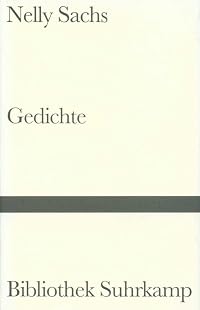
Gedichte
by Nelly Sachs
On This Page
Tags
Recommendations

























Member Reviews
You can't read a collection of lyric poems in one go as you can a novel, so this is a first impression, rather than a review.
This collection was put together posthumously in 1977 by the poet Hilde Domin, who knew Sachs and was also an exile from Germany during the Hitler period. It includes a short but very helpful afterword by Domin summing up Sachs's career, the main themes in her poetry, and her critical reception in postwar Germany.
The poems in this collection are selected from the whole course of Sachs's career as a serious poet (broadly-speaking 1943-1968 - she never allowed her pre-war "juvenilia" to be republished). Most deal in one way or another with her experience as a refugee and as someone who survived when so many were show more killed. Some are specifically addressed to the man she loved, others to victims and survivors more generally. I was struck by the absence of direct topical references in the poems: as Domin also points out, they come out of the specific event of the Holocaust, but they actually speak just as well for the survivors and refugees of other cataclysmic events. They haven't lost any of their relevance: Domin talks about Vietnam, we could say Syria or North Africa. What's crucial to these poems is that they always seem to be looking for ways to move forward, not dealing in revenge and recrimination. Domin describes the process Sachs is engaged in as giving the victims a worthy burial.
There are also some more obscure, more or less mystical poems in the collection, which didn't mean very much to me on a first reading: she repeatedly uses the same set of images in these poems in different contexts (fish, butterflies, stars, sand, footwear...), and there's obviously a particular language that you need to be familiar with. But I'm quite happy with the idea of keeping this book on my bedside table for a few months to dip into and gain familiarity with the way her poetic imagination works: I'm sure it will be worth it.
(A stranger always has / his home in his arms / like an orphan / for whom he's perhaps only / seeking a grave.) show less
This collection was put together posthumously in 1977 by the poet Hilde Domin, who knew Sachs and was also an exile from Germany during the Hitler period. It includes a short but very helpful afterword by Domin summing up Sachs's career, the main themes in her poetry, and her critical reception in postwar Germany.
The poems in this collection are selected from the whole course of Sachs's career as a serious poet (broadly-speaking 1943-1968 - she never allowed her pre-war "juvenilia" to be republished). Most deal in one way or another with her experience as a refugee and as someone who survived when so many were show more killed. Some are specifically addressed to the man she loved, others to victims and survivors more generally. I was struck by the absence of direct topical references in the poems: as Domin also points out, they come out of the specific event of the Holocaust, but they actually speak just as well for the survivors and refugees of other cataclysmic events. They haven't lost any of their relevance: Domin talks about Vietnam, we could say Syria or North Africa. What's crucial to these poems is that they always seem to be looking for ways to move forward, not dealing in revenge and recrimination. Domin describes the process Sachs is engaged in as giving the victims a worthy burial.
There are also some more obscure, more or less mystical poems in the collection, which didn't mean very much to me on a first reading: she repeatedly uses the same set of images in these poems in different contexts (fish, butterflies, stars, sand, footwear...), and there's obviously a particular language that you need to be familiar with. But I'm quite happy with the idea of keeping this book on my bedside table for a few months to dip into and gain familiarity with the way her poetic imagination works: I'm sure it will be worth it.
Ein Fremder hat immer
seine Heimat im Arm
wie eine Waise
für die er vielleicht nichts
als ein Grab sucht.
(A stranger always has / his home in his arms / like an orphan / for whom he's perhaps only / seeking a grave.) show less
Ratings
Members
- Recently Added By
Lists

Writers at Risk
106 works; 17 members
Author Information

81+ Works 539 Members
Nelly Sachs was born into a secular Jewish family in Berlin. She conceived the ambition to become a writer as a young woman, but her early publications attracted hardly any attention. After the rise to power of Hitler, she witnessed the terrible fate of her fellow Jews. Only the intervention of the Swedish writer Selma Lagerlof enabled her to show more leave for Stockholm and escape being sent to a concentration camp. In exile, as she tried to come to terms with the traumatic events of the recent past, she developed the unique poetic idiom for which she is famous. Individual experience hardly seems to exist at all in her poetry, as personal life blends into the mythic story of humanity, especially of her Jewish ancestors. Hans Magnus Enzensberger has written, "The oeuvre of Nelly Sachs is great and mysterious, two attributes that literary criticism has few occasions to apply to poetry these days." (Bowker Author Biography) show less
All Editions
Series
Belongs to Publisher Series
Bibliothek Suhrkamp (549)
Common Knowledge
- Canonical title*
- Gedichte
- Original title
- Gedichte
- Original publication date
- 1977
*Some information comes from Common Knowledge in other languages. Click "Edit" for more information.
Classifications
Statistics
- Members
- 27
- Popularity
- 1,010,996
- Reviews
- 1
- Rating
- (4.63)
- Languages
- English, German
- Media
- Paper
- ISBNs
- 1