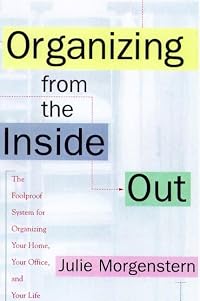
Organizing From the Inside Out
by Julie Morgenstern
On This Page
Description
Hundreds of thousands of people have broken through the clutter and streamlined their lives with Julie Morgenstern's proven techniques. There's no magic, no mystery. Getting organized is a skill that anyone can learn. The beauty of Julie's system, honed during her many years as a professional organizer, is that it enables you to design a unique organizing plan based on your individual goals, natural habits, and psychological needs -- a plan that will work with your personality rather than show more against it. Let Julie Morgenstern set you free to live the life you dream about. show lessTags
Recommendations


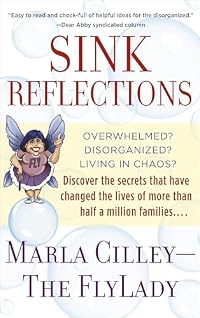
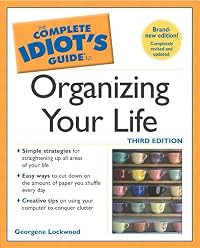
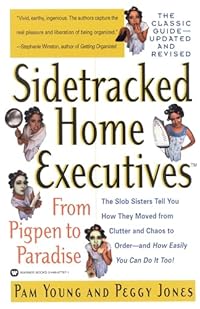



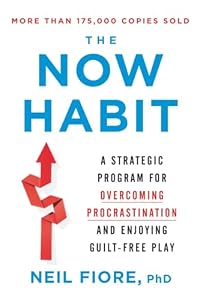







Member Reviews
Rating: 4 of 5
Something finally clicked for me while reading Organizing from the Inside Out. Over the last 10 years, after reading mountains of pages on organizing my life, this was the first author who helped me figure out where my once orderly and well-managed life went hinky.
Morgenstern advised to work with natural habits and tendencies instead of against them. For example, if I constantly have a pile of books beside my bed instead of the reading chair in the library, it's probably time to put a bookshelf close to or next to my bed rather than forcing myself or hoping I'll eventually keep all those books just in the library.
I appreciated Part One (Laying the Foundation) and Part Two (Secrets of a Professional Organizer) almost as show more much as the how-to, activity-focused Part Three (Applying What You've Learned) and Part Four (Tackling Time and Technology). Morgenstern included lots of examples which I always like to see in a how-to book. And I've already made several copies of Appendix A, "Organizing Your Project worksheet."
Projects/areas covered in detail (with examples for each step of her "program" as well as estimated time needed to complete the project) include:
* Handbags, briefcases
* Suitcases
* Traditional offices and filing systems
* Home offices
* Cubicle workstations
* Mobile offices
* Home information centers
* Attics, basements, garages
* Bathrooms* Bedrooms
* Closets
* Kids' rooms
* Kitchens
* Living rooms
* Photographs
Pay attention to the book's title, though, as it truly does put a strong emphasis on pinpointing why your past attempts at implementing organization have failed or, in other cases, why you haven't ever even attempted to get organized. If delving into the reasons behind your actions and habits turns you off, then skip this book. show less
Something finally clicked for me while reading Organizing from the Inside Out. Over the last 10 years, after reading mountains of pages on organizing my life, this was the first author who helped me figure out where my once orderly and well-managed life went hinky.
Morgenstern advised to work with natural habits and tendencies instead of against them. For example, if I constantly have a pile of books beside my bed instead of the reading chair in the library, it's probably time to put a bookshelf close to or next to my bed rather than forcing myself or hoping I'll eventually keep all those books just in the library.
I appreciated Part One (Laying the Foundation) and Part Two (Secrets of a Professional Organizer) almost as show more much as the how-to, activity-focused Part Three (Applying What You've Learned) and Part Four (Tackling Time and Technology). Morgenstern included lots of examples which I always like to see in a how-to book. And I've already made several copies of Appendix A, "Organizing Your Project worksheet."
Projects/areas covered in detail (with examples for each step of her "program" as well as estimated time needed to complete the project) include:
* Handbags, briefcases
* Suitcases
* Traditional offices and filing systems
* Home offices
* Cubicle workstations
* Mobile offices
* Home information centers
* Attics, basements, garages
* Bathrooms* Bedrooms
* Closets
* Kids' rooms
* Kitchens
* Living rooms
* Photographs
Pay attention to the book's title, though, as it truly does put a strong emphasis on pinpointing why your past attempts at implementing organization have failed or, in other cases, why you haven't ever even attempted to get organized. If delving into the reasons behind your actions and habits turns you off, then skip this book. show less
"Julie Morgenstern helped me tame piles of paperwork and organize our house. In our modern life it seems like we have way to much stuff to manage. This book suggests simple but practices tools and techniques to organize things. I am particularly fond of her ""Kindergarten"" principle... everything should have a place to be put away right by where where they will be used. Reading this book also helped me appreciate how my tendency to want to organize things ""exactly"" can lead me to get nothing done... between to lump a few things together. I haevn't read it, but here later book about purging things would go well with this book."
A sensible and thorough guide to tackling organization, which I re-read recently. It gives an overview of a strategy based on deciding what's important to you, and then organizing your spaces and your time to suit. The guide is a wee bit dated, because some technology has outpaced her suggestions since the last revision in 2004. PDAs have been replaced with smartphones, for instance, and few people use Rolodexes. It's a solid reference, though, and I found good tips in every section.
Morgenstern says there are three causes of clutter: technical errors, factors beyond your control, and psychological obstacles. Technical errors: things don't have a home, storage is inconvenient, you have too much stuff, your system is too confusing, you show more leave stuff out as reminders, or you find organizing boring. Uncontrollable factors include too much work, uncooperative partners, not enough time or space, and life transitions. As for psychological obstacles, abundance make some people more secure, while others enjoy the thrill of living in chaos or use clutter as a shield. Some aren't clear about their goals or fear failure or success, or they are perfectionists. Some connect disorganization with creativity, or look to it for distraction, while others just hate the space they are using. Finally, sentimental attachment can be a huge obstacle. Each obstacle must be tackled differently, and you can't deny their existence.
She suggests starting with a needs assessment in each area you organize. Ask: What's working, what's not, what items are essential, why do you want to get organized, and what's causing the problem. She advocates the "Kindergarten" model of organization - a zone for everything, with things stored at their point of use. Build them around your natural habits - don't try to banish books to the bedroom, for instance, if you only read them in the living room. Then estimate the time it will take you to sort, purge, assign homes, put things in containers, and "equalize" (that is, allot time for maintaining your organization system).
I used her system to tackle my handbag, which always causes me problems. I have a big collection of (capacious) bags, I change them often, and I have a tendency to carry too much "in case I have time." Once I looked at it, I realized I don't need to carry a book with me or even my iPad (I can keep another book at work to read, and my iPhone is sufficient), and I should only bring home work if I have scheduled time to do it. Also, I should empty out my bag every night and re-pack it. My wallet should consistently be in the inside zipper pocket (I don't use it much and it's safer there), and my phone in an outside pocket so I can reach it because it is unrealistic to keep it inside. I bought two lipsticks in my favorite color so I can keep one at home and one at work, and did the same with my asthma inhalers, because I had to dig in my bag too often at the wrong times. Once I did all that, I was surprised at how little I was carrying and how easy it was to find things. show less
Morgenstern says there are three causes of clutter: technical errors, factors beyond your control, and psychological obstacles. Technical errors: things don't have a home, storage is inconvenient, you have too much stuff, your system is too confusing, you show more leave stuff out as reminders, or you find organizing boring. Uncontrollable factors include too much work, uncooperative partners, not enough time or space, and life transitions. As for psychological obstacles, abundance make some people more secure, while others enjoy the thrill of living in chaos or use clutter as a shield. Some aren't clear about their goals or fear failure or success, or they are perfectionists. Some connect disorganization with creativity, or look to it for distraction, while others just hate the space they are using. Finally, sentimental attachment can be a huge obstacle. Each obstacle must be tackled differently, and you can't deny their existence.
She suggests starting with a needs assessment in each area you organize. Ask: What's working, what's not, what items are essential, why do you want to get organized, and what's causing the problem. She advocates the "Kindergarten" model of organization - a zone for everything, with things stored at their point of use. Build them around your natural habits - don't try to banish books to the bedroom, for instance, if you only read them in the living room. Then estimate the time it will take you to sort, purge, assign homes, put things in containers, and "equalize" (that is, allot time for maintaining your organization system).
I used her system to tackle my handbag, which always causes me problems. I have a big collection of (capacious) bags, I change them often, and I have a tendency to carry too much "in case I have time." Once I looked at it, I realized I don't need to carry a book with me or even my iPad (I can keep another book at work to read, and my iPhone is sufficient), and I should only bring home work if I have scheduled time to do it. Also, I should empty out my bag every night and re-pack it. My wallet should consistently be in the inside zipper pocket (I don't use it much and it's safer there), and my phone in an outside pocket so I can reach it because it is unrealistic to keep it inside. I bought two lipsticks in my favorite color so I can keep one at home and one at work, and did the same with my asthma inhalers, because I had to dig in my bag too often at the wrong times. Once I did all that, I was surprised at how little I was carrying and how easy it was to find things. show less
Many helpful ideas, but repetitive and it was written in 2004 - before smart phones, the cloud, social media, Gmail. The section on technology is a journey down memory lane, but the basic concepts are still somewhat relevant. Heavy emphasis on how to organize paper files, which many of us still do need to do. One chapter is devoted to living or working with a disorganized person. The author is very gentle about not insisting that you throw out everything.
Getting organized is a skill that anyone can learn, and there's no better teacher than America's organizing queen, Julie Morgenstern, as hundreds of thousands of readers have learned. Drawing on her years of experience as a professional organizer, Morgenstern outlines a simple organizing plan that starts with understanding your individual goals, natural habits, and psychological needs, so that you can work with your priorities and personality rather than against them. The basic steps-Analyze, Strategize, Attack-can be applied to any space or situation.
The first 2 parts are the nuts and bolts here. For me, that's where the real value lies. Part 3 repetitive, but would be useful as reference if you are focusing on organizing one specific room. The technology section at the end is outdated to the point of providing little value. Of course that should be expected from a book that is over 15 years old.
Loved Morgenstern's systematic, fun approach to organising. This book was instructive, well-structured, and chock with interesting stories both personal and professional. I had little clue how to organise until I read this book, but didn't even know it. I cannot recommend it highly enough, if you feel disorganised in your life. Here is an outline of the book: http://www.minezone.org/wiki/MVance/OrganizingFromTheInsideOut
Members
- Recently Added By
Author Information

11 Works 3,900 Members
Julie Morgenstern is the author of the national bestseller "Organizing from the Inside Out" & is a regular guest on television & radio, including two hour-long appearances on "Oprah." She is the founder of Task Masters, a New York-based professional organizing company, & consults with individuals & major corporations on time management. (Bowker show more Author Biography) show less
Awards and Honors
Awards
Distinctions
Common Knowledge
- First words
- OK, so you've been trying for years to get organized.
Classifications
Statistics
- Members
- 2,055
- Popularity
- 10,061
- Reviews
- 28
- Rating
- (3.79)
- Languages
- 9 — Czech, Danish, Dutch, English, French, Norwegian (Bokmål), Polish, Spanish, Swedish
- Media
- Paper, Audiobook, Ebook
- ISBNs
- 29
- UPCs
- 6
- ASINs
- 15