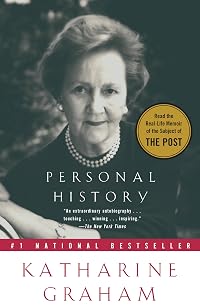
Personal History
by Katharine Graham
On This Page
Description
The captivating, inside story of the woman who helmed the Washington Post during one of the most turbulent periods in the history of American media.Winner of the Pulitzer Prize for Biography
In this bestselling and widely acclaimed memoir, Katharine Graham, the woman who piloted the Washington Post through the scandals of the Pentagon Papers and Watergate, tells her story—one that is extraordinary both for the events it encompasses and for the courage, candor, and dignity of its telling.
show more Here is the awkward child who grew up amid material wealth and emotional isolation; the young bride who watched her brilliant, charismatic husband—a confidant to John F. Kennedy and Lyndon Johnson—plunge into the mental illness that would culminate in his suicide. And here is the widow who shook off her grief and insecurity to take on a president and a pressman's union as she entered the profane boys' club of the newspaper business.
As timely now as ever, Personal History is an exemplary record of our history and of the woman who played such a shaping role within them, discovering her own strength and sense of self as she confronted—and mastered—the personal and professional crises of her fascinating life. show less
Tags
Recommendations











Member Recommendations
Menagerie Two strong women that lived centuries apart but faced many of the same obstacles.
Member Reviews
Katherine Graham's Personal History is long, as she began with the story of her parents' background and marriage, and she dwelt long and deep on her husband, Philip. It is almost a memoir of Philip too, who came across as brilliant but tormented (from manic depression). Besides insights into the publishing world, you also get insights into politics, given both Philip's and Katherine's ties to the various Presidents. It is interesting to learn that the press in the U.S. can come under government pressure and be ostracised. But what I like best is Katherine Graham's honesty about her inadequacies as a leader, and initial fears of being in the public limelight (like having to speak up and do public speaking). She doesn't really offer show more advice on how she overcame those. She just buckled down and did it. That's something to learn too. show less
I was reluctant to read this memoir for a while - it's length intimidated me and I'll admit I anticipated a rather dry, long read. I couldn't have been more wrong - Katharine Graham narrates her own life like few others, providing a rich, compelling witness to history. The daughter of a millionaire investor who bought the Washington Post during the Great Depression, Katharine Graham was a wife and mother while her husband managed the family newspaper. Only after her husband's illness and death did she step up, somewhat reluctantly, to the helm of the Washington Post. A woman in what was a man's world, Graham held her own, and guided the storied newspaper through the Pentagon Papers and Watergate, two singular political scandals that show more built the Post's reputation as a national newspaper. A wonderful book to read that provides both a record of the author's life and a compelling argument for the importance of journalism. show less
I read it mostly because of my morbid fascination with the more miserable aspects of the 1970s, like Watergate, but it’s a very engaging book beginning to end. (To cover some of the same ground I also recommend Ben Bradlee’s A Good Life: Newspapering and Other Adventures (1995).)
So you might think that the most interesting bits would be about the inheriting the Washington Post upon her husband’s suicide, or the Pentagon Papers, or Watergate. But no, the best part was about her knock-down, drag-out labor fight with the craft trade unions that were strangling her paper.
“Knock-down, drag-out fight” is not hyperbole. They were negotiating with the press operators up to the day the contract was set to expire at midnight. show more Negotiators gave each other assurances that so long as the parties continued to negotiate in good faith, they’d continue working and paying status quo. Management was nervous, so they stayed in their offices until after midnight and just keep an eye on things for a while. Everything with the print run for the next morning’s paper was proceeding normally, so at about 2:00 a.m. management went home. At about 4:00 a.m., the pressmen destroyed three presses, set fires, flooded the building, beat the shop foreman nearly to death, and went on strike.
Fourteen of the saboteurs were criminally convicted. The union’s precondition for negotiation was that all fourteen be re-hired with the rest. Graham refused and broke them. She reached deals with all of the other craft unions, but to this day the paper’s presses are run by non-union pressmen. The pressmen’s union was uniformly white, and most of the replacement workers hired were black. show less
So you might think that the most interesting bits would be about the inheriting the Washington Post upon her husband’s suicide, or the Pentagon Papers, or Watergate. But no, the best part was about her knock-down, drag-out labor fight with the craft trade unions that were strangling her paper.
“Knock-down, drag-out fight” is not hyperbole. They were negotiating with the press operators up to the day the contract was set to expire at midnight. show more Negotiators gave each other assurances that so long as the parties continued to negotiate in good faith, they’d continue working and paying status quo. Management was nervous, so they stayed in their offices until after midnight and just keep an eye on things for a while. Everything with the print run for the next morning’s paper was proceeding normally, so at about 2:00 a.m. management went home. At about 4:00 a.m., the pressmen destroyed three presses, set fires, flooded the building, beat the shop foreman nearly to death, and went on strike.
Fourteen of the saboteurs were criminally convicted. The union’s precondition for negotiation was that all fourteen be re-hired with the rest. Graham refused and broke them. She reached deals with all of the other craft unions, but to this day the paper’s presses are run by non-union pressmen. The pressmen’s union was uniformly white, and most of the replacement workers hired were black. show less
Even though I categorized this as an autobiography it is not a traditional "my life" story. Instead, it is Katharine Graham's personal history with The Washington Post first and foremost. She begins with a brief overview of how her parents met, when and where she was born, and her college years. This sets the stage for her increased involvement with the paper. From the time she was 16 years old, when her father bought the failing Washington Post at auction, until the end of her role as chairman of the board in 1991, 58 years of Graham's life was immersed in making the paper a success. Raised without a strong mother-figure or adolescent role models Katharine Graham was a trendsetter for women in business. For her era, her rise to power show more was nothing short of remarkable. But, in addition what makes Personal History such a fascinating read is Graham's unflinching view of her world. She does not hide the fact she had a strained and difficult relationship with her absentee mother. Her voice drips with contempt when she recounts her mother's failed attempts at guidance in life. Graham addresses her husband's mental illness and subsequent suicide in a matter of fact manner. She does not sugar coat the difficulties she faced being a woman of influence in a world traditionally reserved for the man of the house. Despite being born into privilege Graham exemplified the meaning of hard work and perseverance. show less
I knew very little about Katharine Graham when I picked up this book. I've never watched the movie that was based on it. But I loved it.
In spite of her privileged life (her parents were incredibly wealthy), her life was not easy. While early on, she came to appreciate her father, her relationship with her mother remained difficult. She married a man she dearly loved, but that ended in tragedy. After her husband's death, she bravely began running one of the most important newspapers in the world. And she struggled with controversy and sexism in a male-dominated arena.
In her memoir, she was honest about herself and others. She proved herself to be a scrappy woman who cared about doing the right thing above all else. When she made show more mistakes, she admitted them. Honestly, I started reading the book to get the inside scoop on the famous and powerful people she rubbed shoulders with. I wanted to know more about Watergate. The book didn't disappoint in those areas, but I came away with something more. Graham proved herself worthy of respect. While I'm not young, she also taught me some life lessons I'd do well to remember. show less
In spite of her privileged life (her parents were incredibly wealthy), her life was not easy. While early on, she came to appreciate her father, her relationship with her mother remained difficult. She married a man she dearly loved, but that ended in tragedy. After her husband's death, she bravely began running one of the most important newspapers in the world. And she struggled with controversy and sexism in a male-dominated arena.
In her memoir, she was honest about herself and others. She proved herself to be a scrappy woman who cared about doing the right thing above all else. When she made show more mistakes, she admitted them. Honestly, I started reading the book to get the inside scoop on the famous and powerful people she rubbed shoulders with. I wanted to know more about Watergate. The book didn't disappoint in those areas, but I came away with something more. Graham proved herself worthy of respect. While I'm not young, she also taught me some life lessons I'd do well to remember. show less
A memoir about growing up and living amongst ludicrous amounts of wealth and political power. As a record of the rich and powerful, this is an incredible behind the scenes of the way power in politics and business is traded and built upon favours and connections, and how that, beyond a certain level, idealism gives way to the thrall of having power.
Graham is interestingly sidelined in the first half of her own memoir. It focused instead on the life of her parents - her mother heavily critiqued and her father heavily idolised -, her father's purchase of WaPo, her own childhood where her outward poise and confidence were at odds with her insecurity - where she simultaneously acknowledged her out-of-touch-ness with the world due to her show more extremely privileged upbringing and wealth while also still coming across as a bit out-of-touch -, her marriage to the charismatic Phil who would eventually be handed WaPo, and the politics of the times her family owned WaPo and the way they themselves were involved in the politics, perhaps unethically so for owners of a newspaper. The second half does focus more on Graham, but mostly with respect to how various political and cultural events have shaped her as the president/chairman/publisher of WaPo.
The whole book read more like a history of WaPo and Who's Who of Washington and the international political scene. I suppose when your whole life is so intricately intertwined with the growth of your family company, the boundaries between your personal and your professional life tend to get blurry. Imagine being close friends with presidents & Henry Kissinger & Warren Buffett & Jean Monnet (who I didn't know but will now always remember thanks to KG's sly blink-and-you'll-miss-it addendum about how she can testify to his virility!) and many more!
I wonder though, how honest were these recounts. As the wealthy head of a newspaper, the amount of records and accessible expertise at your fingertips definitely requires you to have your facts right. But in terms of the abstractions that make up real life, was she really as insecure and unsure as she painted herself? Did the events really unfold thus because of situations out of her control or her comfort etc? Or is the book an excellent PR exercise? (I believe so.) While an autobiography can never be truly objective and impartial, Graham's has done a great job at appearing fair and also whetting my appetite for other perspectives.
As an educational refresher for major historical events via the journalistic perspective, this book is great. The Pentagon papers, Watergate, and the act of reporting were thrillingly described and deservedly took up a sixth of this brick of a book. My knowledge of them were always very patchy and now the upside of having consolidated a bit more is that I now get about five more 30 Rock references!
The last sixth of the book was about the 1975 union strike, which I was very sceptical about to read from the management's perspective especially a newspaper with obligations to stockholders (Here is good counter to Graham's strike narrative from the union's and history's perspectives). But it was fascinating to read about all the different types of work that goes into physically producing a newspaper, not just the journalism.
Reading context: a surprisingly timely read as it turns out the Washington Post Express very abruptly announced its closure yesterday to its staff - who were not counted as part of the WP Guild union - during a meeting. show less
Graham is interestingly sidelined in the first half of her own memoir. It focused instead on the life of her parents - her mother heavily critiqued and her father heavily idolised -, her father's purchase of WaPo, her own childhood where her outward poise and confidence were at odds with her insecurity - where she simultaneously acknowledged her out-of-touch-ness with the world due to her show more extremely privileged upbringing and wealth while also still coming across as a bit out-of-touch -, her marriage to the charismatic Phil who would eventually be handed WaPo, and the politics of the times her family owned WaPo and the way they themselves were involved in the politics, perhaps unethically so for owners of a newspaper. The second half does focus more on Graham, but mostly with respect to how various political and cultural events have shaped her as the president/chairman/publisher of WaPo.
The whole book read more like a history of WaPo and Who's Who of Washington and the international political scene. I suppose when your whole life is so intricately intertwined with the growth of your family company, the boundaries between your personal and your professional life tend to get blurry. Imagine being close friends with presidents & Henry Kissinger & Warren Buffett & Jean Monnet (who I didn't know but will now always remember thanks to KG's sly blink-and-you'll-miss-it addendum about how she can testify to his virility!) and many more!
I wonder though, how honest were these recounts. As the wealthy head of a newspaper, the amount of records and accessible expertise at your fingertips definitely requires you to have your facts right. But in terms of the abstractions that make up real life, was she really as insecure and unsure as she painted herself? Did the events really unfold thus because of situations out of her control or her comfort etc? Or is the book an excellent PR exercise? (I believe so.) While an autobiography can never be truly objective and impartial, Graham's has done a great job at appearing fair and also whetting my appetite for other perspectives.
As an educational refresher for major historical events via the journalistic perspective, this book is great. The Pentagon papers, Watergate, and the act of reporting were thrillingly described and deservedly took up a sixth of this brick of a book. My knowledge of them were always very patchy and now the upside of having consolidated a bit more is that I now get about five more 30 Rock references!
The last sixth of the book was about the 1975 union strike, which I was very sceptical about to read from the management's perspective especially a newspaper with obligations to stockholders (Here is good counter to Graham's strike narrative from the union's and history's perspectives). But it was fascinating to read about all the different types of work that goes into physically producing a newspaper, not just the journalism.
Reading context: a surprisingly timely read as it turns out the Washington Post Express very abruptly announced its closure yesterday to its staff - who were not counted as part of the WP Guild union - during a meeting. show less
During one of his talks, Warren Buffet recommended this book, so I picked up a used copy. There are a few things I liked about it. First, serving as the publisher of the Washington Post during the 1970’s and 1980’s would be a fascinating job for anyone, and I found it interesting to read the historical context around Ms. Graham’s professional and personal experiences. The Pentagon Papers, Watergate, and labor strife provided the highlights. I also enjoyed reading about the life of a high-profile woman who served in an otherwise male-dominated job. She faced important challenges along the way, and I think she did an admirable job dealing with them. Ms. Graham also faced traumatic personal circumstances with her husband’s show more philandering, mental challenges, and dramatic suicide. She carries a charitable view of him despite his flaws, and that is admirable. I took away a less charitable view of him. Some of the rawest portions of the book, in my view, are those places in which she expresses sadness over the times she neglected her children for the sake of her career or her desire to travel. See, e.g., p. 338.
There are a few reasons that I didn’t rate this book higher. I had to struggle to get through the entire book; it was not a page-turner and, somewhat surprisingly to me, the writing was only fair. But I trudged through to the end. Also, the book carries with it the inherent flaws of most autobiographies: the reader only gets one side of the story. I was sensitive to this throughout the read. Ms. Graham was somewhat self-critical, but any normal person has limits in that regard. I also found it mildly ironic in multiple places when Ms. Graham would express displeasure about how uncomfortable and unpleasant it was for others to closely scrutinize her professional decision-making and her personal life at times. She was the publisher of the Washington Post. Finally, I didn’t walk away from the book thinking that Katharine Graham was an extraordinary person. (Most of us aren’t, so I don’t mean this as a personal criticism!) Rather, I found her to be a fairly ordinary person that happened to end up in extraordinary circumstances because of her birth into a very wealthy family. She handled many things well, but this is not the story of someone who struggled early on in life, only to pull herself up by her own bootstraps to achieve great things. She had great situations handed to her, and she managed them adequately. show less
There are a few reasons that I didn’t rate this book higher. I had to struggle to get through the entire book; it was not a page-turner and, somewhat surprisingly to me, the writing was only fair. But I trudged through to the end. Also, the book carries with it the inherent flaws of most autobiographies: the reader only gets one side of the story. I was sensitive to this throughout the read. Ms. Graham was somewhat self-critical, but any normal person has limits in that regard. I also found it mildly ironic in multiple places when Ms. Graham would express displeasure about how uncomfortable and unpleasant it was for others to closely scrutinize her professional decision-making and her personal life at times. She was the publisher of the Washington Post. Finally, I didn’t walk away from the book thinking that Katharine Graham was an extraordinary person. (Most of us aren’t, so I don’t mean this as a personal criticism!) Rather, I found her to be a fairly ordinary person that happened to end up in extraordinary circumstances because of her birth into a very wealthy family. She handled many things well, but this is not the story of someone who struggled early on in life, only to pull herself up by her own bootstraps to achieve great things. She had great situations handed to her, and she managed them adequately. show less
Members
- Recently Added By
Lists

Best Biographies, Autobiographies and Memoirs
465 works; 160 members

Best Autobiographies and Memoirs
370 works; 67 members
100 Biographies and Memoirs to Read in a (Single) Lifetime
98 works; 12 members

TED 2013 Summer Reading List
190 works; 13 members

Blue Pyramid 1,276 Best Books of All Time
1,248 works; 32 members

Mustich's 1000 Books to Read Before You Die: A Life Changing List
1,001 works; 20 members

Best Biographies of Notable Women
424 works; 102 members

The Complete Rory Gilmore Reading List
506 works; 5 members
Author Information

6+ Works 3,242 Members
Katharine Graham, June 16, 1917 - July 17, 2001 Newspaper publisher Katherine Graham was born into a wealthy and powerful family. In 1933, her father bought the Washington Post. After Graham finished college, she went to work at the Post. It was there that she met her future husband, lawyer Phil Graham. In 1945, Graham's father chose Phil to take show more over the struggling Post and Katherine stayed at home as a wife and mother of four. Phil suffered from manic depression and after a deep depression he committed suicide. At the age of forty-six, she was thrust into the job of newspaper publisher. In 1971, Graham ordered the Post to print a copy of the Pentagon Papers, top-secret documents that revealed the truth about the United States involvement in the Vietnam War. Even though she was friendly with Henry Kissinger and well aware of the battle that would be launched from the Nixon administration, Graham broke the most important political story of modern day, Watergate. The Post continued coverage of the Watergate cover up and the Nixon administration grew increasingly angry. The Post was nearly crippled by their failure to renew crucial television licenses and stock plummeted. Graham managed to keep control over the chaos and the paper became internationally renowned and she has been hailed as the most powerful woman in America. (Bowker Author Biography) show less
Some Editions
Awards and Honors
Awards
Distinctions
Work Relationships
Common Knowledge
- Original publication date
- 1997
- People/Characters
- Katharine Graham; Herbert Hoover; Ronald Reagan; Richard M. Nixon; Eugene Meyer; Philip Graham (show all 13); Don Graham; Ben Bradlee; Lyndon Johnson; Robert McNamara; Bob Woodward; Carl Bernstein; Fritz Beebe
- Important places
- The Washington Post, Washington, D.C., USA
- Important events
- Watergate Scandal; Pentagon Papers
- Related movies
- The Post (2017 | IMDb)
- Dedication
- I would like to dedicate this book to the most important people in it:
my parents, Eugene and Agnes Meyersm
my husband, Philip L. Graham,
my children, Elizabeth (Lally) Weymouth, and Donald, William and Stephen Graha... (show all)m - First words
- My parents' paths first crossed in a museum on 23rd Street in New York.
- Last words
- (Click to show. Warning: May contain spoilers.)It's dangerous when you are older to start living in the past. Now that it's out of my system, I intend to live in the present, looking forward to the future.
- Publisher's editor
- Gottlieb, Robert
- Blurbers
- Quinn, Sally; Conway, Jill Ker; Ephron, Nora
- Original language
- English US
- Canonical DDC/MDS
- 070.5092
- Canonical LCC
- Z473
- Disambiguation notice
- ISBN 0736636978 and 0736636986 are an unabridged audio book in two containers; Read by Francis Cassidy.
Classifications
- Genres
- Biography & Memoir, Nonfiction, General Nonfiction, History
- DDC/MDS
- 070.5092 — Computer science, information & general works News media, journalism & publishing Documentary media, educational media, news media; journalism; publishing Publishing Biography; History By Place Biography
- LCC
- Z473 — Bibliography, Library Science and Information Resources Book industries and trade Bookselling and publishing
- BISAC
Statistics
- Members
- 2,952
- Popularity
- 6,095
- Reviews
- 47
- Rating
- (4.04)
- Languages
- 6 — Chinese, Dutch, English, German, Portuguese, Spanish
- Media
- Paper, Audiobook, Ebook
- ISBNs
- 31
- ASINs
- 12