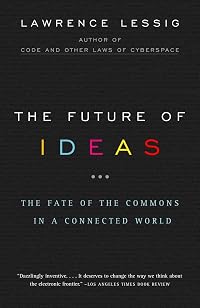
The Future of Ideas: The Fate of the Commons in a Connected World
by Lawrence Lessig
On This Page
Description
The Internet revolution has come. Some say it has gone. In The Future of Ideas, Lawrence Lessig explains how the revolution has produced a counterrevolution of potentially devastating power and effect. Creativity once flourished because the Net protected a commons on which widest range of innovators could experiment. But now, manipulating the law for their own purposes, corporations have established themselves as virtual gatekeepers of the Net while Congress, in the pockets of media show more magnates, has rewritten copyright and patent laws to stifle creativity and progress. Lessig weaves the history of technology and its relevant laws to make a lucid and accessible case to protect the sanctity of intellectual freedom. He shows how the door to a future of ideas is being shut just as technology is creating extraordinary possibilities that have implications for all of us. Vital, eloquent, judicious and forthright, The Future of Ideas is a call to arms that we can ill afford to ignore. show lessTags
Recommendations



Member Recommendations
Member Reviews
A cracking read in Lessig's easily accessible style. A book about the 'innovation commons', the way the internet was designed as a neutral platform, free from central control, which was meant to allow people to innovate and use the network how they chose. The problem is, the debate about old v new has tilted in favour of the old, so that content providers and IP owners can stifle creativity by asserting their ever-increasing property rights. Lessig skips freely over topics such as the physical architecture of the internet, the history of TV and other technologies, the distinction we should draw between property rights in physical space and in 'the ether', and the nature of intellectual property and its relation to innovation. So much show more packed into 265 pages, because the prose is so tight, clear and neat. Great book. show less
I am a Lessig fan. That said, I think this was a very good book and would be a good read for anyone interested in intellectual property especially as related to technology.
Two good issues discussed in the text were the idea of the commons verses ownership and the idea of regulation in advance. The first issue discussed the illusion that just because it is better to have some things as property (controlled by the market) it is better to have everything controlled as property. Thus, the illusion continues, more control is always better. Furthermore, the illusion states, if you fight against more control, you are against control completely. Lessig pointed out that this is not the case. We have things owned in common (highways were a common show more example) and things owned privately. Balance must be achieved even in the physical world. Even more so in the digital world. More so because in the digital world resources have little to no possibility of being used up. Thus, we must consider them as separate from physical property. Ownership will not disappear in the digital world, however, it should not be given a priori; its benefits should be demonstrated by those who want to claim it as property.
The second issue was in response to the fact that many laws and regulations are being made in relation to the expected consequences of new technologies. However, these things limit the use of new technologies and stifle innovation in favor of existing (usually large) companies. The existing parties that are in favor of these regulations thus shift the burden of proving usefulness onto new technologies. Yet if a technology cannot play around in the real world, how is one to determine whether or not there is a use/market for it?
This book is thought provoking and well written. There were some things (mainly the proposed solutions to existing problems) that I felt would have some bugs in implementation, but that did not distract from the book. In fact, they rather prove the point. They were brainstorming, innovation. We cannot know if those methods are right without looking into them more deeply. Similarly, digital technology and intellectual property cannot be treated like physical property. There may be some analogies, but there are also profound differences. show less
Two good issues discussed in the text were the idea of the commons verses ownership and the idea of regulation in advance. The first issue discussed the illusion that just because it is better to have some things as property (controlled by the market) it is better to have everything controlled as property. Thus, the illusion continues, more control is always better. Furthermore, the illusion states, if you fight against more control, you are against control completely. Lessig pointed out that this is not the case. We have things owned in common (highways were a common show more example) and things owned privately. Balance must be achieved even in the physical world. Even more so in the digital world. More so because in the digital world resources have little to no possibility of being used up. Thus, we must consider them as separate from physical property. Ownership will not disappear in the digital world, however, it should not be given a priori; its benefits should be demonstrated by those who want to claim it as property.
The second issue was in response to the fact that many laws and regulations are being made in relation to the expected consequences of new technologies. However, these things limit the use of new technologies and stifle innovation in favor of existing (usually large) companies. The existing parties that are in favor of these regulations thus shift the burden of proving usefulness onto new technologies. Yet if a technology cannot play around in the real world, how is one to determine whether or not there is a use/market for it?
This book is thought provoking and well written. There were some things (mainly the proposed solutions to existing problems) that I felt would have some bugs in implementation, but that did not distract from the book. In fact, they rather prove the point. They were brainstorming, innovation. We cannot know if those methods are right without looking into them more deeply. Similarly, digital technology and intellectual property cannot be treated like physical property. There may be some analogies, but there are also profound differences. show less
Lawrence Lessig has, rightly, achieved hero status amongst netizens for his early, analytical and compelling advocacy of the need for wise regulation by law - and other sorts of code - of that thing William Gibson termed cyberspace.
Lessig's magnum opus is Code and Other Laws of Cyberspace - remixed not long ago into Code: Version 2.0 - the second "version" edited communally by wiki thereby demonstrating, as you would expect from a tribal elder, the man has the courage of his convictions. Lessig's renown has accordingly spread: he is a sought after public speaker (and a compelling one - Lessig is a genius with a PowerPoint presentation) and, rumour has it, a long-time consiglieri of President Obama who in recent times has been linked show more with the job of running the Federal Communications Commission. Boy would *that* frighten the Confederate horses.
As a prolific generator of intellectual property himself, much of which is available through open source copyright licences, Lessig is in the unusual position, a bit like a stand-up comedian from an ethnic minority, of being able to score hits that others cannot without being written off as a liberal/hacker/stoner hand waver (though it isn't to say that this doesn't routinely happen - a quick trot through the one star reviews on this site ought to persuade you of that).
The thing is, his analysis isn't half as glib as his conservative detractors say it is (or their criticisms are!) Lessig is a brilliant and compelling thinker. Code, in my book, is one of the few essential pieces of 21st century political philosophy to have yet emerged.
The Future of Ideas was published in 2001 as a follow up to the original Code, and while its arguments are for the main part compelling, they are also familiar, springing as they do from exactly the turf as those in Code: principally the virtue of the end-to-end architecture of the internet and the possibility for a myriad of unimagined innovations and unprecedented technological developments. Lessig spends more time updating the Garrett Hardin's tragedy of the commons - on which premise modern legal philosophy underlying physical property can be understood - to the non-rivalrous (if you'll excuse the expression: at times Lessig's way with words deserts him) digital commons, and this is an interesting and valuable discussion.
Other than these arguments, much of the heft in this book was also the meat and potatoes of Code, and it didn't feel as if substantial new ground was being broken here, and where it was - for example Lessig's playful reference to the "Sovietisation" of dominant positions in the market - such interesting and fair observations were let down by their expression. To compare corporate titans with communists will infuriate exactly the conservative readers Lessig ought to be doing more to appeal to.
This book, and the author's outlook generally, aren't without their flaws. Lessig is an idealist in at least two pejorative senses: First, in that he believes that fixing the endemic problems he excellently articulates is a matter of straightforward legal or technological regulation, whereas he has (equally excellently) articulated that the first order problems are themselves not of a legal or technological nature. They are with the meatware, and in particular its peculiar sociological constitution. The same "Sovietisation" that cankers corporate titans also ossifies regulators, and for the same ineluctable evolutionary reasons.
Complexity is inevitable in our social systems precisely because (like the internet and successful corporations) they have evolved from institutions and customs designed to solve earlier, different and often unrelated problems. Lessig is extremely convincing on this. But there's the rub: the fix for these historical circumstances came pre-bundled with commercial and political hierarchies the priorities of which have hardened, for predictable but selfish reasons, in ways which, as Lessig now patiently catalogues, create problems of a different nature altogether.
But nor are these hierarchies all for the worse, and they have the benefit of inertia, we all have an innate (no doubt evolved!) resistance to the idea of abandoning established (read evolved) political structures when they still appear to be functioning, however sub-optimally - especially since those in the upper reaches of the political structures who are best placed to change them are also, almost by definition, least incentivised to do so.
Overcoming these facts of life presents social as well as political issues: it is not simply a matter of passing the law: one needs to build the consensus to pass the law. The old paradigm not only needs to be in crisis, it needs to be *believed to be* in crisis - believed by the very people from whose perspective it is least obviously in crisis.
This is where the conservatives cheap shots, which Lessig laughs off, do hit home: preaching to the choir (which squarely includes me, by the way) won't help: the sermon needs to go over with the sceptics in the posh seats. This does seem to be starting to happen where it really matters - commercial and technological development. Personally I'm less exercised than Lessig is about the mendacity of the Recording Industry Association of America since, well, it *is* only rock `n' roll, however much we might like it.
Secondly, Lessig overstates his case. To win over this congregation of Hollywood moguls and record company execs - a tough crowd - he needs to avoid overreaching. His analysis of the internet's architecture is comprehensive and detailed (herein you will learn more than you bargained for about the packet-switching design of the code layer of the internet) but he is not persuasive that this whole edifice, spanning as it does not just real space, public and private property and also international regulatory space really could be, in its entirety, laid low by regulatory action, much less privately or corporately controlled systems design. These days not even Ma Bell has anything like monopoly power, and technological advances (wifi, internet through electricity circuits) ever more militate against it ever happening again. That is to say, I think Lessig is crying wolf.
Since there will always be (virtual) areas of the net which are differently or less heavily regulated or, to use his awful expression, "architected" (Professor Lessig, if you're reading: the word is "designed") and the commercial energy required to rein in defectors will always be greater than that required to ease constrained systems to keep up with the competition, and, absent real-life Sovietisation (these days not quite as ludicrous a prospect as it would have been in 2001!), market share will always go with gravity - downward, to the service provider who places the least constraints on its subscribers.
This, I think, is borne out by the history of the net in the eight or so years since this book was written. The original Napster may have gone the way of all flesh, but the collaborative internet is in rude health, as ADSL has become mainstream the opportunities for innovation and creation seem as present as they ever were.
Another well established end-to-end network - a city - provides an enlightening metaphor: trains or buses might be privately controlled, the use of cars somewhat (but imperfectly) regulated and (as in any network) there will be places we cannot go at all, but we can always, at the limit, walk. The first lesson of evolutionary theory is: Where there's a will, there's a way.
A week is a long time in technology, and eight years is an aeon: The Future Of Ideas is necessarily dated nowadays, and since the revision to Code, has little to offer that can't be found in that somewhat weightier book. show less
Lessig's magnum opus is Code and Other Laws of Cyberspace - remixed not long ago into Code: Version 2.0 - the second "version" edited communally by wiki thereby demonstrating, as you would expect from a tribal elder, the man has the courage of his convictions. Lessig's renown has accordingly spread: he is a sought after public speaker (and a compelling one - Lessig is a genius with a PowerPoint presentation) and, rumour has it, a long-time consiglieri of President Obama who in recent times has been linked show more with the job of running the Federal Communications Commission. Boy would *that* frighten the Confederate horses.
As a prolific generator of intellectual property himself, much of which is available through open source copyright licences, Lessig is in the unusual position, a bit like a stand-up comedian from an ethnic minority, of being able to score hits that others cannot without being written off as a liberal/hacker/stoner hand waver (though it isn't to say that this doesn't routinely happen - a quick trot through the one star reviews on this site ought to persuade you of that).
The thing is, his analysis isn't half as glib as his conservative detractors say it is (or their criticisms are!) Lessig is a brilliant and compelling thinker. Code, in my book, is one of the few essential pieces of 21st century political philosophy to have yet emerged.
The Future of Ideas was published in 2001 as a follow up to the original Code, and while its arguments are for the main part compelling, they are also familiar, springing as they do from exactly the turf as those in Code: principally the virtue of the end-to-end architecture of the internet and the possibility for a myriad of unimagined innovations and unprecedented technological developments. Lessig spends more time updating the Garrett Hardin's tragedy of the commons - on which premise modern legal philosophy underlying physical property can be understood - to the non-rivalrous (if you'll excuse the expression: at times Lessig's way with words deserts him) digital commons, and this is an interesting and valuable discussion.
Other than these arguments, much of the heft in this book was also the meat and potatoes of Code, and it didn't feel as if substantial new ground was being broken here, and where it was - for example Lessig's playful reference to the "Sovietisation" of dominant positions in the market - such interesting and fair observations were let down by their expression. To compare corporate titans with communists will infuriate exactly the conservative readers Lessig ought to be doing more to appeal to.
This book, and the author's outlook generally, aren't without their flaws. Lessig is an idealist in at least two pejorative senses: First, in that he believes that fixing the endemic problems he excellently articulates is a matter of straightforward legal or technological regulation, whereas he has (equally excellently) articulated that the first order problems are themselves not of a legal or technological nature. They are with the meatware, and in particular its peculiar sociological constitution. The same "Sovietisation" that cankers corporate titans also ossifies regulators, and for the same ineluctable evolutionary reasons.
Complexity is inevitable in our social systems precisely because (like the internet and successful corporations) they have evolved from institutions and customs designed to solve earlier, different and often unrelated problems. Lessig is extremely convincing on this. But there's the rub: the fix for these historical circumstances came pre-bundled with commercial and political hierarchies the priorities of which have hardened, for predictable but selfish reasons, in ways which, as Lessig now patiently catalogues, create problems of a different nature altogether.
But nor are these hierarchies all for the worse, and they have the benefit of inertia, we all have an innate (no doubt evolved!) resistance to the idea of abandoning established (read evolved) political structures when they still appear to be functioning, however sub-optimally - especially since those in the upper reaches of the political structures who are best placed to change them are also, almost by definition, least incentivised to do so.
Overcoming these facts of life presents social as well as political issues: it is not simply a matter of passing the law: one needs to build the consensus to pass the law. The old paradigm not only needs to be in crisis, it needs to be *believed to be* in crisis - believed by the very people from whose perspective it is least obviously in crisis.
This is where the conservatives cheap shots, which Lessig laughs off, do hit home: preaching to the choir (which squarely includes me, by the way) won't help: the sermon needs to go over with the sceptics in the posh seats. This does seem to be starting to happen where it really matters - commercial and technological development. Personally I'm less exercised than Lessig is about the mendacity of the Recording Industry Association of America since, well, it *is* only rock `n' roll, however much we might like it.
Secondly, Lessig overstates his case. To win over this congregation of Hollywood moguls and record company execs - a tough crowd - he needs to avoid overreaching. His analysis of the internet's architecture is comprehensive and detailed (herein you will learn more than you bargained for about the packet-switching design of the code layer of the internet) but he is not persuasive that this whole edifice, spanning as it does not just real space, public and private property and also international regulatory space really could be, in its entirety, laid low by regulatory action, much less privately or corporately controlled systems design. These days not even Ma Bell has anything like monopoly power, and technological advances (wifi, internet through electricity circuits) ever more militate against it ever happening again. That is to say, I think Lessig is crying wolf.
Since there will always be (virtual) areas of the net which are differently or less heavily regulated or, to use his awful expression, "architected" (Professor Lessig, if you're reading: the word is "designed") and the commercial energy required to rein in defectors will always be greater than that required to ease constrained systems to keep up with the competition, and, absent real-life Sovietisation (these days not quite as ludicrous a prospect as it would have been in 2001!), market share will always go with gravity - downward, to the service provider who places the least constraints on its subscribers.
This, I think, is borne out by the history of the net in the eight or so years since this book was written. The original Napster may have gone the way of all flesh, but the collaborative internet is in rude health, as ADSL has become mainstream the opportunities for innovation and creation seem as present as they ever were.
Another well established end-to-end network - a city - provides an enlightening metaphor: trains or buses might be privately controlled, the use of cars somewhat (but imperfectly) regulated and (as in any network) there will be places we cannot go at all, but we can always, at the limit, walk. The first lesson of evolutionary theory is: Where there's a will, there's a way.
A week is a long time in technology, and eight years is an aeon: The Future Of Ideas is necessarily dated nowadays, and since the revision to Code, has little to offer that can't be found in that somewhat weightier book. show less
The Internet revolution has come. Some say it has gone. What was responsible for its birth? Who is responsible for its demise?
In The Future of Ideas, Lawrence Lessig explains how the Internet revolution has produced a counterrevolution of devastating power and effect. The explosion of innovatin we have seen in the environment of the Internet was not conjured from some new, previously unimagined technological magic; instead, it came from an ideal as old as the nation. Creativity flourished there because the Internet protected an innovation commons. The Internet's very design built a neutral platform upon which the widest range of creators could experiment. The legal architecture surrounding it protected this free space so that culture show more and information -- the ideas of our era -- could flow freely and inspire an unprecedented breadth of expression. But this structural design is changing -- both legally and technically.
This shift will destroy the opportunities for creativity and innovation that the Internet originally engendered. The cultural dinosaurs of our recent past are moving to quickly remake cyberspace so that they can better protect their interests against the future. Powerful forces are swiftly using both law and technology to ""tame"" the Internet, transforming it from an open forum for ideas into nothing more than cable television on speed. Innovation, once again, will be directed from the top down, increasingly controlled by owners of the networks, holders of the largest patent portfolios, and, most invidiously, hoarders of copyrights.
The choice Lawrence Lessig presents is not between progress and the status quo. It is between progress and a new Dark Ages, in which our capacity to create is confined by an architecture of control and a society more perfectly monitored and filtered than any in history. Important avenues of thought and free expression will increasingly be closed off. The door to a future of ideas is being shut just as technology makes an extraordinary future possible.
With an uncanny blend of knowledge, insight, and eloquence, Lawrence Lessig has written a profoundly important guide to the care and feeding of innovation in a connected world. Whether it proves to be a road map or an elegy is up to us. show less
In The Future of Ideas, Lawrence Lessig explains how the Internet revolution has produced a counterrevolution of devastating power and effect. The explosion of innovatin we have seen in the environment of the Internet was not conjured from some new, previously unimagined technological magic; instead, it came from an ideal as old as the nation. Creativity flourished there because the Internet protected an innovation commons. The Internet's very design built a neutral platform upon which the widest range of creators could experiment. The legal architecture surrounding it protected this free space so that culture show more and information -- the ideas of our era -- could flow freely and inspire an unprecedented breadth of expression. But this structural design is changing -- both legally and technically.
This shift will destroy the opportunities for creativity and innovation that the Internet originally engendered. The cultural dinosaurs of our recent past are moving to quickly remake cyberspace so that they can better protect their interests against the future. Powerful forces are swiftly using both law and technology to ""tame"" the Internet, transforming it from an open forum for ideas into nothing more than cable television on speed. Innovation, once again, will be directed from the top down, increasingly controlled by owners of the networks, holders of the largest patent portfolios, and, most invidiously, hoarders of copyrights.
The choice Lawrence Lessig presents is not between progress and the status quo. It is between progress and a new Dark Ages, in which our capacity to create is confined by an architecture of control and a society more perfectly monitored and filtered than any in history. Important avenues of thought and free expression will increasingly be closed off. The door to a future of ideas is being shut just as technology makes an extraordinary future possible.
With an uncanny blend of knowledge, insight, and eloquence, Lawrence Lessig has written a profoundly important guide to the care and feeding of innovation in a connected world. Whether it proves to be a road map or an elegy is up to us. show less
Similar to Free Culture (also by Lessig). I like his idea of "The Commons" and the fact that he seems to be put forward a pretty balanced argument.
The book lost a little of its clarity toward the end as I was looking for more of his vision and it seemed to be rehashing everything he had said earlier.
The book lost a little of its clarity toward the end as I was looking for more of his vision and it seemed to be rehashing everything he had said earlier.
This book changed my view of the world forever. There are several similar books, by Lessig and by others, but for me this was one of the first and the one that made the strongest impression.
Brilliant book on what is right and what is wrong with the Internet today.
Members
- Recently Added By
Author Information

18+ Works 4,913 Members
Lawrence Lessig is the Roy L. Furman Professor of Law and Leadership at Harvard Law School, host of the podcast Another Way, and co-founder of Creative Commons. Lessig has received numerous awards, including a Webby Life Time Achievement Award and the Free Software Foundation's Freedom Award. He is the author of ten books, including Republic, show more Lost, and a member of the American Academy of Arts and Sciences and the American Philosophical Society. He lives in Brookline, Massachusetts. show less
Common Knowledge
- Original publication date
- 2001
- Dedication
- To Bettina,
my teacher
of the most important
lesson. - Blurbers
- Auletta, Ken; Wolff, Michael; O'Reilly, Tim; Barlow, John Perry; Kapor, Mitch; Young, Bob
Classifications
Statistics
- Members
- 1,075
- Popularity
- 23,892
- Reviews
- 11
- Rating
- (3.98)
- Languages
- English, French, German, Italian
- Media
- Paper, Ebook
- ISBNs
- 7
- ASINs
- 3