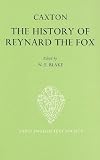
The History of Reynard the Fox
by William Caxton (Translator)
On This Page
Tags
Recommendations






















Member Reviews
"And this booke is maad for nede and prouffyte of all god folke / As fer as they in redynge or heeryng of it shall mowe vnderstande and fele the forsayd subtyl deceytes that dayly ben vsed in the worlde / not to thentente that men shold eschewe and kepe hym from the subtyl and false shrewis that they be not deceyuyd." And so begins William Caxton's 1481 translation of the medieval beast epic concerning Reynard the Fox, in which the cunning vulpine hero triumphs over his enemy, Isegrim the Wolf, and is twice exonerated in the court of King Noble the Lion, despite overwhelming odds against him. The moral ambiguity of the tale is early hinted at, in the introductory passage quoted above, as Caxton (and presumably his source before him, the show more Dutchman Gheraert Leeu), directs his readers toward the 'correct' interpretation of the tale: i.e. that it provides a warning about the cunning villains in this world, who, like Reynard, use their subtle wiles to manipulate others and get their way. And Reynard is certainly a master manipulator! His unerring sense of what tack to use, in persuading others to do as he wishes, makes for a number of humorous passages.
Caxton's Reynard is an important book for many reasons. It represents the first time that the full history of Reynard, which originally appeared in the mid-twelfth century in the Latin poem The Ysengrimus, before making its way into the French (Le Roman de Renart), German (Reinhart Fuchs) and Dutch (Reynaert de Vos) traditions, appeared in English. Although certain elements of the story had appeared before - the story of Reynard and Chanticleer can be found in Chaucer's The Nun's Priest's Tale of the Cock and the Fox, in his Canterbury Tales, and there is a Middle English poem, The Fox and the Wolf, which contains some of Reynard and Isegrim's rivalry - Caxton marks the point at which Reynard's full story enters the English language. The book is also significant because it was one of the earliest printed books in English. Caxton was the first to use the printing press for English language work, beginning in 1473, so his Reynard was created as part of a revolutionary new development in English letters. It is also significant because it was written at a time of great change in the English language itself, coming at the end of the medieval and dawn of the modern periods in England, as Middle English was giving way to its modern descendent.
As a contemporary reader, I sometimes found the language here challenging. It is less familiar than Shakespeare's English, but more intelligible that Chaucer's (naturally). Fortunately, the edition I read, printed in 1970 by Oxford University Press, included a glossary at the rear. Certain archaic words, such as 'dasse,' the old word for a badger, greatly appealed to me! Other words were borrowed by Caxton from his Dutch original, the prose Die Historie van Reynaert de Vos. Although not a text I used directly for my dissertation on children's retellings of Reynard, this was (of course) my starting point, in terms of my more general research into Reynard in English. I'm not sure to whom I would recommend it. Reynard lovers, obviously. Also, perhaps, to those interested in early modern English texts. show less
Caxton's Reynard is an important book for many reasons. It represents the first time that the full history of Reynard, which originally appeared in the mid-twelfth century in the Latin poem The Ysengrimus, before making its way into the French (Le Roman de Renart), German (Reinhart Fuchs) and Dutch (Reynaert de Vos) traditions, appeared in English. Although certain elements of the story had appeared before - the story of Reynard and Chanticleer can be found in Chaucer's The Nun's Priest's Tale of the Cock and the Fox, in his Canterbury Tales, and there is a Middle English poem, The Fox and the Wolf, which contains some of Reynard and Isegrim's rivalry - Caxton marks the point at which Reynard's full story enters the English language. The book is also significant because it was one of the earliest printed books in English. Caxton was the first to use the printing press for English language work, beginning in 1473, so his Reynard was created as part of a revolutionary new development in English letters. It is also significant because it was written at a time of great change in the English language itself, coming at the end of the medieval and dawn of the modern periods in England, as Middle English was giving way to its modern descendent.
As a contemporary reader, I sometimes found the language here challenging. It is less familiar than Shakespeare's English, but more intelligible that Chaucer's (naturally). Fortunately, the edition I read, printed in 1970 by Oxford University Press, included a glossary at the rear. Certain archaic words, such as 'dasse,' the old word for a badger, greatly appealed to me! Other words were borrowed by Caxton from his Dutch original, the prose Die Historie van Reynaert de Vos. Although not a text I used directly for my dissertation on children's retellings of Reynard, this was (of course) my starting point, in terms of my more general research into Reynard in English. I'm not sure to whom I would recommend it. Reynard lovers, obviously. Also, perhaps, to those interested in early modern English texts. show less
Ratings
Members
- Recently Added By
Lists

Books We Love to Reread
695 works; 298 members
Author Information

Some Editions
Series
Belongs to Publisher Series
Work Relationships
Common Knowledge
- Canonical title
- The History of Reynard the Fox
- People/Characters
- Reynard the Fox
Classifications
- Genres
- Fiction and Literature, History
- DDC/MDS
- 398.24 — Society, government, & culture Customs, etiquette & folklore Folklore & Folktales Folk literature Fables, Magical Creatures
- LCC
- PT5584 .E5 .C35 — Language and Literature German, Dutch and Scandinavian literatures Dutch literature Individual authors or works Medieval
- BISAC
Statistics
- Members
- 28
- Popularity
- 984,681
- Reviews
- 1
- Rating
- (4.00)
- Languages
- English, English (Middle)
- Media
- Paper, Ebook
- ISBNs
- 6
- ASINs
- 2