
Anonymous (80)
Author of Embracing Obscurity: Becoming Nothing in Light of God's Everything
For other authors named Anonymous, see the disambiguation page.
Works by Anonymous
Tagged
Common Knowledge
Members
Reviews
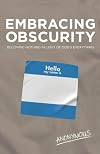
This book has an interesting theme. Being Jesus-like means not merely being humble, which is a foundational point of all major religions, but going to the next level: embracing obscurity. The cute gimmick (which the author insists is not a gimmick, but is cute nonetheless) is that the book is written anonymously.
We crave recognition to overcome the natural obscurity of sharing our world with billions. Why? Why does it seem natural, human, to want to rise above the billions, to be someone show more important? This craving conflicts with our spiritual well-being. Says the author, “I am astounded by Jesus’ complete lack of concern over His reputation.”
By way of warning, a chart is presented showing Christ’s disposition alongside Satan’s. To summarize the entire chart for you: Jesus lives a life of humility followed by honor, while Satan lives a life of pride followed by humiliation. And unless we stop imitating our enemy, we can be absolutely certain that we will also reap the same end: ultimate (perhaps even eternal) humiliation.
As the last paragraph shows, this book is afterlife-oriented, so you can guess that it wasn’t a perfect fit for my brand of Christianity. “Life is not about comfort, but about doing hard things now”—(wait for it, that’s only half of the quote)—“so that we can reap rewards in the life to come.” Yeah, not my brand. Yet there are some very helpful, very uplifting teachings herein. Mr. Anonymous points out that “living for an audience of One is at the heart of embracing obscurity,” and that is a lesson we could all learn…whatever our picture of that One.
This book will be especially appreciated by conservative Christians in need of hope-filled encouragement to continue being Jesus-like. show less
We crave recognition to overcome the natural obscurity of sharing our world with billions. Why? Why does it seem natural, human, to want to rise above the billions, to be someone show more important? This craving conflicts with our spiritual well-being. Says the author, “I am astounded by Jesus’ complete lack of concern over His reputation.”
By way of warning, a chart is presented showing Christ’s disposition alongside Satan’s. To summarize the entire chart for you: Jesus lives a life of humility followed by honor, while Satan lives a life of pride followed by humiliation. And unless we stop imitating our enemy, we can be absolutely certain that we will also reap the same end: ultimate (perhaps even eternal) humiliation.
As the last paragraph shows, this book is afterlife-oriented, so you can guess that it wasn’t a perfect fit for my brand of Christianity. “Life is not about comfort, but about doing hard things now”—(wait for it, that’s only half of the quote)—“so that we can reap rewards in the life to come.” Yeah, not my brand. Yet there are some very helpful, very uplifting teachings herein. Mr. Anonymous points out that “living for an audience of One is at the heart of embracing obscurity,” and that is a lesson we could all learn…whatever our picture of that One.
This book will be especially appreciated by conservative Christians in need of hope-filled encouragement to continue being Jesus-like. show less
This is a thought provoking book. It speaks against everything that our culture today worships: fame, fortune and having it all. The author chose to stay anonymous in order to practice what he preaches, namely, spreading God's word without adding one's own agenda. It was a quick and easy read but it will give you pause and have you reflect on the direction your life is going in. However, I don't think many people will be able to live in the self-sacrificing way that the author proposes. show more Regardless, I would recommend this book! show less
 This review was written for LibraryThing Early Reviewers.
Embracing Obscurity is a book that had to be written. In our evangelical sub-culture, we are as guilty as the larger culture of paying homage to our ministry “rock stars” and celebrities. The name on a cover or poster is guaranteed to sell tickets or books. This author, who wisely chose to remain anonymous, has bravely addressed an issue that we should be embarrassed to admit – namely, we crave the spotlight and adulation of the masses and elevate those who have achieved it as having show more greater worth.
This author points us to imitate the one who, though worthy of such praise, was loathe to receive it. Jesus knew the fickleness of the crowds. On Sunday they hailed him as the son of David; on Friday they cried, “Crucify him.”
In an interesting turn, this book reminds the Christian of the exalted position that he or she possesses in Christ. We are to rejoice that we are the objects of particular redemption. Yet it is only as we come to grips with who we are in Christ that we can authentically embrace obscurity. In the final analysis, all that will matter is the one who sits upon heaven’s throne. That puts us in our place. show less
This author points us to imitate the one who, though worthy of such praise, was loathe to receive it. Jesus knew the fickleness of the crowds. On Sunday they hailed him as the son of David; on Friday they cried, “Crucify him.”
In an interesting turn, this book reminds the Christian of the exalted position that he or she possesses in Christ. We are to rejoice that we are the objects of particular redemption. Yet it is only as we come to grips with who we are in Christ that we can authentically embrace obscurity. In the final analysis, all that will matter is the one who sits upon heaven’s throne. That puts us in our place. show less
This review was written for LibraryThing Early Reviewers.I don’t remember the last time I saw a recently published book with the author’s name given as Anonymous. In Christian circles as much as in your average secular bookstore or website, nothing seems to be as prominent as the author’s name. The more well known the author, the larger space is devoted to his or her name on the book cover. But with a title like "Embracing Obscurity: Becoming Nothing in Light of God’s Everything," the absence of an author name seems appropriate. Still, I show more searched through the book looking for any hint of the author’s identity, half expecting it would be there somewhere. My search was in vain, as the author of this challenging book has embraced its controversial message heart and soul.
The back cover of the book encapsulates its message well with these words: “I hate to break it to you, but you’re not one in a million. In fact, you’re more like one in nearly seven billion. Just one. One life, lived in relative obscurity.” The next line is even more challenging: “Are you okay with that?” Everything about the American dream with its make-your-own-man, you-can-be-anything, do-it-yourself “gospel,” screams the opposite. You are special. One of a kind! And even Christian leaders and authors trumpet the self-esteem, “be your best self now” message. I imagine many who are reading this right now aren’t so sure Mr. Anonymous is making any sense. Doesn’t the Bible teach that we are all God’s special and unique creations?
Anonymous is aiming at the pride and self-reliance which lurks just under the surface of our outwardly Christian lives. The author points out the role that “sub-titles” play in our lives: you know, the extra details we use to fill in someone’s understanding of us when we introduce ourselves. “Hi, I’m Bob, a well-known Christian blogger and father of six.” Such sub-titles function as a way to: “[M]ake others think I’m a somebody. That I matter. That I’m going places. I’m itching for admiration, respect, and yes, jealousy” (pg. 21). The point is not to eschew any titles but rather to not let worldly pursuits define you, or pride rule you.
The book hammers away at Philippians 2:5-11 and the example that our humble King set for us, in the way of humility. And it calls us to find our true significance not in what we can do, but in who we are by grace. Our significance is in being able to make much of Jesus as his creation, his joint-heir, his bride, etc.
The world’s attitude to success contrasts sharply with a Biblical view of true prosperity. Yet too often, worldly standards shape us and even shape the church. Anonymous explains:
"I don’t think we realize how far we’ve come in imitating the world’s tenets of success or just how dangerous that is. I’m shocked at how easily my friends, family, church, and I have swallowed the lie–hook, line, and sinker–that true fulfillment will greet them on the other side of a PhD and a six-figure income, through a romantic comedy-esque love story, or even through leading a prominent ministry. I’m alarmed at how pride and self-promotion are permeating Christian leadership and how it seems to be seeping down the ranks: to you, to me, to our kids, and throughout our congregations." (pg. 75-76)
He moves on to focus on how servanthood should characterize us as Christians. And how very unpopular this is even among Christian ministries today. He brings up what he calls “the Joseph principle” too, when it comes to suffering. This is the idea that God is using suffering to prepare me for something mind-blowingly big. God has something better for me. But while Romans 8:28 (“All things work together for the good of those who love God…”) is true, the notion that God has something tangibly good in a worldly sense for our future isn’t necessarily the case. Anonymous asks “Will you still trust God if your ‘good’ is to go on embracing obscurity–living in simplicity and devotion to Him–your entire life?… Would you mind if your ‘good’ is only a greater understanding of the suffering Jesus went through on your behalf and mine?” (pg. 118-119).
He goes on to talk about embracing the “mystery.” Our lives and choices should seem crazy to unbelievers. “Is my life mysterious?” the author asks. “Or do I live, love and lust like the rest of the world?” (pg. 129). He brings up the example of NFL running back Glen Coffee who walked away from football after one season, because he wanted to follow God’s call on his life. Is that mysterious or what?
The book ends with a look at how to use public notoriety for Christ, when it comes unexpectedly. And how our embracing of obscurity really earns for us an eternal weight of glory in the age to come.
This book packs a punch but is written in a conversational, easy-to-read tone. It is chuck full of down-to-earth illustrations and personal vignettes. The stories of numerous individuals give meat to the skeletal principles discussed, and flesh out what it means to embrace obscurity. The book is not overly long, but the message isn’t light and trivial, so taking one’s time reading and praying through the book would be ideal. Discussion questions are included for each chapter making this perfectly suited for a small group or Sunday school.
As a Christian blogger, this book is especially convicting. I need to focus more on why I do what I do, and need to also look for the pride which so easily hides behind anything we do. I highly recommend this book and trust it will have a wide influence. The message is radical but the problem is real. "Embracing Obscurity" calls us to reexamine what it means to live life as strangers and pilgrims, just passing through this world on our way home.
Disclaimer: This book was provided by Brodman & Holman Publishing. I was under no obligation to offer a favorable review. show less
The back cover of the book encapsulates its message well with these words: “I hate to break it to you, but you’re not one in a million. In fact, you’re more like one in nearly seven billion. Just one. One life, lived in relative obscurity.” The next line is even more challenging: “Are you okay with that?” Everything about the American dream with its make-your-own-man, you-can-be-anything, do-it-yourself “gospel,” screams the opposite. You are special. One of a kind! And even Christian leaders and authors trumpet the self-esteem, “be your best self now” message. I imagine many who are reading this right now aren’t so sure Mr. Anonymous is making any sense. Doesn’t the Bible teach that we are all God’s special and unique creations?
Anonymous is aiming at the pride and self-reliance which lurks just under the surface of our outwardly Christian lives. The author points out the role that “sub-titles” play in our lives: you know, the extra details we use to fill in someone’s understanding of us when we introduce ourselves. “Hi, I’m Bob, a well-known Christian blogger and father of six.” Such sub-titles function as a way to: “[M]ake others think I’m a somebody. That I matter. That I’m going places. I’m itching for admiration, respect, and yes, jealousy” (pg. 21). The point is not to eschew any titles but rather to not let worldly pursuits define you, or pride rule you.
The book hammers away at Philippians 2:5-11 and the example that our humble King set for us, in the way of humility. And it calls us to find our true significance not in what we can do, but in who we are by grace. Our significance is in being able to make much of Jesus as his creation, his joint-heir, his bride, etc.
The world’s attitude to success contrasts sharply with a Biblical view of true prosperity. Yet too often, worldly standards shape us and even shape the church. Anonymous explains:
"I don’t think we realize how far we’ve come in imitating the world’s tenets of success or just how dangerous that is. I’m shocked at how easily my friends, family, church, and I have swallowed the lie–hook, line, and sinker–that true fulfillment will greet them on the other side of a PhD and a six-figure income, through a romantic comedy-esque love story, or even through leading a prominent ministry. I’m alarmed at how pride and self-promotion are permeating Christian leadership and how it seems to be seeping down the ranks: to you, to me, to our kids, and throughout our congregations." (pg. 75-76)
He moves on to focus on how servanthood should characterize us as Christians. And how very unpopular this is even among Christian ministries today. He brings up what he calls “the Joseph principle” too, when it comes to suffering. This is the idea that God is using suffering to prepare me for something mind-blowingly big. God has something better for me. But while Romans 8:28 (“All things work together for the good of those who love God…”) is true, the notion that God has something tangibly good in a worldly sense for our future isn’t necessarily the case. Anonymous asks “Will you still trust God if your ‘good’ is to go on embracing obscurity–living in simplicity and devotion to Him–your entire life?… Would you mind if your ‘good’ is only a greater understanding of the suffering Jesus went through on your behalf and mine?” (pg. 118-119).
He goes on to talk about embracing the “mystery.” Our lives and choices should seem crazy to unbelievers. “Is my life mysterious?” the author asks. “Or do I live, love and lust like the rest of the world?” (pg. 129). He brings up the example of NFL running back Glen Coffee who walked away from football after one season, because he wanted to follow God’s call on his life. Is that mysterious or what?
The book ends with a look at how to use public notoriety for Christ, when it comes unexpectedly. And how our embracing of obscurity really earns for us an eternal weight of glory in the age to come.
This book packs a punch but is written in a conversational, easy-to-read tone. It is chuck full of down-to-earth illustrations and personal vignettes. The stories of numerous individuals give meat to the skeletal principles discussed, and flesh out what it means to embrace obscurity. The book is not overly long, but the message isn’t light and trivial, so taking one’s time reading and praying through the book would be ideal. Discussion questions are included for each chapter making this perfectly suited for a small group or Sunday school.
As a Christian blogger, this book is especially convicting. I need to focus more on why I do what I do, and need to also look for the pride which so easily hides behind anything we do. I highly recommend this book and trust it will have a wide influence. The message is radical but the problem is real. "Embracing Obscurity" calls us to reexamine what it means to live life as strangers and pilgrims, just passing through this world on our way home.
Disclaimer: This book was provided by Brodman & Holman Publishing. I was under no obligation to offer a favorable review. show less
Lists
You May Also Like


Associated Authors
Statistics
- Works
- 22
- Members
- 1,341
- Popularity
- #19,193
- Rating
- 3.8
- Reviews
- 37
- ISBNs
- 9,874
- Languages
- 64
